How to Choose Tweezers for Lash Extensions

Choosing the right tweezers for lash extensions is not a minor purchasing detail. Tip shape, spring behavior, grip, and storage all affect how efficiently a lash artist can isolate natural lashes, pick up extensions, position them, and create volume fans. The right decision depends less on having the largest assortment and more on matching each tool to the technique, hand position, and working environment.
This guide explains what to look for in a professional lash tweezer set, how different geometries support different tasks, and which questions a salon, training studio, or mobile technician should ask before buying. The product shown is a multi-tool lash-application set with several metal tweezers, an organizer case, lash trays, and related accessories. Some specifications are not visible, so buyers should confirm them with the supplier rather than assume them.
Quick reference: what matters when comparing lash tweezers
| Selection factor | Why it matters | What to verify |
|---|---|---|
| Tip geometry | Determines access, pickup behavior, isolation, and fan-making control. | Whether the set includes straight, angled, curved, or pointed tips. |
| Tip alignment | Misaligned tips can make precise pickup inconsistent. | Alignment at the working end under normal handling. |
| Spring action | Influences hand fatigue and control during long appointments. | Whether the closing force feels suitable for the intended technique. |
| Grip surface | Helps reduce slipping when hands are gloved or working under bright lights. | Whether textured sections are functional machining, etching, knurling, or decorative. |
| Storage | Protects narrow tips and keeps tools available at the workstation. | Individual holders, case padding, closure quality, and included accessories. |
Why tip geometry is the first buying decision
Lash tweezers are not interchangeable simply because they look similar. The angle and profile at the front determine how the tool approaches the natural lash and how much contact it makes with an extension. A straight tweezer can offer a direct approach for isolation or placement, while an angled or curved model can improve visibility when the hand needs to remain outside the client’s direct line of sight.
Straight and pointed tips
Straight styles are commonly considered for separating or isolating lashes and for controlled placement in classic work. Pointed tips can provide access between closely spaced lashes, but they also demand careful handling. A sharp point may be useful for precision, yet it should not be treated as automatically better. If the tip is too aggressive for the operator’s technique, it can increase the risk of catching adjacent lashes or contacting the skin.
Angled and curved tips
Angled tweezers change the working approach without requiring the artist to rotate the wrist as far. Curved profiles may help with pickup and placement when working from a different angle or when creating fans. The exact preference is personal, and experienced artists often keep more than one geometry within reach because classic, hybrid, and volume work do not always reward the same tool.
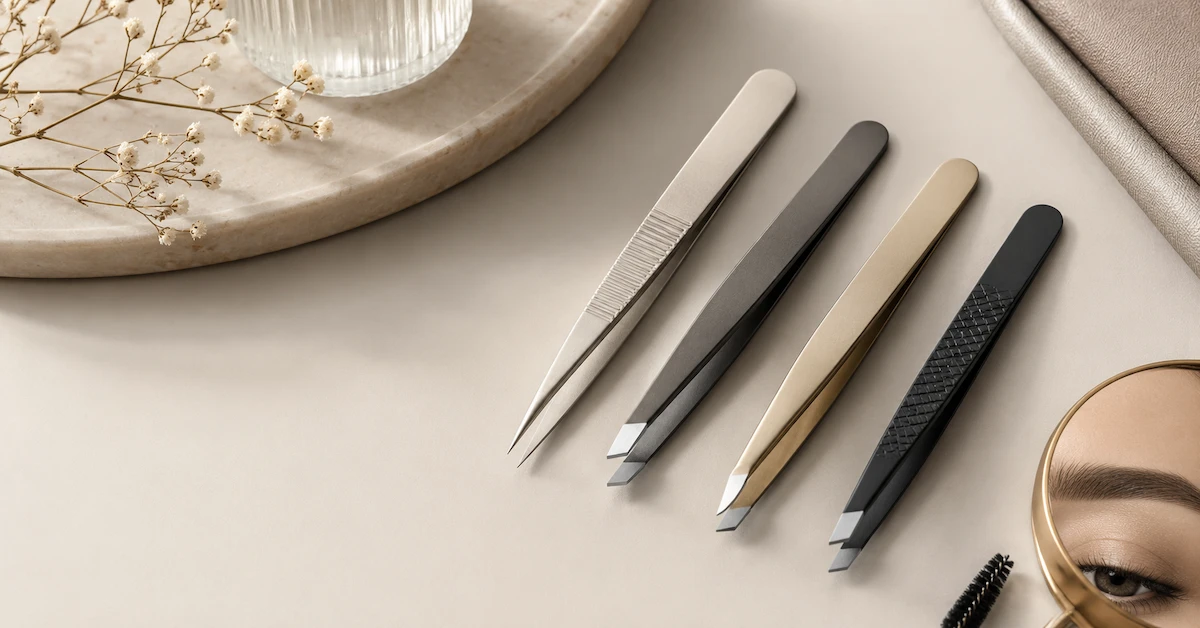
The pictured assortment includes straight, angled, curved, and pointed forms. That variety is useful for a training environment or a workstation supporting multiple techniques. It does not, by itself, confirm that every tweezer will suit every user. Tip alignment, closing pressure, and the feel of the grip still need to be evaluated.
Classic and volume work require different handling priorities
For classic application, many buyers look for classic lash tweezers that provide stable isolation and accurate placement of one extension at a time. A narrow tip can help reach individual natural lashes, while a comfortable spring can make repeated opening and closing less tiring. The tool should close predictably rather than snap shut unexpectedly.
Volume application adds another requirement: the tweezers must support the pickup and control of multiple fine extensions when forming a fan. Some artists prefer a specific curved or angled profile for this work, while others favor a straighter tool with a particular tip contact area. It is difficult to specify one universally correct design because hand size, pickup method, extension diameter, and personal technique all change the result.
Buyers considering fiber tip lash tweezers should ask what “fiber tip” means in the supplier’s specification. The term may refer to a particular gripping surface or tip treatment, but the available product information here only confirms metal tweezers with varied geometries and some darker or textured grip areas. Do not assume that a visible dark section is a fiber tip, coating, or performance feature without written confirmation.
What the manufacturing details can tell you—and what they cannot
Professional lash tweezers are small precision tools. Their manufacture may involve metal forming or machining, tip grinding, surface polishing, and assembly of the two spring arms. Textured handle areas may be produced by etching, knurling, or another process, although the visible product does not establish which method was used.
The tweezers appear to be made from metal, possibly stainless steel or another corrosion-resistant alloy. That is an observation, not a confirmed material specification. The exact grade should be requested if the tools will be cleaned frequently, used in a professional environment, or subject to a defined hygiene procedure. Similarly, a polished appearance does not prove a particular corrosion-resistance level or sterilization compatibility.
Tip quality deserves more attention than decorative finish. A buyer should inspect whether both working ends meet evenly, whether the arms close smoothly, and whether the tips remain aligned when light pressure is applied. A patterned handle can look attractive, but it is only valuable if it contributes to secure handling without creating uncomfortable pressure points.
Assessing a multi-tool set and organizer case
The displayed product is organized as a compact professional kit. It includes multiple tweezers in individual positions, a hinged or folding black case, lash trays in a lower compartment, and additional items such as adhesive-related containers, disposable applicators, a small cup, and preparation or cleaning accessories. This arrangement may suit salons, academies, and mobile technicians who need a portable workstation rather than loose tools in a drawer.
Still, the purchase contents should be confirmed. The image does not establish the exact tool count, dimensions, lash specifications, adhesive formulation, or whether every visible accessory is included in the selling unit. Ask for a packing list before placing a repeat order, especially when kits will be issued to trainees or distributed across several workstations.
Individual holders are practical because narrow tips are vulnerable to impact. A rigid exterior and padded or fabric-lined interior may provide useful protection during transport, but buyers should check the hinge, closure, internal fit, and resistance to contamination. A case that organizes tools but cannot be cleaned appropriately may create more inconvenience than a simpler open holder.
Common purchasing mistakes
- Buying by appearance alone: Shiny metal and elaborate grip patterns do not confirm tip alignment or suitable spring tension.
- Assuming one geometry covers every technique: Isolation, classic placement, and volume fan-making can benefit from different working profiles.
- Ignoring hand fatigue: A tool that feels acceptable for five minutes may become tiring during a full day of appointments.
- Failing to check hygiene requirements: Confirm cleaning and sterilization compatibility rather than inferring it from the material’s appearance.
- Overlooking replacement planning: Ask whether individual tweezers, cases, or accessories can be reordered separately if one tool is lost or damaged.
- Accepting unclear kit contents: Request a written list of included tweezers, trays, accessories, and packaging.
A practical buyer checklist
Before approving a purchase, evaluate the set against the actual workflow. A salon may prioritize several dependable geometries and easy workstation access. A mobile technician may place more value on compact storage and protection during transport. A training academy may need a broad assortment so students can compare straight, angled, curved, and pointed profiles under supervision.
Request product samples or clear close-up photographs when possible. Check tip alignment, closing action, handle balance, and the feel of any textured area. Ask the supplier to identify the metal grade, surface finish, cleaning guidance, sterilization compatibility, tool dimensions, and included quantities. These are basic procurement questions, not excessive demands for a precision hand tool.
It is also sensible to define acceptance criteria internally. For example, the receiving team can inspect each tool for visible damage, uneven tips, rough edges, loose joints, and case fit. Exact tolerances should come from the manufacturer; they should not be invented by the buyer after delivery.
Frequently asked questions
Should a beginner buy several tweezer shapes?
A multi-shape set can be useful for learning, provided the user receives proper instruction and understands which profile is intended for each task. A larger assortment is not a substitute for consistent technique.
Are metal tweezers suitable for professional use?
Metal construction is common for precision lash tools, but suitability depends on the alloy, finish, tip quality, cleaning guidance, and working condition. Confirm the exact material and hygiene compatibility with the supplier.
Does a case improve tool life?
Proper storage can reduce contact damage, contamination, and misplaced tools. The case shown has individual holders and a rigid hinged format, which appears useful for organization. Its actual protective and cleaning performance should be verified before relying on it for frequent transport.
What should be confirmed before ordering this type of kit?
Confirm the exact tool count, tip styles, dimensions, material, spring characteristics, alignment expectations, case construction, accessory list, and any cleaning instructions. Also clarify whether the visible lash trays and related supplies are part of the purchase.
Next step for buyers
Use the visible assortment as a starting point, not as a complete specification. Compare the included geometries with your lash techniques, then request the supplier’s technical details and a sample inspection before committing to volume. For salons, academies, and mobile professionals, the best set is the one that combines predictable handling with protected storage and a clearly defined contents list.