
Eyebrow Razor Wholesale: Product and Supplier Checklist
Eyebrow razor wholesale buyers can reduce ordering risk with a checklist for blade design, guard fit, packaging, claims, supplier evidence, samples and repeat supply.
Define the buyer decision
buyer due diligence, product claims and supplier evidence. Start with an approved reference and observable acceptance criteria. A catalog photograph can introduce eyebrow razor wholesale for buyer due diligence, product claims and supplier evidence, but the finished sample should decide whether this program fits the intended user and channel.
Procurement checks before the RFQ
Put intended market, blade and guard requirements, pack format, artwork, quantity, inspection and destination terms in the RFQ. For buyer due diligence, product claims and supplier evidence, normalize quantity, packaging, inspection scope and delivery assumptions so quotations can be compared on the same basis. During buyer due diligence, product claims and supplier evidence, record open questions rather than converting an unverified supplier statement into a product claim.
Manufacturing and sample approval
Ask how blade geometry, guard assembly, handle finishing and pack protection are checked from incoming materials through carton release. Keep the approved sample, revision, artwork, material evidence and inspection result together for buyer due diligence, product claims and supplier evidence. For buyer due diligence, product claims and supplier evidence, any change to a working interface, finish, pack-out or component list should trigger a documented review before production release.
What Buyers Usually Want From Eyebrow Razor Wholesale Supply
Most B2B buyers searching for eyebrow razor wholesale options are trying to solve two problems at once. First, they need a simple grooming tool that customers understand immediately. Second, they need a product that fits a commercial channel, whether that is beauty retail, salon resale, travel accessories, online bundles or general personal care distribution.
An eyebrow razor typically sits between cosmetic accessories and everyday grooming tools. Customers may use it to shape brows, clean up stray hairs or manage fine facial hair. Because it is visible, personal and often bought on impulse, the appearance of the tool matters more than many purchasing teams expect. A razor that looks flimsy, has inconsistent color, or arrives in weak packaging may reduce perceived value even if the basic function is acceptable.
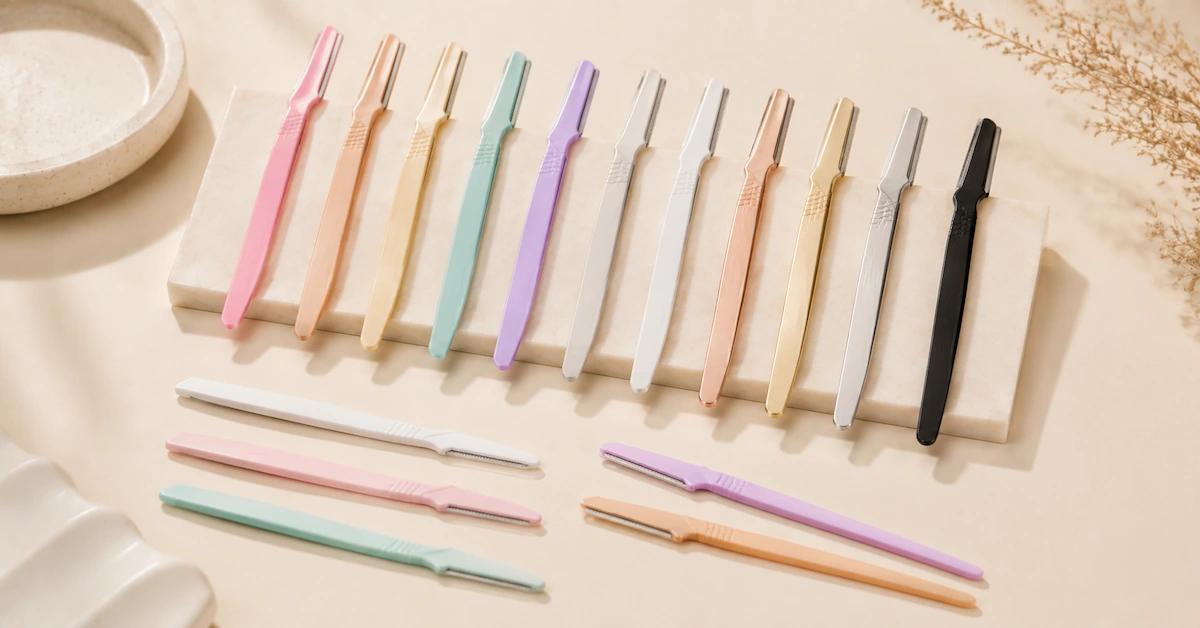
The product style commonly used in this category is a slim handheld tool with a long narrow handle and a small angled cutting head. The version described here features a smooth, tapered appearance, a textured grip area near the head and color options such as pink, peach, beige, mint, lavender, white, silver and black. Those colorways are commercially relevant because buyers can use them for mixed packs, beauty sets, private label programs or channel-specific assortments.
Why Eyebrow Razors Remain a Useful Wholesale Category
Eyebrow razors continue to sell because they address a recurring grooming need with a low-learning-curve product. Many consumers want a fast way to tidy brows or remove fine facial hair without booking a service or using a more complex device. Salons may keep them for finishing work or retail add-ons. Online sellers often place them in brow care kits, facial grooming sets or travel-friendly personal care bundles.
For a wholesale buyer, this means the category can support multiple merchandising strategies. A simple disposable-style razor may work for value channels. A refined color assortment can fit beauty boutiques. A neatly packaged set can suit online marketplaces, gift kits or travel grooming programs. The same base product category can therefore serve different retail stories, but only if product selection and packaging are aligned from the start.
Buyers can review broader grooming assortments through Olimor beauty tool products to see how eyebrow razors may sit beside related personal care items. When building a wholesale range, it is often easier to sell a coordinated grooming story than a single isolated tool.
Product Features to Check Before Buying in Bulk
The most important product checks are simple, but they should be done with physical samples whenever possible. Product images can show shape and color, but they cannot confirm hand feel, cap fit, edge alignment or packaging strength.
Handle shape and grip control
A slim, tapered handle is practical for short controlled strokes around the brow area. The textured grip area near the head is also useful because the user needs stability when working close to the eye area. During sample review, buyers should hold the razor in several positions and check whether it feels secure when angled. A handle that is too slick can create a poor user experience even if the tool looks attractive in photos.
Head angle and blade presentation
The small angled cutting head is a defining feature of eyebrow razors. Buyers should inspect whether the head is aligned consistently and whether the cutting edge is presented neatly. The blade appears to be metal and may be stainless steel, but the exact grade, edge treatment and blade construction should be confirmed through supplier documents. Do not describe the product using unverified blade claims in retail copy.
Cap, cover or protective presentation
For any beauty tool with a blade, protection during storage and shipping is important. Buyers should confirm whether the product includes a protective cap or other packaging protection, and whether that protection remains secure after handling. Loose covers, weak packaging or exposed edges can lead to complaints, damaged goods or retail rejection.
Color consistency and assortment logic
Color is not only cosmetic. Pastel tones such as mint and lavender can support beauty-focused merchandising, while black, white and silver may suit a more functional or premium look. Mixed-color assortments can help distributors serve several accounts from one purchase, but only if carton packing and SKU labeling are clear. Ask whether colors are packed randomly, evenly or according to a defined assortment plan.
How Eyebrow Razors Are Commonly Manufactured
Based on the visible structure, this type of eyebrow razor is likely made with an injection-molded plastic handle and an assembled metal blade insert. Plastic injection molding is common for compact grooming tools because it can produce consistent handle shapes, smooth surfaces and color variation at volume. After molding, the blade component is typically assembled into the head area, and the finished item is packed for bulk or retail use.
Buyers should still avoid assumptions. The visible product does not confirm material grade, blade coating, sterilization method, replaceable-blade design or any special treatment. Those points must come from supplier specifications. For private label buyers, the specification sheet should be detailed enough to support accurate product descriptions, artwork, warning statements and import documents.
Useful sample checks include molding seams, burrs, discoloration, handle warping, head alignment, blade seating and package closure. With small grooming tools, minor defects are easy for customers to notice because the product is held close to the face. A sourcing team should treat cosmetic finish and assembly quality as commercial quality factors, not only engineering details.
Wholesale Selection Checklist
The following checklist can help purchasing teams compare eyebrow razors from different suppliers without focusing only on unit price.
| Check area | What to review | Why it matters |
|---|---|---|
| Handle comfort | Grip texture, taper, surface finish and control during short strokes | Affects user confidence and repeat purchase potential |
| Blade presentation | Head alignment, edge placement and written blade specification | Supports accurate product claims and consistent user experience |
| Protective packaging | Cap fit, retail pack strength, transit protection and shelf appearance | Reduces damage risk and improves retail presentation |
| Color assortment | Available colors, packing ratio and color consistency across samples | Helps match beauty, salon, travel or value channels |
| Batch consistency | Uniform molding, assembly, finish and labeling across sample units | Prevents mixed quality within one wholesale shipment |
| Supplier documentation | Material description, packaging details, artwork files and compliance documents | Helps buyers prepare listings, labels and import records |
| Customization options | Color, packaging format, branding or set-building possibilities | Supports private label and retailer-specific programs |
Packaging Choices for Retail, Salon and Kit Programs
Packaging should be chosen according to the sales channel. Loose bulk may be suitable for kit assembly or internal salon supply, but retail channels usually need cleaner presentation. Beauty stores may prefer carded packs, blister-style presentation, boxed sets or multi-piece packs that show color clearly. Online sellers need packaging that photographs well and protects the tool during parcel handling.
For salon resale, the packaging should look professional without being excessive. A simple but neat pack can communicate hygiene, convenience and value. For travel kits, compact packaging and protection are especially important because the razor may be packed with other personal care items. Buyers should check whether the packaging prevents rubbing, bending or cap displacement during transit.
Private label buyers should also think about instruction copy and warning statements. Because eyebrow razors are used near delicate facial areas, packaging should avoid exaggerated claims and should provide clear use and storage guidance appropriate to the market. Public bodies such as the U.S. Consumer Product Safety Commission and the European Commission’s product safety framework may be relevant depending on destination market and product classification. Always verify current rules, label requirements and supplier documents for the market where the product will be sold.
Cost Factors Beyond Unit Price
Eyebrow razors are often compared by unit price, but the real landed cost includes more than the razor itself. Packaging format, color assortment, customization, inspection requirements, carton packing, freight efficiency and after-sales risk all influence profitability. A cheaper product can become expensive if it creates returns, repacking work or retailer complaints.
When comparing quotations, ask what is included. Does the price refer to loose bulk, standard retail packaging or customized packaging? Are mixed colors included or treated as separate production arrangements? Does the supplier provide artwork support or only physical goods? Are samples available for checking before order confirmation? These questions help buyers compare equivalent offers rather than choosing a low number that excludes important work.
Customization can also affect cost. Color matching, branded packaging, set assembly and special carton labeling may require additional coordination. Buyers should not assume that every customization option is available for every order size. Instead, discuss the intended sales channel and ask the supplier which practical options are suitable for the project.
Common Sourcing Problems and How to Prevent Them
Many wholesale issues in this category come from under-checking samples. Buyers may approve a product based on appearance, then discover that the handle is slippery, the cap fit is inconsistent or the color assortment is not packed as expected. A short sample review process can prevent many of these issues.
- Problem: The product looks too basic for beauty retail. Review color, finish and packaging before ordering. A better pack or coordinated color set may improve perceived value.
- Problem: Mixed colors arrive unevenly. Ask for the packing ratio in writing and confirm whether colors are fixed, random or buyer-selected.
- Problem: Retail copy makes unsupported claims. Use only confirmed specifications. Do not assume blade grade, coating, sterilization or safety features without supplier documentation.
- Problem: Caps or protective parts loosen during shipping. Test sample packaging by handling, shaking and repacking before approving the format.
- Problem: The item does not match the channel. Decide early whether the razor is for value resale, salon retail, travel kits, online bundles or private label beauty sets.
For buyers building a broader assortment, reviewing related items in the beauty tool collection can help identify whether eyebrow razors should be sold alone or bundled with tweezers, brow combs, mirrors or other grooming accessories.
How to Evaluate an Eyebrow Razor Supplier
A dependable supplier should be able to answer product and packaging questions clearly. Strong communication is especially important for small personal care tools because many quality details are not visible in catalog photos. Before placing an order, buyers should request samples, written specifications and packaging information that matches the intended selling channel.
Ask about handle material, blade construction, standard colors, packaging choices, customization options and quality control steps. Also ask how the supplier handles sample approval and production confirmation. If the supplier cannot explain what is standard and what requires customization, the project may become difficult once artwork, packing and shipment details are involved.
Supplier evaluation should also include document review. Depending on the destination market, buyers may need product descriptions, material information, packaging details, import documents or safety-related statements. Regulations can change, and requirements vary by country and sales channel. Verify current versions of applicable rules and ask for supplier documents rather than relying on general statements.
Practical Questions to Ask Before Ordering
Use direct questions to make comparison easier:
- What handle material and finish are used for the standard eyebrow razor?
- What blade specification can be provided in writing?
- Is the blade fixed, replaceable or offered only as a single-use style tool?
- What protective cap, sleeve or packaging format is standard?
- Which colors are available, and how are mixed colors packed?
- Can samples show the actual production color assortment and packaging?
- What customization options are practical for packaging, color or branding?
- What inspection points are checked before shipment?
- Which documents can be supplied for the buyer’s import or retail review?
If your team is comparing eyebrow razors for retail, salon resale or bundle assembly, share your intended channel when contacting the supplier. A short project description can help the supplier recommend the right packaging and assortment. Buyers can start a sourcing discussion through Olimor’s inquiry page or use contact options for project-specific questions.
FAQ: Eyebrow Razor Wholesale Buying
Can buyers request samples before placing a bulk order?
Sample review is strongly recommended. Samples allow buyers to check handle feel, blade presentation, color, cap fit and packaging before confirming a larger purchase. Ask whether the sample reflects current production materials and standard packaging.
Is there a fixed MOQ for eyebrow razors?
MOQ can depend on packaging, color selection, customization and current production arrangements. Buyers should confirm the applicable MOQ with the supplier for the exact product version and sales channel they plan to use.
Can eyebrow razors be customized for private label programs?
Customization may be possible through color selection, packaging format, branding or set assembly, depending on the project. Buyers should confirm available options, artwork requirements and any order conditions before developing retail packaging.
What quality details should be inspected before shipment?
Key checks include handle molding, surface finish, head alignment, blade seating, cap fit, color consistency, packaging closure and carton labeling. Written inspection criteria help both buyer and supplier avoid misunderstandings.
How should buyers discuss lead time?
Lead time depends on order details such as standard stock, customized packaging, color requirements and production schedule. Buyers should confirm timing in writing after samples, specifications and packaging artwork are approved.
4. Build Three Commercial Pack Architectures
Three pack archetypes can help importers test a category without launching dozens of near-identical SKUs. They are proposed buying formats, not confirmed OLIMOR stock products or standard minimum quantities.
A. Single protected razor
A single retail unit is simple to explain and may support trial purchases or shelf merchandising. The buyer must account for the protector, retail backing or box, instructions, barcode and the space required to display it. The per-razor packaging cost may be relatively high because one tool carries the entire pack cost.
B. Three-piece consumer pack
A three-pack can communicate quantity value and may be suitable for e-commerce or everyday grooming assortments. But it requires checking the contents, color mix, count, individual protection and package stability. If one piece is missing, the entire sellable pack may be incorrect even when the remaining razors function properly.
C. Ten-piece professional-supply pack
A larger case or bagged unit can be relevant for approved professional supply channels if each razor is protected and handling instructions are appropriate. It should not be marketed as sterile or suitable for unrestricted reuse. The purchaser must decide whether the actual unit of sale is ten individually protected razors, ten retail packs or a bulk inner carton.
| Format for evaluation | Pieces per sellable unit | Packaging role | Best-suited channel to investigate | Primary QC risk |
|---|---|---|---|---|
| Single protected razor | 1 | Clear identity and shelf presentation | Retail trial / individual purchase | Exposed blade or weak cap retention |
| Three-piece consumer pack | 3 | Convenience and value presentation | E-commerce / general beauty retail | Inaccurate count or mixed versions |
| Ten-piece professional-supply pack | 10 | Organized storage and repeat purchase | Salon-supply distributor | Missing individual protection or receiving errors |
Avoid treating multipacks as a guaranteed higher-margin format. More pieces per pack can reduce packaging cost for razor, yet the selling price, channel fees and demand may also change. A ten-pack that sits unsold for a year is not more profitable merely because its initial cost per blade is low.
5. Define a Bill of Materials for Each Sellable Pack
A small razor pack can contain more components than a buyer expects. A clear bill of materials (BOM) lists every material and component required for one finished unit. For an eyebrow razor, it may include the base tool, protective cap or folding storage component, sleeve, printed card, carton, insert, instructions, barcode label and master-carton specification. Actual components depend on the selected design.
For a three-piece format, the BOM must make clear whether the package contains three identical tools, three colors or different head styles. If colors vary, record the approved combination and the permitted tolerance for appearance. If spare accessories are advertised, name and count them exactly; do not imply that items are included because they appear in lifestyle photographs.
The quotation should reference the BOM revision. The same BOM should drive package artwork, the purchase order, the inspection checklist and the warehouse receipt. Otherwise, a perfectly acceptable loose tool can become a defective finished retail SKU because the packaging components are inconsistent.
For private-label projects, ask whether decoration and custom-printed materials have different minimum batches. A supplier may be able to quote an established razor while the packaging printer requires a separate order quantity. These constraints need to be exposed before the buyer approves the pack design.
9. Worked Landed-Cost Comparison: One, Three or Ten Razors
A pack-first cost model should calculate both landed cost per razor and landed cost per sellable pack. The first is useful for understanding component economics; the second is essential for comparing channel pricing and inventory value.
The following figures are hypothetical teaching assumptions, not OLIMOR quotations, verified industry averages, current freight rates or import duties. Assume, per razor, a base tool cost of US$0.24, an individually approved protector allowance of US$0.03, freight and import allocation of US$0.06, and inspection/inbound allocation of US$0.02. That yields a hypothetical pre-retail-pack cost of US$0.35 per razor. Assume packaging costs of US$0.14 for a single, US$0.23 for a three-pack and US$0.48 for a ten-pack.
| Hypothetical format | Razor pieces | Subtotal before retail packaging | Packaging per sellable pack | Landed cost per sellable pack | Landed cost per razor |
|---|---|---|---|---|---|
| Single pack | 1 | $0.35 | $0.14 | $0.49 | $0.49 |
| Three-pack | 3 | $1.05 | $0.23 | $1.28 | $0.427 |
| Ten-pack | 10 | $3.50 | $0.48 | $3.98 | $0.398 |
Under these assumptions, larger packs allocate less packaging expense to each razor. The calculation does not prove that freight would remain US$0.06 per razor at all pack dimensions or destinations; a real shipping quotation may change the result. It also excludes any additional platform fees, claims testing, marketing, storage, returns, finance costs or unusual packaging development.
For a business buyer, the right conclusion is not “always buy ten-packs.” It is “define each pack clearly, obtain actual input costs and then compare the total cost against the relevant channel price.”
13. Replenishment: Forecast in Sellable Packs and Components
Reordering requires more than monitoring the total number of razor pieces in the warehouse. A three-pack cannot necessarily be replenished by taking three single retail packs out of stock; different artwork, product identifiers and packing configurations may apply. Forecast demand at the saleable-SKU level, then convert the forecast into physical component requirements for the supplier.
A simplified reorder point is:
Reorder point (packs) = average weekly demand (packs) × (confirmed supply lead time + chosen safety coverage), both measured in weeks.
For example, imagine a retailer sells 85 three-packs per week, its verified planning lead time is 6 weeks and it chooses 2 weeks of safety coverage. The illustrative reorder point is 85 × (6 + 2) = 680 three-packs. That corresponds to 2,040 individual razors before allowance for scrap or supplier pack multiples. Neither the demand nor the lead time is a claim about OLIMOR.
If the store has 420 three-packs on hand, 180 confirmed on order and 30 customer backorders, the stock position is 420 + 180 − 30 = 570 packs, below the 680-pack example reorder point. The next purchase quantity still depends on desired coverage, open purchase orders, MOQ, cash limits, promotions and carton multiples; it is not automatically just the 110-pack difference.
Review actual lead time from the current supplier quote rather than reusing a number from an old order. Ask whether the stated timeline covers sample approval, packaging printing, manufacturing, shipment departure or arrival at destination. A trade term alone does not establish a guaranteed arrival date.
A Sensible Next Step for Sourcing Teams
The best way to source eyebrow razors wholesale is to begin with a focused sample comparison. Review the tool as a customer would: how it looks, how it feels, how it is protected and how clearly it can be presented in a retail or wholesale program. Then review it as a buyer: how it is specified, packed, documented and supported by the supplier.
Eyebrow razors can work as simple personal care tools, salon retail items, travel kit components or part of a wider wholesale eyebrow grooming tools range. The right choice depends on channel fit, not just price. By confirming product details, packaging expectations and supplier capabilities before ordering, buyers can reduce sourcing risk and build a more reliable beauty accessory assortment.
Buyer FAQ
What should a first sample prove?
It should match the requested geometry, guard, handle, finish, package and labeling, with function checked on more than one unit.
Can buyers copy a supplier's safety claim?
Only after the claim, test basis and market requirements have been verified for the exact product.
How do you compare two suppliers fairly?
Use the same specification, sample method, pack-out assumptions and delivery basis for both quotations.
Prepare the eyebrow razor wholesale sourcing brief
For this buyer due diligence, product claims and supplier evidence program, document the intended user, channel, function, finish, packaging and inspection priorities. In a buyer due diligence, product claims and supplier evidence brief, compare the relevant eyebrow razor collection, review adjacent brow tool options, and use request a sourcing quote to request a sample and quotation.
Tag: