

1. What Is a Private Label Eyebrow Razor?
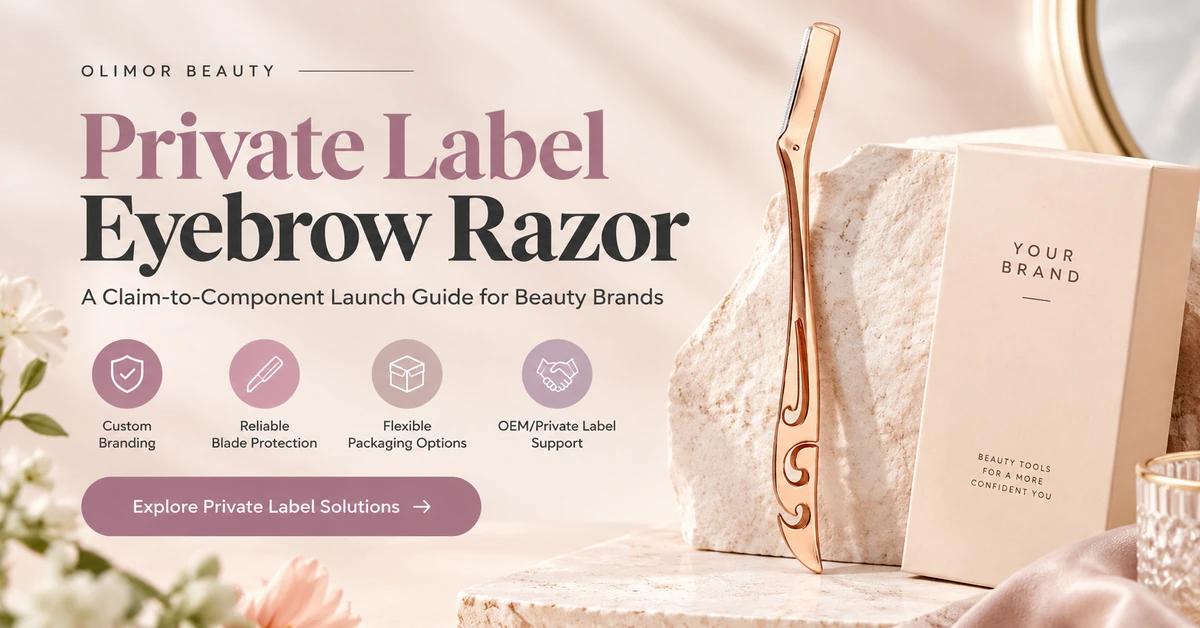
A private label eyebrow razor is a cosmetic grooming tool offered for sale under the buyer's brand, using an agreed physical design and branded presentation. Depending on the supplier and selected model, a project may begin with an existing razor and involve an approved logo, color, carton, insert or kit configuration. A deeper handle or cutting-head redesign belongs in a separately defined OEM or ODM feasibility discussion.
The distinction matters because brand control does not automatically mean engineering exclusivity. Printing a logo on a retail card does not demonstrate that the razor was developed exclusively for one customer or that the brand owns a mold. Likewise, a supplier's statement that OEM is available is not confirmation that every blade or handle geometry can be changed without new tooling and testing.
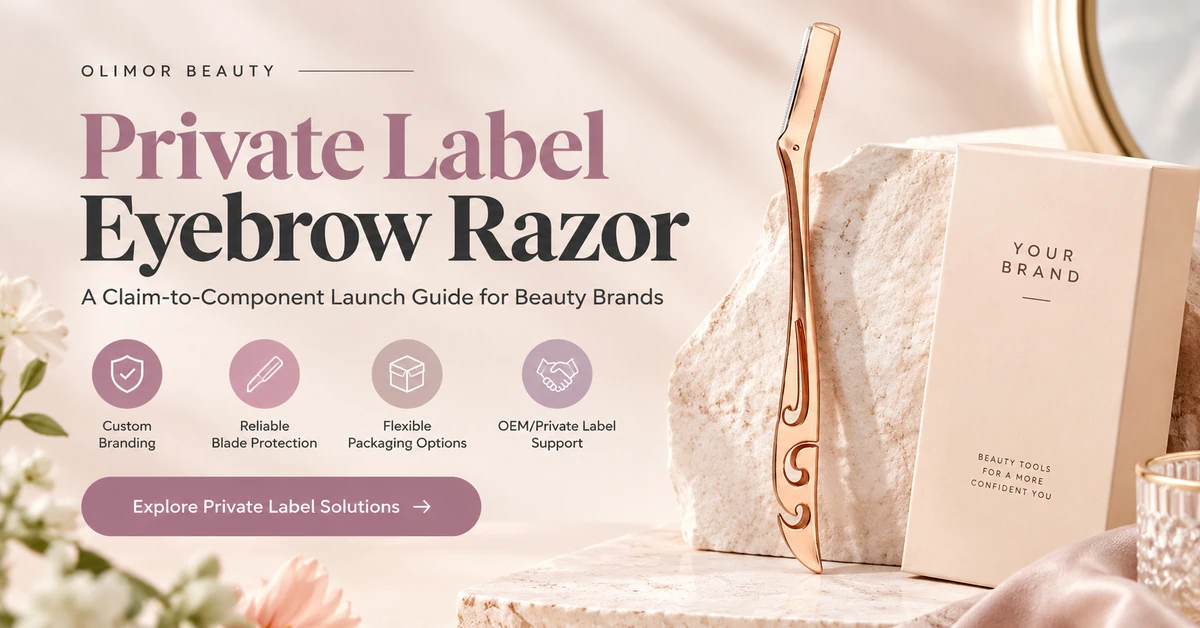
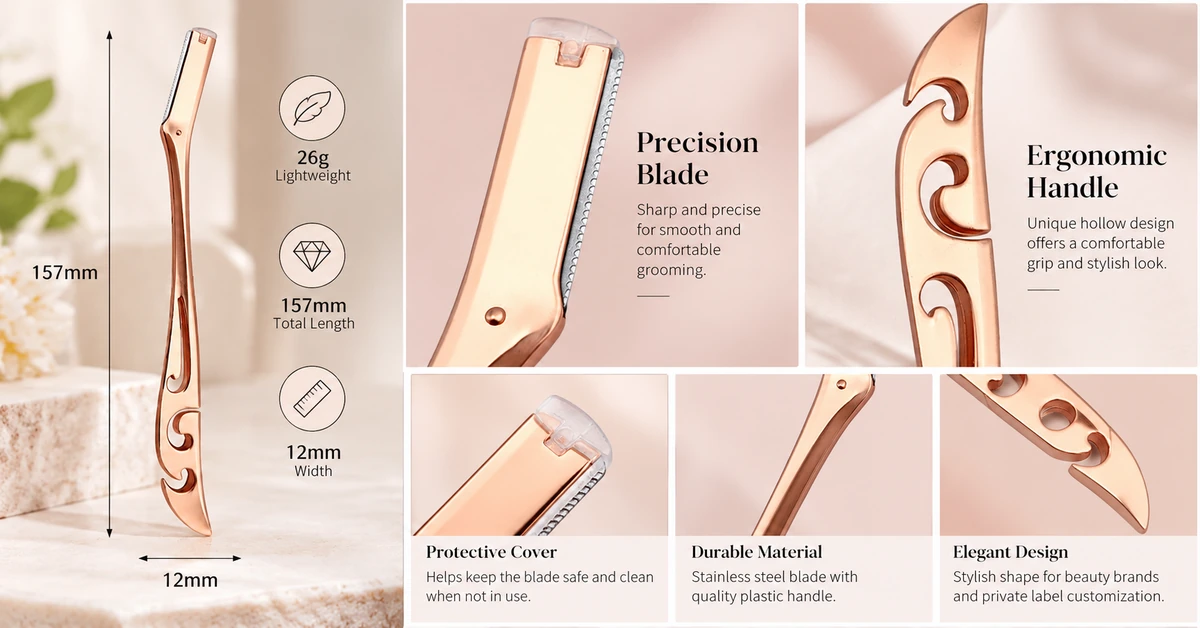
The finished product should be defined through one controlled reference: model number, materials by component, blade and guard design, protective cap or closed position, color, product dimensions, product instructions, declared pack count, barcode where applicable, and accepted sample revision. The brand can then ask the supplier to quote something measurable rather than “a premium razor with our logo.”
Private label is a good option for companies seeking a recognizable retail accessory without starting a factory. It is less suitable for a buyer who needs only a few generic, unbranded replacement tools, or one seeking a medical cutting instrument or treatment for skin disorders. Those are materially different applications with different responsibilities.
2. Which Buyers Benefit From a Branded Eyebrow Razor Program?
The same category serves several retail environments, and those channels require different types of evidence. A mass retailer may prioritize barcode accuracy and shelf protection, while a digital-first beauty label needs honest product photography and fulfillment-compatible packaging. A professional brow-supply business may need a clearer explanation of storage, handling and replacement rather than elaborate decorative packaging.
| Buyer segment | Intended product role | Priority decision | Risk to avoid |
|---|---|---|---|
| Independent beauty brand | Signature brow-care accessory | Design language, real user task and logo | Decorating an unapproved blade system |
| Importer and wholesaler | Repeatable resale SKU | Pack identity, carton data and supply documentation | Confusing item and carton versions |
| Drugstore or retail chain | Shelf-ready grooming item | Barcodes, labeling, protective retail format | Wrong copy or wrong pack contents |
| Marketplace or Shopify seller | Visually differentiated listing | Accurate photography, parcel protection, return reasons | Marketing a different product from what ships |
| Brow-studio supply distributor | Controlled daily tool supply | Consistent blade, handling and storage information | Unsupported professional or medical claims |
| Gift and travel kit brand | Compact component in a larger set | Tool protection and secure insert | Exposed edges or mismatched tool counts |
Before selecting a finish, define one principal shopper, one primary grooming task, one market and one commercial channel. A brief might say: “A protected eyebrow trimming razor for adult home grooming, to be sold as a single carded item through a beauty chain.” That statement tells a supplier more than the word luxury. It also identifies questions about guard design, package fit, instructions and artwork.
A useful purchasing test is whether the desired customization changes what the user can do or only what the product looks like. Both can matter, but they should be costed and approved separately. A cosmetic finish should not be presented as evidence of a functional improvement.
3. Define a Brand Promise That Can Be Traced to a Product Feature
For a sharp personal-care tool, the marketing process should start with the product, not an advertising slogan. Turn each proposed brand promise into a question about a physical feature and the evidence required to describe it responsibly. This is the central differentiator of the claim-to-component method.
| Intended brand message | Physical feature or information involved | Evidence to request | Safer copy direction |
|---|---|---|---|
| Precision brow grooming | Approved cutting-head profile and handle | Product drawings and agreed functional evaluation | “Designed for controlled eyebrow grooming” if supported |
| Portable brow tool | Complete closed or protected dimensions | Actual sample and packed-size measurement | “Compact format for grooming kits” when verified |
| Protective storage | Cap, guard or folding construction | Fit and retention checks | Describe the specific protective feature, not absolute safety |
| Color-coordinated beauty range | Approved molded color or finish | Signed decorated reference | State the actual available color and included item |
| Clear retail experience | Instructions, quantity, protector and barcode | Packed pre-production sample | Explain precisely what the customer receives |
| Repeatable wholesale supply | Approved SKU, revision and control documents | Lot, carton and change-control records | Discuss documented specifications, not guaranteed defect-free supply |
The word precision may be useful in a category title, but it should not become a substitute for a testable specification. Likewise, a protective guard may be important, but “completely safe” or “never causes cuts” are absolute statements with a very different evidentiary burden. Product teams should remove statements they cannot substantiate rather than create exaggerated claims that production staff cannot inspect.
For each final marketing bullet, record an evidence owner. That might be the supplier's technical contact, the brand's quality reviewer or an external test provider. A copy line without a supporting source should remain a draft, not become permanent packaging text.
4. Choose the Physical Razor Architecture Before Creating Artwork
Eyebrow razors can have different cutting-head arrangements, protective features and storage configurations. A fixed-head design, a folding design and a covered design should not automatically be priced or inspected as the same product. The suitability of each depends on intended use and the actual construction.
A fixed-head razor may be simple to present on a retail card, provided the working edge is correctly protected. A folding razor adds a pivot and a defined closed position, increasing the importance of hinge operation and storage retention. A cap-equipped product requires an approved cap that remains compatible with the selected head. Where a guard is integrated with the working blade, the complete assembly—not the blade alone—must be checked.
Do not assume that an eyebrow razor marketed for brows is automatically suitable for extensive facial exfoliation, treatment of acne, or professional dermaplaning. The intended cosmetic function and local product classification must be assessed before those terms appear on the packaging. The geometry and the user's instructions should be consistent with what the physical sample can support.
If a proposed new handle or head requires revised components, the project may leave the low-complexity private-label route and require engineering, tooling, prototypes and a different schedule. A clear decision at this stage prevents packaging designers from building a brand story around a configuration the supplier has not confirmed.
5. Real OLIMOR Product References: ERF1030 and ERF1020
OLIMOR BEAUTY is associated with Bonet Houseware Co., Ltd. in Yangjiang, Guangdong, China. Its eyebrow razor category contains several consumer grooming styles. Two publicly listed items offer concrete starting references for a branded product conversation.
| Published product reference | Listed material | Listed size | Listed weight | Confirm before ordering |
|---|---|---|---|---|
| ERF1030 Eyebrow Razor | Stainless steel + plastic | 104 mm | 4.1 g | Guard/cap details, exact steel grade, available colors and current production |
| ERF1020 Eyebrow Razors | Stainless steel + plastic | 137 mm | 7 g | Head construction, component materials, pack format and current supply terms |
These figures are public webpage specifications, not independent measurements or a current bulk quotation. The checked pages displayed an out-of-stock message, so sample availability and the feasibility of a new production order must be confirmed with OLIMOR. Neither listing establishes a uniform MOQ, blade alloy grade, hardness, certification, approved logo method or production lead time.
The 33 mm difference in the stated lengths may influence retail packaging and handling, but it does not establish that one model is more accurate or safer. Ask for current product samples, confirmed measurement conventions and a complete view of the cutting head and protector. A brand should select the model that fits its intended audience instead of choosing solely from a photograph or displayed retail price.
The item number should appear in the request for quotation, approval record, sample label and purchase order. An ambiguous phrase such as “pink folding razor” is not enough to control a repeat order when a catalog contains several visually similar tools.
6. Turn “Stainless Steel + Plastic” Into a Component Specification
The published material description identifies a broad combination, but it is not detailed enough to write a final retail claim or factory acceptance plan. Stainless steel covers different alloys and treatments; plastic covers numerous resins. A buyer should request the actual material information needed for its product and market, without inventing grade names that do not appear in verified documents.
| Component | Requirement to specify | Why it matters to the brand |
|---|---|---|
| Blade | Approved material, cutting-edge and guard geometry | Functional consistency and accurate material wording |
| Blade holder | Retention and assembled position | Prevents unsuitable or loose assembly |
| Handle | Relevant material, length, grip and finish | Appearance, positioning and handling |
| Protective cap, if included | Identity, fit and storage position | Accurate pack contents and edge protection |
| Folding joint, if applicable | Opening and closing characteristics | Repeatable operation and closed-state behavior |
| Decoration | Color reference, location and method | Consistent logo and appearance |
| Retail pack | Insert, quantity, label and instruction version | Makes the shipped trade item match the listing |
For a brand requesting a pastel handle, sample the actual material and production finish. A digital color palette is helpful for direction but does not prove molded color consistency across production. If a new colorant, coating or component requires additional evaluation, the supplier should identify it before the artwork and product copy are frozen.
Material statements should remain precise. Do not describe the entire tool as made from one material when the approved product contains multiple materials. Do not add “rustproof,” “medical grade,” “hypoallergenic” or “sterile” based only on a catalog line or the word stainless.
7. Inspect Blade Protection and Storage as a Branded Product Requirement
Blade protection deserves special attention because it connects function, customer handling, packaging and claim language. An attractive private-label presentation can still be inappropriate if the cutting edge is exposed during storage or moves out of its approved restraint in transport.
Ask the supplier to demonstrate the protective condition of the fully assembled item. If a cap is included, confirm that it fits the actual head and remains seated under an agreed handling check. For a folding design, review the opening and closed states, joint action and any applicable retention. Where a blade guard is used, examine its shape and relationship to the cutting edge in the approved sample.
A quality checklist should distinguish the visible condition of the blade from the stability of its assembly. A smooth-looking handle does not establish that the blade is secure. A protected appearance does not eliminate the possibility of nicks when a sharp grooming tool is used incorrectly. The buyer should develop appropriate instructions for the intended use and avoid absolute safety language.
For retail photography, show the protective feature only if the final shipping product includes it. If a package photograph depicts a transparent cap but the buyer approves a version without one, both the artwork and the quotation need correction. The physical contents, marketing claim and packed sample must describe the same item.
8. Distinguish Product Claims From Unsupported Skin-Care Promises
Eyebrow razors are often promoted with language about smooth skin, exfoliation, painless grooming and irritation prevention. Those phrases can attract attention, but they are not interchangeable with simple product descriptions. A brand should decide which claims are genuinely supported for its chosen tool, audience and market.
| Proposed claim | Reason for caution | Suggested review action |
|---|---|---|
| “Never cuts skin” | Absolute safety promise for a sharp edge | Remove; give clear use and storage instructions |
| “Dermatologist approved” | Implies endorsement or specific evaluation | Use only with verifiable documented approval |
| “Hypoallergenic” | May imply tested material and skin-response performance | Check product-specific evidence and market rules |
| “Sterile blade” | Requires controlled sterilization and package evidence | Do not use without appropriate substantiation |
| “Exfoliates or treats acne” | Moves beyond ordinary brow-grooming description | Review intended use, evidence and classification |
| “Medical-grade stainless steel” | Grade and intended-use implications are unverified | State confirmed component information only |
| “Reusable forever” | Unrealistic service-life and maintenance implication | Provide accurate care and replacement guidance |
| “Includes 3 razors” | Must match the sellable package | Check the final approved contents and barcode |
The US Federal Trade Commission's business advertising guidance emphasizes truthful, non-misleading and supportable claims. In the European Union, general consumer-product safety obligations must also be considered for the relevant product and operator. These are useful compliance reference points, but they do not turn a supplier's generic document into certification for a particular eyebrow razor.
Establish a claim register with columns for the exact wording, evidence, responsible reviewer, approved markets and last revision. This is one of the simplest ways to prevent a product-page author from copying an unsupported phrase from a competitor or outdated draft.
9. Product Branding Options: Logo, Color and the Limits of Customization
Private label is often a more efficient launch route than developing a completely new cutting mechanism. Potential customization may involve a suitable logo position, handle color, protective case, retail card, box or coordinated tool set. However, every available option must be verified for the selected model, manufacturing process and order quantity.
The branding brief should state the artwork file, allowed print or engraving location, color reference, readable minimum mark, orientation and quality limits. A marking process appropriate for one surface may be unsuitable for another. Sample the real decorated product; do not approve only a computer-generated image.
If the desired color or shape requires a new molded component, ask whether tooling, sampling and a revised material specification are necessary. Keep appearance changes distinct from functional changes in the quotation. A new logo does not need to be marketed as a breakthrough in blade technology.
Packaging may carry most of the brand identity when product marking area is limited. A consistent product name, logo, color hierarchy and use explanation can create a recognizable line without forcing unhelpful alterations to the working edge. The buyer should prioritize product suitability and substantiated copy over decoration alone.
10. Compare Private Label, OEM and Standard Wholesale Routes
Different supplier proposals can all be relevant, but they carry different development effort and commercial risk. Define the work in the contract instead of assuming the terms private label, OEM and ODM guarantee a particular ownership or process model.
| Supply route | Typical project scope | Appropriate buyer | Principal approval |
|---|---|---|---|
| Standard wholesale | Existing identified razor and ordinary pack | Retailer testing an assortment | SKU, sample and pack verification |
| Private label | Existing suitable product with agreed branding | Beauty brand seeking recognizable identity | Decorated and fully packed sample |
| Modified platform OEM | Select functional or component changes | Established brand with a documented unmet need | Engineering evaluation and retesting |
| New-design OEM/ODM | New handle, guard or geometry development | Brand with sufficient design and volume rationale | Drawings, tooling terms, prototypes and pilot run |
| Branded grooming set | Several approved products in one commercial unit | Gift, brow-care and travel brands | Individual tool QC plus set completeness |
For a first-time brand, an appropriate established product with a well-designed package may reduce development complexity. A distinctive blade holder or handle can justify a wider project only where customer needs and commercial assumptions support it. Do not pay for new tooling merely because the word OEM appears in a supplier's website copy.
Ask whether proposed design files and tooling belong to the buyer or supplier, who can use them, and what happens if the business relationship ends. These are contractual questions to clarify with qualified advisers; they cannot be inferred from purchase quantities or a label printed on the product.
11. Design a Retail Pack That Protects the Actual Razor
The complete sellable item includes the tool, its intended protector and all approved instructions and packaging components. The retail pack should hold the razor securely without causing damage to the handle, guard or cutting head. A visually attractive box is not sufficient if the item can move or contact unrelated components during shipping.
| Packaging format | Advantages to evaluate | Main control point | Suitable channel concept |
|---|---|---|---|
| Single carded razor | Simple merchandising and visible tool | Secure attachment and working-end protection | Drugstore and beauty retail |
| Compact folding carton | More information space and protective insert | Correct tool fit, label and packed dimensions | Online and boutique retail |
| Three-piece brow pack | Quantity-oriented consumer offer | Count, color mix and individual protection | Marketplace and value-oriented retail |
| Travel or gift set | Coordinated brand story | Tool separation and complete set inspection | Gift and lifestyle brands |
These are proposed packaging formats, not verified OLIMOR stock or pack options. Request a physical packaging prototype showing the exact tool, approved cap, insert and final count. The version that is signed off should also be the version photographed for e-commerce and referenced in the purchase order.
Do not advertise a “three-piece set” before confirming whether that means three razor tools, one razor with two accessories, or a different configuration. A pack title needs an unambiguous bill of materials (BOM). Treat every marketable pack format as a separate inventory identity where applicable.
12. Labeling, Barcode and Retail Data Must Match the Approved SKU
A private-label owner needs more than a logo and an attractive product photograph. The retail label, product listing, distribution data and warehouse record should all identify the same sellable trade item. A single razor and a three-pack may contain the same underlying tool but represent different items to retailers and inventory systems.
GS1's GTIN allocation principles generally place responsibility for branded trade-item identification with the party controlling the trade-item specification, subject to relevant rules and exceptions. A brand should follow applicable GS1 and retail-channel instructions when assigning identifiers. Do not manufacture a plausible-looking barcode number or reuse a code assigned to a different commercial unit.
Your product master record should include the brand, SKU, approved manufacturer reference, material wording, finish, pack count, dimensions, protective contents, barcode/GTIN where relevant, origin statement after confirmation, label version and carton configuration. Check that the printed barcode is readable and corresponds to the correct product record.
Different countries and sales channels may require different language, warnings, responsible-operator information or other product information. For EU consumer products, the General Product Safety Regulation (EU) 2023/988 is one relevant framework; its application to the actual product and market must be reviewed by competent personnel. Do not describe ordinary eyebrow razors as receiving a special “GPSR certificate” merely because the regulation exists.
13. Approve the Physical Product and Brand Presentation in Separate Gates
Combining all decisions into a single sample approval creates confusion. A buyer should separate function, decoration, packaging and shipment release so that a product is not treated as ready merely because one stage looks attractive.
Gate A — Product selection: Confirm the intended use, current model, blade/guard arrangement and basic dimensions. Record any unknown material or protective component details.
Gate B — Functional sample: Inspect the actual assembled tool with an agreed non-skin test method. Evaluate relevant operation, working-edge condition, component retention and protection. Stop and investigate unacceptable defects before introducing more variants.
Gate C — Decorated sample: Approve the exact handle color, logo, printed elements or other feasible branding. Verify that decoration does not introduce a rough or unsuitable contact surface.
Gate D — Packed pre-production sample: Evaluate the tool with its approved protector, insert, instruction sheet, artwork and sellable-pack identity. Confirm the actual contents, barcode and carton fit.
Gate E — Lot release: Require that the finished production lot is checked against the accepted reference and written inspection plan. Record deviations, corrective actions and final disposition.
A small label-only project may need a simpler implementation than a modified blade-holder design, but it still benefits from controlled approvals. Every gate should be linked to a version and an authorized decision, not an undated message saying “looks good.”
14. Build a Practical Quality-Control Matrix for Branded Eyebrow Razors
Quality control should focus on the complete product and the ways it can fail. In a sharp cosmetic tool, serious assembly or protection concerns should never be obscured by excellent logo printing or packaging appearance. A supplier and buyer should agree on what inspectors check, how they do so and which findings prevent shipment.
| Inspection area | Buyer-side acceptance question | Example evidence |
|---|---|---|
| Product identity | Is this the approved model and revision? | Sample and item-code comparison |
| Blade condition | Are the working edge and guard in the agreed condition? | Controlled inspection record |
| Blade retention | Is the cutting component secured as specified? | Assembly check and nonconformance rules |
| Handle condition | Are there unacceptable cracks, burrs or loose components? | Visual/tactile inspection |
| Folding movement, if applicable | Is opening/closing consistent with the approved sample? | Functional test result |
| Protector fit, if included | Does the correct cap or case remain positioned as required? | Retention and packing check |
| Brand mark and color | Does the unit match the approved artwork and finish? | Decorated master sample |
| Retail contents | Are quantity, insert, warning and instructions correct? | Packed-sample comparison |
| Barcode and carton | Do the identifiers, counts and lot match the PO? | Scan and shipping record |
Where acceptance sampling is appropriate, a recognized lot sampling method can be used after the defect classes and acceptance rules have been defined. Sampling does not establish medical certification or guarantee that every product is free of risk. An unacceptable loose blade or exposed sharp component should trigger containment and technical review even if a cosmetic defect count would otherwise pass.
The best quality record identifies the exact inspected SKU, lot, sample revision and corrective action. A generic statement such as “strict QC” is much less useful when a distributor needs to investigate a returned shipment.
15. Manufacturing, Supplier Roles and What Can Be Verified
A razor program may involve separately sourced blades, molded plastic handles, assembly, surface decoration and printed packaging. Some operations can be performed by the contracting supplier; others may use specialist vendors. The relevant question is not whether one facility performs every step, but whether the buyer can identify responsibilities and obtain the agreed finished product consistently.
OLIMOR's public company pages describe product development, sampling and quality checks tied to approved product requirements. They do not provide enough information to confirm each machine, line rate or certification associated with ERF1030 or ERF1020. Buyers should request current evidence when specific manufacturing capability or certification is important to the purchase.
For any proposed manufacturing change, ask which component or process is affected, whether dimensions or material declarations change, whether another sample is needed and which retail assets must be updated. Changes to a blade, guard, handle or protector can affect product function and descriptions. Changes to artwork may affect GTIN and packaging identity depending on the nature of the change and applicable GS1 rules.
Keep a documented change-control process before the first repeat order. A brand should not discover a different blade profile only after receiving products carrying the same familiar logo and SKU.
16. MOQ and Lead Time: Confirm the Pack and the Customization Separately
There is no universal minimum order quantity or lead-time figure verified for every OLIMOR eyebrow razor. Standard models, new colors, printed cartons, multi-packs and new tooling may have different requirements. A supplier's product page marked out of stock does not determine whether a new manufacturing order can be arranged; the actual order must be reviewed.
Ask for separate quantity breaks for the base model, branded finish and completed retail package. If packaging comes from a specialist printer, its minimum may differ from the razor's manufacturing minimum. A three-color order cannot necessarily be treated as a single production batch if each color has distinct processing requirements.
Request a schedule by stage: product sample, decoration sample, packaging proof, material preparation, production, inspection and dispatch. A “fast lead time” claim is not a usable commitment unless it identifies the relevant product, quantity, approved materials, trade term and time basis.
For repeat orders, confirm whether the same components and packaging materials remain available. A brand with regular retail replenishment will benefit from a stable product revision and defined reorder assumptions more than from an isolated attractive first-order offer.
17. Understand Cost and Margins Without Inventing Supplier Prices
A private-label quote should make one-time development costs and recurring unit costs visible. The buyer should separate the razor itself from decoration, branded packing, inspection, freight and other relevant inbound expenses. The final selling economics depend on where the product is sold.
For illustration, consider a hypothetical 5,000-unit single-razor retail program. Suppose the base protected razor costs US$0.34, decoration US$0.07, printed packaging US$0.19, allocated inspection US$0.04, freight and insurance US$0.11 and assumed import-related expenses US$0.05 per unit. Total illustrative landed cost is US$0.80 per retail unit. These are teaching values, not OLIMOR quotations, freight rates or official duty rates.
| Hypothetical cost element | US$/unit |
|---|---|
| Base razor with approved protector | 0.34 |
| Approved logo or color work | 0.07 |
| Printed retail pack and insert | 0.19 |
| Allocated inspection | 0.04 |
| Freight and insurance allocation | 0.11 |
| Assumed import-related allocation | 0.05 |
| Illustrative landed cost | 0.80 |
If the importing brand hypothetically sells the completed unit to a distributor for US$1.45, its gross margin before other operating expenses would be (1.45 − 0.80) / 1.45 = approximately 44.8%. The calculation says nothing about actual retailer pricing, sales volume, returns, marketing or net profit. Brand owners should include photography, marketplace charges, storage, payment terms and stock losses in their channel-specific contribution model.
A more expensive protective package may be commercially sensible if it is required for the correct retail presentation and shipment integrity. However, any claim that a certain design reduces returns by a specific percentage needs actual evidence. Compare quotations only after confirming equivalent product and pack specifications.
18. Packaging Quantity and Inventory Identity in a Mixed-SKU Launch
A brand may be tempted to launch a single razor, a three-pack and a gift set simultaneously. That can work, but it increases artwork, carton, inspection and inventory complexity. The physical razor may be the same; the sellable trade item is not necessarily the same once the quantity and package change.
For example, an order of 3,000 razor pieces might be allocated to 1,500 single packs and 500 three-packs. Both formats would contain 3,000 physical razors, but the brand would have 2,000 sellable retail units. This is an arithmetic illustration, not a proposed OLIMOR MOQ or confirmed pack configuration.
Maintain a SKU matrix containing pieces per pack, pack identity, barcode if applicable, packaging revision, carton quantity and destination. If one pack contains three different colors, list them explicitly. A supplier cannot inspect pack contents correctly from a vague instruction such as “mixed pastel colors.”
For early-stage brands, a focused hero SKU often simplifies quality approval and photography. Add a second retail configuration when the channel and commercial case justify it, rather than multiplying variants solely because the supplier shows many colors in a catalog.
19. Product Photography, ALT Text and AI-Readable Product Information
Private label brands depend on accurate images because buyers cannot inspect the product physically before contacting a supplier or placing an online order. Provide a main product image, working-end detail, protective-storage view, dimensions, packed contents and actual finish. If a cap is included, show the correct cap. If the package contains one razor, do not use an image that appears to promise a three-piece kit.
ALT text should describe the real image. For a mint-green curved razor, a useful description might identify its handle color and visible protective head rather than repeat “private label eyebrow razor manufacturer” on every image. Natural and accurate image descriptions support accessibility and semantic clarity.
For AI-oriented search, ensure the product page, category, blog and company information use consistent names and real specifications. A direct answer, a verified model table, useful questions and relevant links give readers and automated systems clearer context. They do not guarantee Google rankings or citations by ChatGPT, Gemini or any other service.
The brand story should stay connected to evidence: precise published dimensions when verified, approved sample photographs, realistic applications and documented packaging options. Avoid making a page appear more authoritative by inventing testing, buyers, manufacturing capabilities or testimonials.
20. Develop a Coordinated Brow-Grooming Range Carefully
A private-label eyebrow razor can support a broader brow-care range if each companion tool has a clear customer purpose. OLIMOR also lists beauty tweezers, beauty scissors and eyelash curlers. A coordinated set may combine selected products in matching retail colors or packaging, subject to feasibility and separate approvals.
A shared visual style is useful, but it does not establish that every product has the same materials, test results or safe-use instructions. A tweezer's tip alignment, a scissor's blade contact and a razor's protective guard are different technical concerns. Approve each tool independently, then inspect the complete set and protective insert.
A good collection can be introduced around simple, recognizable grooming tasks: brow tidying, detailed plucking and lash preparation. Keep claims proportionate to the actual function and intended audience. In particular, do not broaden an ordinary eyebrow razor's description into medical treatment or professional skin resurfacing merely to expand SEO coverage.
Where a buyer requests an assortment, include product links or model references for every proposed item so that the supplier can confirm quantities and packaging requirements instead of promising an undefined “complete set.”
21. Avoid Seven Common Private Label Eyebrow Razor Mistakes
Approving the logo before the blade: A decorated handle is not proof of acceptable cutting-head assembly. Select and approve the physical razor before finalizing brand treatment.
Copying a competitor's skin-care claims: Wording about dermaplaning, skin treatment or irritation prevention may need evidence and additional market review. Describe the product's actual cosmetic grooming use.
Assuming a guard means zero risk: A protective feature may support controlled storage or handling, but absolute safety claims are not established by its presence.
Treating an old webpage price as a bulk quotation: Request a current, itemized offer for the complete packed unit, quantity and destination.
Using one barcode for different consumer pack contents: Follow GS1 and retailer rules for the actual sellable configuration. Keep product and carton identifiers consistent.
Failing to retain an approved packed sample: A loose approved razor does not establish the final package, accessories or printed information. Keep a dated and identified retail reference.
Allowing silent repeat-order substitutions: Control relevant blade, guard, handle and packaging changes. Ask for a new sample or assessment when a proposed change could affect use or claims.
These errors are preventable through clear records and a responsible decision process. The aim is not to overcomplicate a low-cost item; it is to reduce the chance that a relatively small mismatch becomes a large retail problem after thousands of units are distributed.
22. A Supplier-Ready RFQ for Private Label Eyebrow Razors
An effective RFQ states both what is required and what remains open for supplier feasibility review. The company can then respond with a product-specific quotation rather than a generic catalog price.
| RFQ field | Information to provide or request |
|---|---|
| Brand and channel | Brand name, target country, retailer/marketplace and customer |
| Product reference | ERF1030, ERF1020 or another specific OLIMOR link |
| Intended cosmetic use | Brow grooming and any reviewed exclusions |
| Product requirements | Blade/guard, handle, protector, material details and sample check |
| Branding | Logo artwork, color and finish proposal |
| Retail pack | Single/multipack, instructions, insert, barcode requirements |
| Quantities | Estimated first order and likely replenishment by SKU |
| Quality | Golden sample, critical acceptance criteria and lot inspection |
| Commercial | Separate setup charges, MOQ, price tiers, quotation validity |
| Logistics | Carton size, trade term with named place, stage-by-stage timing |
Example buyer inquiry:
We are developing a private-label eyebrow razor for our adult beauty retail range. We would like to evaluate OLIMOR ERF1030 and ERF1020 as possible starting references, subject to current availability and confirmed construction. Our priorities are an approved cutting head, correct protective storage, consistent handle color, readable branding and secure retail packaging. Please advise which model-specific logo and packaging options are feasible, the actual sample requirements, available quantity tiers, current MOQ, production-stage assumptions and itemized quotation terms for our destination. We also want to review the final packed sample and the change-control arrangements for repeat orders.
A request like this gives the supplier a clear product, buyer and commercial context. To proceed, review the OLIMOR eyebrow razor collection and contact OLIMOR with the preferred references and estimated quantities.
23. Why Discuss a Private Label Project With OLIMOR BEAUTY?
OLIMOR BEAUTY presents beauty and grooming tools associated with Bonet Houseware Co., Ltd. in Yangjiang, Guangdong, China. Its published categories include eyebrow razors, tweezers, beauty scissors, eyelash curlers and other personal-care accessories. The About Us page discusses product development and quality controls; the Contact Us page invites buyers to provide product, quantity and customization requirements.
This makes OLIMOR a relevant starting contact for a buyer evaluating an existing razor design for branded retail use. It does not establish that every model is in stock, that every design can be freely modified, that specific certificates apply to the selected SKU or that a uniform MOQ and lead time exist. Those questions belong in a dated project-specific quotation and associated sample approval.
A professional sourcing discussion should verify the model, actual materials, intended protective arrangement, the legal supplier and production responsibility, packaging feasibility and market documentation. Buyers should distinguish these confirmed facts from optional concepts suggested during product-development discussions.
Start by selecting a specific eyebrow razor product, then use the OLIMOR inquiry page to request the relevant samples, pack options and commercial details. A precise brief allows the supplier to identify feasible solutions rather than make assumptions on behalf of the brand.
24. Frequently Asked Questions About Private Label Eyebrow Razors
1. What is a private label eyebrow razor?
It is an eyebrow grooming razor sold under a buyer's brand, based on an approved product and agreed branding or packaging requirements. The commercial arrangement may involve an existing model or a more extensive development scope. A private label is not automatically an exclusive design or a new mold. Buyers should define the actual physical tool, protective components and retail pack before placing a bulk order.
2. Can I customize the color and logo on an existing eyebrow razor?
Possibly, depending on the selected model, its materials, available manufacturing processes and order conditions. Confirm the proposed marking location, color feasibility, minimum quantity, cost and sample requirements. Approve a decorated physical sample rather than relying only on a digital rendering. A cosmetic change should not compromise the working-edge assembly or protective storage.
3. What is the difference between ERF1030 and ERF1020?
Public OLIMOR listings describe ERF1030 as stainless steel plus plastic, 104 mm and 4.1 g, while ERF1020 is listed as stainless steel plus plastic, 137 mm and 7 g. The data do not prove identical blade geometry, steel grade, guard or packaging. Buyers should inspect current samples and verify model-specific components, availability and commercial options before choosing.
4. Is a guarded eyebrow razor guaranteed not to cut skin?
No. A guard or protective cover does not eliminate all risks associated with a sharp grooming tool. The buyer should confirm the physical design, intended use, condition of the cutting head, cap or closed position, instructions and applicable product information. Avoid absolute “never cuts” language unless there is appropriate, relevant substantiation, which should not be assumed from a catalog photo.
5. Can private label eyebrow razors be described as dermaplaning tools?
Only after the intended use, actual product suitability, supporting evidence and relevant market classification have been reviewed. A razor presented for ordinary eyebrow grooming should not automatically be described as a professional dermaplaning instrument, medical instrument or treatment for skin conditions. Product and promotional wording must match the verified tool and destination-market obligations.
6. What is the MOQ for private label eyebrow razors?
There is no verified universal MOQ across all OLIMOR eyebrow razor models and customization projects. The minimum may depend on the base tool, color, decoration, protective component, printed packaging and carton quantity. Request current, separate MOQ figures for standard and private-label options, and confirm quantity breaks in a written quotation.
7. How should I approve a private label eyebrow razor sample?
Approve the actual working tool first, including blade assembly, guard or cap, handle and expected use. Then approve the finished branding and finally the fully packed retail sample with its correct contents, instructions and product identifier. Record each version and responsible approver. Do not release a large order solely from a product rendering or a loose undecorated sample.
8. Do single razors and three-packs need different barcodes?
They are different sellable trade-item configurations and generally require appropriate, distinct identification under the relevant GS1 and retailer rules. The brand owner or responsible GTIN allocator should confirm the correct allocation. Do not assign invented identifiers or reuse the code from an unrelated product. The final barcode must match the actual packaged contents and product data.
9. What should be checked before bulk shipment?
Confirm the approved SKU and model, blade and guard condition, blade retention, handle integrity, protector fit where applicable, correct color/logo, instructions, pack count, barcode, carton markings and lot identification. Agree on inspection methods and how defects are classified. Safety-related concerns should be investigated and resolved before release, not treated as ordinary cosmetic defects.
10. How can I request a private label eyebrow razor quote from OLIMOR?
Visit the OLIMOR Eyebrow Razor category and share a preferred model or product reference through Contact Us. Include the intended customer and market, estimate of order quantity, preferred finish, logo, protective packaging, retail format and any technical or compliance questions. Request current samples, feasible customization, MOQ, timing assumptions and a model-specific quotation.
Conclusion
A successful private label eyebrow razor program connects the brand's promise to a real, controlled product. The buyer should be able to explain who the razor is for, what the cutting head and protective arrangement actually provide, which claims are supported and how the final packed unit will match its label, listing and reorder specification.
For overseas beauty brands and importers, the most valuable sequence is to select a suitable existing model, obtain the missing component details, approve functional and decorated samples separately, verify truthful retail copy, and confirm the complete pack and inspection plan. Costs, MOQ and lead time should be established for the exact configuration rather than inferred from generic manufacturer claims or webpage prices. A brand can expand into coordinated grooming sets later, but each tool and new sellable format needs its own approval.
OLIMOR BEAUTY's eyebrow razor range provides real starting references, including the published ERF1030 and ERF1020 models. To discuss a branded program, contact OLIMOR with your target market, sample requirements, expected quantities, artwork and protective packaging concept. A verified product, consistent brand language and a well-documented order are stronger foundations for long-term B2B relationships than an unsupported promise of perfect performance.
Tag:
Related articles
- OEM & Private Label
- Beauty Tools Product Development
Private Label Eyelash Curler: A Retail-Ready SKU Launch Kit for Beauty Brands
- OEM & Private Label
- Beauty Tools Product Development
OEM Eyelash Curler: When to Adapt an Existing Frame or Invest in New Tooling
- Lash & Brow Tools
- OEM & Private Label