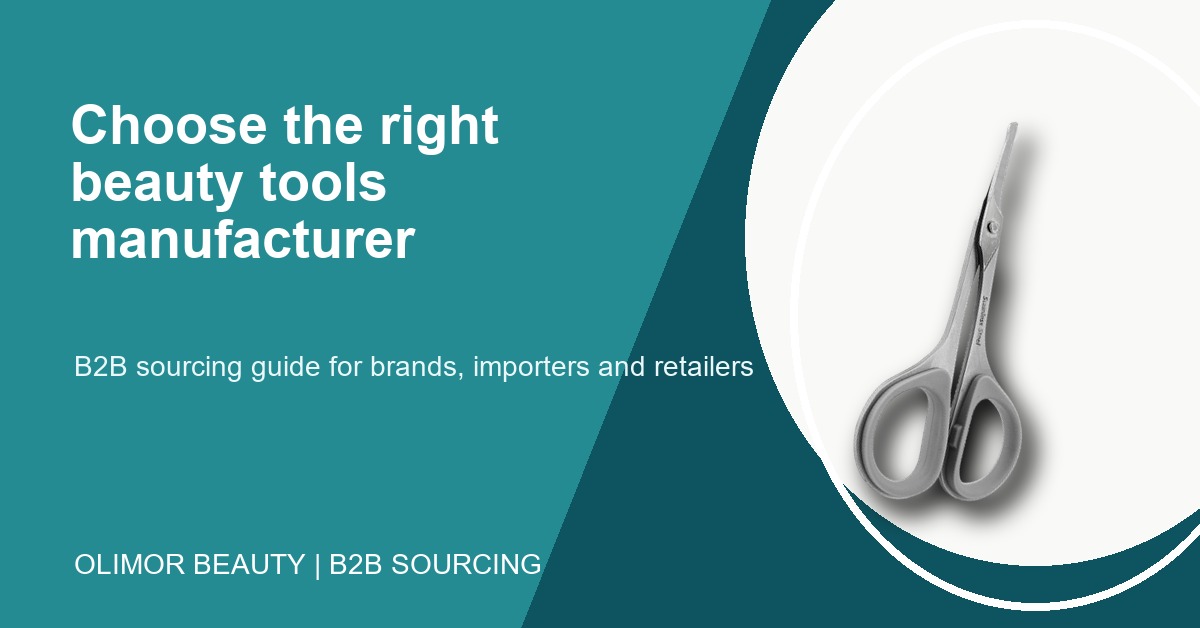
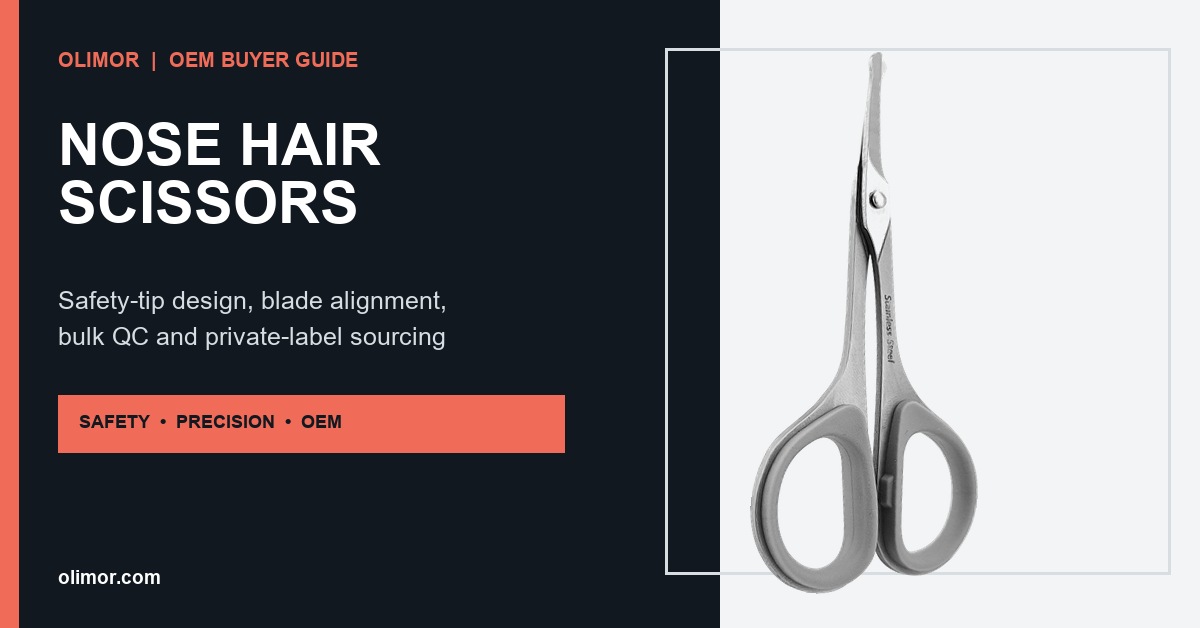
A dependable nose hair scissors manufacturer should control three things before discussing color or packaging: the shape of the safety tip, the way both blades meet, and the stability of the pivot through repeated opening and closing. For beauty brands, grooming-kit companies, importers, pharmacies, ecommerce sellers, and hospitality buyers, those details determine whether a small pair of scissors feels precise and reassuring or awkward and inconsistent. This guide explains how to write a useful specification, compare samples, plan private-label options, and inspect a bulk order without inventing performance claims that the selected model has not been tested to support.
Short buyer answer: choose a model by intended user, tip geometry, blade length, handle space, pivot feel, material, finish, and packaging. When comparing a nose hair scissors supplier, approve several physical samples rather than one presentation sample. Record the accepted cutting feel and alignment in a signed specification, then use that sample and document during production inspection.
Why Nose Hair Scissors Need Their Own Product Specification
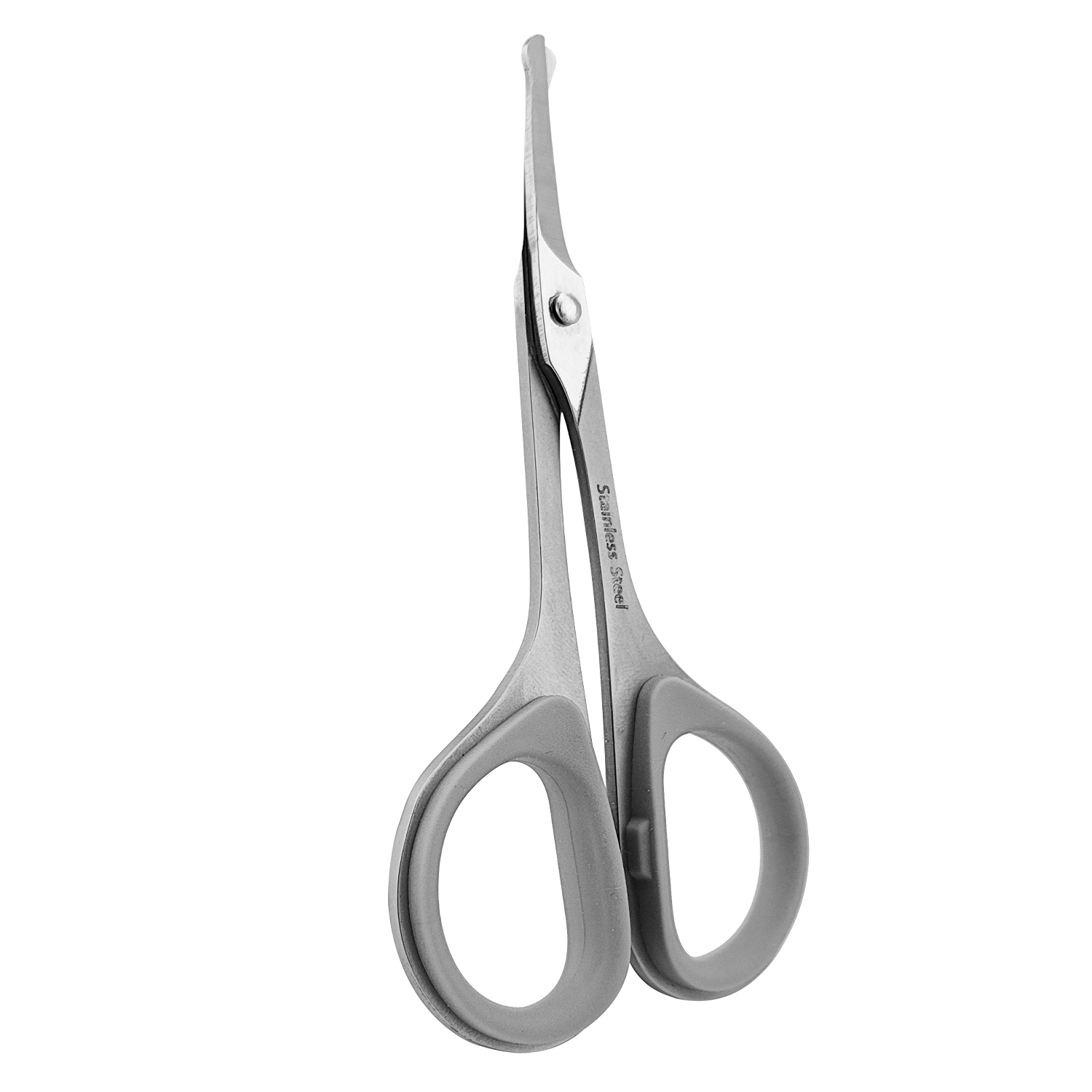
Nose hair scissors look simple, yet they combine a cutting edge with a rounded working end intended for controlled grooming in a sensitive area. A buyer who purchases them as if they were ordinary eyebrow scissors can miss the features that users notice immediately. A pointed beauty scissor may offer excellent visibility for brow work, but that same point is not the feature most customers expect from a nasal grooming tool. The product definition must therefore begin with use, not with a generic factory photograph.
The intended market also changes the brief. A men's grooming brand may want a larger handle and a restrained matte finish. A compact travel kit may prioritize a shorter overall length and a protective sleeve. A pharmacy or mass retailer may focus on straightforward instructions, tamper-conscious packaging, and a design that is easy to understand at a glance. A hotel amenity program may care about space, unit protection, and reliable replenishment. These are not cosmetic differences. They influence the scissor platform, packaging size, sampling plan, and acceptable cost.
Start the project with a one-sentence use statement. For example: “A rounded-tip stainless steel grooming scissor for adult retail customers, packed as a single tool in branded hanging-card packaging.” That sentence will not replace a specification, but it prevents the project from drifting into an undefined request for “good scissors at the best price.”
The Parts That Control Function and User Confidence
| Feature | What the buyer should define | What to check on samples |
|---|---|---|
| Safety tip | Rounded profile, symmetry, surface smoothness | No sharp corner, burr, rough transition, or mismatched tip shape |
| Blades | Useful cutting length, curvature, edge geometry | Even contact, clean cut on agreed test material, no visible chip or roll |
| Pivot | Joint type, operating resistance, allowable play | Smooth travel, stable blade relationship, no sudden looseness |
| Finger loops | Opening size, shape, insert or bare-metal design | Comfort, edge smoothness, control with typical hand sizes |
| Finish | Polished, matte, colored component, branding area | Uniform appearance, clean surface, no stain, scratch, plating gap, or polishing residue |
| Packaging | Retail format, tool restraint, instructions, market labels | No movement, blade contact, scuffing, mixed components, or inaccurate copy |
Safety-Tip Geometry: Rounded Does Not Mean Uncontrolled
The rounded end is the clearest visual difference between a nose hair scissor and many general beauty scissors. Buyers should look at the tip from the front, side, and top. The two sides should appear balanced. The transition from the blade to the rounded end should feel smooth, and the non-cutting exterior should not present a burr or an abrupt corner. A heavily rounded tip that blocks the working view may feel clumsy; an excessively narrow end may not communicate the intended safety-oriented design. The right shape depends on the model and target user.
Do not approve the tip from a catalog rendering alone. High-contrast photography can hide a rough edge, and a front view can conceal a side-profile mismatch. Ask for close photographs and physical samples. During sample review, use consistent lighting and a magnifier if the brand's acceptance standard requires it. Run a fingertip carefully around the non-cutting exterior without touching the cutting edge. The goal is not to perform an improvised medical-safety test; it is to identify obvious finishing defects before the product reaches a consumer.
The package should also describe the tool accurately. Words such as “safe” can be too broad if they imply that misuse is impossible. “Rounded-tip grooming scissors” is more specific. Instructions should state the intended grooming use, normal handling, cleaning direction, storage, and any warning required by the target market. A responsible specification controls the product and the claim together.
Blade Alignment and the Pivot Matter More Than a Sharp-Sounding Claim
Buyers often ask whether the scissors are “sharp.” That question is understandable but incomplete. A scissor cuts because two edges move past one another in a controlled relationship. If the pivot is loose, the blades can separate or twist. If it is too tight, the action may feel sticky and tiring. If the blades are ground unevenly, one part may cut while another folds the test material. A very aggressive edge cannot compensate for poor alignment.
Define an agreed functional test before production. The test material should be consistent, available to both supplier and buyer, and relevant enough to reveal gross cutting problems without pretending to duplicate every real grooming condition. Record how the sample is held, where along the blade the cut is made, and what counts as acceptable. Check multiple pieces. One unusually smooth sample says little about a production lot.
Inspect the action slowly. The blades should open without scraping in an abnormal way, close without jumping, and maintain a stable relationship at the tip. A small amount of operating resistance may provide control, but the acceptable feel should be agreed through approved samples rather than described with vague words. If the product uses a riveted or screwed pivot, the specification should identify the selected construction and what movement or play is unacceptable.
Material and Finish: Ask for the Exact Product, Not a Generic Metal Story
OLIMOR's public product pages identify several nose hair scissor models as stainless steel. That is a useful starting point, but “stainless steel” is a material family, not a complete engineering specification. If a particular grade, hardness, corrosion test, or chemical compatibility matters to the order, the buyer should request documentary confirmation for that model and production version. A blog article or sales photograph should never be used as a substitute for the agreed product specification.
Ask the nose hair scissors manufacturer to connect each material or finish statement to the item number, approved sample, and purchase document. This keeps a general catalog description from becoming an accidental promise for a different construction or production lot.
The finish affects appearance, hand feel, cleanability, branding, and how minor production variation becomes visible. A bright polish can look crisp but may show fingerprints and fine scratches. A matte treatment can reduce glare but must still be even. Colored inserts or coatings add visual differentiation while creating additional inspection points, including color consistency, adhesion, masking around the joint, and compatibility with the buyer's cleaning directions.
Ask what the material statement covers. It may refer to the main scissor body while finger-loop inserts, screws, decorative parts, sleeves, and packaging use other materials. A complete private-label specification separates those components. It also states whether any finish or coating claim has been tested, and it avoids absolute promises such as “never rusts.” Storage humidity, residue, cleaning chemistry, handling, and finish quality all matter.
Published OLIMOR Models as a Shortlisting Reference
The following details come from OLIMOR's public product information and are useful for initial shortlisting. They should be reconfirmed for the selected item, sample, packaging version, and order before publication on a buyer's retail package.
| Item | Published material | Published size | Published weight | Shortlisting use |
|---|---|---|---|---|
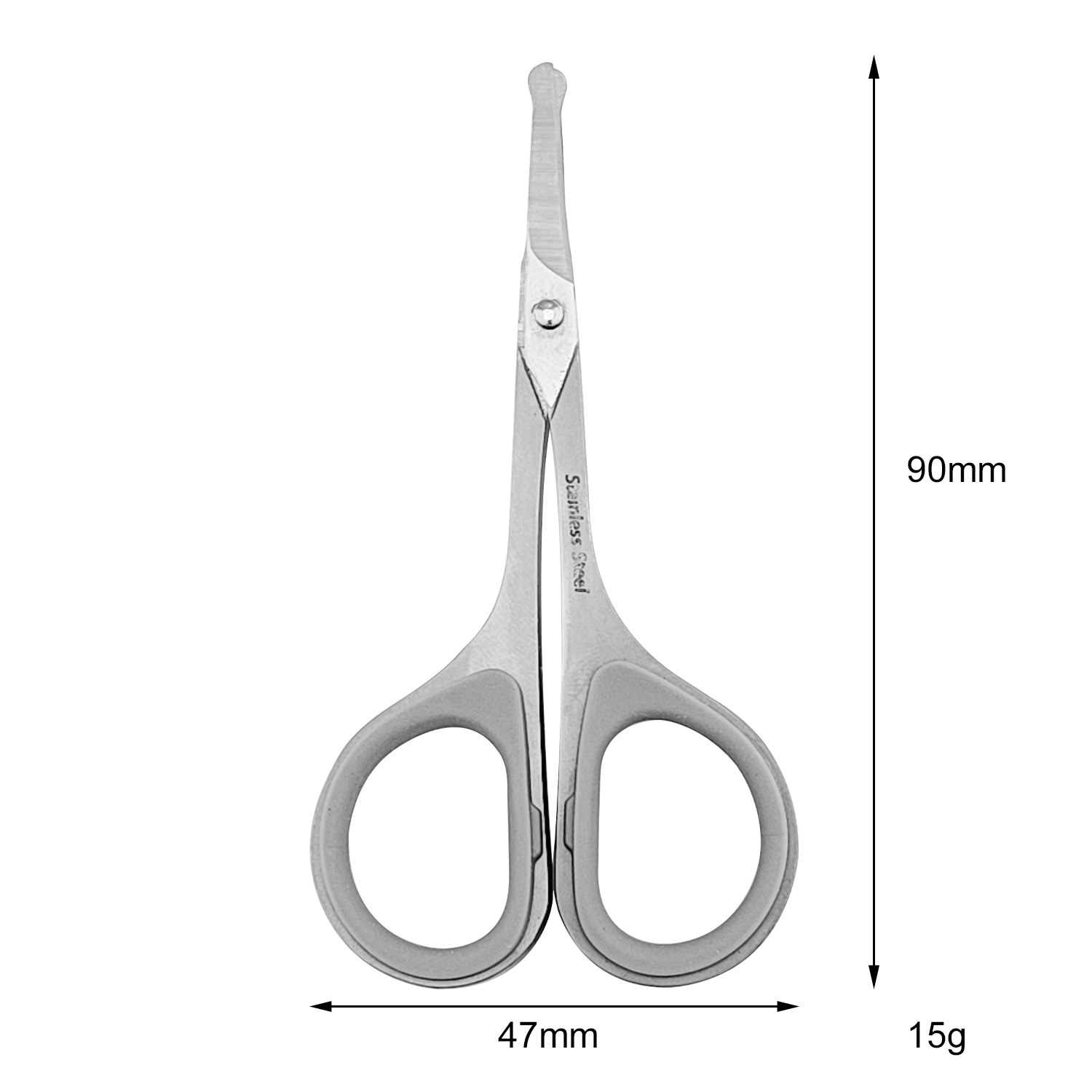
| SCB3060 | Stainless steel | 4.7 × 9 cm | 15 g | Compact rounded-tip option with finger-loop inserts |
| SCH4003 | Stainless steel | 10.5 × 5.5 cm | 22 g | Longer grooming format for comparison |
| SCB3012 | Stainless steel | 11.2 × 5.2 cm | 24 g | Alternative handle and length evaluation |
| SCB3049 | Stainless steel | 11.2 × 5.2 cm | 24 g | A further product platform for sample comparison |
These numbers do not tell a buyer which model will feel best. They narrow the sample set. Handle comfort, tip profile, blade action, finish, packaging footprint, and target price still need physical evaluation. When two products list similar dimensions, inspect whether the extra mass is located in the handles, blades, pivot, or inserts. Balance can matter more than the number alone.
Who Buys Nose Hair Scissors, and What Changes by Channel?
Men's grooming and personal-care brands
These buyers often build a coordinated range around nail clippers, tweezers, grooming scissors, and travel cases. They may prioritize a consistent finish, brand color, masculine or neutral packaging, and a clear product hierarchy. A nose scissor can be sold alone or included in a multi-tool kit, but the kit creates extra checks: every cavity must fit, every tool finish must coordinate, and the carton must contain the correct assortment.
Beauty retailers, pharmacies, and supermarkets
Retail buyers tend to emphasize visible product function, dependable packaging, barcodes, label language, hanging performance, and consistent replenishment. The scissor needs to arrive clean and restrained so the blades and finish are not damaged in transport. The package copy should be understandable without oversized promises.
Ecommerce sellers
Online shoppers cannot handle a sample before purchase. Product photography, dimensions, included components, material wording, and the description of the rounded tip must match the supplied item. Variation between listing images and production can produce avoidable returns. Ecommerce buyers should review the photography sample together with the functional sample, rather than finishing the listing before the production specification is stable.
Travel, gift, and hospitality programs
These programs may value compact size and presentation, but packing density cannot come at the expense of tool restraint. A metal scissor moving inside a case can scratch neighboring tools, damage printed inserts, or arrive out of position. The package engineer should consider the entire distribution path, not just the open-box appearance.
OEM Nose Hair Scissors: What Can Be Customized?
An OEM nose hair scissors project normally begins with an existing platform. The buyer then chooses which elements create meaningful differentiation without destabilizing function. The available choices depend on the selected model and production method, so the list below is a discussion framework rather than a promise that every option applies to every item.
For OEM nose hair scissors, freeze the functional platform before approving decorative changes. A new finish, insert, logo position, or case can affect handling, inspection, package fit, and timing even when the blade outline remains unchanged.
- Logo: possible branding area, method, size, position, contrast, and durability.
- Finish: polished, matte, or another confirmed surface direction.
- Finger-loop inserts: color, material, fit, and color tolerance where the model uses inserts.
- Packaging: card, box, pouch, sleeve, tray, travel case, instruction insert, or kit arrangement.
- Assortment: standalone scissor or coordinated set with compatible grooming tools.
- Label content: product name, material statement, origin, barcode, warnings, instructions, and target-market language.
A change that appears decorative can affect production. A dark surface may require a different logo method for legibility. A thicker insert can change how the package closes. A new case can press against the finger loops or rounded tip. Approve the fully assembled, branded, packaged sample, not only the bare tool.
Build a Sample Approval Plan That Can Survive Mass Production
A useful sample approval process is deliberately repetitive. The buyer should not fall in love with one hand-selected sample. Request enough pieces to compare variation, and identify whether samples came from normal production processes or were specially prepared. If the order is intended for a kit, evaluate the complete kit. If retail packaging matters, test the retail package.
- Identity check: verify item number, revision, material statement, dimensions, weight range, finish, and included parts.
- Visual check: examine the tip, blades, pivot area, handles, logo, surface, and cleanliness under consistent light.
- Operating check: open and close the scissors slowly, feeling for uneven resistance, scraping, excessive looseness, or a sudden stop.
- Cutting check: use the agreed test material and method at defined areas of the blade.
- Packaging check: confirm restraint, protection, print position, label accuracy, barcode, instructions, and carton configuration.
- Record approval: photograph the approved sample, sign or seal it where appropriate, and attach the final specification and artwork revision.
Keep ambiguous adjectives out of the acceptance record. “Smooth,” “premium,” and “high quality” need a reference. A sealed sample, acceptable defect examples, measurement method, and test procedure create a better shared language.
Bulk Quality Control: Inspect the Failure Modes Users Actually Notice
A production inspection should cover identity, workmanship, function, package, and quantity. The inspection level and sampling plan should be agreed for the order; this article does not prescribe a universal AQL or pass/fail number. The key is to define defects before the inspector opens cartons.
| Defect area | Examples to control | Why it matters |
|---|---|---|
| Rounded tip | Burr, sharp corner, asymmetry, rough polish | Directly affects perceived safety and finish |
| Blade relationship | Gap, twist, inconsistent contact, chipped edge | Can cause folding, pulling, or inconsistent cutting |
| Pivot | Excessive play, stiffness, uneven motion | Controls operating feel and alignment |
| Handles | Sharp edge, cracked insert, loose insert, deformation | Affects comfort, control, and appearance |
| Surface | Scratch, stain, residue, inconsistent finish, incorrect logo | Influences shelf impression and brand consistency |
| Package | Wrong copy, movement, damaged card, missing sleeve, mixed SKU | Creates returns, compliance risk, and retail disruption |
Inspect cartons from different positions in the shipment where practical. Compare more than one production carton. Confirm the inner and master carton markings, quantity, protection, and moisture exposure plan. A perfect top carton cannot represent the entire lot.
Packaging Is Part of the Product, Not the Last Graphic Task
The rounded tip reduces one obvious point hazard, but the cutting edges still require thoughtful restraint. The tool should not move enough to scratch itself, damage the print, or cut through a weak internal component. If the package exposes the scissor, the retail design should prevent casual contact with the working area while still presenting the product accurately.
For kits, check the closing path of the case. A scissor placed near a zipper, snap, magnet, or hinge can shift during distribution. Tool cavities should match the final production tool, including inserts and finish. Do a transport simulation suitable for the project, then recheck the blade relationship and appearance. Package testing must represent the final pack, not an empty box.
Artwork control deserves the same discipline as product control. Maintain one approved file revision. Verify product name, item number, barcode, country-of-origin wording, material description, instructions, warning text, importer details where applicable, and translations. The supplier can help coordinate production, but the brand owner should obtain appropriate target-market compliance review.
What Determines Cost, MOQ, and Lead Time?
There is no responsible single price for “custom nose hair scissors” without a product and packaging brief. Cost can move with the platform, dimensions, construction, material requirement, finish, inserts, logo method, packaging, inspection, quantity, and whether new tooling or structural development is involved. An existing model with a standard finish and custom printed card is a different project from a new handle, custom joint, special finish, molded travel case, and market-specific test program.
MOQ may be constrained by the tool, the surface process, the insert color, the printed package, or a combination. One component can set a higher practical minimum than the base scissor. Ask the supplier to separate these constraints. A buyer may be able to use a standard tool color while customizing the package, or combine markets under one tool platform with different language labels, subject to production and compliance confirmation.
Lead time should be discussed as a sequence: requirement review, sample preparation, buyer feedback, artwork approval, component procurement, production, inspection, and shipment readiness. Revisions restart parts of that clock. Provide final artwork and consolidate feedback to reduce avoidable delay. Do not publish a fixed delivery promise until the supplier confirms the exact order and current production plan.
How to Evaluate a Nose Hair Scissors Supplier
A polished sample is necessary, but supplier evaluation should go further. Ask how the factory controls blade forming, grinding, pivot assembly, surface finish, cleaning, and packaging for the selected product. Request the inspection points that apply to the model. Look for clear answers about revision control and nonconforming product, not just a long equipment list.
A capable nose hair scissors supplier should be willing to distinguish confirmed facts from options still under review. That is more valuable than answering every question with “yes.” If a material grade, finish, logo method, test, or packaging claim is not yet confirmed, record it as open. Good project communication makes uncertainty visible early enough to resolve it.
When a second nose hair scissors supplier is being considered, send both companies the same revision-controlled brief and ask them to mark every exception. A comparison based on shared assumptions is more useful than comparing prices built around different products.
For repeat orders, ask how the approved sample and artwork are retained. Confirm how substitutions or process changes will be communicated. The commercial relationship becomes more reliable when both sides agree what must remain unchanged and what can vary within a defined tolerance.
A Practical RFQ Template
A useful inquiry gives the manufacturer enough context to recommend a platform and identify open questions. Include:
- Target country or region and sales channel.
- Intended user and whether the product is standalone or part of a kit.
- Reference model, photograph, drawing, or OLIMOR item number.
- Estimated order quantity and expected repeat-order pattern.
- Preferred dimensions, handle style, tip direction, material, and finish.
- Logo artwork, desired branding location, and packaging concept.
- Required labels, languages, barcode format, warnings, and instructions.
- Sample quantity and functional checks that matter to your team.
- Target date, destination, and any third-party inspection plan.
- Claims or certification documents that must be reviewed before order confirmation.
Instead of writing “Please send your best price,” send a brief that allows comparable quotations. If two suppliers quote different assumptions, the cheaper figure is not necessarily the cheaper product.
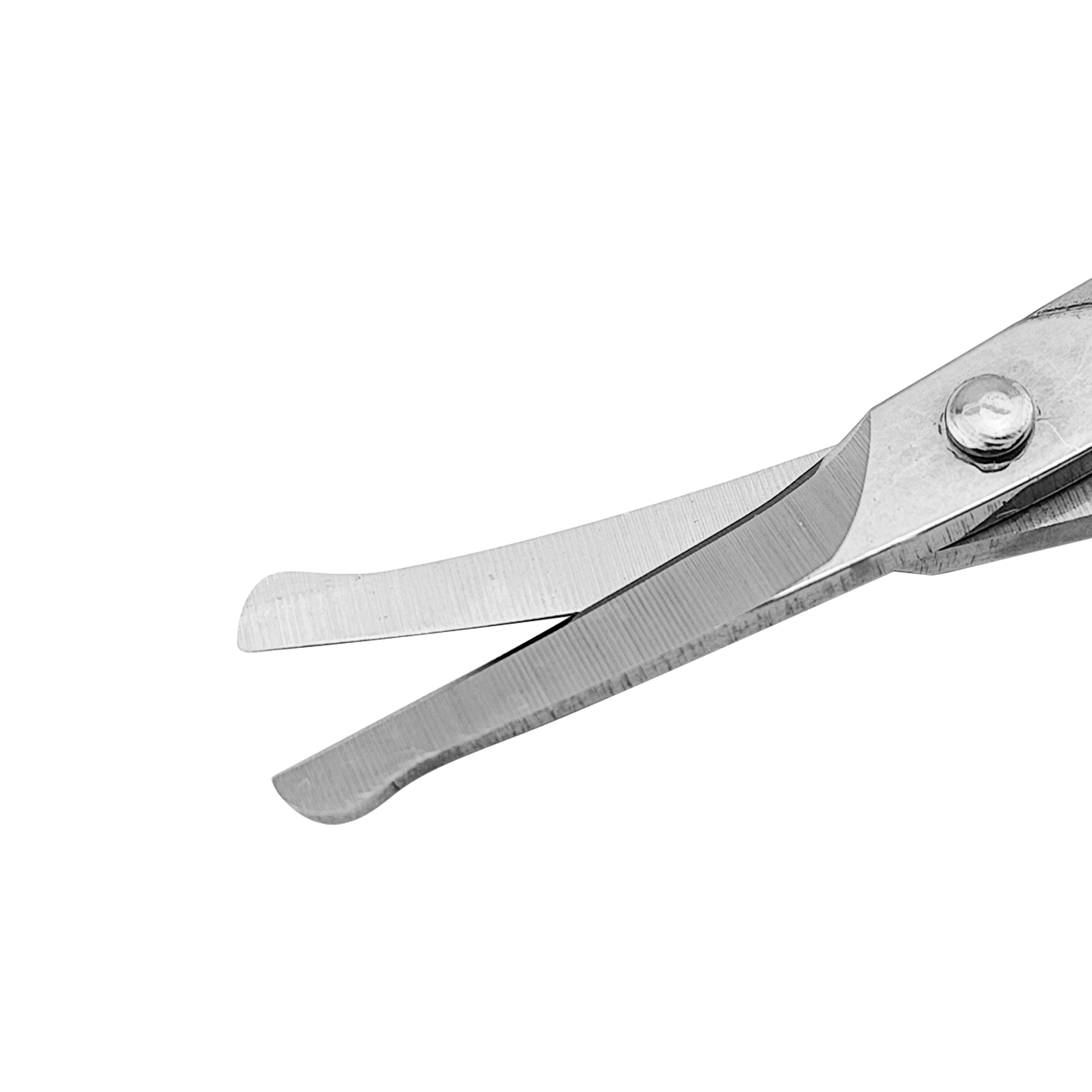
Before ordering OEM nose hair scissors, ask for a final packed sample that represents the intended logo, finish, inserts, instructions, and retail presentation. Approving only the bare metal tool leaves too many commercial details open.
How OLIMOR Supports a Nose Hair Scissors Project
OLIMOR offers beauty scissors and other personal-care tool categories that can support a standalone item or a coordinated grooming range. Buyers can begin with the Beauty Scissor collection, review specific nose-scissor product pages, and compare the published platforms before requesting samples.
Depending on the selected model and confirmed project scope, the discussion may include product selection, logo placement, finish direction, packaging, assortment planning, sample approval, and production inspection. Exact material details, available customization, MOQ, pricing, and timing should be confirmed for the chosen item and order rather than copied from a general article.
A practical first message to the nose hair scissors manufacturer should identify the sales channel, destination market, estimated quantity, shortlisted model, packaging format, and required launch window. That allows technical and commercial questions to be handled together.
OLIMOR also supplies other beauty and personal-care tools, which may help buyers build a consistent retail or travel collection. Learn more about OLIMOR, or send a project brief through the contact page.
Frequently Asked Questions
What should I check first when choosing nose hair scissors?
Check whether the model is genuinely designed for the intended grooming use. Review the rounded tip from several angles, blade alignment, pivot resistance, handle comfort, cutting performance on an agreed test material, surface finish, cleanliness, and package restraint. Approve multiple samples rather than relying on one display piece.
Are all rounded-tip grooming scissors the same?
No. Products can differ in overall length, blade length, tip profile, finger-loop size, inserts, pivot feel, balance, finish, and packaging footprint. Two models with similar published dimensions may feel different in the hand, so physical comparison is important.
Can a logo be added to stainless steel nose scissors?
Branding may be possible on the product, packaging, or both, depending on the selected model, available surface, finish, logo size, and production method. Confirm the method and approve a branded sample. Check contrast, position, resistance to normal handling, and consistency across several pieces.
Can nose hair scissors be included in a private-label grooming kit?
They can potentially be combined with nail clippers, tweezers, files, and compatible grooming tools. The complete set needs a separate approval because tool cavities, finish consistency, movement in transit, package copy, and assortment accuracy create risks that do not exist with a single item.
What information is needed for an accurate quotation?
Provide a reference product or item number, target market, channel, quantity, dimensions, finish, logo artwork, packaging concept, kit composition if applicable, sample needs, quality requirements, destination, and target timing. The supplier can then identify which elements are confirmed and which require development.
How should bulk nose hair scissors be inspected?
Use an agreed sampling plan and check identity, dimensions, tip finish, blade relationship, pivot movement, functional cutting, handle condition, surface appearance, logo, cleanliness, package accuracy, carton markings, and quantity. The signed sample and final specification should be available to the inspector.
Final Buyer Checklist
- Define the user, channel, and packaging format before choosing a model.
- Approve rounded-tip geometry, blade action, pivot feel, and handle comfort on physical samples.
- Confirm what the stainless steel statement covers and document any grade or test requirement.
- Review the final branded and packaged sample, not only the bare scissors.
- Write objective inspection checks and retain a signed reference sample.
- Separate confirmed options from open questions in the quotation.
- Inspect multiple pieces and cartons before shipment.
- Avoid absolute safety, corrosion, or quality claims without supporting evidence.
Selecting a nose hair scissors manufacturer is ultimately an exercise in controlling small details. The rounded end has to be smooth, the blades have to work together, the joint has to stay stable, and the package has to protect the approved product. When those points are written into the brief and checked on real samples, buyers can compare suppliers on evidence rather than adjectives.
A nose hair scissors supplier can quote more accurately when the requested model, test method, finish, packaging, and acceptable variation are already clear. For OEM nose hair scissors, that same clarity also protects the brand's approved appearance when an order is repeated.
Planning a new grooming item or private-label set? Review OLIMOR's nose hair and beauty scissor options, then send your target market, quantity, preferred model, finish, logo, packaging concept, and sample requirements. That information gives the OLIMOR team a practical basis for a model-specific discussion.
A final discussion with the nose hair scissors manufacturer should close every open point in the sample record, quotation, artwork, and inspection plan before bulk production begins.