
Eyelash Curler Trends: Ergonomic Features Buyers Can Test
Eyelash curler trends are useful only when buyers test frame curvature, handle leverage, pad contact, finish durability, packaging and user-specific fit.
Define the buyer decision
feature testing, fit evidence and design-to-production decisions. Start with an approved reference and observable acceptance criteria. A catalog photograph can introduce eyelash curler trends for feature testing, fit evidence and design-to-production decisions, but the finished sample should decide whether this program fits the intended user and channel.
Procurement checks before the RFQ
Turn each feature into a sample question covering user fit, dimensions, pad replacement, finish, packaging and target quantity. For feature testing, fit evidence and design-to-production decisions, normalize quantity, packaging, inspection scope and delivery assumptions so quotations can be compared on the same basis. During feature testing, fit evidence and design-to-production decisions, record open questions rather than converting an unverified supplier statement into a product claim.
Manufacturing and sample approval
Confirm frame forming, hinge fit, handle assembly, pad production or insertion, finish inspection and final movement checks. Keep the approved sample, revision, artwork, material evidence and inspection result together for feature testing, fit evidence and design-to-production decisions. For feature testing, fit evidence and design-to-production decisions, any change to a working interface, finish, pack-out or component list should trigger a documented review before production release.
Why Ergonomic Eyelash Curlers Are Gaining Attention
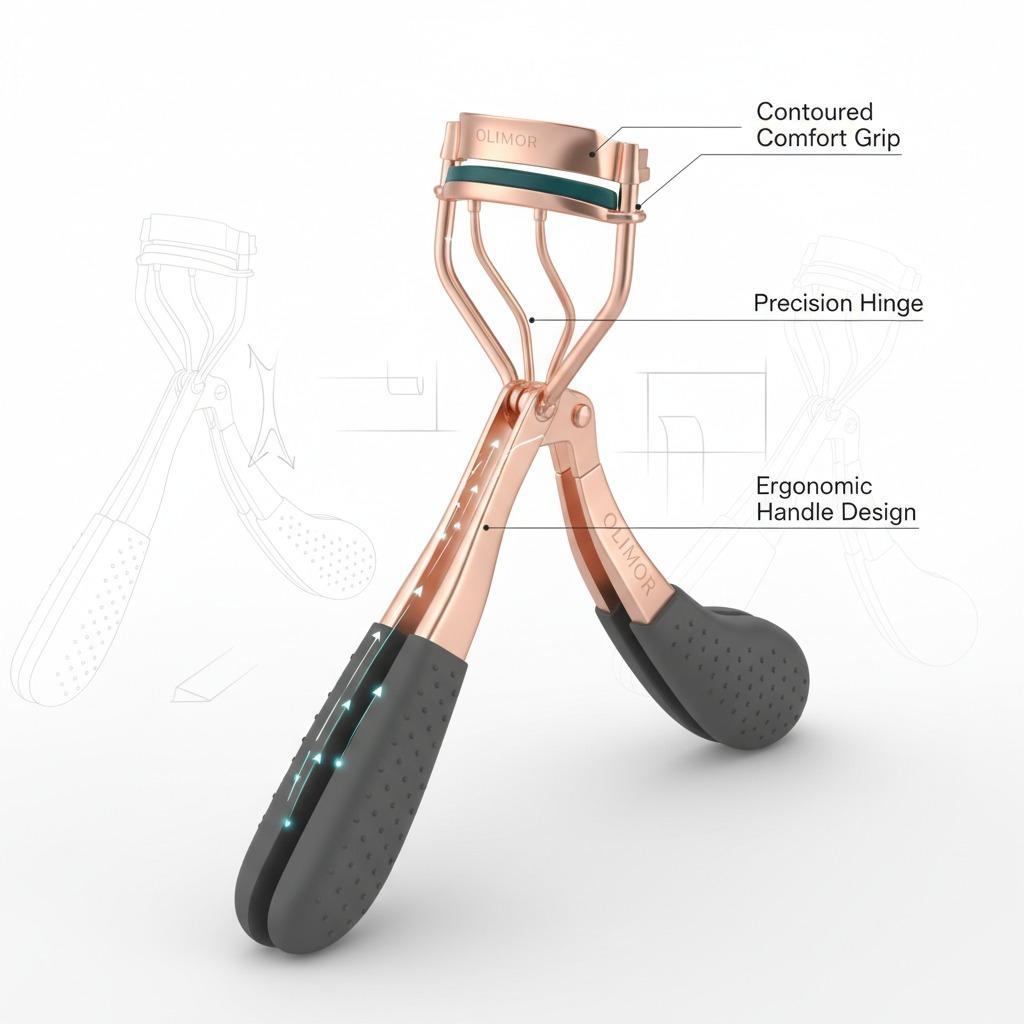
Ergonomic handle design is one of the clearest trends in eyelash curlers because it directly affects the user experience. A curler may look attractive in product photos, but if the handle is awkward, narrow, slippery, or difficult to squeeze evenly, the customer will notice immediately. Poor control can lead to uneven curling, over-pressing, or discomfort near the eyelid.
A well-designed handle should allow the user to position the curler close to the lash root without forcing the wrist into an uncomfortable angle. The finger loops or grip area should feel stable enough for light, gradual pressure rather than a hard squeeze. For makeup beginners, this helps reduce fear of pinching. For experienced users, it helps achieve a cleaner lift in fewer attempts.
When comparing ergonomic eyelash curler designs, look beyond the general claim of comfort. Useful questions include: Is the grip easy to hold with dry or slightly moisturized hands? Does the handle open and close smoothly? Can the user control pressure in small increments? Does the shape suit both personal and professional use? These details influence returns, reviews, and repeat purchases.
Key Features Buyers Should Compare
Modern eyelash curler features tend to focus on comfort, lash protection, and curl consistency. Some trends, such as heated elements and adjustable tensions, appear across the market, but they should be evaluated carefully against the intended customer and sales channel. A professional makeup artist may value adjustability, while a daily consumer may prefer a simpler tool that is easy to clean and replace pads on.
The following checklist can help buyers compare eyelash curlers in a structured way:
- Handle comfort: The tool should be easy to hold, squeeze, and release without hand strain.
- Frame alignment: The upper frame and pad should meet evenly so the curl is consistent across the lash line.
- Pad material: Silicone pads are widely used because they provide a cushioned contact surface for lashes.
- Pad fit and replacement: Replacement pads should sit securely in the channel and be simple for the user to change.
- Tension feel: The spring or hinge action should allow controlled pressure, not a sudden clamp.
- Edge smoothness: Contact areas should feel clean and safe, without rough edges near the eye.
- Packaging suitability: Retail packaging, storage protection, and instruction space should match the sales channel.
These criteria are more useful than relying only on broad claims such as “professional quality.” A good eyelash curler earns trust through consistent mechanics, comfortable handling, and a pad design that supports safe, repeatable use.
Silicone Pads, Lash Protection, and Curl Shape
The pad is a small component, but it has an outsized effect on the final curl. Silicone pads are popular because they cushion the lashes during pressing and help reduce harsh creasing when the user applies moderate pressure. A pad that is too hard may create a sharp bend, while a pad that is too soft may not give enough lift or may wear quickly.
Buyers should pay attention to how the pad sits in the curler. If it shifts during use, the customer may experience uneven pressure. If it is difficult to remove, the user may delay replacement, which affects hygiene and performance. Replacement pad availability can also be important for retail customers who want a longer product life.
Curl shape also depends on the curve of the frame. A flatter frame may suit some eye shapes, while a more curved frame may reach others more naturally. There is no single universal shape that fits every user perfectly, so product positioning matters. If the target customer is a broad retail audience, choose a balanced design that is easy to approach. If the product is for a specialized collection, the frame curve and opening width may be more targeted.
Material and Manufacturing Details That Matter
Stainless steel remains a common choice for eyelash curlers because it supports a stable frame and a clean appearance. However, material choice is only part of the decision. Buyers should also consider how the tool is finished, assembled, inspected, and packed. A curler with a strong-looking frame can still perform poorly if the hinge is loose, the pad channel is uneven, or the handle movement feels inconsistent.
For sourcing teams, a practical review should include sample handling, repeated open-close testing, surface inspection, pad fit checks, and packaging drop or transport considerations where appropriate. These checks do not require exaggerated claims; they simply help identify whether a product is ready for everyday use and retail presentation.
Olimor Beauty’s work in beauty tools includes attention to quality assurance steps from raw material selection to final packaging. For buyers comparing beauty tool products, that type of process focus is important because eyelash curlers are used close to the eye. Consistency, clean finishing, and stable assembly should be treated as core requirements, not optional extras.
How to Match an Eyelash Curler to Your Audience
The best eyelash curler for one channel may not be the best for another. Before choosing a design, define who will use it and how it will be sold. A makeup beginner may want a simple stainless steel curler with a soft silicone pad and clear instructions. A beauty retailer may want a visually clean product that photographs well and fits standard shelf displays. A salon or makeup artist may place more emphasis on smooth tension, reliable replacement pads, and easy cleaning between uses.
Use the table below to connect buyer priorities with product decisions:
| Audience | Important Priorities | Feature Focus |
|---|---|---|
| Daily makeup users | Comfort, ease of use, lash protection | Ergonomic handle, silicone pad, smooth squeeze |
| Retail beauty brands | Consistent quality, attractive presentation | Clean finish, stable frame, suitable packaging |
| Salons and makeup artists | Control, repeatability, easy maintenance | Precise alignment, reliable tension, replaceable pads |
| Gift or travel ranges | Compact appeal, safe storage | Protective packaging and clear usage guidance |
This approach keeps sourcing decisions connected to real user needs. It also helps prevent overcomplicating the product. Heated elements or adjustable tension may be useful in some markets, but they are not automatically the right choice for every audience.
Use, Cleaning, and Maintenance Guidance Customers Appreciate
An eyelash curler performs best when customers understand how to use and maintain it. Clear instructions reduce misuse and improve satisfaction. Users should curl clean lashes before applying mascara, position the pad near the lash base without touching the eyelid, and apply gentle pressure in short pulses rather than one hard clamp. For a softer curve, they can move slightly outward along the lashes and press again lightly.
Maintenance is equally important. Makeup residue, skin oil, and mascara can collect on the pad and frame. Customers should wipe the pad and metal surfaces regularly with a suitable cosmetic tool cleaner or a gentle cleaning method recommended for the product. Pads should be replaced when they become worn, cracked, flattened, or loose. A damaged pad can reduce curl quality and may increase the risk of pulling lashes.
For brands and retailers, including these instructions on packaging or inserts can reduce customer confusion. It also supports a more responsible product experience, especially because eyelash curlers are used near a sensitive area.
Choosing Olimor Beauty for Eyelash Curler Sourcing
When reviewing eyelash curler trends, the strongest direction is clear: users want tools that feel safe, controlled, and comfortable, while buyers need products that can be inspected, packaged, and presented consistently. Ergonomic handles, silicone pads, stainless steel construction, smooth tension, and thoughtful quality checks all contribute to a better final product.
Olimor Beauty supports buyers looking for practical beauty tool solutions without unnecessary overstatement. If you are comparing designs, planning a private product range, or reviewing beauty tool categories, explore Olimor’s product collections or send an inquiry with your sourcing needs. A clear brief that includes target users, preferred handle style, packaging expectations, and pad requirements will make eyelash curler selection more focused and efficient.
Buyer FAQ
Which feature should be tested first?
Start with frame and pad contact for the intended user, then evaluate handle control and finish.
Can an ergonomic handle compensate for poor curvature?
No. Handle comfort cannot correct a frame that does not approach the target lash line evenly.
What should a buyer save for a reorder?
Keep the tested sample, dimensions, pad reference, finish, artwork and acceptance record together.
Does a trend prove a curler is better?
No. A trend is a design direction; buyers still need fit, control and finished-sample evidence.
Why test the pad separately?
Pad material, contact and retention affect the working result and should be checked over representative use.
What should an ergonomic claim name?
State the intended user and observable geometry or handling benefit instead of promising universal comfort.
Material Changes: Pads, Handles and Surface Finishing
The most visible evolution in eyelash curlers is the frame, but the pad is one of the most important performance components. Modern curlers commonly use silicone-style pads rather than very hard rubber-like cushions. A suitable pad helps reduce harsh creasing and makes the pressure feel smoother. Pads are also a wear part: over time, they can flatten, split, or collect cosmetic residue, which affects both hygiene and curl quality.
Surface finishing has also improved the category. Rounded edges, polished contact areas, and smoother hinge movement can reduce the risk of uncomfortable pulling. Handles have changed too. Some curlers use scissor-style finger loops, while others use broader grips or spring-assisted structures. Each format has a different feel, so the right choice depends on the target customer.
- Frame alignment: The upper bar and lower pad should meet evenly from end to end.
- Pad resilience: The pad should compress smoothly and return to shape after use.
- Eye curve: The curvature should suit the intended market, whether the design is more rounded, flatter, or general-purpose.
- Edge finishing: Areas near the lash line should feel smooth, with no rough burrs.
- Handle control: The user should be able to apply gradual pressure, not only a hard squeeze.
- Replacement plan: If pads are replaceable, confirm how replacements will be supplied or packaged.
How to Choose an Eyelash Curler for Retail, Salon or Private-Label Use
Choosing an eyelash curler for a product line is different from choosing one for personal use. A personal buyer may only need a tool that fits their own eye shape. A retail buyer needs a product that performs well for many customers and generates fewer complaints. A salon buyer may care more about control, cleanability, and repeat use. A private-label buyer also needs packaging space for instructions, warnings, and brand presentation.
The following comparison can help clarify what to evaluate before placing an eyelash curler into an assortment:
| Buying focus | What to check | Why it matters |
|---|---|---|
| Daily consumer use | Comfortable curve, smooth squeeze, soft pad | Reduces pinching and helps beginners use the tool correctly |
| Salon or makeup kit | Durable frame, easy cleaning, consistent hinge movement | Supports frequent handling and repeatable results |
| Retail packaging | Clear usage instructions and visible pad information | Helps customers understand value before purchase |
| Eco-conscious positioning | Minimal packaging, long tool life, replacement pad plan | Makes sustainability claims more practical and credible |
| Private-label sourcing | Sample review, finish consistency, packaging compatibility | Protects brand presentation and customer experience |
When reviewing samples, test more than one unit. Open and close each curler several times, check whether the pad stays seated, and inspect the contact line under light. If the curler feels different from unit to unit, the issue may not be the design concept but the consistency of assembly and finishing.
Prepare the eyelash curler trends sourcing brief
For this feature testing, fit evidence and design-to-production decisions program, document the intended user, channel, function, finish, packaging and inspection priorities. In a feature testing, fit evidence and design-to-production decisions brief, compare the relevant eyelash curler collection, review adjacent lash and brow tools, and use request curler samples to request a sample and quotation.
Tag: