

Why a retail beauty tools supplier needs the right nail cutter in the mix
If you sell into salons, cosmetic shops, or private-label beauty channels, the small tools often decide whether a customer comes back. A retail beauty tools supplier may focus on brushes, tweezers, and files, but a dedicated false nail clipper can quietly become one of the most useful items in the range. It solves a very specific problem: trimming acrylic nails, nail extensions, and other artificial enhancements without the rough finish or splitting that comes from using the wrong tool.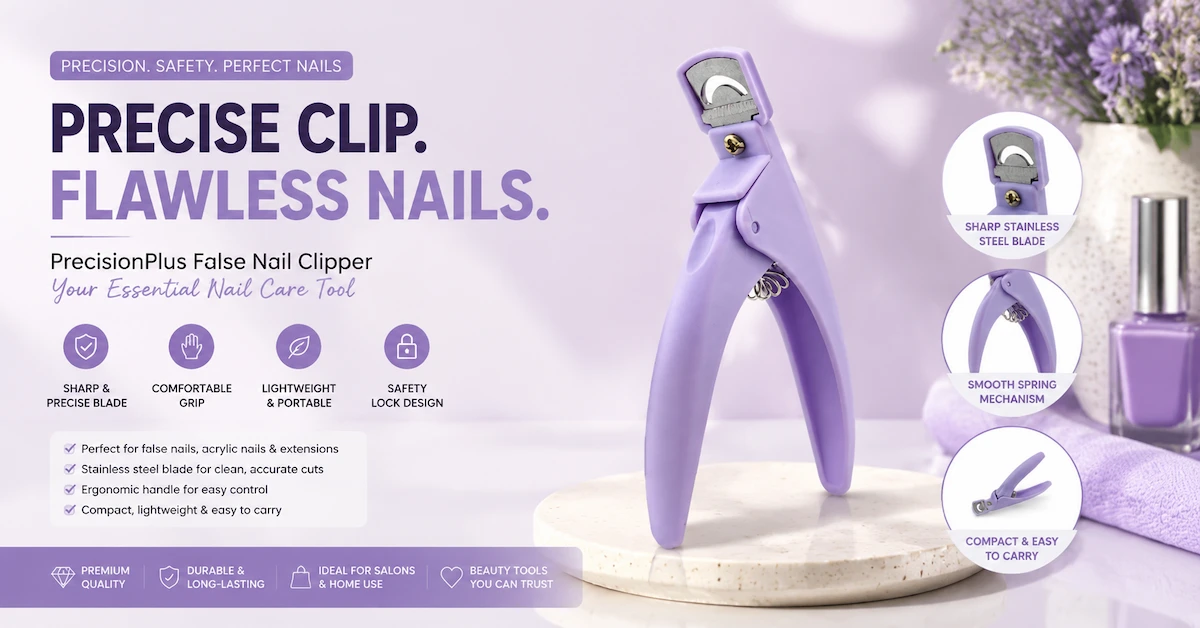
That matters because buyers in this category are not just looking for “another manicure item.” They are choosing tools that reduce service time, protect the finished look, and feel reliable in the hand. For a professional beauty tools supplier, the question is less about novelty and more about whether the tool fits real salon workflows, home manicure kits, and retail shelves where the product has to explain itself quickly.
What this type of false nail clipper is designed to do
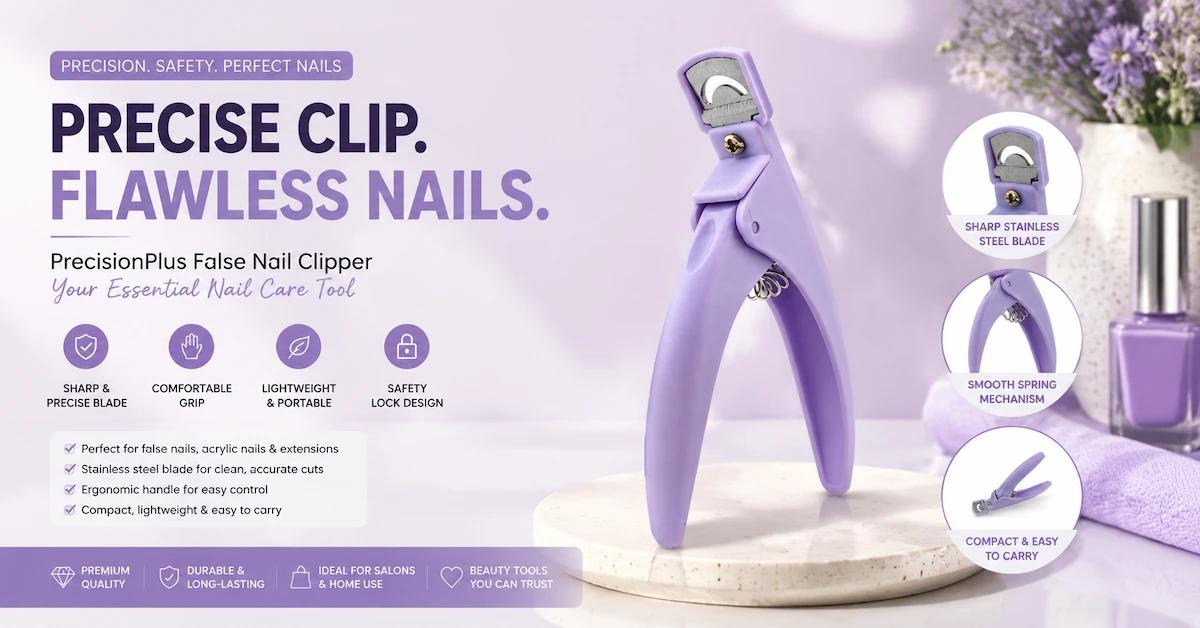
This is a plier-style manicure tool with a short cutting head, long curved handles, a visible spring mechanism, and a safety lock. It is designed for false nails, acrylic nails, and nail extensions rather than general household cutting. That distinction is important. Artificial nail materials behave differently from natural nails, and a cutter built for them needs controlled action, a stable blade, and enough leverage to take small sections cleanly.
The visible stainless steel blade is one of the main selling points. Stainless steel is widely used in beauty tools because it offers a practical balance of durability, corrosion resistance, and easy cleaning. The purple handle body appears to be plastic-coated or painted, with a smooth matte-like finish that should feel less slippery than bare metal. From a buyer’s perspective, that combination gives the product a retail-friendly look while still keeping the cutting end functional and serious enough for salon use.
Key takeaways for buyers
The tool is compact, portable, and clearly positioned for manicure use.
It is meant for artificial nail work, not as a generic all-purpose cutter.
The safety lock adds a useful storage and handling feature for kits and retail packaging.
The ergonomic grip and spring action suggest easier repeated use, which matters in busy nail rooms.
Why the wrong tool creates avoidable problems
Anyone who has handled acrylic nails knows the common failure modes. A weak cutter can crush the edge instead of slicing it. A tool with poor leverage can force the user to apply too much pressure, making the job awkward and sometimes unsafe. And a generic clipper can leave jagged edges that then need extra filing, which slows service and eats into margin in a salon setting.
For retailers, this becomes a product education issue. Customers may assume all nail cutters are interchangeable. They are not. A false nail clipper is a dedicated tool, and that specificity helps prevent disappointment after purchase. In practice, a clean cut on an extension is often the difference between a neat finish and a repair job that takes ten extra minutes. That may sound small, but in a high-throughput nail business, those minutes add up quickly.
How to evaluate a beauty tools wholesale purchase
When sourcing beauty tools wholesale, buyers tend to focus on three things: usability, appearance, and packaging story. This product can support all three if it is presented well.
First, the cutting head and blade material need to inspire confidence. The stainless steel blade is a practical baseline, especially for a hand tool expected to be used repeatedly.
Second, the handle and grip matter more than many importers expect. The curved handles and ergonomic form help the user keep control during the cut. The smooth spring action also reduces the sense of strain, which is important for professional users making multiple cuts in a single service.
Third, the safety lock is not just a small convenience. It helps with storage, prevents accidental opening in a kit, and makes the tool easier to merchandize in a retail environment where compact, tidy presentation sells.
A cautious note here: buyers should always confirm how the blade geometry behaves on the materials they care about most. A tool advertised for artificial nails may still vary in performance depending on thickness and formulation of the enhancement. That is not a defect; it is simply how hand tools work in the real world.
What salons and resellers should look for in the product story
The strongest retail story is straightforward. This is a manicure tool for false nails, acrylic nails, and extensions. It uses a stainless steel cutting blade, has a compact plier-style body, and includes a spring and safety lock for convenience. That tells the end user what problem it solves.
For salon buyers, the practical benefit is speed and control. For cosmetic retail buyers, it is a clearly defined tool that fits into manicure kits and add-on sales. For resellers, especially those serving mixed beauty accounts, a focused product like this is easier to explain than a vague multi-use cutter. It does one job, and that is usually a plus.
The purple finish also matters more than it may seem. Beauty tools are not judged on performance alone; they are judged on shelf appeal. A neat colorway, compact shape, and clean metal-to-body contrast can make the difference between something that looks generic and something that looks like it belongs in a curated nail-care assortment.
Common mistakes when choosing nail cutting tools
One of the most common mistakes is buying a cutter that looks sharp but is not designed for artificial material. On paper, many small tools appear similar. In use, they are not.
Another mistake is ignoring handle comfort. A tool that works in a quick sample may feel tiring after repeated use. In salons, fatigue changes user behavior. The technician slows down, presses harder, or switches tools halfway through the job. None of those outcomes is ideal.
A third mistake is overlooking storage behavior. Tools without a lock can open in a drawer or travel kit, which is annoying at best and unsafe at worst. For beauty tools wholesale customers building kits or bundles, small details like this are not cosmetic; they are part of the product’s usefulness.
Where this product fits in a broader retail assortment
A retail beauty tools supplier usually builds around categories, not single items. This false nail clipper fits naturally beside nail files, buffers, cuticle tools, and manicure scissors. It can be sold on its own, but it also works well as a bundle item in nail kits for home users or as a back-bar tool for salons.
It may also appeal to beauty tool resellers who want a clearer split between general grooming items and specialist nail products. That separation helps with merchandising and reduces confusion. Customers shopping for acrylic nail maintenance expect a different toolset than someone buying basic fingernail care products.
Buyer-facing practical advice
If you are sourcing for retail, ask for clear product photography that shows the blade, spring, and lock mechanism.
If you are supplying salons, pay attention to how the tool feels in repeated use rather than only how it looks on arrival.
If you are building a kit, make sure the product label makes the artificial-nail use case obvious.
FAQ buyers usually ask
Is this tool for natural nails?
The available product details position it for false nails, acrylic nails, and extensions. It should not be assumed to be a general natural-nail cutter unless the supplier confirms that use case.
Is stainless steel important here?
Yes, because it supports durability and practical cleaning in a professional beauty setting. It is not the only factor, but it is a meaningful one.
Does the safety lock matter for retail?
It does. It helps with storage, transport, and the overall impression of a well-finished tool.
Who is the best buyer for this product?
Nail salons, home manicure customers, cosmetic retail stores, manicure kit assemblers, and beauty tool resellers all have a plausible use for it.
What a good sourcing decision looks like
The best sourcing choice is usually the one that matches the product’s real job. In this case, that job is controlled trimming of artificial nails. The product’s plier-style body, stainless steel blade, ergonomic grip, spring action, and safety lock all support that role. It is not trying to be everything at once, which is actually a strength.
For a buyer comparing options, the decision comes down to whether the tool is being sold as a specialized nail accessory or just another small metal item in a crowded catalog. The first framing usually performs better. It gives your sales team a cleaner story and gives end users a clearer reason to buy.
If you are evaluating a retail beauty tools supplier for this category, ask for product visuals, material confirmation, and clear use-case positioning. Those three things will tell you more than a long generic specification sheet. And if the supplier can support beauty tools wholesale programs with consistent presentation across nail-care SKUs, the product becomes easier to place, easier to explain, and easier to reorder.
Next step
For sourcing teams, the practical move is simple: compare a few samples side by side, test them on artificial nail materials, and look closely at cutting control, hand feel, and lock reliability. That is usually where the real differences show up. If you are building a manicure assortment, this is the kind of small tool that can strengthen the whole range when it is chosen with purpose rather than as an afterthought.
Tag:
Related articles
- Retail & Wholesale Solutions
- Beauty Tools Buying Guide
Beauty Tools Factory China Product Comparison: Nail Clippers, Tweezers and Eyelash Curlers
- Retail & Wholesale Solutions
- Beauty Tools Buying Guide
How to Evaluate a Beauty Tools Factory China for Private Label Brands
- Beauty Tools Manufacturing
- Retail & Wholesale Solutions