Nail Clipper Material Guide: How to Choose Durable Clippers

A nail clipper looks simple, but its material determines how cleanly it cuts, how long the edge stays usable, how easy it is to clean, and whether the tool feels reliable in daily grooming. For retailers, salons, travel kit suppliers, and personal care brands, choosing the right clipper is not only about appearance. It is about balancing cutting performance, corrosion resistance, comfort, finishing, and long-term consistency.
This nail clipper material guide explains the main selection factors behind a dependable grooming tool. It focuses on practical buyer questions: what material is suitable, how blade shape affects results, what to check in a sample, and how to maintain clippers so they remain hygienic and comfortable to use. If you are comparing finished tools for a product range, you can also explore Olimor Beauty beauty tool products or review broader product collections for related grooming categories.
Why Nail Clipper Material Matters
The cutting edge of a nail clipper works under repeated pressure. Each squeeze forces two sharpened metal edges to meet and shear through keratin. If the material is too soft, the edge can deform or dull quickly. If the surface is poorly protected, moisture from bathrooms, travel bags, or salon workstations can lead to rust. If the body is weak, the lever may flex, which makes cutting less controlled.
Material choice affects several practical outcomes:
- Cut quality: A stable, sharp edge helps create a cleaner cut with less crushing or splitting.
- Durability: Better resistance to wear can reduce how quickly the clipper feels blunt.
- Corrosion resistance: Grooming tools are often exposed to water, hand oils, alcohol wipes, and humid storage conditions.
- Cleaning and hygiene: Smooth, corrosion-resistant surfaces are easier to wipe and dry after use.
- User confidence: A clipper that feels solid, aligned, and comfortable encourages careful trimming.
For daily personal grooming, material problems may show up as rough nail edges, repeated squeezing, or discoloration. For professional or retail buyers, the same problems can create returns, poor reviews, and inconsistent customer experience.
Stainless Steel and Other Common Clipper Materials
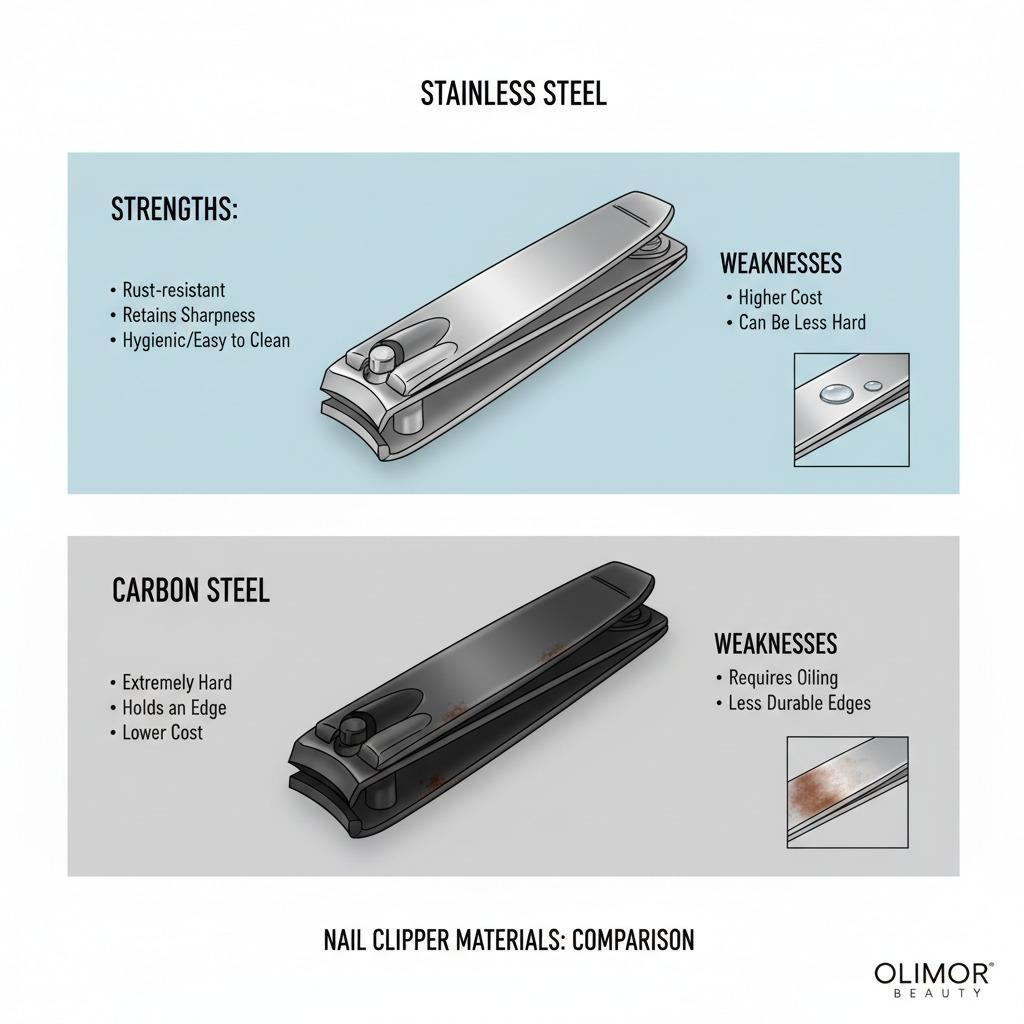
Stainless steel is widely used for nail clippers because it offers a practical balance of strength, edge retention, and resistance to rust and corrosion. In the supplied product description, stainless steel is highlighted as a preferred material for maintaining sharpness over time, and the clipper is described with a polished metallic finish. That combination is important: the base metal contributes to durability, while the finish affects smoothness, appearance, and ease of cleaning.
Carbon steel is another material sometimes found in nail clippers. It can cut well when new, but it is generally more vulnerable to rust if the surface is not protected and maintained. Low-cost clippers may feel acceptable during a quick test but can become uneven or dull after repeated use, especially when stored in damp environments.
Some clippers also include non-metal or coated handle areas for grip or decoration. These details can improve handling, but the cutting jaw remains the most important area to evaluate. A comfortable handle cannot compensate for poor blade alignment or weak cutting edges.
Material Comparison for Nail Clipper Buyers
The best material depends on the intended use. A compact travel clipper, a salon-ready grooming tool, and an economy set may not require the same balance of cost, finish, and expected lifespan. The table below gives a practical comparison without relying on unverified technical grades.
| Material or Feature | Main Advantage | Watch For | Best Fit |
|---|---|---|---|
| Stainless steel | Good corrosion resistance and dependable cutting performance | Blade alignment, edge sharpness, and surface finish still need inspection | Daily grooming, travel kits, retail beauty tools, salon accessories |
| Carbon steel | Can provide an initially sharp cut | More care needed to avoid rust; finish quality varies | Cost-sensitive products where maintenance instructions are clear |
| Polished metallic finish | Smooth appearance and easier wipe-down | Look for scratches, burrs, or uneven plating-like effects | Gift sets, personal care ranges, visible retail packaging |
| Ribbed handle texture | Improves grip and control during trimming | Ribs should feel secure without sharp edges | Personal use, professional grooming, wet-hand environments |
| Integrated nail file | Adds finishing convenience after clipping | Check that it is secure, usable, and not rough around the edges | Compact kits and everyday grooming sets |
Blade Shape, Grip, and Cutting Control
Material is the foundation, but design determines how that material performs in the hand. The original product details describe curved blades, ribbed handles, and an integrated nail file. These are useful features when they are executed correctly.
Curved blades help follow the natural shape of fingernails and toenails. A gentle curve can make trimming smoother, especially when shaping the free edge of the nail. However, curved blades should meet evenly from side to side. If one corner contacts before the other, the clipper may tear instead of cut.
Ribbed handles provide a non-slip grip. This matters because nail clipping requires controlled pressure, not just force. A handle that slips can cause over-cutting or an uneven trim. When evaluating samples, press the lever several times and note whether the grip pattern feels comfortable or too sharp.
An integrated nail file is convenient for smoothing small rough points after clipping. It should sit securely and be easy to access without making the clipper bulky. For retail sets, an integrated file can improve perceived usefulness, but only if it is finished cleanly and does not rattle.
How to Evaluate Nail Clippers Before Sourcing
Whether you are selecting a clipper for your own grooming kit or comparing options for a beauty tool line, sample testing is essential. A visual inspection alone cannot confirm cutting feel, edge consistency, or comfort. Use a structured checklist so decisions are based on repeatable observations rather than first impressions.
- Check blade alignment: Close the clipper slowly and confirm both cutting edges meet evenly without a visible gap.
- Test cutting smoothness: A good clipper should cut with controlled pressure, not crushing force. Avoid testing on unsafe materials that could damage the edge.
- Inspect the edges: Look for burrs, chips, rough corners, or uneven sharpening.
- Review the finish: The polished metallic surface should be smooth, with no obvious staining, flaking, or sharp seams.
- Assess grip comfort: Ribbed areas should help the fingers stay in place while remaining comfortable during repeated use.
- Open and close repeatedly: The lever action should feel stable, not loose, wobbly, or gritty.
- Examine the nail file: If included, it should be securely attached and practical for light finishing.
- Consider packaging and storage: A clipper stored in a damp pouch or poorly ventilated kit may need extra care instructions.
For business sourcing, it is also useful to define the intended audience before comparing samples. A beauty retailer may prioritize finish and packaging compatibility. A salon supplier may focus on cleaning, grip, and repeat-use durability. A travel kit supplier may prefer compact size and safe storage. If you need help comparing available options, you can contact Olimor or send an inquiry with your product requirements.
Maintenance Tips for Longer Tool Life
Even a well-made stainless steel nail clipper benefits from proper care. Maintenance is simple, but it makes a noticeable difference in hygiene, appearance, and long-term cutting feel.
- Wipe after use: Remove nail dust and skin oils with a clean, dry cloth.
- Dry before storage: Avoid leaving the clipper wet on a sink or inside a sealed damp bag.
- Clean the jaw area: Small particles can collect around the cutting edge and hinge area.
- Avoid harsh misuse: Do not use nail clippers to cut wire, plastic tags, or hard non-grooming materials.
- Store safely: Keep the tool in a dry case or grooming kit compartment to protect the edge.
- Replace when performance drops: If a clipper starts tearing, crushing, or requiring excessive force, it may no longer provide a clean trim.
For shared environments such as salons or household kits, cleaning discipline is especially important. Clippers should be kept dry between uses and handled as personal care tools, not general-purpose cutters.
Choosing the Right Nail Clipper for Your Range
A reliable nail clipper comes from the right combination of material, blade geometry, finishing, and quality control. Stainless steel is a strong choice for many buyers because it supports corrosion resistance and durable daily performance. Curved blades can improve shaping, ribbed handles can improve control, and an integrated nail file can make the tool more convenient. Each feature should still be judged by how it performs in the hand.
When comparing nail clippers, avoid choosing by price or appearance alone. Look closely at edge alignment, lever stability, grip comfort, surface finish, and cleaning practicality. These details determine whether the tool feels precise on the first use and remains dependable after repeated grooming sessions.
For personal care brands, distributors, and beauty tool buyers, a clear material and feature checklist helps reduce uncertainty. Start with the intended user, then match the clipper material and design to that use case. The result is a more practical grooming tool, fewer avoidable quality issues, and a better experience for the people who use it every week.
Tag: