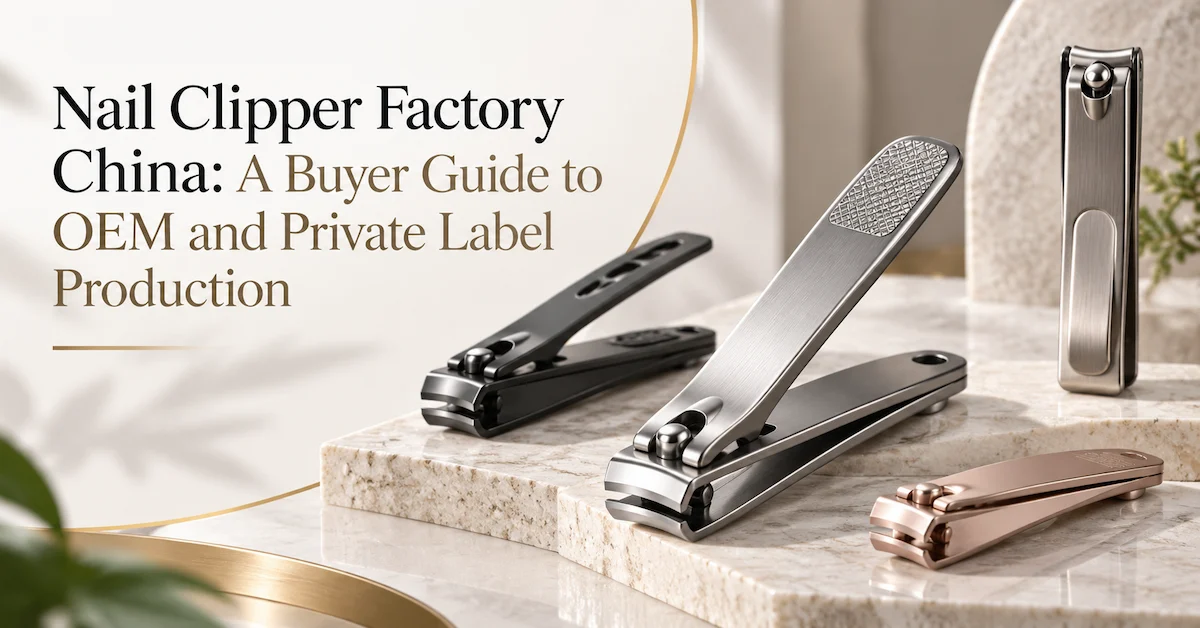
Direct answer: When you assess a nail clipper factory China, ask the team to walk through your actual SKU. You need to know how its material is formed, how the edge is finished, how any heat treatment is handled, how the lever is assembled, and how the finished tool and package are checked. A catalogue image starts the conversation. The decision becomes real when a controlled sample, a written specification, a model-level quality plan, and an itemized quotation all point to the same product.
The reader here is the person building a nail-care assortment for a brand, import business, retailer, distributor, or ecommerce channel. The guide covers nail clippers, manicure kits, cuticle tools, files, buffers, and related products. It also looks at how to compare a nail clipper manufacturer China option, choose OEM or ODM, plan private label nail clippers, discuss stainless steel, design the pack, and preserve the approved result for replenishment. The focus is evidence and useful questions, not a blanket claim about any supplier.
The company profile supplied for OLIMOR BEAUTY gives 2011 as the business start and 2017 as the factory start. It describes a site of roughly 6,000 square metres and about 200 employees, with reported yearly capacity around 5 million metal sets and 2.5 million injection-moulded pieces. The same profile names metal stamping, heat treatment, plastic injection, polishing, water deburring, assembly, inspection, packing, and export coordination. Those figures describe the company, not a promise for a particular order. The selected model still needs its own material, route, MOQ, schedule, certificate scope, package, and documents.
| Buyer question | Practical answer | Evidence to request |
|---|---|---|
| Can this factory make my clipper? | Match the model to its material, blade design, lever, finish, and process route. | Drawing, reference sample, process map, and critical inspection points. |
| Can I sell it under my brand? | Logo, colour, finish, set composition, and package depend on the SKU. | Decoration proof, colour reference, artwork approval, and packed sample. |
| Will production match the sample? | Only when the sample, specification, revisions, and quality checks are controlled. | Sample code, first-piece record, inspection plan, and change log. |
| How do quotes compare? | Normalize the same model, material, finish, pack, quantity, and shipping basis. | Itemized quotation with one-time and recurring costs separated. |
| What should I send first? | Give the user task, reference, target market, quantity range, and open decisions. | A focused RFQ with an annotated reference and a question list. |
1. Define the nail-care job before choosing a model
A nail clipper may be small, yet the brief still needs a job. It could be a compact travel item, a bathroom staple, a professional-kit component, a gift-set accessory, or part of a baby grooming range. Those choices affect size, grip, edge protection, finish, package, and the copy printed on the product or box.
Write a one-sentence use case: "A compact clipper for a travel manicure kit, sold online in a protective paper box." That sentence gives the factory useful context. It also helps the buyer decide whether a straight lever, a catcher, a file, a case, or a larger handle belongs in the configuration. Without a use case, a product discussion can drift toward colour and decoration before the basic function has been agreed.
Describe the intended user without making a medical or safety promise that has not been tested. An adult nail clipper can be described by its intended grooming task, size, handle, and care routine. A baby series requires its own design review and market requirements; do not assume an adult specification is suitable. If the tool is for professional channels, state whether the buyer expects a certain handling pattern or cleaning routine and ask the supplier what evidence is available.
2. Understand the difference between OEM, ODM, and private label
OEM nail clipper manufacturer for a controlled specification
An OEM nail clipper manufacturer is a fit when the buyer provides a drawing, physical sample, dimensions, mechanism requirements, or a defined appearance concept. The factory reviews feasibility, proposes a production route, develops samples, and prepares the item for repeatable manufacture. The more the buyer controls the design, the more important it becomes to define what is critical and how approval is recorded.
ODM nail-care development for a platform or collection
ODM is useful when the buyer wants help selecting a platform, adapting a catalogue model, or creating a coordinated collection. Ask the supplier to mark every feature as standard, configurable, or new development. A new handle, coating, blade geometry, catcher, file, or case may change tooling, sample rounds, price, and schedule even when the base clipper looks familiar.
Private label nail clippers for a branded launch
Teams searching for private label nail clippers may need a proven platform with a new logo, colour, finish, set combination, or package. This route can be efficient, but it still requires final-material and final-pack approval. A standard clipper in a new coating can behave differently at the edge, lever, or insert. Private label should be treated as a complete product project, not as a logo-only task.
| Route | Typical starting point | Questions to settle |
|---|---|---|
| OEM | Buyer drawing, sample, mechanism, dimensions, or appearance concept. | Which requirements are fixed? What requires tooling? What does the sample prove? |
| ODM | Supplier platform or collection recommendation. | Which parts are standard, configurable, or new development? |
| Private label | Existing tool with brand and retail presentation changes. | How will logo, colour, finish, package, and function be approved together? |
3. Map the production route before comparing price
A credible nail clipper factory China discussion should identify how the selected model moves from material to packed product. OLIMOR's supplied capabilities include metal stamping, heat treatment, polishing, water deburring, assembly, packaging, and inspection. Those operations may support different parts of a nail clipper project, but the actual route depends on the SKU.
One formed metal model might move through blank preparation, forming, edge work, any applicable heat treatment, grinding, polishing, decoration, lever assembly, and inspection. An injected handle introduces plastic processing and a metal-to-plastic fit check. A catcher, file, or case adds its own accessory and pack questions. Ask for the route of the selected model and the handoffs most likely to affect quality or timing.
4. Evaluate blade geometry and lever action
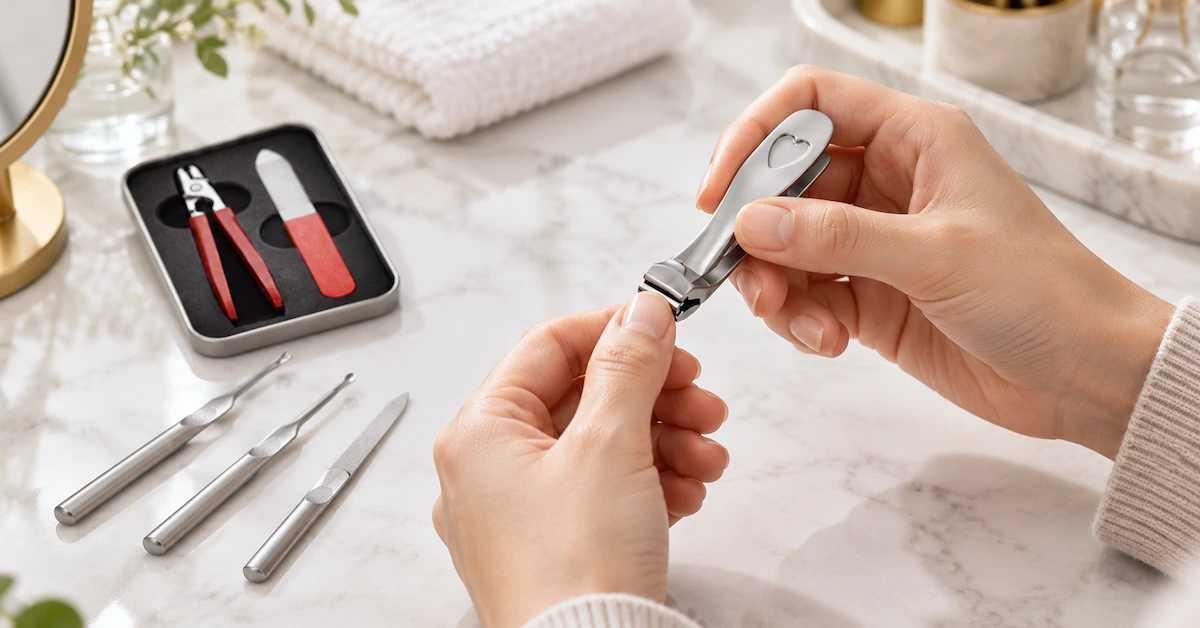
The cutting edge tells you more about a clipper than its shine. Watch the two edges meet, feel whether the closing action stays controlled, and check that the lever transfers force without binding. A bright polish cannot hide a gap, a catch, or an inconsistent cut. Agree with the factory how the intended task will be tried and what result counts as acceptable.
Look at the relationship between blade, body, pin, and lever. A small change in alignment can affect the user's hand pressure and the way the cut is made. If the model has a catcher, confirm that the catcher does not interfere with the lever or edge and that it can be emptied or cleaned as described. If the product is compact, check whether the smaller geometry remains controllable for the intended user.
Review the first sample with the same task every time. Note opening resistance, return action, edge meeting, burrs, visible marks, and hand feel. Do not generalize from one clipper to every model in the supplier's catalogue. A large nail clipper, a small travel clipper, a nipper, and a baby series tool need separate criteria.
5. Select stainless steel and other materials by part
A buyer searching for a stainless steel nail clipper manufacturer should ask where stainless steel is used. It may describe the complete tool or only selected components. The quotation and final specification should identify material by part, along with finish, colour, coating, care guidance, and any market-specific document requirement.
Material selection follows function and finish. The body, lever, pin, spring, catcher, file, or handle may have different requirements. If a material is still being evaluated, write it as a preference rather than a confirmed claim. Ask whether the selected finish changes edge behaviour, logo contrast, corrosion-care guidance, or the fit between moving parts.
For injected handles or accessories, confirm colour control, flash, fit, texture, and alignment. Ask whether a physical master sample or colour reference will be used. When a metal tool and plastic insert meet, identify the dimension or position that controls the relationship. A colour match that looks correct on a flat chip does not prove that the finished handle, body, and package will look consistent together.
6. Build a specification a nail clipper supplier can quote
A useful RFQ exposes the decisions that affect function, cost, and timing. Include product task, user, channel, destination market, reference model, dimensions, material by part, finish, colour, logo, accessories, package, quantity range, launch window, and required documents. Mark each item as fixed, preferred, or open.
Separate product requirements from commercial targets. A target price is useful for planning, but it should not silently change the material, edge, lever, or package. A quantity range is more useful than a request for a universal MOQ. A standard model with stock packaging cannot be compared fairly with a new design that includes tooling, custom colour, logo decoration, and a printed box.
Use precise terms in the specification. Replace "premium" with the surface and finish that should be visible. Replace "sharp" with the edge meeting and cutting result that should be checked. Replace "easy to use" with the expected lever movement and hand control. These descriptions help purchasing, quality, packaging, and content teams refer to the same product.
7. Plan custom logo nail clippers
For custom nail clipper manufacturer projects, provide vector artwork, desired position, size, colour, orientation, and file revision. The supplier should confirm whether the proposed decoration method suits the surface and finish. A mark that looks sharp on a paper dieline may lose detail on a curved, polished, textured, or coated handle.
Approve the logo on the final substrate. Review line clarity, fill, contrast, position, orientation, and visible damage around the mark. If the package insert or sleeve touches the logo, inspect the packed sample after handling. Keep the decoration proof with the functional sample and package artwork; three separate approvals can easily drift into three different versions.
Logo approval is not functional approval. The brand mark may be perfect while the edges fail to meet or the lever binds. Keep the product revision, sample code, artwork file, colour reference, and package drawing in one release record.
8. Design packaging as protection and communication
A package protects a sharp working edge, prevents lever movement, communicates use, and determines carton volume. A single clipper may need a card, blister, paper box, pouch, or sleeve. A clipper set may need a formed insert, case, or compact gift box. The correct choice depends on the channel and the physical movement allowed during storage and shipment.
For a nail care tools manufacturer project, specify primary pack, insert, orientation, barcode area, languages, warnings, material statement, pack count, carton size, and outer-carton marks. Confirm who owns the dieline and who approves final artwork. Do not assume a package shown in a catalogue is available for every model.
Approve a packed sample, not only a digital artwork file. Handle the package as a shopper and as a logistics item. Check movement, scratching, crushed corners, edge contact, lever pressure, closure, barcode readability, and opening instructions. Packaging changes can affect freight, carton count, shelf presentation, and replenishment cost, so they belong in the product release.
Discuss Your Nail Clipper Sample
9. Create a model-specific QC plan
The supplied OLIMOR information mentions process inspection, finished-product or shipment inspection, and torque and hardness equipment. Ask where those capabilities enter the chosen clipper's route. A useful plan names the critical features, the check method, the record owner, and the response when a piece misses the agreed result.
- Incoming checks: confirm the identity and visible condition of metal, pins, levers, springs, plastic parts, files, catchers, inserts, and packaging.
- First-piece approval: compare the first completed pieces after setup or a meaningful change with the current drawing and sample.
- In-process checks: monitor dimensions, edge relationship, lever fit, finish, colour, and assembly features that may drift.
- Finished-product checks: review cutting function, movement, burrs, surface, logo, accessories, count, and primary pack.
- Shipment checks: confirm quantity, carton marks, package integrity, selected inspection records, and dispatch documents.
Write the test in task language. "Function check" is not enough if the team has not agreed what it means. For a clipper, specify edge meeting, cutting action, lever movement, and any applicable hardness or finish requirement. For a set, add item identity, position, retention, and closure. The method and acceptance values must be confirmed for the model; do not copy a generic number from another product.
10. Use quality standards as references, not marketing claims
ISO 9001 provides a recognized quality-management framework built around controlled processes, documented information, evaluation, and improvement. A buyer can use it to ask who owns the current drawing, how revisions are distributed, how inspection records are retained, and how complaints are corrected. It does not prove that every clipper meets a buyer's performance requirement.
ISO 2859-1 describes lot-sampling procedures indexed by an acceptance quality limit. It can provide common vocabulary for sample size and accept-or-reject decisions. The buyer and supplier still need to define defect classes, inspection level, and acceptance criteria for the exact clipper. A functional edge failure should not automatically be treated like a minor cosmetic mark.
The company information records ISO and BSCI as confirmed certifications, but the standard number, holder, site, and validity period need to be matched to the project. Request current documents relevant to the supplying entity, factory, product, material, and destination. Do not turn a general certification statement into a claim that every nail clipper is certified for every market.
11. Compare MOQ, tooling, price, and lead time
There is no useful universal MOQ for nail clippers. The minimum depends on model, material, finish, colour, decoration, packaging, tooling, components, and order configuration. A catalogue platform in an existing finish may have different conditions from a new edge, handle, coating, logo, and box. Ask for the MOQ of the exact configuration.
Request separate cost lines for tooling, sample development, colour matching, artwork preparation, logo setup, insert, box, unit, and carton. State currency, trade term, destination, quote validity, and shipping assumptions. This makes a nail clipper supplier China quotation comparable with another source. A lower unit price is not a saving if it excludes the package or assumes a different material.
Ask for milestones rather than a single delivery promise. Feasibility, tooling, sample, buyer review, artwork, material preparation, production, inspection, and dispatch may each affect the calendar. Confirm what starts each stage and how a revision changes the date. The supplied company information does not provide a universal lead time, so the schedule must be model-specific.
12. Score a factory with evidence
A weighted scorecard protects the decision from a low but incomplete price. Adjust the weights to your program. A premium clipper may put more weight on edge control and finish. A mass-market set may put more weight on package efficiency, consistency, and replenishment.
| Area | What to examine | Suggested weight |
|---|---|---|
| Product fit | Does the supplier understand the user task, edge, lever, material, and target channel? | 20% |
| Process fit | Does the proposed route match forming, heat treatment, finishing, assembly, and packing? | 15% |
| Sample result | Do function, geometry, finish, logo, and package match the brief? | 20% |
| Quality evidence | Are critical checks, records, sampling, and corrective action defined? | 20% |
| Commercial clarity | Are MOQ, tooling, unit, pack, schedule, and shipment assumptions visible? | 15% |
| Communication | Does the team track questions, changes, approvals, and open risks? | 10% |
Score what can be checked. A marked sample report is stronger than "excellent quality." A milestone table is stronger than "fast delivery." A quote with exclusions is stronger than a bare unit number. Record unresolved questions separately because uncertainty has a commercial cost.
13. Control the production handoff
Before mass production, create one release package containing the current specification, drawing, sample code, material description, finish and colour reference, logo proof, package artwork, carton requirement, quality plan, quantity, and approved deviations. Purchasing, product, quality, packaging, and the factory should all be able to identify the same revision.
Use first-piece approval after setup and after meaningful changes. Compare the first completed pieces with the current sample and drawing, not with memory. If the edge, lever, finish, logo, or pack is outside the agreed result, correct the setup before the full run. The supplier owns the production method; the buyer should still understand the release gate.
A substitute component, different coating, revised carton, or adjusted lever can affect the product. Record the reason, affected quantity, evidence, decision owner, and whether a new sample or inspection is needed. Silence is not approval.
14. Build a repeat-order evidence file
A repeat order should not restart from an old photograph and invoice. Keep the latest specification, drawing, approved sample photos, material information, finish and colour reference, logo proof, package artwork, packed-sample record, carton data, inspection checklist, approved deviations, complaint history, and change log together.
Before replenishment, ask what has changed. Check material source, components, tooling condition, finish, package supplier, artwork, barcode, warning, insert, destination, and buyer requirements. If nothing changed, reference the previous approved revision. If something changed, identify the impact and approve the new reference.
This file helps a nail clippers wholesale China program stay consistent. It gives the supplier a clear history and gives the buyer a fair basis for comparing new commercial terms. It also keeps public product content aligned with the actual SKU.
15. Common nail clipper sourcing problems
The edges do not meet evenly
The likely cause is uncontrolled geometry, setup, or a vague function requirement. Record the failure against the sample and drawing, isolate the affected pieces, and agree the edge-contact check before the next run.
The lever feels stiff or loose
Review the relationship between lever, pin, body, and spring or joint. Confirm the expected movement in the sample approval and ask how it is checked during assembly and finished-product inspection.
The finish scratches inside the package
The package may allow tool-to-tool contact or pressure on a coated surface. Review the insert, orientation, restraint, and packed sample. A change in insert material may require a new fit review.
The logo is correct on the box but not on the tool
Decoration was probably approved on artwork rather than on the final substrate. Test the mark on the actual body or lever, then review contrast, line width, position, and handling.
The quote looks cheap but the project total grows
Tooling, package, logo setup, colour matching, or inspection may have been excluded. Ask for one itemized quotation and list all assumptions before comparing unit price.
16. Prepare an inquiry that a factory can answer
Send the following information to an OEM nail clipper manufacturer or other shortlisted supplier:
- Company, destination market, sales channel, and launch window.
- Product task, user, size position, and whether the item is single or part of a set.
- Reference model, annotated photograph, drawing, or physical sample.
- Material preference by part, finish, colour, edge, lever, catcher, and accessories.
- Logo file, decoration method, position, size, orientation, and revision.
- Package type, insert, printed information, pack count, and carton requirement.
- First-order and annual quantity ranges.
- Required documents, inspection expectations, and market-specific requirements.
- Target price position, with fixed, preferred, and open items separated.
- Questions about feasibility, sample scope, tooling, MOQ, lead time, and quotation validity.
Use a temporary code for each model when several products are included. Ask the supplier to repeat the quoted configuration next to the price. This makes it easier to identify whether two quotations describe the same clipper, finish, package, and inspection responsibility.
Request a Model-Specific Nail Clipper Quote
Frequently asked questions
What does a nail clipper factory China supplier usually support?
The scope can include metal forming, heat treatment where applicable, grinding, polishing, deburring, assembly, inspection, packaging, and export coordination. The exact process depends on the selected model. Ask which operations are in-house and which are coordinated for your SKU.
How do I choose a nail clipper manufacturer China option?
Start with the user task and model. Then compare material by part, edge and lever function, sample evidence, quality plan, logo and package capability, MOQ, lead time, and commercial assumptions. A country label or catalogue size is not enough evidence by itself.
What is the difference between private label nail clippers and OEM?
Private label often uses an existing platform with brand, finish, colour, set, or packaging changes. OEM generally starts with more buyer-controlled input such as a drawing, sample, dimensions, or mechanism. Confirm which features are standard, configurable, or new development.
Should I choose stainless steel for every nail clipper?
Not automatically. Confirm the material by part and connect it to function, finish, care, cost, and market requirements. If stainless steel is preferred, ask whether it covers the whole tool or selected components and put the agreed wording into the final specification.
What is the MOQ for custom nail clippers?
MOQ varies with model, material, finish, colour, logo, tooling, package, components, and order configuration. Ask for the minimum attached to the exact project rather than copying a general catalogue statement.
How much does an OEM nail clipper cost?
Cost depends on dimensions, material, edge and lever design, finish, decoration, tooling, package, quantity, inspection, trade terms, and destination. Request an itemized quotation and separate one-time development charges from recurring unit and packaging costs.
How long does a nail clipper project take?
The calendar depends on feasibility, tooling, sample rounds, artwork, material preparation, production, inspection, and shipment. Request milestones for the selected SKU and confirm what starts each stage. Avoid relying on a universal delivery promise.
How should I review a nail clipper sample?
Perform the intended cutting task, check edge meeting and lever movement, compare geometry and finish with the reference, review logo and accessories, and inspect the packed sample for movement or damage. Record the result by sample code and revision.
What should a nail care tools manufacturer show before production?
Ask for a controlled specification, sample or drawing, material and finish details, decoration proof, package artwork, packed sample, critical inspection points, and a release record. The exact document set depends on the product and destination market.
Can one nail clipper supplier China source support wholesale orders?
A supplier may support both smaller brand programs and larger orders, but MOQ, capacity, schedule, and packaging must be confirmed for the exact configuration. Compare evidence and assumptions rather than relying on a general claim about flexibility.
Turn one clipper into a reliable product program
A successful nail-care launch is built from visible decisions. Define the shopper task, select the right OEM or ODM route, map the production process, specify blade and lever behaviour, confirm material by part, approve logo and packaging on final samples, write a product-specific QC plan, and retain the release file for replenishment. This sequence helps brands compare factories on evidence rather than slogans.
OLIMOR BEAUTY's supplied information describes nail-care product categories alongside metal and plastic processing, assembly, inspection, packaging, OEM/ODM development, and export coordination. The next practical step is a model-specific conversation. Send the reference, intended use, material preference, finish, logo, package, quantity range, destination, and launch window.