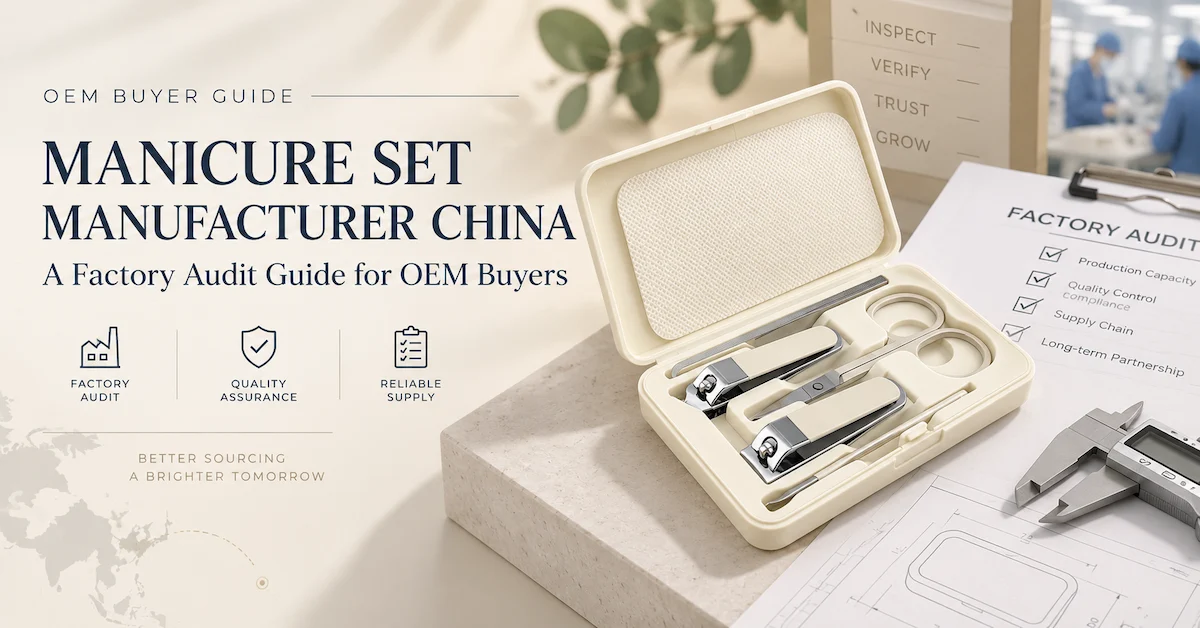
Direct answer: Before approving a manicure set manufacturer China, trace one proposed kit from its component list to the finished export carton. Verify who makes each tool, where forming and finishing occur, how the case and insert are sourced, which sample controls production, what inspectors record, and how changes are approved. A long catalogue may prove category breadth. It does not prove that a specific clipper, file, tweezer, case, and printed sleeve will arrive together in the version your team signed off.
This guide is designed for brand owners, purchasing managers, importers, retail groups, distributors, and ecommerce teams sourcing manicure kits from China. It treats a factory audit as a product investigation, not a tour of impressive equipment. You can use the same method during a site visit, a live video audit, or a structured document review. The objective is to leave with enough evidence to decide whether the supplier can control your exact SKU.
The supplied OLIMOR BEAUTY company file gives 2011 as the business start and 2017 as the factory start. It describes a site of roughly 6,000 square metres, about 200 employees, and reported annual capacity of approximately 5 million metal sets plus 2.5 million injection-moulded pieces. It also lists metal stamping, heat treatment, plastic injection, polishing, water deburring, assembly, inspection, packaging, and export coordination. These are company-level reference facts. Availability, output, materials, minimum quantity, timing, tests, documents, and costs still need confirmation for the model under discussion.
1. Audit one real kit instead of discussing the factory in general
Begin the audit with a product on the table. Give it a temporary project code if a final item number does not exist. Ask the sales contact, engineer, production representative, quality inspector, and packaging coordinator to use that code throughout the discussion. General answers become easier to test when everyone is looking at the same clipper, scissors, file, tweezer, pusher, case, and insert.
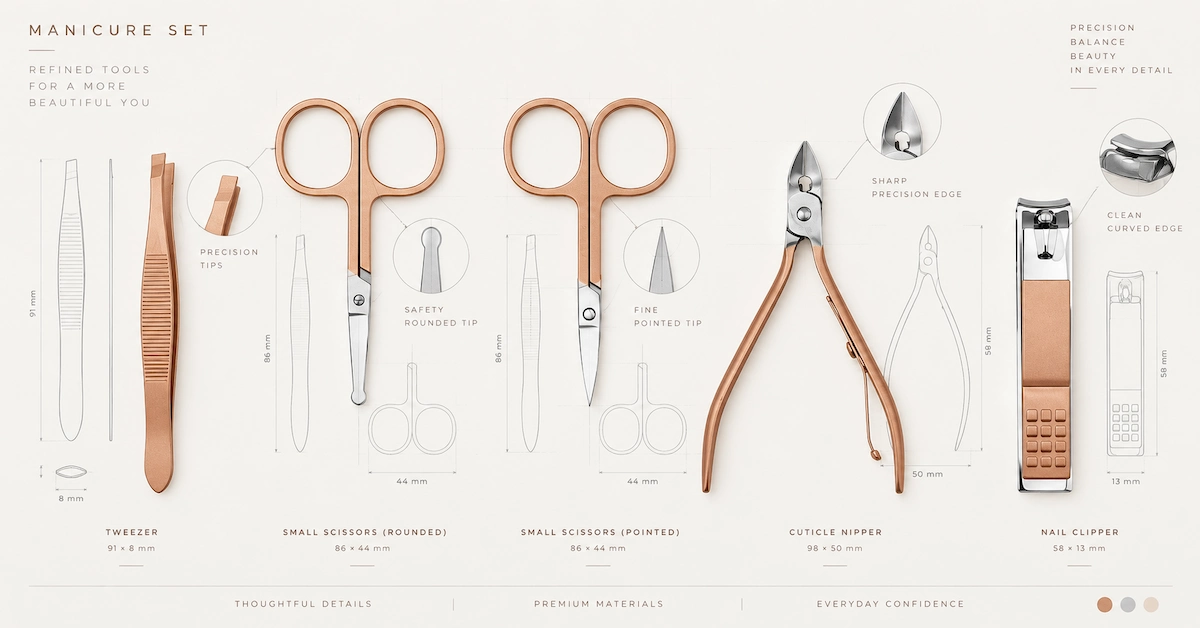
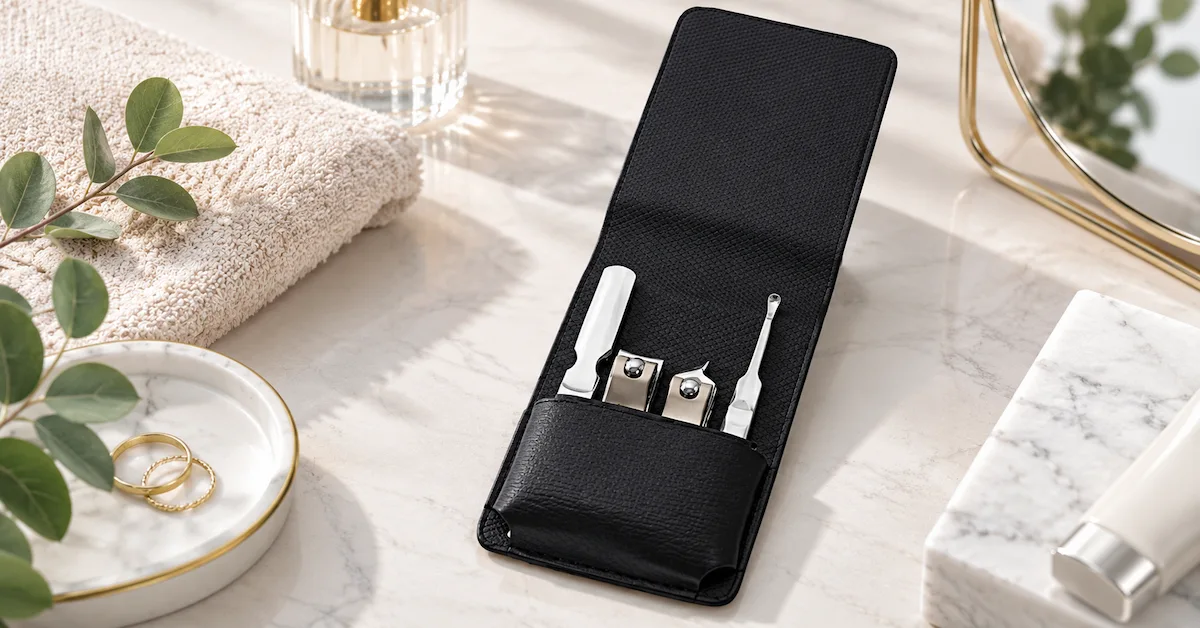
Request the proposed component list before the meeting. It should name each tool, quantity per kit, candidate material, finish, decoration, source, and current sample status. Add the case, insert, instruction card, retail sleeve or box, labels, and outer carton. The list exposes a basic question that many buyers miss: is the supplier manufacturing a set or merely assembling unconnected items purchased elsewhere?
Outside sourcing is not automatically a weakness. Cases, printed packaging, specialty files, or particular accessories may come from qualified partners. What matters is visibility and control. The supplier should be able to identify the process owner, incoming check, approved reference, and response when a component changes.
| Audit question | Useful evidence | Weak answer |
|---|---|---|
| Who makes each component? | A component list showing in-house and coordinated sources | "We can supply everything" without a route |
| What controls the current version? | Drawing or specification revision linked to a sample code | An unmarked catalogue image |
| How is incoming material checked? | Item-specific receiving criteria and a recent record | "Our supplier has good quality" |
| What happens after a failed check? | Identification, isolation, disposition, correction, and follow-up | An inspector simply sorts pieces without a record |
| How is the packed kit released? | Approved master, count check, pack inspection, and shipment record | Approval of individual tools only |
2. Prepare an audit packet before the call or visit
A productive audit starts several days before anyone walks onto a production floor. Send a concise packet containing the intended customer, sales channel, destination, tool list, reference photographs, target finish, branding idea, package direction, quantity range, and open questions. Mark statements as fixed, preferred, or undecided. This lets the factory prepare the relevant people and records instead of giving a generic presentation.
Ask the supplier to return a preliminary feasibility note. It should identify standard components, parts that need adjustment, possible new tooling, outside processes, decoration options, and unresolved material questions. Differences between your packet and the returned note become the first audit agenda.
For a live video audit, request a continuous walk through the areas relevant to the selected model. A sequence of edited clips is useful for orientation but may hide process handoffs. Ask the presenter to show the project code on screen, then move from a component or work area to its inspection point and record. Respect factory confidentiality: the goal is evidence for your product, not images of another customer's design.
If your search begins with professional manicure set manufacturer China, define what "professional" means in the audit packet. It might describe a salon sales channel, a particular tool combination, controlled handling, documentation, or a finish position. An adjective cannot replace an observable requirement. Give the supplier the user, task, and evidence you expect to review.
3. Confirm whether the supplier fits your development route
The same factory can support different project types, but the buyer's inputs and approval burden change. Define the route before treating a quotation as complete.
Buyer-led OEM development
An OEM manicure set manufacturer China project begins with more buyer control: a drawing, dimensional envelope, physical reference, component combination, mechanism requirement, or protected appearance. During the audit, ask who reviews feasibility, how design questions are logged, how tooling is identified, and how the approved requirements reach production and inspection.
Do not assume that sending a sample transfers a complete specification. Two people may interpret the same reference differently. Write down which features must match, which can change, and which are included only to demonstrate scale or function. Photograph the sample code rather than relying on a description such as "the black set we sent last month."
Supplier-led ODM development
An ODM manicure set manufacturer China project normally starts with a platform the supplier already understands. The audit should reveal what is genuinely established. Ask to see the base model, existing tooling status, known component choices, standard quality checks, and the boundary between a normal option and new development.
A platform can shorten the decision path, yet every change has consequences. Replacing a clipper may alter an elastic loop. Moving from polished silver to a coloured finish may require new handling protection. A different logo location can affect inspection and case contact. Record those effects rather than calling the project "standard" after several changes.
Private-label execution
A private label manicure set manufacturer should connect brand files to physical production controls. Ask where the approved logo artwork is stored, who checks its revision, how placement is measured, what controls colour, and whether the case, insert, card, retail box, and carton use the same brand version. The final approval unit should be a packed set, not a digital artwork PDF.
4. Follow metal components through their actual process route
A manicure kit may contain several metalworking problems in one case. A clipper has a body, cutting relationship, lever, and joint. Scissors or nippers introduce paired blades and movement. Tweezers depend on tip contact and spring response. Pushers and cleaners have different tip forms. A file introduces another working surface. Ask for the route by component rather than accepting one process diagram for the whole set.
Where relevant, follow material identification into forming, any applicable heat treatment, grinding or edge work, deburring, polishing, coating, decoration, and assembly. At each stage, ask two practical questions: what can go wrong here, and how would the next person know? A controlled handoff may use a first-piece record, sample board, drawing, gauge, labelled container, traveller, or inspection sheet.
During a factory video, look for version identification and separation. Similar-looking parts for different kits can be mixed if containers, stations, or records are unclear. Ask how rework is marked and how accepted parts are protected from scratches before assembly. Small metal tools often pass through many hands; handling is part of the finish process.
5. Examine heat treatment and edge work without guessing specifications
Heat treatment may apply to selected cutting components, but the requirement belongs to the model and material. Ask which parts receive the process, where it occurs, what property is being controlled, and what record connects the result to the batch. If a hardness instrument is used, ask which value and method apply to that component. Do not copy a number from a different clipper, scissors, or nipper.
Edge work needs task-based review. The audit should connect the edge geometry to the intended nail-care action and an agreed sample method. Look for alignment, burr control, smooth movement, and consistent contact where applicable. The finish can look excellent while the working surfaces remain mismatched, so appearance inspection and functional inspection should be separate.
Ask to see how an inspector records a failure. A useful demonstration includes identification of the affected lot, separation of nonconforming pieces, review of the setup or process cause, and confirmation after correction. Sorting alone may protect one shipment without preventing a repeat.
6. Audit polishing, coating, and decoration as linked operations
Polishing affects more than shine. It can reveal or hide forming marks, soften edges, influence how a logo appears, and change the way two parts move or fit. Ask which surfaces have functional limits and which are cosmetic. Review the approved appearance under a defined lighting and viewing condition that both buyer and supplier can reproduce.
A stainless steel manicure set manufacturer should identify stainless-steel content by component rather than apply one phrase to an entire mixed-material kit. The case, insert, coating, pivot, handle, file surface, or accessory may use other materials. Public claims should match the final component specification and available documentation.
For coloured finishes, compare pieces from different areas of the set side by side. The clipper, scissors, tweezer, and pusher may follow different process routes and display colour differently. Ask how the master reference is stored, how variation is assessed, and what happens when a component is replaced mid-project.
Decoration should be audited on the final surface. Request the vector file name and revision, position reference, size, orientation, method, and acceptance example. Open and close the case to see whether a loop or lining rubs the mark. A logo can pass visual approval on day one yet show contact damage after ordinary handling.
Request a Manicure Set Factory Review
7. Treat plastic parts, cases, and inserts as engineered components
If the kit uses an injection-moulded case, plastic handle, tray, or insert, ask to see the relevant mould identification and current sample. Review colour, surface texture, flash, fit, closure, hinge movement, and the relationship with metal tools. A case that closes correctly when empty may bow or resist closure after a tool substitution.
Soft cases bring different questions. Check zipper travel, stitching, lining, elastic or pockets, odour expectations, logo placement, and recovery after repeated opening. Ask how the case is inspected before the tools are loaded. Once filled, a lining defect may be hard to see and expensive to correct.
The insert should hold tools firmly without making them frustrating or unsafe to remove. During the audit, ask someone unfamiliar with the project to take out and replace each item. Watch whether fingers approach working edges, small tools disappear behind a flap, elastic marks a coating, or the arrangement becomes disordered after one use.
8. Walk through assembly and count control
Assembly is where parts become tools and tools become a sellable kit. Ask the line leader how the current work instruction is identified. Watch how levers, pins, joints, handles, or accessories are fitted. Ask which checks happen during setup, during the run, and after a changeover.
Set packing adds a count-control problem. A case with visually similar tools can leave the line with a duplicate and a missing item. Ask how workers distinguish components, how the pack sequence is arranged, and where a second count occurs. A silhouette tray, compartment map, labelled fixture, weight check, or final visual reference may help, depending on the design.
Trace one packed set backwards. Can the team identify the component batches, assembly date or line, inspection result, and artwork version? The appropriate traceability depth depends on the project, but the supplier should explain the system clearly and use it consistently.
9. Review inspection records, not only inspection equipment
A room full of gauges says little unless the factory can link equipment, method, person, and product. Select one critical feature from the proposed kit and ask the inspector to demonstrate the check. Confirm that the method in use matches the current document and that the result can be traced to the lot or sample.
| Inspection stage | What to trace | Questions for the auditor |
|---|---|---|
| Incoming | Material or component identity, condition, quantity, and supplier lot | How is an incorrect or damaged delivery isolated? |
| First piece | Setup result against the current drawing and master sample | What changes trigger another first-piece check? |
| In process | Critical function, dimensions, movement, finish, and decoration | How often is the check made, and who reacts to drift? |
| Finished component | Tool identity, function, appearance, and approved revision | Can accepted pieces be mixed with reworked pieces? |
| Packed set | Correct assortment, case, insert, copy, barcode, and protection | Does the record cover the whole SKU or only one tool? |
| Shipment | Quantity, carton marks, package condition, and dispatch documents | Who signs the release, and what evidence is retained? |
If sampling is used, agree the inspection level, defect categories, and acceptance criteria for the exact set. A missing tool, failed cutting action, wrong logo, minor scratch, and slightly shifted insert do not necessarily carry the same risk. The buyer and supplier should classify them before inspection rather than argue after the report arrives.
10. Verify certification and document scope
The supplied company information records ISO and BSCI as confirmed certifications. Put the certificate beside the purchase documents during due diligence. Do the holder and factory site match? Is the scope relevant, and are the issuer and dates current? Only then can the record answer the question you asked. A management-system certificate or social-audit result should never be presented as proof that the manicure kit itself is certified.
Product and market documents need the same discipline. List the destination, product description, materials, pack text, and any customer-specific test or declaration. Ask who decides which documents apply and whether testing must use final production material. A report for another model or material is not automatically transferable.
Keep claims conservative until evidence is matched. Avoid placing CE, FDA, medical, hypoallergenic, corrosion, or universal professional-performance language on a manicure kit simply because similar products use it elsewhere. The brand owns the customer-facing statement and should retain the supporting record.
11. Open the box before you sign off the logistics plan
The retail pack has to survive several worlds: a packing bench, a carton, a warehouse, a product photo, a shop shelf, and finally a customer's hands. Examine the actual case while it is sitting inside the proposed sleeve or box. Read the item name and piece count. Check the material wording, logo version, languages, barcode area, instructions, and any destination-specific company or origin details.
Ask for pack and carton dimensions based on the physical sample, not an early rendering. A small increase in case thickness can change the number of units per carton. An insert revision can create pressure on the tools. A glossy sleeve may scuff during packing. Check movement, abrasion, closure, barcode readability, carton marks, and the opening sequence.
A custom manicure set factory China project should include packaging changes in the engineering record. A new tool mix requires another insert review. A finish change may require added surface protection. A new retail channel may change the hang tab, box opening, or imagery. Packaging is not a separate design task after product approval.
12. Use the audit to build a comparable quotation
The commercial offer should read like the outcome of the audit, not like a number sent from another conversation. Beside the price, look for the project code and exact tool list first. Then check the stated materials, finish, decoration, case, insert, and print pack. Quantity band, inspection owner, trade term, destination basis, milestone assumptions, and the date when the offer expires should be visible rather than buried in email.
Mark each charge as either a first-time expense or something expected on every order. A mould, colour trial, artwork setup, development sample, fixture, printing plate, or special test may be paid only at a particular stage. Tools, cases, inserts, retail packs, cartons, agreed inspection, and logistics support are more likely to return. Ask which supposedly one-time charge would come back if the design changed.
A manicure kit supplier China may offer alternative platforms or quantity tiers. Put each alternative on its own row with the exact differences. A cheaper case may change pack volume or presentation. A standard tool may improve timing but reduce differentiation. When the team chooses, write a one-sentence reason. That reason is more useful to the next buyer than the boldest number on the supplier's quotation.
13. Release a pilot run before scaling
A pilot run tests whether information survives production. Freeze the current component list, specifications, sample code, colour and finish references, decoration files, case drawing, insert layout, printed artwork, carton data, and inspection plan. Give the release a date and revision. Everyone should be able to identify the same master without searching through message attachments.
Request first-piece checks after relevant setups or changeovers. Compare the first finished components and first packed kits with the released references. If a working edge, joint, colour, logo, tool count, or insert position misses the target, correct the cause before the balance is packed. Keep the updated evidence with the pilot record.
Use the pilot to observe the whole timeline. Which component arrived last? Where did inspectors need clarification? Did packing create unexpected marks? Was the carton information ready when production was ready? These notes turn an audit from a pass-or-fail ceremony into a practical improvement plan.
14. Evaluate wholesale readiness through repeat-order control
A wholesale manicure set manufacturer China relationship matters most when the second and third shipments remain recognizable as the approved product. Ask how tooling condition, component supply, finishes, case materials, artwork, and inspection references are reviewed before repeat production.
Keep a buyer-side release folder. It should include the component map, individual tool specifications, approved sample photos and code, material statements, finish and colour masters, logo proofs, case and insert files, artwork, carton information, inspection criteria, accepted deviations, complaint history, and change log.
Before each replenishment, require a short change declaration. If nothing changed, reference the last approved revision. If something changed, identify the reason, affected quantity, possible impact, reviewer, and evidence needed. A substituted tweezer, elastic loop, coating, card stock, or carton can alter function, presentation, or logistics even when the catalogue name remains the same.
15. Red flags to investigate before placing an order
The sample has no code or revision
An unmarked sample can be admired but not reliably reproduced. Assign a code, record the date and changes, and identify which specification and artwork belong to it.
The supplier will not distinguish in-house and outside work
Coordinated sourcing is common, but hidden sourcing prevents meaningful control. Request the process boundary, incoming criteria, approved reference, and change-notification method.
One certificate is used to answer every compliance question
Management systems, social audits, product tests, material reports, and market declarations serve different purposes. Match the document to the entity, site, model, material, destination, and claim.
The quotation does not repeat the configuration
A bare price invites misunderstanding. The offer should identify tool count, models, materials, finish, branding, case, packaging, quantity, term, and exclusions.
Every problem is solved by sorting
Sorting can contain a batch, but it does not correct the reason a problem occurred. Ask how the setup, work method, incoming source, or inspection control will change.
A component substitution needs no new review
A small replacement can affect fit, colour, function, pack layout, claims, or cost. Require documented impact review and decide whether a new sample or check is needed.
16. Write the decision note while the audit is still fresh
Within a day of the audit, write six short observations. First, name who owns the proposed product and every coordinated source. Second, describe the route you actually saw for the chosen model. Third, state whether drawings, samples, and changes were easy to trace. Fourth, note which quality check was demonstrated and whether the record matched it. Fifth, describe how well the tools, case, artwork, and carton were controlled as one set. Last, state whether the quotation assumptions were complete.
You can still assign weights if your purchasing process requires a score. Product and quality evidence deserve more influence than the appearance of a meeting room. Commercial clarity and communication matter too, because unclear assumptions rarely become clearer after an order is placed.
Place every unresolved point under the decision note, along with the person responsible for closing it and the evidence required. A strong visit does not cancel an unanswered question about material, source, or documentation. Approval should follow the evidence that arrives afterward.
17. Questions buyers ask about China manicure set factories
How do I verify a manicure set manufacturer in China?
Choose one proposed kit and trace its component sources, process steps, current specifications, sample code, inspection records, case, artwork, packaging, and shipment release. Use a site visit, live video, records, and physical samples together rather than relying on a catalogue or certificate alone.
What should I ask during a video factory audit?
Ask the presenter to follow the selected product through relevant work areas, show version identification, demonstrate one critical inspection, explain nonconforming-product control, and connect the finished set to its component and packing records.
Is an OEM manicure set different from a private-label set?
OEM commonly begins with more buyer-controlled product requirements. Private label often adapts an established platform with branding and packaging. Either route may involve custom work, and both require a controlled packed-SKU approval.
Can a China factory customize every tool in a manicure kit?
Customization depends on the tool platform, material, process, tooling, finish, decoration area, case fit, quantity, and schedule. Ask the supplier to mark each request as standard, adjustable, or newly developed and explain its impact.
How should stainless steel be specified in a manicure set?
Identify the material component by component, then keep that wording beside the bill of materials and its supporting records. The words "stainless-steel set" can easily be read too broadly. They may say nothing about the case, insert, surface layer, joint, handle, or one of the small accessories.
Can the factory give one MOQ for every manicure kit?
There is no universal MOQ. The minimum varies with component availability, tooling, material, finish, colour, branding, case, printed package, and order configuration. Request the MOQ for the exact written SKU.
How long does OEM manicure set production take?
Timing depends on feasibility, tooling, sample rounds, component supply, finish, case and insert work, artwork, production scheduling, inspection, and shipping. Ask for model-specific milestones and the event that starts each stage.
What quality records should a factory provide?
The appropriate set may include incoming, first-piece, in-process, finished-component, packed-set, and shipment records. The records should link to the model or lot and use methods and criteria agreed for the project.
How can I prevent changes on a repeat order?
Maintain one release folder and request a change declaration before production. Review any change to a component, source, tool, finish, case, insert, artwork, test, or destination requirement before accepting it.
Use the audit to make the purchase decision clearer
A useful audit follows evidence. Put one real kit at the centre of the review, separate in-house and coordinated work, trace each component through its route, watch a relevant inspection, connect branding to controlled files, test the loaded case, read the records, normalize the quotation, and release a pilot before scaling.
OLIMOR BEAUTY's confirmed range includes manicure sets and associated nail-care tools. Its supplied information also describes metal and plastic processing, finishing, assembly, inspection, packaging, OEM/ODM support, and export coordination. The next step is not a general request for the lowest price. Send one proposed configuration with its customer, tool mix, finish, brand requirements, case, quantity range, destination, and timing.