

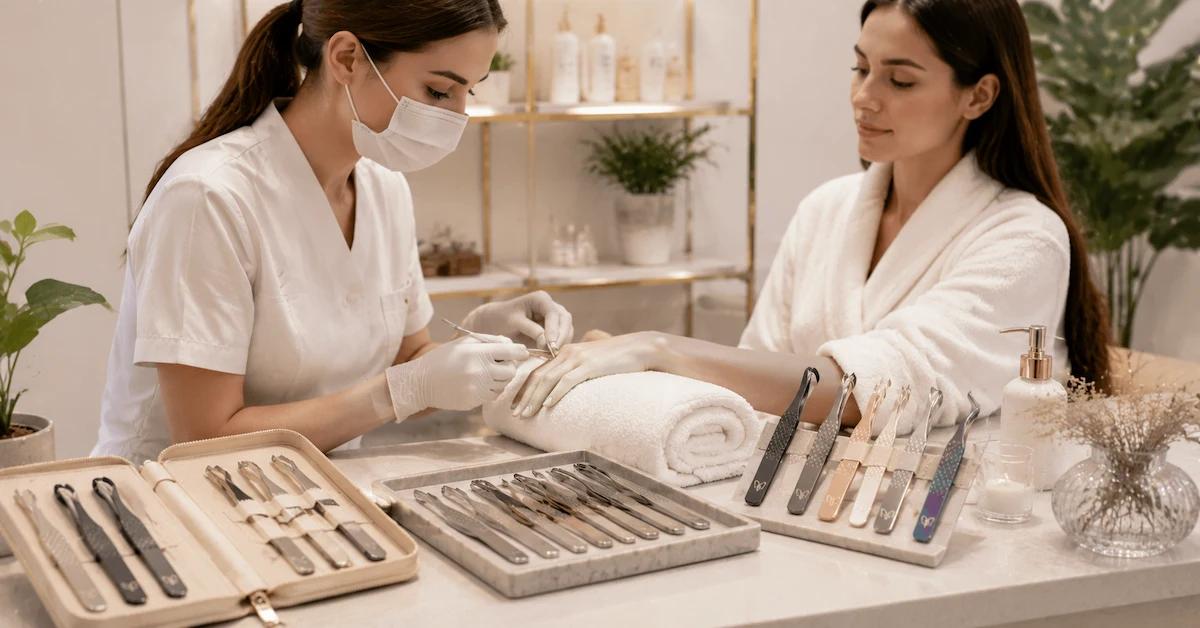
For buyers comparing logo printed beauty tools, the real question is not whether a logo can be added. It is whether the tool set still feels dependable in the hand, looks cohesive on the shelf, and survives normal salon use without the branding wearing away too quickly. That matters to salon owners, sourcing teams, and private-label brands because a small grooming tool can carry a surprising amount of brand weight. A tweezers set, a cuticle tool, or a compact beauty kit is handled often, stored in trays, carried in cases, and shown to clients at close range. If the branding is sloppy, the whole line looks cheaper than it should.
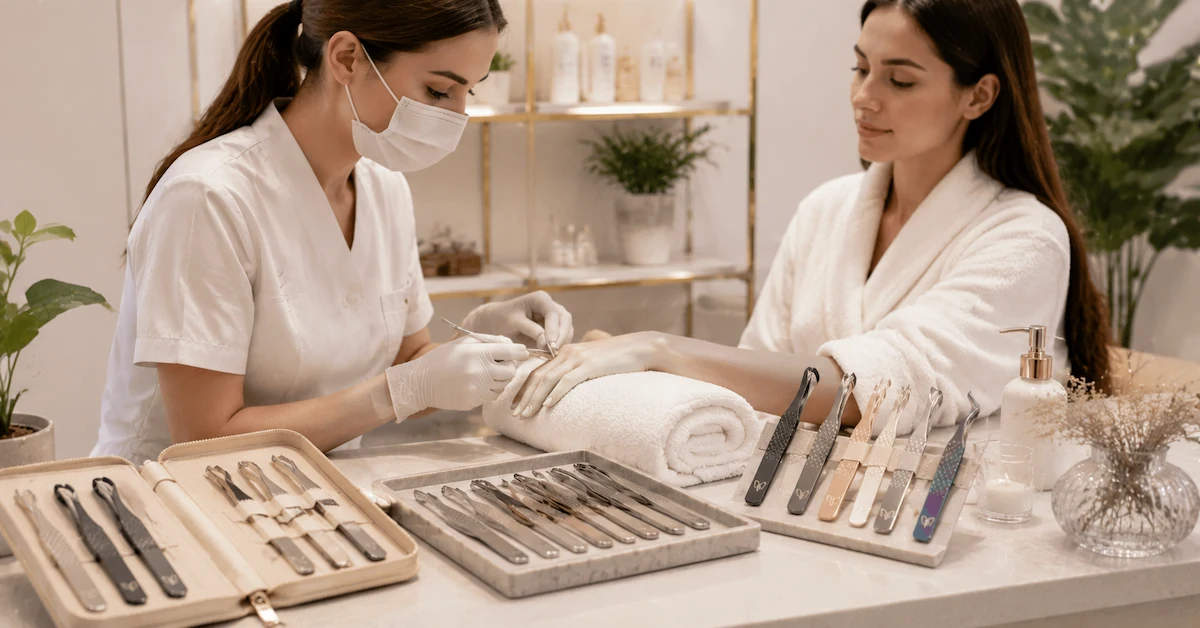
The set shown here points to that reality clearly: slim metal hand tools, different finishes, organized trays, and an open zippered carrying case. Some handles carry visible brand marks, while the finishes vary from silver to black, gold-toned, rose-gold, and decorative printed patterns. In other words, the product is doing two jobs at once. It is a working instrument and a branded retail object. Buyers who understand both sides usually make better procurement decisions.
Why branded beauty tools sell differently from plain tools
Unbranded beauty tools are easy to compare on price alone. Branded tools are judged by a wider set of cues: how the metal feels, whether the finish looks consistent, how the logo sits on the handle, and whether the packaging feels ready for retail or professional resale. That is why private-label beauty tools often need more thought than commodity hand tools.
In salons and spas, the tool is part of the service experience. A client notices when a technician reaches for matching tweezers and a neat case instead of a loose drawer full of mixed items. For retail buyers, a branded set can support repeat purchase behavior and make the assortment easier to merchandise. For manufacturers, the challenge is to keep the branding visible without interfering with grip, cleaning, or tool balance.
What usually goes into a branded grooming set
From the product details available, this category appears to center on precision tweezers and related hand tools for eyebrow shaping, lash work, and manicure or cuticle tasks. That is a practical combination. These are the tools most likely to be kept together in one service kit because they support complementary tasks and are small enough to package in a compact case.
A buyer looking at this sort of assortment should pay attention to three things:
- Tool geometry — angled, slanted, pointed, or curved tips serve different jobs.
- Handle feel — slim, elongated bodies are useful, but only if they remain comfortable during repetitive work.
- Set organization — trays and a zippered carrying case make the difference between a display item and a usable kit.
That last point is easy to underestimate. A tidy case does not just look better. It also helps protect tips from damage, keeps tool families grouped together, and reduces the chance of mix-ups in a professional setting. For retail, it improves shelf presentation. For field use, it improves portability. Those are not glamorous benefits, but they are often the ones buyers remember after the first month.
Materials and finishes: what buyers can infer, and what they should not assume
The visible tools appear to be metal, most likely stainless steel or a similar corrosion-resistant alloy. That is a sensible base material for grooming tools because it supports precision forming, polishing, and cleaning. The product imagery also shows several surface finishes: natural silver, matte black, gold or brass tones, rose-gold, and some decorative printed handles. Those finishes help a single product line look broader without changing the core tool design.
Still, buyers should be careful not to confuse appearance with performance. A gold-toned or black-coated surface may look premium, but the useful questions are underneath that layer: How stable is the coating? Does the finish chip where the tool is handled most? Does the surface affect cleaning or sterilization routines? Those details are not visible in a photo, and they should not be guessed at.
As a practical matter, metal grooming tools are often processed through stamping or forming, then tip grinding, polishing, and surface finishing. That workflow supports consistent shapes across multiple variants. The visible product mix suggests a manufacturer that can offer differentiated SKUs from the same core production family, which is usually helpful for private-label sourcing.
How logo marking usually fits into the process
The branding visible on some handles suggests logo printing or laser marking, though the exact method is not verifiable from the image. In this category, that distinction matters more than it sounds. Printing can be attractive for decorative or promotional use, while laser marking is often favored when a buyer wants a sharper, more permanent-looking brand presence. Neither is automatically better. The right choice depends on the finish, the intended price point, and how the tools will be handled.
One caution is worth making plainly: a logo placed where fingers constantly rub can wear faster than expected, especially on tools used daily in salons. That is a packaging and placement issue as much as a marking issue. Buyers should ask where the brand will sit on the handle, how it behaves on curved metal surfaces, and whether the mark still looks clean after routine cleaning and storage. A logo that looks excellent in the first sample can become a weak point if it sits in the wrong location.
What private-label buyers should specify before ordering
When teams source private label beauty tools, the temptation is to focus on the logo artwork first. That is understandable, but it is not the best place to start. The functional specification should come first, and the branding should follow it.
A useful order brief usually covers these points:
- Which tool types belong in the set, and which are optional.
- Whether the tools are intended for salon service, retail resale, or promotional use.
- Preferred finish families, such as silver, black, gold-toned, or decorative print.
- Brand placement, size, and visual contrast against the handle.
- Case style, tray layout, and whether the kit should be ready for shelf display.
That may sound obvious, but it prevents a common problem: a buyer approves a beautiful sample that photographs well but turns out to be awkward in daily use. A compact case can be elegant while still being inconvenient if the layout makes tools hard to remove or return. Likewise, a decorative handle may look strong in a presentation but feel slippery in service. The best private-label beauty tools usually balance appearance with a very ordinary requirement: they must be comfortable enough that professionals keep using them.
Logo printed beauty tools versus other branded accessory lines
Compared with larger beauty accessories, logo printed beauty tools ask more of the manufacturing partner. A makeup brush handle or cosmetic pouch can tolerate a broader range of decoration choices. Precision tweezers and similar grooming tools depend on alignment, tip shape, and grip. A slightly careless coating or uneven marking can become a functional issue very quickly.
That is why some buyers separate tool branding from softer accessories. They may choose one look for the actual hand tool and another for the case, card insert, or outer carton. Others prefer a more unified line and use the same branding language across the whole set. There is no universal answer, but the second approach requires more discipline. If the handle finish, logo style, and package artwork do not match, the assortment can look pieced together rather than intentionally developed.
Common mistakes buyers make
The most common mistake is treating all metal beauty tools as interchangeable. They are not. Tweezers, lash tools, and cuticle tools may live in the same category, but the user experience is very different. A tool that works well for brow shaping may be wrong for detailed cuticle tasks. Buyers should think in terms of use case, not just overall appearance.
Another mistake is overemphasizing decorative finishes. A rose-gold set can sell well, and matte black can look clean on a retail shelf, but finish should not come before handling performance. The same caution applies to logo size. Bigger is not always better. If the brand mark overwhelms the tool or interrupts the grip area, the set may look promotional rather than professional.
Finally, do not overlook packaging. The visible trays and zippered carrying case are not incidental details. They are part of the product story. If a supplier can make the tools look organized in a case, that often signals they understand how the items will be presented and stored. If the tools arrive loose, with no clear system for arrangement, buyers may spend extra time fixing a problem that should have been addressed in the first sample.
Quick buyer checklist
If you are comparing suppliers for this category, keep the checklist practical:
- Does the tool shape match the intended service task?
- Is the base metal and finish appropriate for routine handling?
- Does the branding sit cleanly on the handle without affecting grip?
- Are the set, tray, and case coherent as a retail or salon product?
- Can the supplier support a consistent look across multiple variants?
That simple review often does more for sourcing quality than a long round of cosmetic revisions. It keeps the team focused on what the customer will actually use.
FAQ
Are logo printed beauty tools only for retail brands?
No. They can also serve salons, spas, nail bars, and esthetics studios that want a more polished service presentation. In some cases, the branding is part of the client experience rather than a shelf-sale strategy.
What is the best finish for private label beauty tools?
There is no single best finish. Silver, black, gold-toned, and rose-gold each solve a different branding problem. The right choice depends on the market position, the case design, and how much handling the tools will see.
Should buyers request samples before placing a larger order?
Yes, especially in this category. Small differences in tip alignment, handle feel, surface coating, and logo placement are easier to spot in hand than in a product photo.
A practical next step for sourcing teams
If your team is evaluating logo printed beauty tools, start with the tool function, then confirm the finish, then decide how the brand should appear on the handle and packaging. Ask for a sample that reflects the actual use case, not just the best-looking version of the product. That is the fastest way to separate a viable private-label beauty tool program from one that only looks good in a catalog.
For brands building a broader assortment, the same logic applies across private label beauty tools and even adjacent categories such as logo makeup brushes: the best product line is usually the one that feels coherent, works cleanly, and does not make the user think too hard. In this business, that is often what “premium” really means.
Tag: