How to Choose Cuticle Nippers for Professional Nail Techs
Choosing cuticle nippers for professional nail techs is less about finding the sharpest-looking tool and more about matching jaw geometry, hand control, maintenance needs, and sanitation procedures to the work being performed. A nipper may look simple, but small differences in the cutting head, spring action, pivot, and finish can affect how confidently a technician prepares the nail fold. This guide helps salon owners, distributors, and professional users assess a compact hand tool before placing a purchase order.
The decision matters because cuticle work is localized and unforgiving. A tool that is too broad may not reach the intended area cleanly. A tool with an awkward spring or poorly controlled handles can increase hand fatigue. Meanwhile, a polished metal surface may be easy to wipe down without automatically proving that the instrument is compatible with every sterilization process. Buyers should separate what can be observed from what must be confirmed with the manufacturer.
Quick buying view
| Feature | Why it matters | What to verify |
|---|---|---|
| Pointed or narrow jaws | Supports localized trimming around the nail fold | Jaw profile, alignment, and access in the intended service |
| Spring-assisted opening | Returns the handles after each squeeze and supports repetitive work | Spring feel, replaceability, and expected service life |
| Central pivot | Controls the relationship between handle movement and jaw movement | Smooth operation, adjustment method, and looseness after use |
| Polished metal finish | Can support routine cleaning when compatible with the care process | Exact material, surface durability, and validated sanitation guidance |
| Compact form | Fits salon stations, portable kits, and mobile services | Overall dimensions, grip comfort, and storage protection |
What the tool is designed to do
Professional cuticle nippers are compact plier-style instruments with two opposing cutting jaws. The pointed jaws are intended to trim loose cuticle and small pieces of non-living skin around the nail. That distinction is important: the instrument is a finishing and preparation tool, not a substitute for clinical assessment or treatment of damaged, infected, or painful tissue.
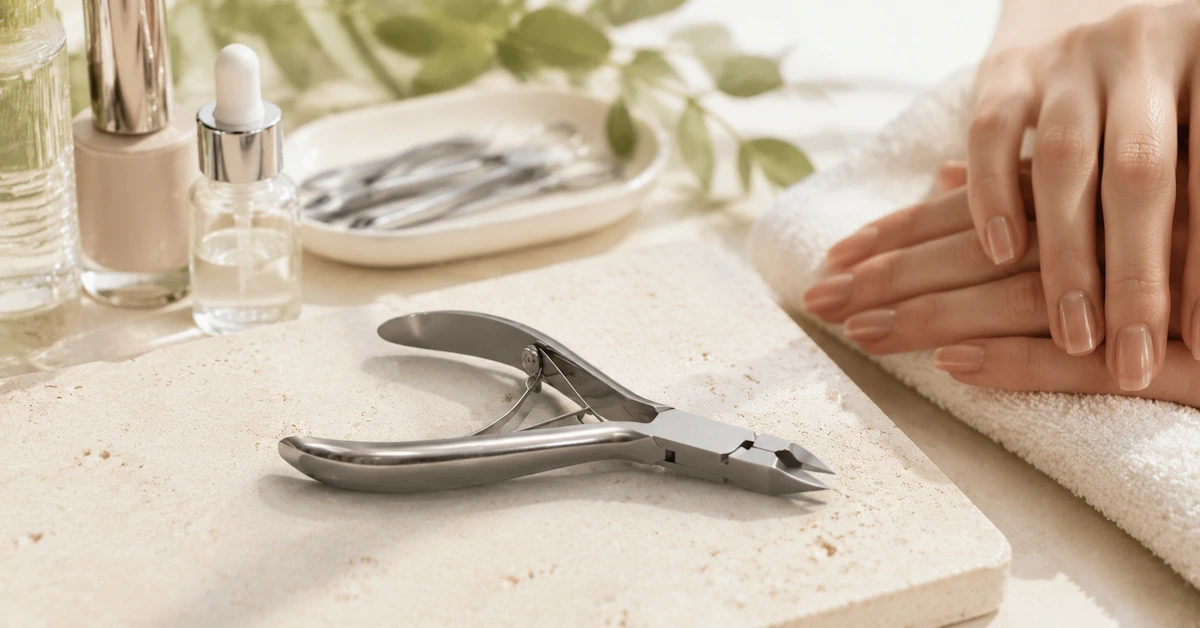
The product shown has a narrow, pointed cutting head that appears slightly angled for access around the nail fold. Its curved handles are shaped for manual operation, and a central pivot fastener connects the two sides. A visible double-leaf spring sits between the handles and helps reopen the tool after the user releases pressure. This arrangement is familiar in professional manicure tools because it allows repeated opening and closing without a separate power source.
Those visible features are useful indicators, but they do not establish performance by themselves. A pointed profile may improve access, yet the actual user experience depends on jaw alignment, edge preparation, pivot adjustment, and the force required at the handles. Buyers should request specifications or samples rather than infer cutting capacity from photographs.
Geometry and control: the practical selection issue
Pointed jaws for localized trimming
Narrow jaws can be advantageous when a technician needs to work close to a small section of loose cuticle instead of removing a broad strip. Precision cuticle nippers are generally selected for this kind of controlled access. However, “precision” should describe a measured or demonstrated result, not merely a marketing label. Ask whether the jaws meet evenly at the tip, whether they remain aligned through the opening range, and how much play is present at the pivot.
A buyer should also consider the technician’s normal service mix. A nail professional performing detailed natural-nail preparation may prefer a more localized cutting head. A busy salon that serves a wide range of users may need a handle and jaw configuration that balances access with ease of control. There is no universal best profile; the right choice depends on the operator and the workpiece.
Spring and pivot behavior
The double-leaf spring is not a decorative detail. Its tension affects the rhythm of the tool and the amount of effort required between cuts. If the spring is too stiff, repetitive use may feel tiring. If it is too weak or poorly seated, the handles may not reopen consistently. The central pivot also deserves attention. A smooth pivot can support controlled movement, while excessive looseness can make a fine cutting head feel unreliable.
During sample evaluation, open and close the instrument slowly, then repeat the movement at normal working speed. Look for smooth travel, consistent spring return, and a jaw that closes evenly without lateral shifting. This simple hands-on check often tells a buyer more than a glossy product photograph.
Material and finish: what can and cannot be assumed
The tool has a smooth, reflective silver-colored finish consistent with polished metal. It may be stainless steel or another polished metal, but the exact alloy is not identifiable from the available product information. Buyers looking for stainless steel cuticle nippers should request the specific material grade and any relevant material documentation before using that description in a technical specification or procurement contract.
Material selection affects corrosion behavior, surface maintenance, hardness, edge retention, and compatibility with cleaning chemicals. Yet none of those properties should be assumed from color or shine. The exact steel grade, hardness, jaw sharpness, and edge-retention performance remain unconfirmed here. A supplier should state what has been tested and under which conditions.
The polished surface appears suitable for routine cleaning, but that does not verify sterilization compatibility. Salons and clinics should ask for the manufacturer’s recommended cleaning and disinfection process, limits on heat or chemicals, and any available validation information. If instruments are processed in an autoclave, do not assume that every polished metal tool is approved for that cycle. The care instructions need to match the actual alloy, joint construction, and spring design.
Manufacturing details worth asking about
This type of instrument is likely made through a combination of formed or forged metal components, machining or grinding of the jaws, polishing, pivot assembly, and spring installation. That is an informed manufacturing interpretation rather than a confirmed process route. The supplier should clarify whether the components are forged, stamped, CNC-machined, or produced using several methods.
For professional procurement, process questions are worthwhile because the cutting head and pivot are function-critical areas. Ask how jaw alignment is checked, how the cutting edges are finished, whether the pivot is adjusted during assembly, and how the spring is retained. If the product will be purchased in volume, request a control plan or inspection summary where available. Exact tolerances, spring cycle life, and cutting-capacity figures should be supplied by the manufacturer rather than estimated by the buyer.
Common purchasing mistakes
The first mistake is choosing by appearance alone. A bright polished finish can make a tool look premium, but it does not prove edge quality, durability, or sanitation suitability.
The second is treating jaw sharpness as the only performance criterion. A very aggressive edge may not be the easiest for every technician to control. Alignment, handle comfort, spring return, and pivot stability all influence practical results.
The third is overlooking service and storage. Compact tools are convenient for mobile technicians and portable manicure kits, but the cutting jaws should be protected during transport. A buyer should also ask whether the spring or pivot can be serviced, whether replacement parts are available, and how the supplier handles tools that arrive misaligned.
Finally, do not add professional, medical, or sterilization claims to a purchase specification unless the supplier supports them. The product is intended for manicure and nail-care work based on the available information, but compliance certifications, medical-device status, warranty terms, country of manufacture, and packaging contents have not been confirmed.
A practical evaluation process for salons and distributors
Start with the intended user. Have several technicians handle a sample if the purchase will support a multi-person team. Compare the opening resistance, grip feel, visibility of the pointed head, and ease of reaching the nail fold. Ask users to comment after a normal working session rather than after one or two cuts; fatigue and control become more apparent over time.
Next, inspect the closed jaws under good lighting. They should appear properly aligned, without obvious gaps or rough finishing. Operate the pivot and spring repeatedly. Then review the supplier’s material statement and care instructions. If sanitation is a critical requirement, make that a written pre-purchase question, not an assumption based on the reflective finish.
For distributors, consistency across production batches may matter as much as the first sample. Confirm the inspection method, acceptable variation, packaging protection, and incoming quality procedure. Exact dimensions and tolerances can be added to the specification once the supplier provides them.
Frequently asked questions
Are these nippers suitable for professional salon use?
The design is intended for professional manicures and pedicures, including cuticle trimming during nail preparation. Suitability for a particular salon depends on the tool’s confirmed material, performance, care instructions, and the technician’s evaluation.
Are they made from stainless steel?
The polished finish appears consistent with stainless steel or another polished metal, but the exact alloy is not confirmed. Request the material grade from the supplier before making a purchasing decision.
Can they be sterilized in an autoclave?
That cannot be confirmed from the visible design alone. Ask the manufacturer for validated cleaning and sterilization guidance, including any restrictions related to heat, chemicals, the pivot, or the double-leaf spring.
What is the advantage of the pointed cutting head?
Its narrow geometry is intended to provide access for localized trimming around the nail fold. The actual level of control depends on jaw alignment, edge preparation, pivot condition, and user technique.
Next step for buyers
Before approving a production order, request a sample and a concise technical sheet covering the material, dimensions, jaw geometry, care procedure, inspection points, packaging, and available service support. Evaluate the tool in the hands of the technicians who will use it. A compact nipper can be a dependable salon instrument, but the best purchase is the one supported by clear specifications rather than assumptions.