Heated vs Traditional Eyelash Curlers: Which Type Fits Your Routine?

The choice between heated and traditional eyelash curlers is not only about which one creates a stronger curl. It depends on lash type, makeup habits, hand skill, travel needs, and how much maintenance you are willing to do. A traditional clamp curler gives a quick mechanical bend at the lash base, while a heated curler uses gentle warmth to help shape lashes in a way that can feel closer to using a styling tool on hair.
For beauty buyers, salons, makeup artists, and retailers comparing lash tools, the best option is the one that solves a real user problem without adding unnecessary complexity. Some customers want a simple stainless steel curler they can keep in a makeup bag. Others want a heated tool because their lashes point downward, lose shape quickly, or need a softer-looking lift after mascara. Olimor Beauty focuses on practical beauty tools for everyday and professional use; you can browse related beauty tool products or compare broader product collections when planning a purchase.
How Traditional Eyelash Curlers Work
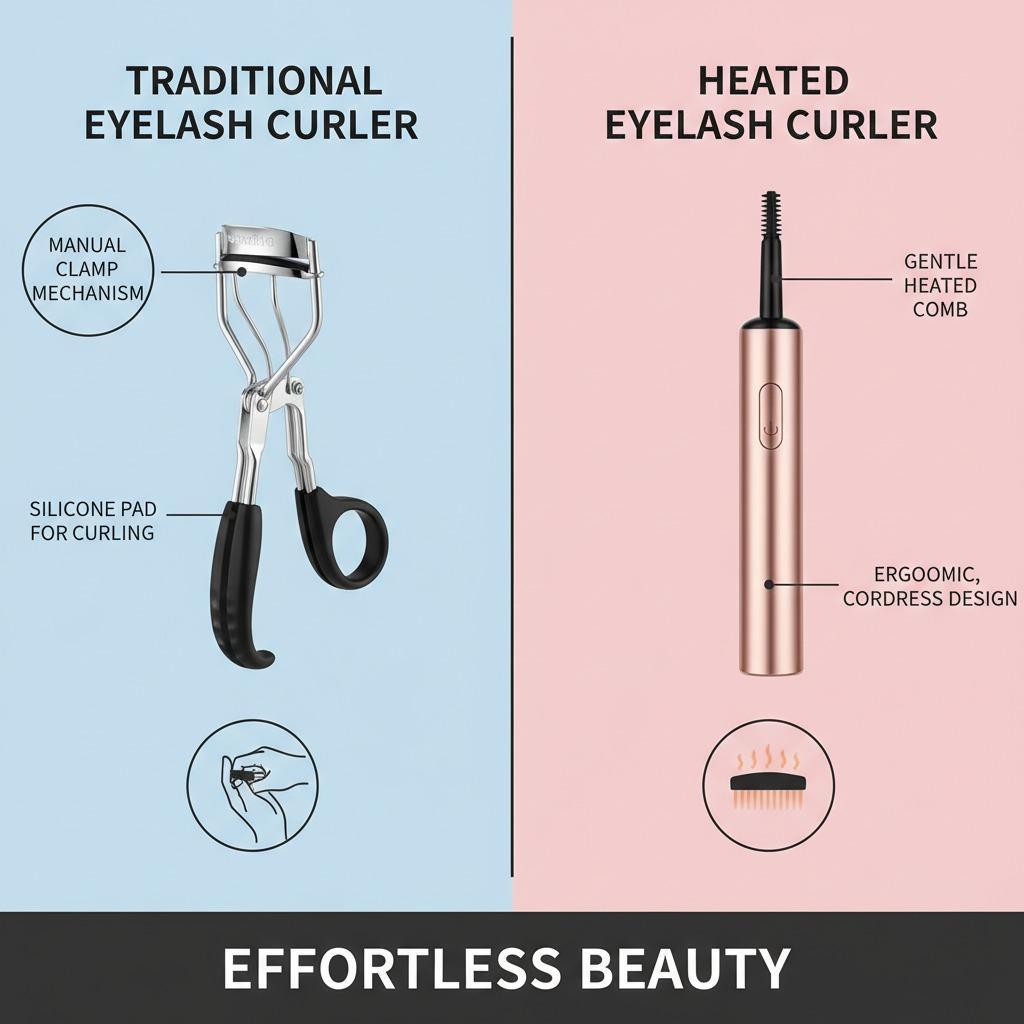
A traditional eyelash curler uses a curved frame, handles, and a cushioned pad to press lashes into an upward shape. The main advantage is direct control. You place the curler near the lash root, close it gently, hold for a few seconds, and release. The result is immediate, and there is no battery, charging cable, temperature setting, or waiting time.
Traditional curlers are often preferred by users who want a sharp lift before applying mascara. They are also easy to understand, which makes them useful for retail counters, makeup kits, and beginner-friendly beauty sets. A well-shaped frame matters because eyelids and eye curves vary. If the curve does not fit the eye comfortably, the user may pinch skin, miss corner lashes, or press unevenly. The cushion pad is equally important: it should be resilient enough to support the lashes without creating a harsh crease.
Traditional curlers do require technique. Pressing too hard, curling after mascara has dried, or using a worn pad can cause discomfort or lash stress. For the best result, users should curl clean, dry lashes and apply pressure gradually rather than clamping aggressively. For many people, this simple habit is enough to get a natural open-eye effect in seconds.
How Heated Eyelash Curlers Work
A heated eyelash curler uses warmth to help lashes hold a lifted shape. The concept is similar to how warm styling tools help shape hair, though lash tools should be used with much more care because the eye area is delicate. Heated curlers are commonly designed as comb-style tools or warming clamp-style tools. Instead of relying only on pressure, they soften the shaping process with controlled heat.
The main appeal is curl hold. Users with straight, downward-pointing, or stubborn lashes often find that a standard clamp creates lift at first, but the curl drops during the day. A heated tool can help set the shape more gradually, which may be useful in humid weather or for long workdays. Heated curlers may also appeal to users who dislike the crimped look that can happen when a traditional curler is pressed too hard.
However, a heated curler is not automatically better for everyone. It may need charging or batteries, and users must pay attention to temperature, timing, and safe placement. It is also not the tool to rush with when the user is tired or applying makeup in a moving car. For retail or wholesale selection, the best heated designs are those that make safe use intuitive: clear on/off operation, comfortable grip, sensible heat behavior, and easy-to-clean surfaces.
Heated vs Traditional: Practical Comparison
The right choice becomes clearer when the tools are compared by use case rather than by hype. The table below summarizes the major decision points for daily users and product buyers.
| Decision factor | Traditional curler | Heated curler |
|---|---|---|
| Speed | Very fast once technique is learned | May need warm-up time |
| Curl style | Strong lift at the base; can be dramatic | Softer shaping; useful for setting curl |
| Best for | Normal lashes, quick routines, travel kits | Straight lashes, drooping lashes, longer wear |
| Skill needed | Placement and pressure control matter | Timing and heat awareness matter |
| Maintenance | Clean pad and replace worn cushion | Clean contact area and manage power source |
| Portability | No power required | Depends on battery or charging design |
For a makeup artist, keeping both types can be practical. A traditional curler gives predictable base lift before mascara. A heated tool can refine lashes that resist shaping or revive a curl after mascara, depending on the tool design and instructions. For an individual user choosing only one, the decision should start with lash behavior. If lashes curl easily and stay lifted, a traditional curler is likely enough. If lashes flatten quickly, a heated option may be worth considering.
Which Curler Is Better for Different Lash Types?
Lash type is one of the strongest indicators of which tool will feel satisfying. Short lashes often benefit from a curler that can reach close to the base without pinching the eyelid. A bulky frame may be frustrating, so curve fit and pad shape matter more than heat. Long lashes may work with either type, but users may prefer a traditional curler for base lift and a heated curler for smoothing the tips upward.
Straight or downward lashes are the group most likely to compare heated tools seriously. Mechanical pressure can lift them, but the result may relax quickly. Heat can help set the direction, especially when used patiently and according to product guidance. Sparse or fragile lashes need a gentler approach. For these users, the winning tool is not the strongest curler; it is the one that allows light pressure, clean contact, and minimal pulling.
Eye shape also matters. Deep-set eyes, hooded lids, and flatter eye curves may not fit the same curler comfortably. When selecting products for a store assortment or professional kit, consider offering options that address different curves, handle styles, and user preferences instead of assuming one lash curler fits every customer equally.
Safety, Comfort, and Maintenance Checklist
Both heated and traditional curlers can be used comfortably when the user avoids rushing and keeps the tool clean. The eye area is sensitive, and a poorly maintained curler can tug lashes, collect makeup residue, or deliver inconsistent results. Before choosing a tool for personal use or sourcing a product line, review these practical criteria:
- Comfortable grip: Handles should feel stable so the user can apply controlled pressure or guide heat carefully.
- Smooth contact surfaces: Edges should not feel sharp, rough, or misaligned near the lash line.
- Pad quality for traditional curlers: The cushion should compress evenly and should be replaced when it develops grooves or cracks.
- Heat control for heated curlers: The tool should be easy to operate and should not require guesswork during use.
- Cleaning access: Mascara, eyeliner, and skincare residue should be easy to wipe away from the pad, frame, or heated contact area.
- Clear user instructions: A good lash tool should make correct placement, timing, and care easy to understand.
- Packaging for the audience: Retail packaging may need simple usage visuals, while professional buyers may prioritize durability and repeat handling.
For traditional curlers, wipe the pad and frame regularly with a suitable cosmetic-tool cleaning method and let it dry before storage. Do not continue using a pad with a deep split, because lashes can catch in the groove. For heated curlers, keep the heating area free from mascara buildup and store the tool away from moisture. Users should avoid applying excessive heat near the eyelid and should stop immediately if the tool feels uncomfortable.
Buying Guidance for Retailers, Salons, and Beauty Brands
If you are choosing eyelash curlers for resale, salon use, or a branded beauty-tool range, think beyond the single question of heated versus traditional. The better sourcing question is: which user problem should this product solve? A travel-focused customer may value a compact traditional curler with no power requirements. A customer with stubborn lashes may look for a heated tool that feels controlled and easy to learn. A makeup artist may want reliable construction, consistent curve shape, and easy cleaning between clients.
Evaluate samples with real handling tests. Check whether the grip slips when hands have lotion on them, whether the frame aligns evenly, whether the pad sits securely, and whether corner lashes are easy to reach. For heated tools, observe warm-up behavior, user guidance, charging or battery convenience, and cleaning access. Avoid relying only on appearance; lash tools are used very close to the eye, so comfort and control affect repeat purchase potential.
Olimor Beauty supports buyers looking for practical beauty tools and sourcing discussions. To compare available options, start with beauty tool products. If you need help matching a lash curler style to your market, you can contact Olimor or send an inquiry with your intended use, target customer, and packaging needs.
Final Verdict: Which One Wins?
There is no universal winner for every lash type. A traditional eyelash curler wins for simplicity, speed, portability, and direct lift. It is the practical choice for users who want a dependable tool without power requirements. A heated eyelash curler wins when lash hold is the main problem, especially for straight or downward lashes that lose shape quickly.
For most users, the smartest decision is to match the tool to the routine. Choose traditional if you want a quick curl before mascara and prefer a low-maintenance tool. Choose heated if your lashes resist curling, you want a softer set, or you need longer wear during the day. For product buyers, offering both categories can serve different customer expectations while keeping the focus on comfort, safe handling, and consistent results.
Tag: