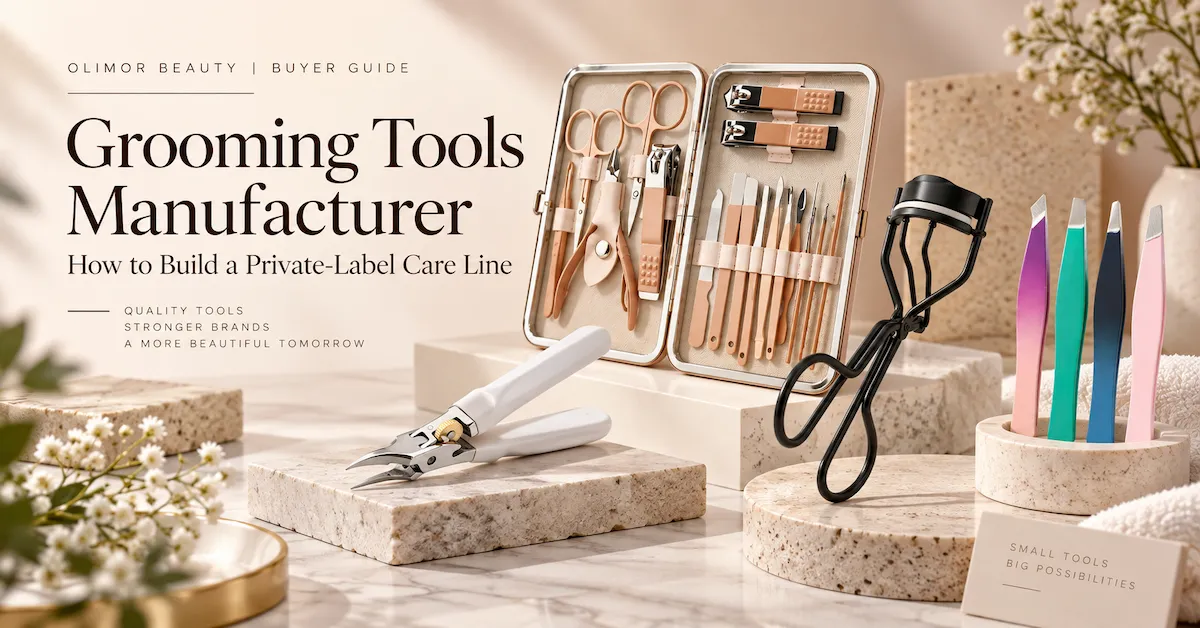
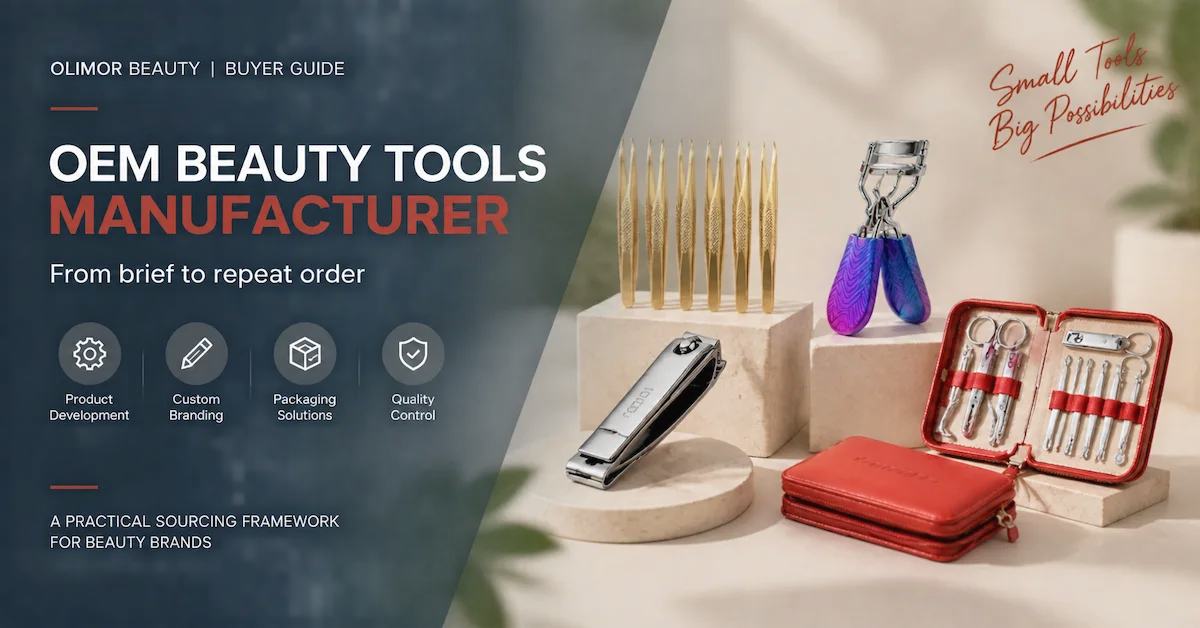
A grooming tools manufacturer should help buyers build a product range that works as a system, not simply supply unrelated items from a catalogue. For a private-label brand, importer, distributor or retailer, the important questions are whether each tool fits its intended grooming task, whether the relevant manufacturing process can be explained, whether samples can be approved against clear requirements, and whether branding and packaging can remain consistent across several SKUs.
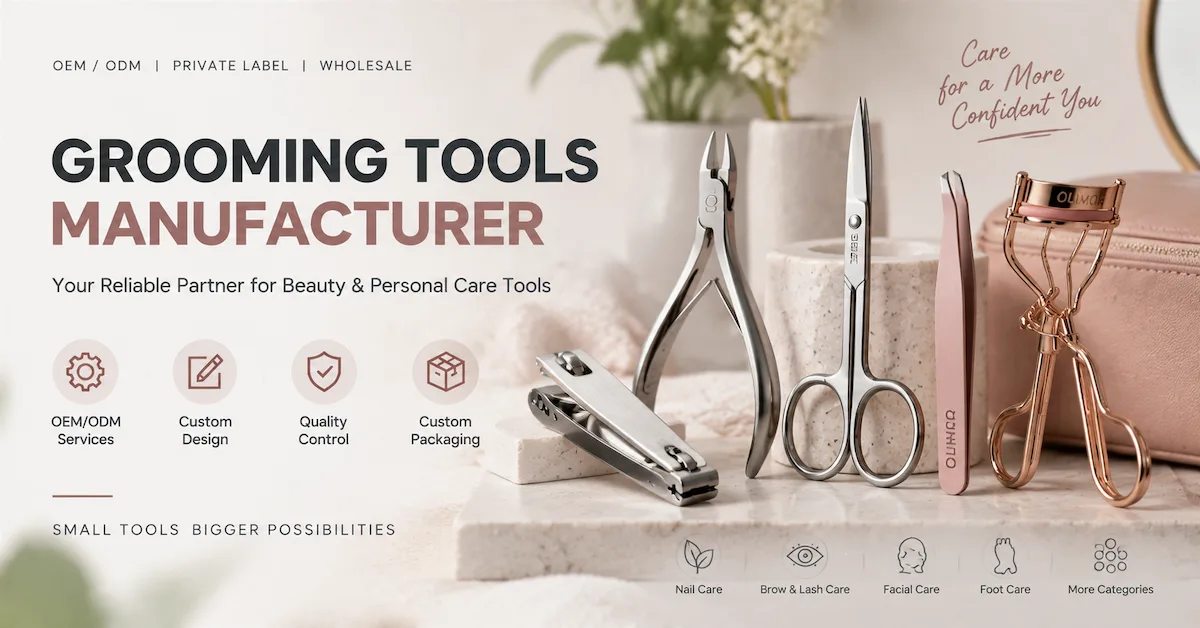
OLIMOR BEAUTY's current product scope includes manicure sets, eyelash curlers, nail clippers, cuticle nippers, tweezers, lash tweezers, beauty scissors, facial tools, tongue scrapers, eyebrow razors, nail files, nail buffers, foot files and related grooming products. Buyers can review the current OLIMOR BEAUTY product range before deciding which categories belong in the same private-label program.
The advantage of working with one supplier across several grooming categories is coordination. The risk is assuming that products with the same logo also share the same material, manufacturing route or QC standard. They usually do not. A successful multi-category program keeps the brand language consistent while controlling each SKU separately.
What Does a Grooming Tools Manufacturer Mean for B2B Buyers?
The term “grooming tools” covers products used for nail care, brow and lash grooming, facial care, foot care and general personal grooming. A buyer searching this term is often looking for a broader sourcing partner rather than a factory that makes only one tool.
That distinction changes supplier evaluation. A single-product buyer can concentrate almost entirely on one construction and one inspection plan. A buyer building a grooming collection must coordinate several materials, working geometries, packaging formats and customer use cases at the same time.
A good supplier should therefore be able to answer two different questions. First: Can you make this particular SKU correctly? Second: Can you manage several different SKUs under one consistent private-label program?
The second question involves artwork control, packaging consistency, sample records, assortment management and communication between product categories. It is one reason why buyers should examine manufacturing and project-management capability separately from catalogue size.
Which Buyers Benefit Most from a Multi-Category Grooming Tools Supplier?
A broad grooming tools manufacturer is particularly relevant to private-label brands, beauty and personal-care distributors, importers, retail chains, e-commerce sellers and buyers developing grooming or manicure gift sets.
A specialist salon buyer may prefer to go deeper into a narrow product category such as lash tweezers or professional nail tools. By contrast, a retailer building a coordinated personal-care shelf may need nail clippers, tweezers, scissors, curlers and manicure accessories that share colour, finish and packaging language.
| Buyer type | Typical priority | What the supplier needs to coordinate |
|---|---|---|
| Private-label brand | Product differentiation and brand consistency | SKU selection, finish, logo, packaging and approval records |
| Importer | Multi-category sourcing and repeatability | Product specifications, carton information and shipment coordination |
| Distributor | Range depth and reorder stability | Category assortment,model identification and change control |
| Retail chain | Shelf presentation and consistent packaging | Barcodes, pack format, product identification and visual system |
| E-commerce seller | Clear differentiation and parcel-ready packaging | Product information, dimensions, package protection and images |
| Professional beauty supplier | Functional performance | Model-specific geometry, handling and QC |
| Gift-set buyer | Coordinated assortment | Tool combination, case layout, colour and complete-set inspection |
A buyer that only needs one simple stock product may not require the full development capability described in this guide.The value becomes greater when several tools, custom branding or repeat programs are involved.
Build the Product Architecture Before Requesting Quotations
A common sourcing mistake is to ask the factory for its “best grooming tools” and then choose from dozens of unrelated models. That approach leaves the assortment logic to the catalogue.
Instead, divide the range according to the grooming task first.
| Product family | Examples in the OLIMOR range | Main buying question |
|---|---|---|
| Nail grooming | Nail clippers, cuticle nippers, nail files, nail buffers | What cutting, shaping or surface-care task must each tool perform? |
| Brow grooming | Tweezers, eyebrow razors, beauty scissors | Which working geometry is appropriate for the intended task? |
| Lash grooming | Lash tweezers, eyelash curlers | What tip, frame,hinge or pad arrangement is required? |
| Manicure sets | Multi-tool manicure or grooming combinations | Which tools genuinely belong together for the target user? |
| Facial grooming | Facial extraction and related grooming tools | What is the intended non-medical grooming use and working end? |
| Foot care | Foot files and related pedicure tools | What surface and handling configuration is appropriate? |
| Oral/personal care | Tongue scrapers and related personal-care tools | What material,edge geometry and cleaning requirements apply? |
| Baby grooming | Baby-oriented grooming products where applicable | Which SKU is specifically intended for this user group? |
This map helps prevent assortment duplication. If two products solve essentially the same customer problem, there should be a commercial reason for carrying both: different price points, different working geometry, different packaging or a clearly different intended user.
It also gives the supplier something more useful than “send your catalogue.” A product architecture tells the factory what the buyer is trying to build.
Do Not Use One Specification for Every Grooming Tool
A multi-category program needs a shared specification format, but the actual checkpoints must change by product.
For a nail clipper, blade meeting and lever movement can be critical. For tweezers, the relationship between the two working tips may matter more. For an eyelash curler, frame geometry, hinge movement and pad position form one system. A manicure set adds another level because the complete assortment and case must also be approved.
| Product | Important geometry | Handling point | Packaging priority |
|---|---|---|---|
| Nail clipper | Cutting edge, opening, lever, pivot | Lever movement and grip | Protect cutting area and control movement |
| Cuticle nipper | Cutting edge,joint and handle | Opening/closing control | Protect cutting end |
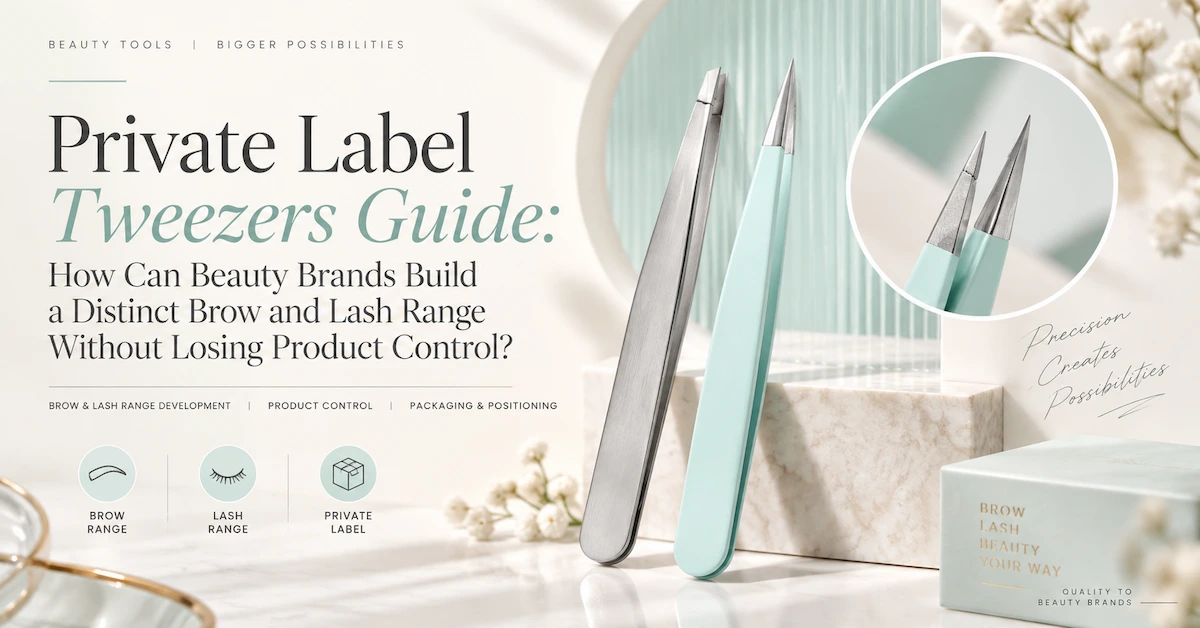
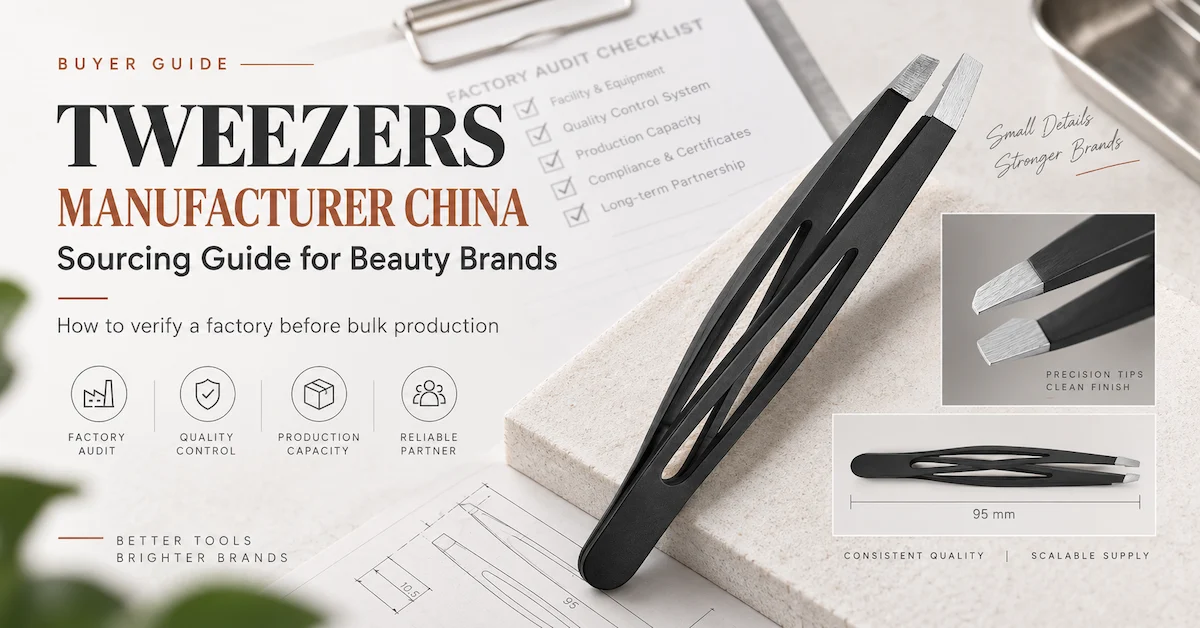
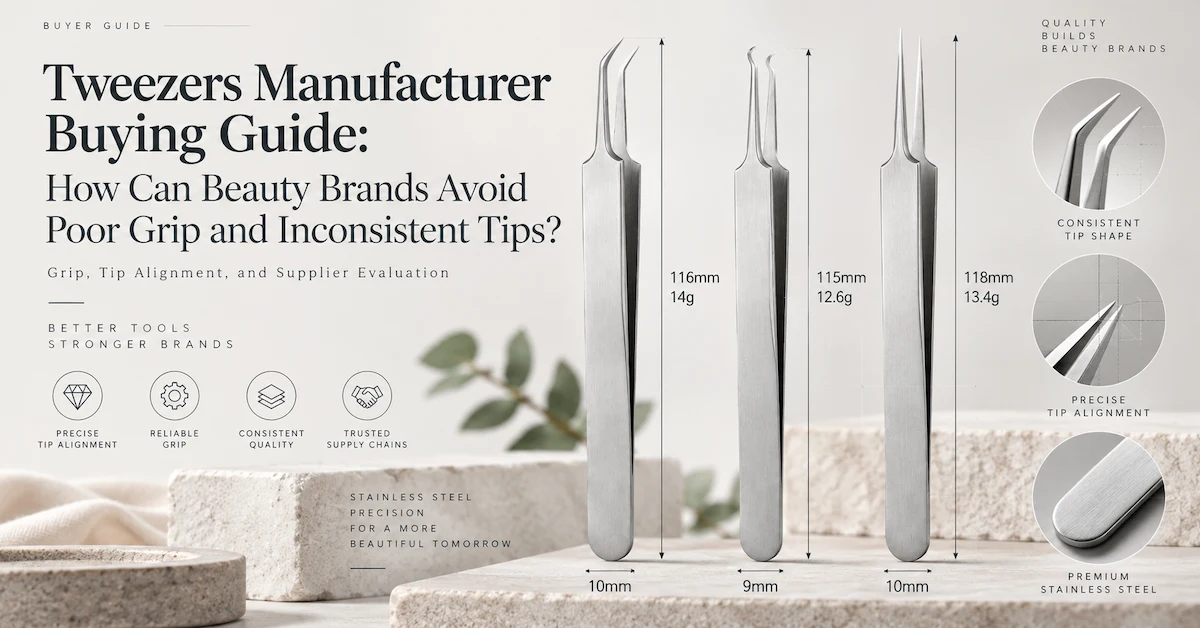
| Tweezers | Tip shape and contact area | Closing pressure and tip control | Prevent tip damage |
| Lash tweezers | Application-specific working tip | Precision handling | Strong working-end protection |
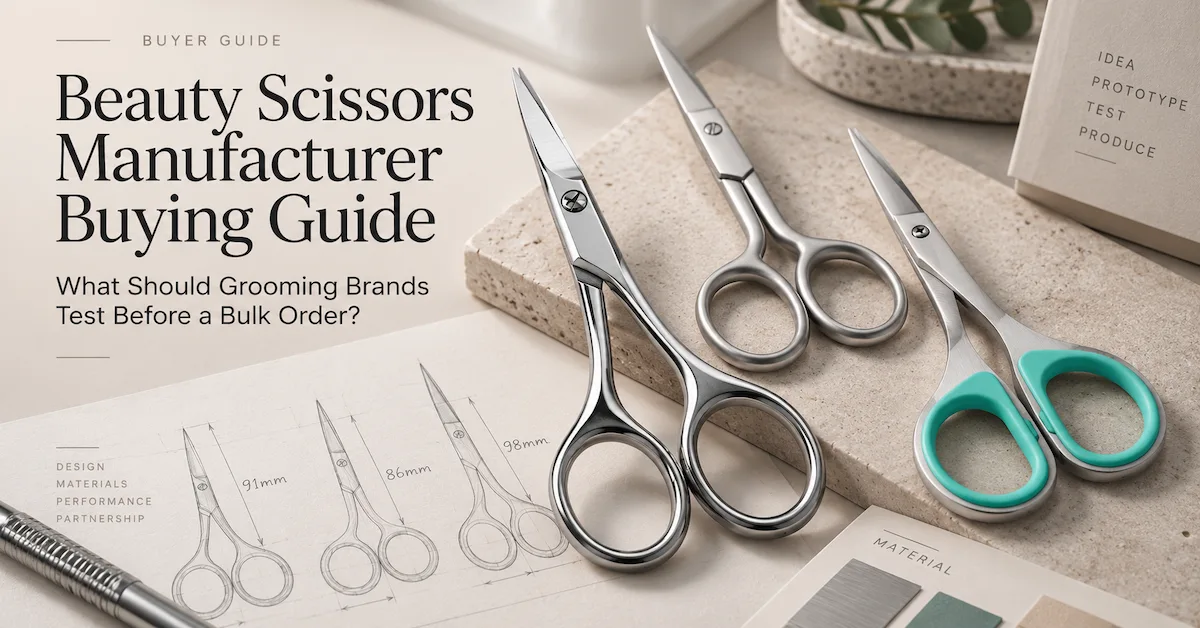
| Beauty scissors | Blade relationship, tip and joint | Opening and cutting movement | Edge and tip protection |
| Eyelash curler | Frame,hinge and pad position | Opening control | Prevent frame or pad deformation |
| Nail file | Working surface and shape | Grip and filing control | Protect surface and adjacent items |
| Manicure set | Individual tools plus case layout | Overall set usability | Keep every component in position |
A professional beauty tools manufacturer should be able to move from a category name to this level of discussion. “Good quality stainless steel tool” is not enough information to approve a production order.
Keep Material Decisions at SKU and Component Level
One of the easiest ways to create inaccurate product content is to assign one material to an entire grooming category.
OLIMOR's product materials already show why this should be avoided. Different tools and components may use different metals, finishes or plastic parts. The company catalogue includes specific stainless-steel references, while nail-clipper sections also include carbon-steel references and zinc-alloy handle designs. That does not establish one universal construction for every model.
Buyers looking specifically for a stainless steel grooming tools manufacturer should therefore ask four questions: Which SKU uses the material? Which component does the description refer to? What finish or treatment is used? Which document or approved sample records the final specification?
This becomes especially important when a product combines materials. A metal cutting component, injected handle, silicone pad, spring and retail case should not all inherit the same material description.
For a multi-SKU line, create one material record per product rather than a sentence such as “our entire collection is stainless steel” unless that statement has actually been verified.
Match Each Product to Its Manufacturing Route
OLIMOR's company information describes metal stamping, cutting-edge heat treatment, polishing and grinding, water deburring, injection moulding, assembly, torque and hardness testing, and packaging equipment. These capabilities are relevant to beauty and grooming products, but not every model passes through every process.
A buyer should ask the grooming tools manufacturer to identify the operations relevant to the selected SKU rather than simply provide a factory-machine list.
For example, a metal tweezer project may focus on forming, working-tip preparation, alignment and surface treatment. A nail clipper can involve a different sequence around forming, relevant treatment, edge preparation, assembly and lever operation. A plastic-handled grooming tool introduces injection-moulding and metal-to-plastic fit questions. A manicure set requires individual tool manufacturing plus complete-set assembly and packaging control.
This process mapping has two benefits. It helps the buyer understand cost and timing, and it makes quality discussions much more specific. If an important feature can change during a particular operation, the inspection plan can be placed near that operation instead of relying solely on final inspection.
More information about OLIMOR's company and manufacturing background is available on the About Us page.
OEM, ODM and Private Label Grooming Tools Require Different Briefs
OLIMOR's supplied company information states that the business supports OEM and ODM development. Buyers can provide drawings, physical samples or product concepts for project discussion, while existing products can provide a starting point for private-label programs.
The terms should not be treated as interchangeable.
Private label grooming tools often begin from an existing product platform. The buyer may focus on the selected SKU, finish, colour, logo and package.
OEM development usually involves more buyer-defined requirements, such as a reference sample, dimensions, structure or other product details.
ODM work can begin with a commercial or functional requirement and involve a greater level of supplier proposal or adaptation.
A project can also be hybrid. A brand might select an existing tweezer body, change the tip and finish, then develop new packaging.What matters is not the acronym but the list of changes.
| Project route | Starting point | Main questions before sampling |
|---|---|---|
| Private label | Existing model | Which branding, finish and packaging options apply? |
| OEM | Buyer sample,drawing or detailed specification | Which features must be reproduced and how will they be checked? |
| ODM | Buyer concept or product goal | What platform or structure is proposed and what must be developed? |
| Hybrid | Existing model plus selected modifications | Which parts remain standard and which require new approval? |
A custom beauty tools manufacturer should be able to make those boundaries visible before the buyer invests in repeated sample rounds.
Use One Brand System, but Keep Every SKU Separately Approved
Multi-category sourcing works best when common brand rules are controlled centrally.
A brand can define one colour family, logo system, typography direction and packaging architecture across clippers, tweezers and curlers. This creates visual consistency for retail buyers and end users.Yet each actual tool must still retain its own specification and approval history.
The shared brand guide might define the rose-gold finish direction, logo size hierarchy, box typography and barcode area. The individual product records would then define the tweezer tip, nail-clipper construction or eyelash-curler frame.
This is particularly useful when launching five or ten products at once. Without the separation, a branding update can accidentally be interpreted as a technical product change, while a structural product revision may reach the packaging team without being noticed.
The simple rule is: share the brand language; do not share unverified technical specifications.
How Should Quality Control Work Across Different Grooming Categories?
OLIMOR's current company profile describes production-process inspection and finished-product or shipment inspection, together with torque and hardness testing equipment. Those statements establish useful capability areas, but the actual QC plan should still be created around the selected product.
| QC stage | What should be considered |
|---|---|
| Incoming material/component check | Identity and visible condition of relevant metals, plastics, pads, springs and packaging |
| First-piece review | Critical geometry, function, assembly and appearance against the approved reference |
| In-process inspection | Product characteristics that could change during forming, grinding, finishing, injection or assembly |
| Finished-product inspection | Function, appearance, branding,accessories and package contents |
| Packing/shipment review | Correct SKU, quantity, carton mark, packaging condition and required shipment records |
| Nonconformance control | Identification, separation, review and disposition of unacceptable pieces |
The actual checkpoint must use product language. For tweezers, “check appearance” is too general if the buyer's main concern is tip contact. For nail clippers, an attractive polished surface cannot compensate for a lever or blade problem. For a grooming set, every component can pass individually while the complete set still fails because one item is missing or moves inside the case.
This is where a broad grooming tools manufacturer should demonstrate category knowledge rather than applying one generic inspection sheet to every SKU.
How Should Buyers Review Certificates and Factory Evidence?
OLIMOR's company-provided information currently records ISO and BSCI items.Before using them for a specific sourcing decision, buyers should request the relevant current documentation and confirm the entity, factory site, scope and date.
A certificate logo in a catalogue should not be used as proof that every product has passed a particular product test. Company-level management or audit information and product-level material or compliance evidence are different things.
The same principle applies to factory photographs and machinery. A photograph can demonstrate that equipment exists in a facility, but the buyer's more useful question is whether that equipment is relevant to the proposed SKU and how its output is controlled.
For GEO and AI visibility, this distinction is also valuable. Clear, scoped facts are easier for search systems to understand than broad statements such as “fully certified products” when the supporting evidence has not been defined.
Packaging Is a Multi-Category Engineering Problem
Packaging is often where a coordinated grooming collection becomes complicated.
A pointed tweezer needs tip protection. A nail clipper requires control of the cutting area and moving lever. An eyelash curler has a larger three-dimensional frame that should not be crushed or distorted. A manicure set needs an insert or case capable of holding several different components in their intended positions.
For that reason, private-label buyers should define a visual packaging family but approve physical packaging product by product.
The buyer should confirm the primary pack, insert, product orientation, accessory location, pack count, barcode area, required artwork and outer-carton information. Where several items are bundled, approve the complete packed configuration rather than a loose collection placed next to a packaging mock-up.
A packaging change should also trigger a logistics review because final packed dimensions and carton quantity can affect freight assumptions.
MOQ and Lead Time Should Be Managed by Configuration
There is no useful universal MOQ for an entire grooming-tool category.
An existing tweezer in a standard finish may involve one commercial setup. The same body with a new surface treatment, custom decoration and printed package may involve another. A new tool structure can create additional development or tooling decisions.
The same applies across a multi-SKU order. A buyer should not assume that ten products can simply share one MOQ because they use the same brand.
Ask the supplier to show commercial conditions by SKU and then explain whether any parts of the program can be consolidated.Separate recurring product cost from development, tooling, decoration and packaging items where relevant.
Production timing should follow the same principle. The schedule needs to reflect the actual product mix, sample status, customization scope and packaging approval, rather than a generic catalogue statement.
This is especially important for seasonal retail launches. A collection is only ready when its slowest unresolved SKU is ready.
How Do You Compare Two Grooming Tools Manufacturers?
A useful comparison should start after both suppliers have received substantially the same brief.
| Evaluation area | Strong supplier response |
|---|---|
| Product range | Categories relevant to the buyer are clearly identified rather than inflated by unrelated catalogue items |
| Product understanding | Supplier distinguishes the critical function of each tool |
| Manufacturing route | Relevant processes can be explained by SKU |
| OEM/ODM | Standard changes and new development are clearly separated |
| Sampling | Approvals and outstanding decisions are documented |
| Quality | Inspection points are tied to actual product functions |
| Packaging | Protection, presentation and pack configuration are reviewed together |
| Commercial clarity | MOQ, cost and schedule assumptions are visible |
| Multi-SKU control | Products share brand rules but retain individual specifications |
| Repeat orders | Approved references and product changes can be traced |
A lower quotation can still be the better commercial option, but only after the buyer knows what is included.The scorecard prevents a polished catalogue or headline price from hiding differences in specification.
Common Mistakes When Building a Grooming Tools Collection
The first mistake is selecting too many models before defining the customer. A larger assortment is not automatically a stronger assortment. Several similar tweezers or clippers can create confusion without adding meaningful choice.
The second is using the same material description across an entire collection. Material should follow the actual model and component.
The third is approving appearance without function. Colour, logo and packaging can be excellent while the tip, blade, hinge or working surface still needs correction.
The fourth is treating OEM and private label as the same amount of development. Changing packaging is not equivalent to developing a new structure.
The fifth is waiting until the end to consider packaging. The final package can change product protection, carton volume and project cost.
The sixth is treating the first order as the end of product development. A repeat-order program needs change control so that a replacement component, revised finish or new package does not silently alter the approved product.
What Should Be Included in a Grooming Tools RFQ?
A strong request for quotation should tell the supplier enough to recommend a realistic configuration.
Start with the intended market, buyer type and product family. List the SKUs or functions you want to include. Attach reference images, drawings or physical sample information where available. State preferred materials and finishes only where they are genuinely requirements. Add the logo and packaging direction, estimated quantity by product, destination market and target launch window.
Then ask the supplier to identify which product platform is proposed, which requirements are standard, which require development, how sampling will be handled, which function-specific QC points apply and what information is still missing.
For a larger collection, use an assortment matrix rather than separate unconnected emails. One document can show the common brand rules while maintaining individual columns for material, geometry, finish, package and approval status.
Buyers can begin by reviewing the OLIMOR product categories, then use the Contact Us page to send the selected categories, reference products and customization requirements.
Where Does OLIMOR Fit as a Grooming Tools Manufacturer?
OLIMOR BEAUTY's current company information describes beauty and personal-care tool development and manufacturing, OEM/ODM customization, production, quality inspection and export services. The product list covers several grooming categories rather than only one narrow product family, which makes the company relevant to buyers considering a coordinated private-label assortment.
Its provided manufacturing information includes metal stamping, cutting-edge heat-treatment equipment, polishing and grinding, water deburring, injection moulding, assembly lines, torque/hardness testing equipment and packaging equipment. The useful value of these capabilities is not that every product uses every process; it is that metal, plastic, assembly and packaging requirements can be discussed within one project when they apply.
For a buyer evaluating OLIMOR as a grooming tools manufacturer, the recommended next step is still model-specific. Select the intended products, identify the target user and sales channel, and then confirm material, structure, branding, package, MOQ, timing and QC requirements for each SKU.
You can review additional company background on OLIMOR About Us and browse related sourcing content through the OLIMOR Blog.
FAQ About Grooming Tools Manufacturing
What products can a grooming tools manufacturer supply?
A grooming tools manufacturer can cover different categories depending on its actual product range. OLIMOR's current list includes nail clippers, cuticle tools, tweezers, lash tools, eyelash curlers, beauty scissors, manicure products, nail files, foot-care items, facial tools, tongue scrapers and related personal-care products. Buyers should confirm the specific models available for the planned program.
What is the difference between a grooming tools manufacturer and a beauty tools manufacturer?
The terms overlap significantly in B2B sourcing.“Grooming tools” often emphasizes practical personal-care tasks such as trimming, shaping, cutting and maintaining nails, brows, lashes or other grooming areas, while “beauty tools” can be used more broadly. The useful distinction is the actual product scope rather than the label.
Can one manufacturer supply an entire private-label grooming collection?
A multi-category supplier may coordinate several products under one program. However, each SKU still requires its own specification, material confirmation, sample and appropriate QC criteria. Shared branding should not be used as a substitute for model-level product control.
Does OLIMOR support OEM and ODM grooming tools?
Yes. OLIMOR's supplied company information states that OEM and ODM are supported and that development can begin from customer drawings, samples, appearance concepts or structural requirements. The exact development scope and commercial conditions should be confirmed for the selected product.
Can I customize the logo, color and packaging?
Customization can be discussed as part of an OEM, ODM or private-label project.The applicable logo method, finish, colour, packaging format and quantity should be confirmed for the individual SKU before final approval.
Are all OLIMOR grooming tools stainless steel?
No category-wide material claim should be assumed. The available materials can vary by product and component. Buyers should obtain the confirmed material specification for each selected model.
What should I check when approving a grooming-tool sample?
Start with function and geometry, then review material, movement or hand feel, finish, colour, logo and final packaging. Record exactly which features have been approved and which remain open.
What is the MOQ for private label grooming tools?
There is no single reliable MOQ that should be applied to every product configuration. MOQ can depend on the selected SKU, finish, branding, packaging and development work. Request the requirement for the exact proposed order.
How do I compare several grooming tools suppliers?
Give each supplier substantially the same product brief and compare product fit, manufacturing route, sample quality, QC plan, customization scope, packaging, MOQ, lead-time assumptions and repeat-order control. A quotation should only be compared once the underlying configurations are clear.
What should I send OLIMOR for an OEM or private-label inquiry?
Send the target market, intended buyer, product categories, reference products or drawings, estimated quantities, material or finish preferences, branding requirements and packaging concept. Use the OLIMOR contact page to begin a project-specific discussion.
Conclusion
Choosing a grooming tools manufacturer for a private-label program is ultimately about managing differences across products while keeping the collection commercially consistent.Nail clippers, tweezers, curlers, scissors, manicure tools and personal-care accessories may share the same brand identity, but they should not automatically share one material statement, inspection method or manufacturing assumption.
A stronger sourcing process begins with a clear assortment architecture, creates one specification and approval record for each SKU, connects those specifications to relevant manufacturing and quality-control steps, and only then compares MOQ, lead time and price. Buyers planning a multi-category range can explore OLIMOR BEAUTY products and contact OLIMOR with their target categories, reference designs, estimated quantities and private-label requirements.