

What buyers need to know before placing a foot file wholesale order
If you are comparing foot file wholesale options, the real question is not just which tool looks good in a catalog. It is whether the product will hold up in salon use, move cleanly through retail channels, and give the end user a simple way to manage rough heels and dry skin without frustration. A foot file seems like a small item, but in practice it sits at the intersection of comfort, hygiene expectations, packaging economics, and repeat purchase behavior.
That is why sourcing teams tend to look beyond the headline price. A wholesale foot file has to be easy to grip, compact enough for kits and shelf displays, and consistent enough that one batch does not feel noticeably different from the next. For a product like this, the buyer is often deciding among multiple use cases at once: personal foot care, spa supply, salon pedicure kits, promotional beauty packs, or general beauty-tool distribution. The best option is rarely the fanciest one; it is the one that matches the channel.
What the product is, and why the design matters
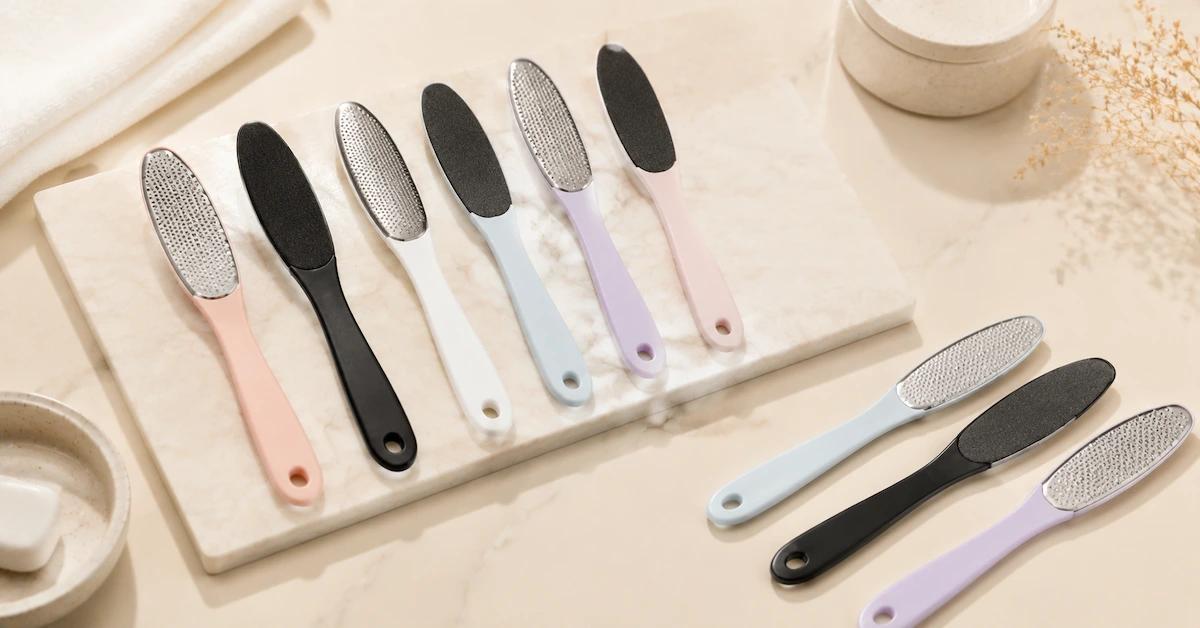
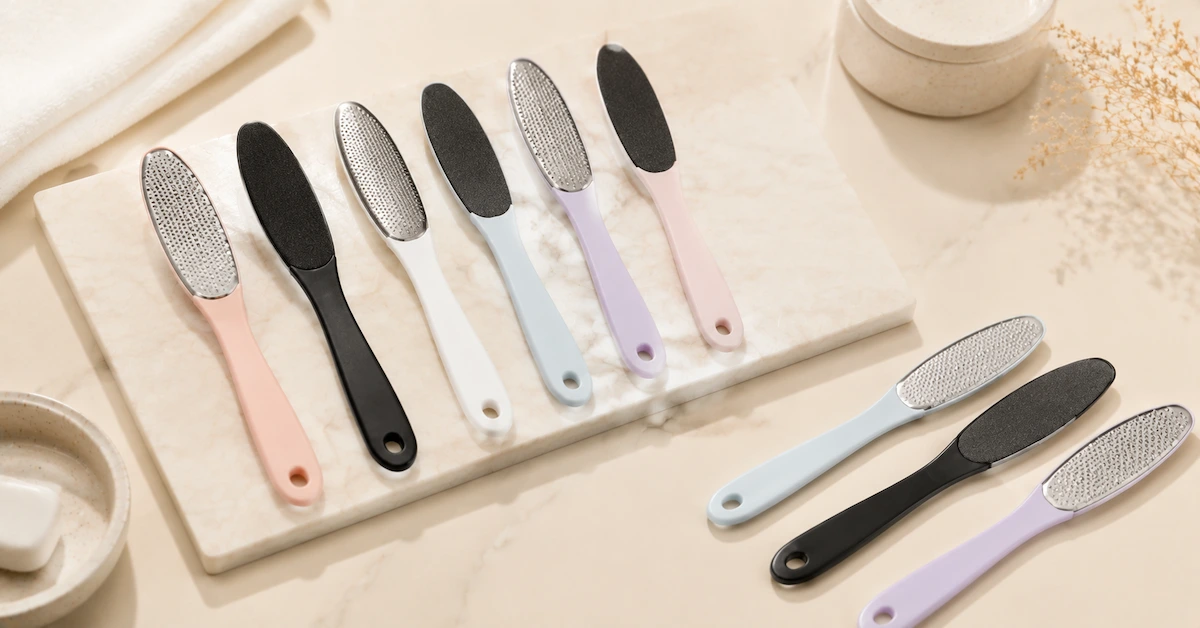
The visible product here is a handheld foot file, also commonly called a callus remover tool. It has a slim, elongated paddle shape with an oval or rounded filing surface and a flat handle that includes a hanging hole. That sounds straightforward, but the geometry matters more than many buyers expect.
A contoured filing head gives the user a broader contact area across the heel or ball of the foot, while the long handle helps with leverage and reach. The hanging hole is a small detail that becomes useful in a salon setting, where tools need to dry, store, or hang alongside other accessories. The overall size also suggests a product suited to travel kits and countertop display, not just bulk back-room inventory.
The handles appear to be molded plastic in several colors, including pink, black, white, light blue, and lavender. That is not only a styling choice. In wholesale beauty goods, color variation can help buyers segment product lines by retail theme, spa branding, or kit colorways. A neutral black version may suit salon use, while softer shades can fit consumer beauty sets more comfortably.
The abrasive face appears to vary by unit. Some examples show a textured perforated or etched metal-like surface, while others look more like a bonded abrasive pad or sanding surface. Because the exact material is not confirmed, a cautious buyer should treat surface claims carefully until the supplier provides a clear specification sheet and sample confirmation.
Quick buyer takeaways
For wholesale purchasing, the main decision points are usually simple, but they should be checked in order:
The handle should feel stable in the hand and not flex excessively.
The filing surface should be consistent across units, since uneven abrasiveness can create customer complaints.
The size should suit the intended channel: salon kits, retail peg hooks, travel sets, or general personal care assortment.
Color range can help retail presentation, but only if the supply can hold color consistency.
Storage and hanging features matter more in professional environments than many first-time buyers assume.
If your channel is salon or spa, the tool’s grip and cleanability may matter more than packaging aesthetics. If your channel is retail, display value and perceived quality often drive sell-through.
How wholesale buyers should evaluate a foot file supplier
When talking to a bulk foot file supplier, it helps to move past generic product descriptions and ask questions that reveal whether the factory or trading partner really understands the item.
1. Clarify the material stack
The product appears to combine a molded plastic handle with an abrasive head, but the exact build is not visible from the image alone. Ask what material is used for the handle, what the abrasive side is made of, and whether the surface is metal, coated, etched, or bonded to another substrate. That detail matters for durability, perceived value, and how the item behaves after repeated use.
2. Ask how consistent the finish is
A foot file is a simple tool, but inconsistency shows quickly. If the filing face feels rough in one batch and smoother in another, customers notice. For wholesale programs, ask for sample units from the same production lot, or at least a representative pre-production sample before committing to a large order.
3. Review the grip and shape for real use
The flat handle and elongated body are practical, but not all handheld foot files feel the same in use. A tool that looks compact may still be awkward if the handle is too narrow, too slick, or poorly balanced. In salon work, that becomes tiring over a shift. In consumer use, it becomes an item that ends up in a drawer after one attempt.
4. Check packaging fit, not just packaging looks
For a wholesale foot file order, packaging has to support the channel. A hanging hole may be useful for blister cards or peg display. For salon supply, a simple bulk pack may be enough. For retail, the package should protect the abrasive face and keep the product from scuffing other items in transit. A pretty pack that arrives damaged is not a win.
Where this kind of foot file fits best
This product format is best suited to straightforward, high-frequency foot care tasks. It is a practical choice for removing dry skin and smoothing calluses, especially on heels. Because the tool is handheld and compact, it also fits neatly into pedicure kits and travel-friendly beauty sets.
For spas and salons, the tool’s appeal is not just its function but its simplicity. Staff need products that are easy to identify, quick to store, and cheap enough to stock in quantity without overcomplicating inventory. For retail beauty brands, the color options can help create a friendlier shelf presence. For distributors, the one-piece format reduces the number of parts to track, which is a small operational advantage that often matters more than buyers admit.
Common mistakes in sourcing foot files
One frequent mistake is treating every foot file as interchangeable. They are not. Even a modest-looking difference in surface texture or handle shape can change customer satisfaction.
Another mistake is over-focusing on unit price while ignoring packaging and damage rate. A low-cost item that arrives scuffed, bent, or inconsistently finished can become expensive once returns and replacements are counted.
A third issue is assuming that a visible metal-like surface tells the whole story. Unless the supplier confirms the underlying material and manufacturing method, the buyer should not promise specific performance characteristics to downstream customers.
There is also a practical caution for brands selling into professional settings: if the tool is intended for salon use, buyers should consider whether their customers expect easy cleaning and routine replacement. If that is not addressed, the product may be fine for retail but awkward for service environments.
Practical procurement advice for sourcing teams
If you are building a wholesale assortment, start by matching the foot file to the channel rather than the other way around. A spa supplier may want a restrained color palette and dependable packaging. A mass retail buyer may want multiple color variants and a simple hook-friendly format. An e-commerce seller may prefer a product that photographs clearly and communicates value in a single glance.
It also helps to request a small set of samples in different colors if those are part of the offer. Color can be a reliable way to evaluate mold consistency and finish quality. Look at the hanging hole, the handle edges, and the bond between the abrasive head and the body. These details tell you more about production quality than a product title ever will.
If you are comparing a wholesale foot file against other callus remover tools, think about user effort. A larger filing face may cover more skin, but a tool that is too aggressive or too awkward can discourage repeat use. There is a balance between effectiveness and comfort, and the best-performing product usually lands somewhere in the middle rather than at the extremes.
FAQ for wholesale foot file buyers
Is this type of foot file suitable for retail and salon channels?
Yes, the visible format is versatile enough for both. The final fit depends on the supplier’s material quality, packaging, and consistency.
Can the color options help with merchandising?
Yes. Multiple color variants can help segment SKUs, support gift sets, or match brand themes. They also make shelf displays look more intentional.
Should buyers ask about replaceable heads?
Absolutely, if that feature matters to your channel. It is not confirmed here, so do not assume it exists.
Is the abrasive surface definitely metal?
Not necessarily. The visible finish suggests a metal-like or abrasive surface, but that should be confirmed by the supplier before any product claims are made.
What to ask for before you place an order
Before you commit, ask for a sample, a written material description, packaging details, and photos of the actual production unit rather than just a styled render. If the order is going into a salon, confirm how the tool is intended to be stored and whether the hanging hole is functional in the final package. If the order is retail-facing, ask how the color finish appears under normal store lighting, because some pastel plastics photograph well but look different on shelf.
For buyers comparing wholesale foot file options, the safest path is to treat this as a small product with big downstream consequences. The right tool can move steadily through beauty aisles, kit bundles, and professional supply orders. The wrong one creates returns, complaints, and awkward questions from customers who expected a simple foot care item to work like the sample.
If you are reviewing a new sourcing program, start with a sample comparison and a packaging check. Those two steps usually reveal whether the item is ready for a serious wholesale conversation or still needs refinement.
Tag:
Share On
Click to expand more
Related articles
- Manicure & Nail Tools
- OEM & Private Label
Gift Business Manicure Kit Supplier Guide: Custom Nail Care Sets for Brands and Retailers
- Manicure & Nail Tools
- OEM & Private Label
OEM Nail Clipper Manufacturer: Complete Guide to Custom Nail Care Solutions
- Manicure & Nail Tools
- OEM & Private Label