Quick Answer: To choose an eyelash curler manufacturer, approve a complete, coded sample rather than a catalogue photo. Check whether the frame curve suits the intended user, the upper bar meets the pad evenly, the pad stays seated, the hinge moves predictably, and the handle gives controlled pressure. Then review the actual finish, logo, retail pack, and replacement-pad arrangement. Put each accepted feature, inspection method, and revision on the quotation and production specification before authorizing a bulk order.
Introduction: the sample on your desk is not yet the product on your shelf
A lash curler can look refined in a photograph and still feel awkward when someone places it close to the eyelid. A rose-gold finish does not tell a buyer whether the upper bar meets the cushion evenly. An attractive package does not reveal whether the hinge sticks halfway through a squeeze. Those are small observations, but they determine whether a beauty brand is approving a usable tool or merely approving an image.
The problem becomes more serious when a buyer adds a logo or asks for a new colour. The early sample might use a standard pad and a bare-metal frame. The final unit may have another finish, a decorated handle, a different insert, and a spare pad. If none of these changes is tied to a revision and approval method, the next batch can drift while everyone believes they are ordering the same curler.
This article is a sample-to-production guide for brands, beauty retailers, salon distributors, and importers. It is deliberately different from a general supplier list or a consumer tutorial. It shows what to ask, what to compare, what to record, and when to pause. The real OLIMOR BEAUTY product pages below illustrate possible design directions; a page photograph is a starting point, never a substitute for checking the precise model and final project configuration.
What is the manufacturer responsible for on this SKU?
For procurement purposes, an eyelash curler manufacturer is accountable for the finished relationship between frame, upper pressing bar, lower pad channel, cushion, moving joint, and handle. A quoted design may also include a coated surface, grip piece, spare pad, or protective carton. Hold an open sample against the light and watch it close: the two ends of the bar should not tell different stories. A cushion can be immaculate yet leave one side of the lash line under a different pressure.
Trace that relationship back through the work on the quoted item. Who forms the frame? Who fits the pad and sets the joint? Does a finishing step occur before or after movement is adjusted? Which inspection rejects a bar that lands unevenly? Outsourcing one operation is not automatically a weakness. What a buyer needs is a named control point and an answer to what happens when the next tray of parts no longer matches the signed sample.
OLIMOR BEAUTY's portfolio includes lash curlers, and its project material describes development from drawings, physical references, appearance concepts, and structural requirements. The wider beauty-tool capability list covers stamping, heat treatment, injection, polishing, deburring, assembly, and packaging. Ask for the actual route of the proposed curler before attributing every listed operation to it. A category page alone cannot identify its steel grade, cushion compound, coating performance, or site of every operation.
First define one buyer and one use case
A sample review has no useful pass condition if the product brief only says "premium curler." Write down who will use it and where it will be sold. A mass-market starter tool, a salon retail accessory, a travel set component, and a colour-coordinated private-label line can demand different grip, pack, and service details. The frame is used near the eye in every case, so control and comfortable positioning remain central; the business priorities surrounding it vary.
State the intended user, sales channel, target appearance, expected pack, and launch market. Record whether your team wants a classic full-width curler, a narrower partial-lash option, or another structure. Do not promise that any one curvature fits every eye shape. Instead, decide which audience your sample panel represents and document the fit observations. If the product is presented for professional use, define what that means for this range rather than assuming the word itself proves performance.
For example, a private-label retailer might brief a rose-gold full-width curler for everyday makeup, with a logo visible in the product photograph, a stable pad, a spare pad only if compatible, and a protective carton. A salon distributor might prioritize repeated operation and cleaning guidance. Those briefs lead to different sample questions and different quotations even when the catalogue silhouette is similar.
| Project brief item | Decision the brand makes | Evidence requested from the supplier |
|---|---|---|
| Audience and channel | Starter retail, salon resale, online, or set component | Relevant candidate models and complete product photos |
| Functional format | Full-width, partial, or another approved format | Physical coded samples and component description |
| Appearance | Finish, grip colour, logo, and visual family | Actual decorated sample and approved colour reference |
| Pack and market | Protection, language, barcode, instructions, and shipping route | Final packed sample and market-specific artwork review |
| Service plan | Whether a matching spare pad is included or supplied | Pad specification, fit check, and replenishment answer |
Build a shortlist that compares structures, not just colours
A professional eyelash curler manufacturer should help a buyer narrow the range by use case. Request two or three distinct construction directions. A loop-handle metal model, a model with a broader grip, and a compact or decorative design may reveal useful differences in hand position and pad access. Do not ask for twenty anonymous samples and then try to remember which photograph belongs to which physical tool.
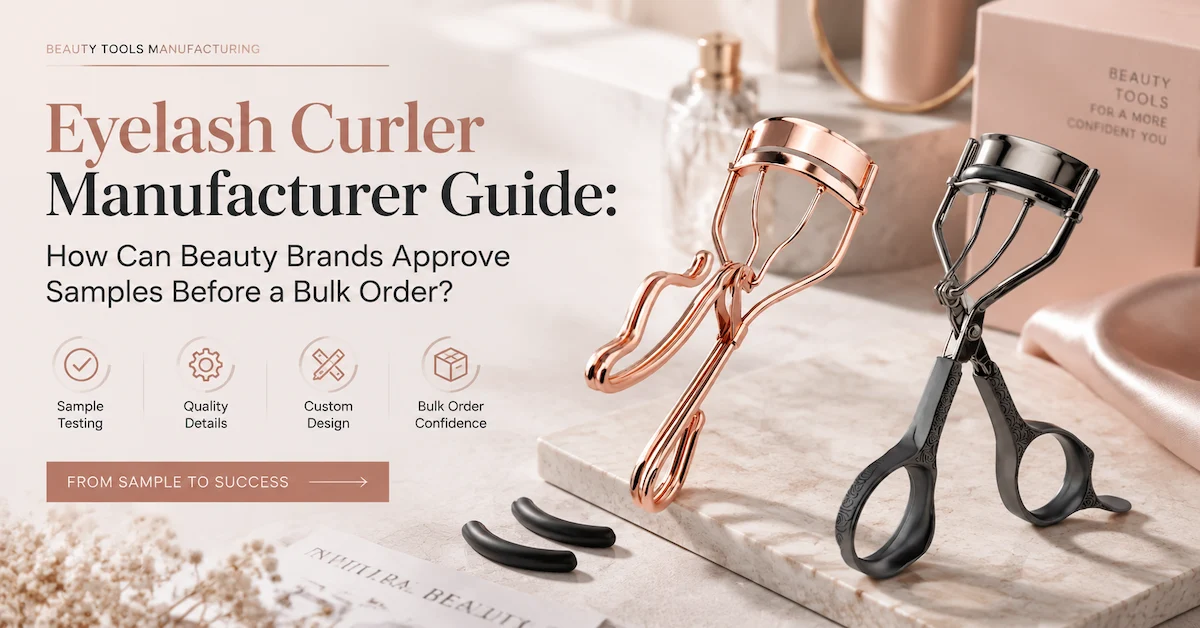
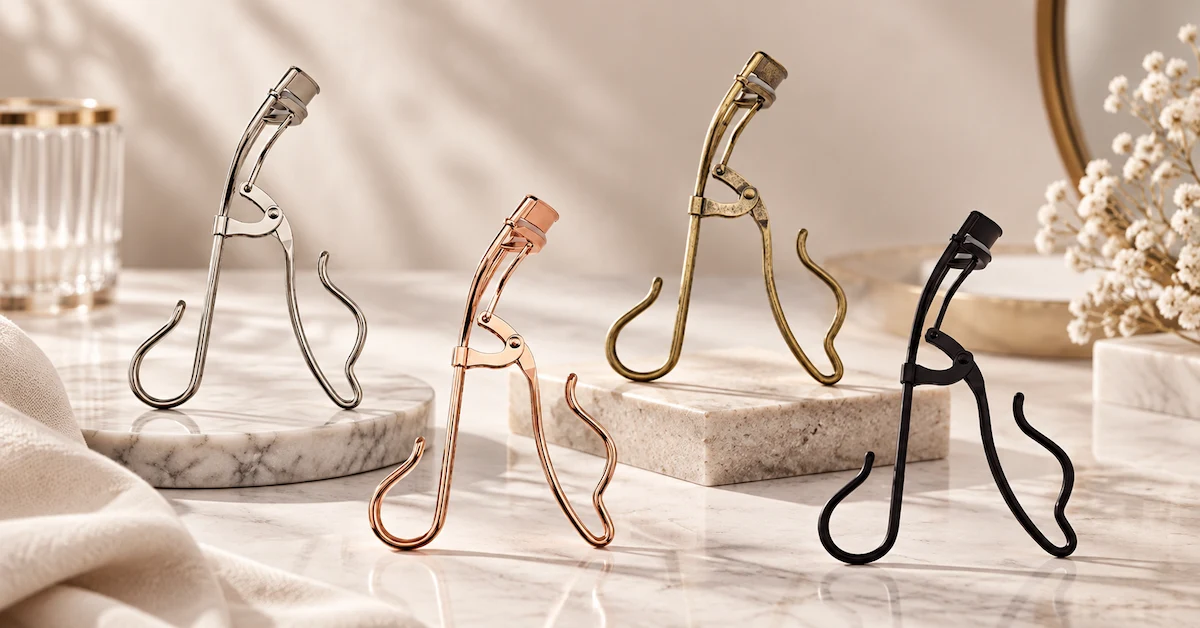
Label each candidate with its live product URL, SKU, finish shown, sample revision, and date received. Use product pages as traceable starting references. For example, OLIMOR's ECH4001 page shows a rose-gold loop-handle direction. Its ECM2039 page shows a darker decorated-handle direction. ECB3007 shows a colour-family approach. The photographs establish appearance; the actual sample must establish feel, closure, and pack suitability.
Never merge the published attributes of different models into an imaginary "standard OLIMOR curler." Even when two frames look similar, their pad dimensions, hinge behaviour, materials, and packaging may differ. Ask for the component map of the candidate actually being quoted and for a note identifying any proposed substitution.
Gate 1: does the frame curve match the intended lash line?
Look at the pressing bar from the front, side, and top. Note its width, curve, and clearance relative to the lower pad. A shallow curve may not reach the corners for some users; a deeper curve may feel intrusive for others. The purpose of the review is not to declare one universal geometry. It is to discover whether the candidate suits the brand's stated audience without forcing the user to press the frame into the lid.
Have reviewers position an unclosed curler near the lash line with a mirror, without squeezing on skin. Record whether the frame allows a clear view and catches the intended area. Then inspect the unused tool on the bench. Does the bar sit symmetrically over the pad? Are the ends consistent? Are there burrs or edges where the user grips or where the frame approaches skin? These observations are separate: a comfortable demonstration cannot replace a visual inspection, and a neat bench inspection cannot establish fit.
Keep the sample panel appropriate to the market. A few people can flag problems, not prove a universal fit claim. If the brand wants to use wording such as "fits most eye shapes," it needs a defined basis for that claim in the intended market. In the absence of such evidence, describe the actual geometry and user experience more modestly.
Gate 2: does the pad remain seated and recover after pressure?
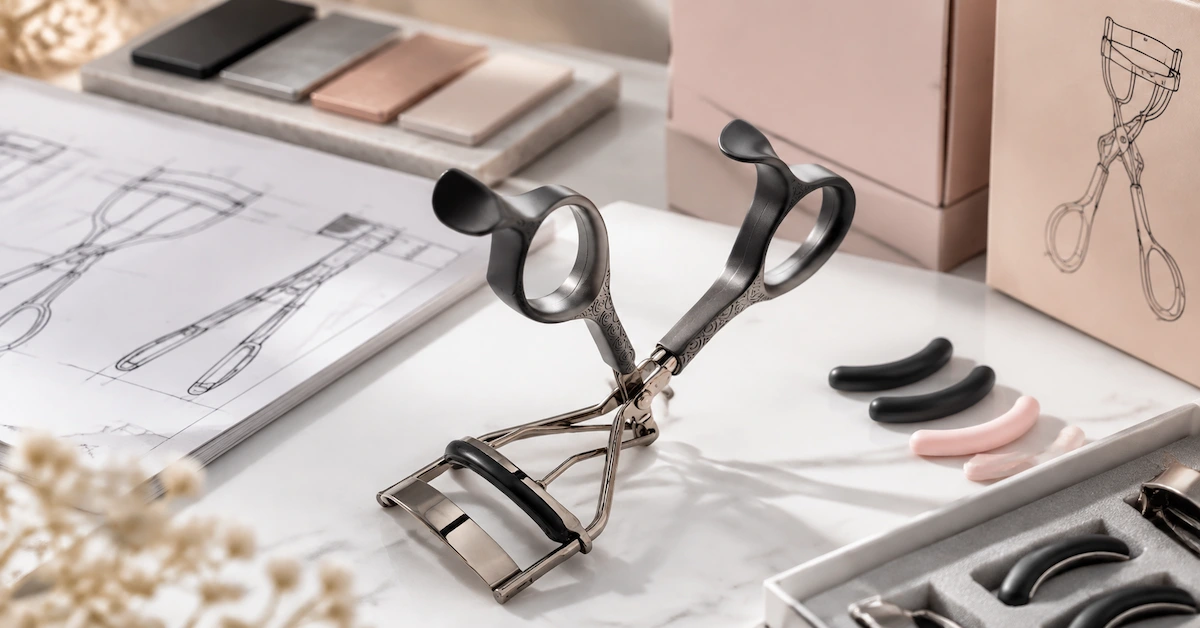
The cushion is the interface between the moving bar and the lashes. Before operating the handles, photograph the pad head-on and at both channel ends. Flag a nick, split, deep permanent groove, residue, or one end riding above the metal lip. Close the sample slowly and note whether the pad walks sideways or springs back after release. These observations can be repeated on a later production sample; a vague comment such as "pad looks fine" cannot.
Agree the pad material statement with the manufacturer rather than calling every cushion silicone. Confirm its colour and surface, dimensions, fit, and replacement compatibility for the quoted model. If a spare pad is offered, test the spare in the same channel. An included accessory that does not seat correctly creates a future complaint even when the original pad passes inspection.
Do not write that any pad "prevents lash damage." Careful use, frame fit, cleanliness, and pad condition all matter. The brand can instead explain how to inspect and replace a worn pad. For an eye-area tool, straightforward care guidance is more credible than a promise of risk-free curling.
Gate 3: does the hinge close predictably?
Operate each sample through its normal travel several times while observing the bar and pad. A sudden catch can make the squeeze difficult to control. Side-to-side wobble can alter where the bar lands. Excessive force can encourage a user to press harder than necessary. The ideal sensation depends on design, so describe the observed action and compare it against a reference rather than inventing a universal force number.
Ask what the first-piece inspector checks after assembly. If the supplier proposes a movement-force range, establish the instrument, fixture, travel, and sample condition before putting the number on a specification. If the review is sensory, identify the approved reference sample and a consistent checklist. A statement such as "smooth hinge" is not enough when two teams use different meanings of smooth.
After a short handling cycle, recheck the pad seating and bar contact. This is a buyer comparison exercise, not a lifetime test. A durability claim needs a defined protocol, cycle count, acceptance criteria, and recorded result for the particular model. No such figures are assumed here.
Gate 4: can a user control the handles without squeezing too hard?
Grip geometry influences the angle at which the frame approaches the eye. Try the candidate with clean, dry hands and note whether fingers remain stable, whether any edge presses uncomfortably, and whether the handle gives enough visual clearance. A decorative loop can look excellent on a product card but still feel narrow to part of the intended audience. A larger or coated grip can change both feel and packed dimensions.
Record comments by sample code, not by the colour alone. If a buyer changes only the handle cover, repeat the function review because a small geometry change may alter hand position. For salon or makeup-artist ranges, repeated use deserves attention, but do not invent an endurance claim from an informal trial. For a gift set, check whether the handle is easy to remove from and return to the insert without touching or bending the pressing bar.
Gate 5: approve the complete finish, logo, and pack
Function is only one half of a brand launch. A private label eyelash curlers project also requires a physical branded reference. Put the decorated sample beside its agreed colour chip in both the photography setup and the intended shelf light. Rotate it around the joint; colour changes, rub marks, exposed roughness, or a logo hidden by a gripping finger are much easier to see than in a front-facing render.
Supply vector logo artwork, size, location, orientation, colour reference, and revision. Ask which marking method is proposed for the selected surface, and look at the actual result. A digital mockup does not establish how a logo appears on a curved metal handle. Any change that reaches the hinge or pad channel needs a new functional check after finishing.
Place the final decorated tool in the actual retail insert, sleeve, box, blister card, or pouch. Remove and replace it several times. Does a hard insert push on the bar or pull the pad? Can components rub the finish in transport? Can the shopper identify the model, usage instructions, care guidance, and contact route? For EU-bound consumer products, the importer and brand should review the applicable safety, traceability, and economic-operator duties rather than assuming that a supplier photograph or generic certificate solves them. The EU General Product Safety Regulation summary is a starting source, not a project-specific legal opinion.
OEM, ODM, and private label: choose the route before you request a price
An OEM eyelash curler manufacturer can work from a buyer's drawing, reference unit, component requirements, or defined functional brief. This route is useful when the brand already owns a distinct form or requires controlled geometry. Ask which features can be preserved, what needs tooling or development, and which approval steps are required. A visual imitation of another brand's product should not be treated as permission to reproduce protected design or trade dress.
An ODM eyelash curler manufacturer can propose an existing development platform. This may simplify early selection, but "existing" does not mean every finish, pad, or pack is already qualified. Ask the supplier to identify standard elements, optional decoration, structural changes, and the tests or sample gates triggered by each. If the colour changes and nothing else, confirm that in writing; if the pad or pressing bar changes, treat it as a functional revision.
A custom eyelash curler manufacturer brief often mixes both routes. The buyer may select an existing frame, then specify a new finish, grip, logo, and carton. That combination should be described precisely. "Custom" alone does not say whether a new tool is made, whether a component is modified, or whether only presentation changes. The quotation, schedule, sample budget, and inspection plan all depend on this distinction.
For every route, settle intellectual-property ownership, artwork control, tooling terms if relevant, approved subcontracted processes, and permission to show the finished design in future catalogues. These are commercial terms for the project, not benefits that can be assumed from a generic OEM/ODM label.
Stainless steel is a component question, not a blanket promise
When contacting a stainless steel eyelash curler supplier, request a component map beside the SKU. Is the claim about the frame, pressing bar, joint, or an entire metal assembly? The grip, cushion, coating, and decoration need their own descriptions. OLIMOR's ECH4004 listing names carbon steel for that model. A buyer who silently copies "stainless steel" from another curler page could approve the wrong material wording before the sample even arrives.
Request a component-level material declaration, finish description, and supporting documents relevant to the destination market. Do not turn a material name into "medical grade," "hypoallergenic," "rust proof," "sterile," or "safe for every user." Cleaning copy belongs to the complete curler, not just its metal frame. Agree one care method with the supplier after checking its effect on the cushion and decorated surface, then print only the wording actually supported for that configuration.
If the metal choice determines whether your retailer will accept the item, put the component and material wording on the quotation. Confirm them again against the final coded sample. A substituted metal is a project revision even when a coating makes both versions look identical.
Compare China factory proposals on the same configuration
The search phrase eyelash curler factory China often leads to very different offers. One quote may concern a standard unbranded metal model in a simple bag. Another may include a custom finish, logo, spare pad, printed box, market-specific information, and project inspection. A lower unit price is not necessarily a lower landed cost or a comparable product.
Send every supplier the same revision-controlled request: model or drawing, target audience, material by component, finish, pad and spare-pad configuration, logo artwork, retail and shipping pack, inspection criteria, target market, quantity range, delivery terms, and required documents. Ask suppliers to price deviations separately. When an answer is unknown, mark it "to be confirmed," not "standard."
MOQ and production time should be confirmed by model, customization scope, tooling, finish, packaging, and order configuration. This article does not publish a universal quantity, sample lead time, or unit price. Ask when the schedule begins: after a deposit, after artwork approval, after golden-sample sign-off, or after material release. The answer affects launch planning more than an optimistic headline date.
| Quotation line | Required answer | Why a buyer needs it |
|---|---|---|
| Curler and revision | SKU, sample code, drawing date, and approved configuration | Prevents a cheaper alternate model from being treated as equivalent |
| Materials and finish | Components, finish process, colour reference, and evidence available | Separates visual choice from construction and care claims |
| Branding | Method, location, artwork proof, and setup cost if any | Shows how the private-label appearance is actually delivered |
| Pad and accessory | Fitted pad, spare pad if offered, and replacement compatibility | Avoids a non-fitting spare or undocumented material change |
| Packaging | Retail pack, insert, shipping carton, print, and inspection | Protects the tool and supports the intended market listing |
| Commercial terms | MOQ by configuration, sampling, tooling, incoterm, payment, lead-time trigger | Makes offers comparable without a fictitious universal price |
Build a golden sample with a record anyone can read
A golden sample is the agreed physical reference for the exact configuration to be produced. It should not be a loose curler in someone's desk drawer. Give it a code and connect it to the drawing, component list, finish master, logo artwork, retail package, inspection plan, and signed changes. Keep a protected master and, where useful, an agreed working reference at the manufacturer.
Write the approval boundaries next to the sample. Was the frame fit approved? Was the sample made with the final pad? Is the finish production-representative? Does the pack have final text and barcode? A prototype can answer one question while leaving another open. Saying "sample approved" without scope can create expensive ambiguity when a later team interprets that approval more broadly.
Photograph the moment the upper bar touches the pad, both channel ends, the joint, the handle, the logo, and the closed pack. Put the sample code in the frame and note the viewing angle. If a later inspector sees a lifted pad end, the team can compare it with a particular reference image instead of trying to reconstruct a verbal approval from months earlier. Keep the physical master protected as well.
Turn defects into observable acceptance criteria
"Good quality" cannot guide inspection. Describe the condition that fails the user's task or the brand's presentation. Examples include a pad that slips out of its channel, one-sided bar contact, sharp burrs at a skin-facing edge, an unstable hinge, missing spare pad, wrong logo, damaged finish, and an incorrect barcode. Determine the consequence of each defect in the purchase agreement rather than copying a generic checklist without regard to use.
Place checks where they can prevent more cost. Incoming component review may detect wrong pads or finish materials. First-piece approval can catch alignment before a run continues. In-process observation can identify drift. Final-tool checks assess movement, contact, appearance, and identity. Packed-unit checks catch omissions and protection failures after assembly.
If the parties use acceptance sampling, ISO 2859-1 is an official source for attribute-based lot sampling. It does not set an eyelash-curler-specific defect tolerance for your brand. Agree defect classes, lot definition, inspection level, sample plan, and the response to failure with qualified staff. Function and eye-area risks may call for additional controls beyond any sampled cosmetic check.
| Inspection moment | Example observable check | Record and decision |
|---|---|---|
| Incoming parts | Pad fit, frame identity, grip and finish input | Accept, isolate, or seek clarification |
| First assembled piece | Bar-pad contact, hinge travel, handle clearance | Release setup or adjust before production |
| During production | Movement and finish remain comparable to reference | Continue, contain, or investigate drift |
| Final tool | Pad seating, burrs, logo, colour, moving action | Accept, rework, sort, or reject per agreement |
| Packed unit | Correct SKU, pad count, insert, barcode, protection | Release only the approved complete configuration |
Do not let the second order become a different product
Reorders can fail even after a successful launch. A pad vendor changes, a coating shop adjusts colour, a carton insert is redesigned, or a component is substituted without an updated reference. Each change may be small in isolation. Together they can alter fit, handling, claims, and the shopper's impression of the line.
Require notice before a change to the frame, pressing bar, hinge, pad, grip, material, finish, logo process, pack, or inspection method. Decide whether that change needs a new sample, partial recheck, updated artwork, or new market review. Record accepted deviations with a date and batch scope. A casual message saying "same quality" does not identify what was changed or how it was verified.
Keep a retained reference from the approved production batch and compare it with a sample from the next order. Note any systematic difference in movement or pad compression before the new batch ships. This approach is especially important for a wholesale eyelash curler supplier relationship where several retailers or markets may receive the same model under different packs.
What should an inquiry to OLIMOR include?
A useful first message should let a supplier answer with a model shortlist and a clear list of open points. State your company and destination market, the intended channel, target customer, approximate order range, desired shape or reference product, metal and pad requirements if known, finish, logo, packaging format, spare-pad expectation, required documents, and preferred timing. Attach a drawing or reference image that your company has the right to share.
Ask for the current product specification and sample procedure, not a generic promise of quality. If ECH4001, ECM2039, or ECB3007 is of interest, name the exact SKU and link. Request the material-by-component description and whether the photographed finish is available for the order configuration. Ask which variables affect MOQ and lead time and which inspection information can be supplied. State which questions are still open on your side.
A precise inquiry is not a commitment to buy. It helps the supplier propose a meaningful next step. It also gives the buyer a way to compare answers without chasing a different interpretation from every contact.
Copy-ready inquiry brief: "We are sourcing an eyelash curler for [market/channel] and [target user]. Please review [OLIMOR SKU or attached reference]. We need [frame/handle preference], [finish], [logo method/location], [retail pack], and [spare-pad requirement]. Our estimated first order range is [range]; our desired launch window is [date]. Please identify material by component, sample stages, available QC records, packaging options, MOQ by configuration, tooling if any, and the lead-time trigger. We will approve a coded functional and packed sample before bulk production."
FAQ: questions that decide whether to place the order
How should a brand choose an eyelash curler manufacturer?
Choose a supplier that can explain the exact model's frame, pad, hinge, finishing, packaging, and inspection route, then demonstrate the final configuration with coded samples. Compare suppliers against one brief, not different product photographs. The best decision is one your team can reproduce when the second purchase order is raised.
What is the difference between OEM and ODM for curlers?
OEM usually starts from the buyer's defined design or technical brief. ODM usually begins with a manufacturer-developed platform that the buyer evaluates or adapts. A private-label project may use either route. Ask what is standard, what is changed, who owns tooling or artwork, and which revisions require new approval; these commercial details are not settled by the acronym alone.
Can a manufacturer add a logo and custom box without changing the curler?
Often a project can discuss decoration and packaging for an existing model, but feasibility depends on the actual surface and pack. The buyer still needs an approved decorated and packed sample. Marking may interact with a finish, and an insert may press against a moving component. Treat packaging as a functional protection decision, not only graphic design.
What should be checked before placing a wholesale order?
Verify the sample code and specification; frame curve and bar-pad contact; pad condition and any spare fit; hinge movement; grip comfort; material wording; finish and logo; complete retail and shipping pack; defect definitions; quotation inclusions; MOQ and schedule basis; destination-market documentation; and the change-control procedure. The list is most useful when each item has an owner and an approval record.
Does stainless steel make every curler rust-proof or suitable for all cleaning methods?
No. Confirm the material of each component, the selected grade if specified, finish, pad, and care instructions. A listing for one OLIMOR curler identifies carbon steel, which is a reminder not to generalize category materials. Any durability, corrosion, or chemical-compatibility claim needs evidence for the particular product and method.
How much do private-label eyelash curlers cost and what is the MOQ?
There is no useful universal figure. Model structure, material, finish, logo process, pad configuration, tooling, retail pack, order quantity, inspection scope, and shipping terms affect the quote. Ask for an itemized offer against one approved configuration and for MOQ by variant. Do not compare a plain unbranded bagged sample with a decorated boxed set as if they were identical.
Is a catalogue photo enough to approve an order?
No. It establishes visual direction and a link to a product. A physical, coded sample lets the brand examine frame fit, pad seating, hinge travel, surface, branding, and pack. State exactly which features are approved and which require another sample. Retain a protected golden sample for production and reorders.
What documents should an importer request?
Start with the product and component specification, final artwork, instruction and warning text, traceability plan, inspection agreement, and market-specific evidence relevant to the product. Requirements vary by destination and product configuration. The brand or importer should have competent review of applicable rules; a generic ISO certificate or unrelated test report cannot establish every product claim or regulatory obligation.
The decision: approve a configuration, not an adjective
An eyelash curler manufacturer should be judged by whether it can turn a chosen design into a clear, inspectable, repeatable product. A curved frame, resilient pad, controlled hinge, comfortable handle, honest material statement, protective pack, and readable specification are connected decisions. Approving them as one unit gives a beauty brand a better basis for launch than a collection of attractive but untracked samples.
OLIMOR BEAUTY's real curler pages provide starting points for a shortlist, from the ECH4001 rose-gold form to the ECM2039 handle direction and ECB3007 colour assortment. Send the exact model and the audience you serve. Ask which features are standard, what can be customized, how the sample will be approved, and what the final quotation includes. The resulting response should make it easier to decide whether the next step is a sample, a revision, or a production order.