Quick Answer: Choose an eyebrow razor manufacturer by matching the razor format to your retail channel, then checking the blade head, handle control, storage protection, packaging, and written order specification. A fixed razor and a folding razor create different handling and merchandising questions; neither is automatically the better purchase. Compare quotations for the same complete retail configuration, not just the loose tool. Request the exact model, component materials, customization scope, inspection criteria, and reorder conditions before committing to a branded assortment.
Introduction: A Retail Listing Needs More Than a Good-Looking Razor
For a beauty brand, pharmacy buyer, salon distributor, or online retailer, an eyebrow razor is a small purchase with several decisions hidden inside it. The photograph may show a pleasing color and a slim profile. It does not tell you whether the blade is protected when the customer opens the pack, whether the handle suits the intended grip, or whether a replacement order will arrive in the same retail presentation.
That gap matters when a product moves from a supplier catalog into your own range. Your team must explain what the tool is for, show it accurately, choose a package, establish receiving checks, and answer customer questions. If those decisions are postponed until the bulk order is finished, an inexpensive tool can become an expensive packaging or listing problem.
This guide takes a retail assortment approach to selecting an eyebrow razor manufacturer. It compares fixed and folding formats, separates blade materials from whole-product claims, and explains how to request comparable quotations. The objective is not to find the longest capability list. It is to obtain a product configuration your brand can describe clearly, inspect consistently, and reorder without unnecessary ambiguity.
What Is an Eyebrow Razor Manufacturer?
An eyebrow razor manufacturer produces or coordinates the manufacture of small grooming razors intended for brow-area hair trimming. Depending on the project, the work may include blade-head components, handles, protective parts, assembly, surface finishing, and retail packing. Buyers should establish which operations are performed directly and which rely on component or packaging partners.
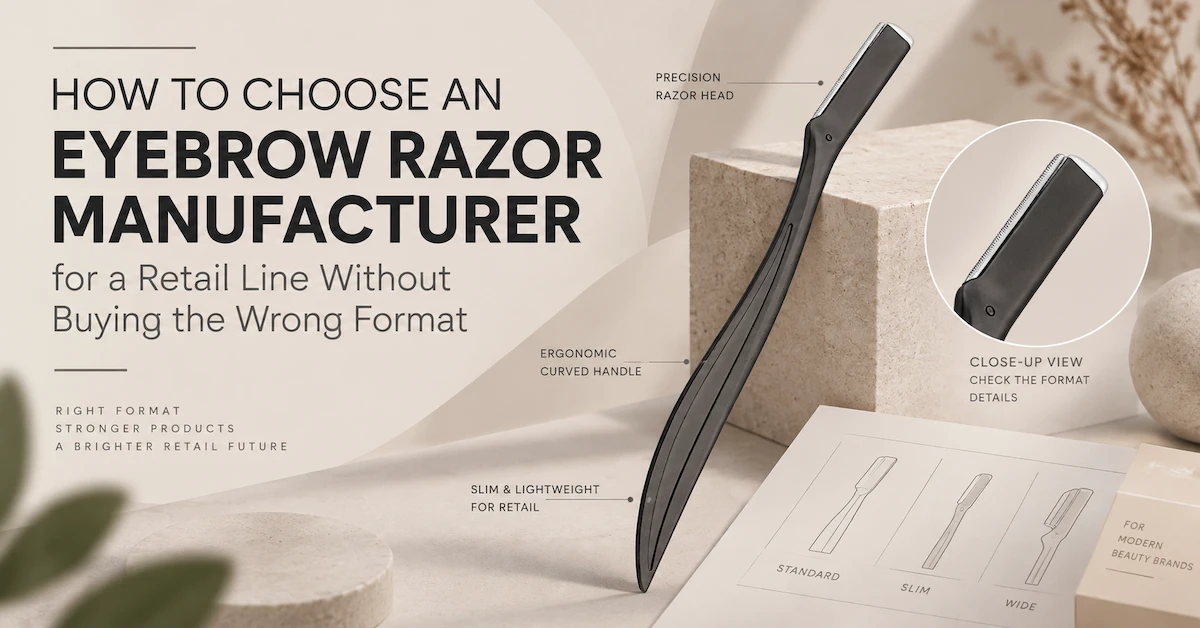
The tool itself usually consists of a cutting edge, a blade support or head, a handle, and some form of storage protection. Some models have a fixed handle; others fold. A visible fine pattern along a blade edge may be part of its guard construction, but a photograph alone cannot establish its dimensions, performance, or suitability for a particular user.
These products commonly appear in brow-grooming ranges, personal-care aisles, travel selections, and branded beauty kits. That does not make every razor suitable for every application. A product positioned for brow shaping should not automatically be sold with broad facial-exfoliation claims simply because another listing uses the word dermaplaning. The intended use and instructions need to be agreed for the actual model.
OLIMOR BEAUTY supports OEM and ODM beauty-tool projects, including development from drawings, samples, appearance concepts, and structural requirements. For an eyebrow razor project, ask the team to identify the closest catalog model and explain what can be changed on that model. General customization capability is a starting point, not a promise that every blade, handle, finish, and package can be combined.
Start With the Shelf: What Job Will This SKU Do?
Before contacting a professional eyebrow razor manufacturer, write a short retail brief. Specify who will buy the product, where it will be sold, and what role it will play in the range. A single-item pharmacy pack has different constraints from a beauty subscription insert or a salon-distributor assortment.
A retail brief might say: a compact brow-grooming tool, sold individually online, with clear storage instructions and a package that can be photographed from the front and back. Another might call for an eye-catching fixed-handle model to sit beside tweezers in a coordinated beauty collection. Neither brief needs a made-up forecast or a claim about consumer preference. It needs enough detail for a supplier to narrow the product options.
Consider the package footprint at this stage. Hanging displays require a suitable presentation and retailer-compatible hanging arrangement. Online sales require images that explain what is included without relying on the buyer handling the pack. A gift assortment may need the razor to fit beside other tools without exposing the blade during unpacking.
Do not launch multiple colors merely because they look attractive in a catalog. Each additional color can create another item code, packaging variation, inventory balance, and reorder decision. Begin with a range you can distinguish by purpose or presentation. If two SKUs differ only in color, decide whether that difference earns its place on the shelf.
Fixed vs Folding Eyebrow Razors: Which Format Fits Your Range?
The first useful comparison is structural. A fixed razor remains in its working shape during storage. A folding razor changes shape around a joint. Folding can reduce the stored footprint, but the joint introduces questions about movement, blade clearance, and how the customer opens and closes it. A fixed model avoids that hinge question but still requires an agreed protective arrangement.
| Format | Retail opportunity | Question to resolve | Useful evidence |
|---|---|---|---|
| Fixed, curved handle | A clear product silhouette for a single-tool listing | How is the edge protected in the pack and after opening? | Actual model, close-up head images, complete packed sample |
| Fixed, decorative handle | A distinctive visual option for a coordinated beauty line | Does the decorative profile leave enough comfortable gripping space? | Physical sample and the proposed logo position |
| Folding plastic-handle format | A compact stored shape for a portable grooming selection | Does the blade clear the handle during closing, and what holds the intended positions? | Open and closed samples, agreed movement checks, storage instructions |
Use the comparison to shortlist formats, not to declare a winner. A folding design may suit a compact range while being unnecessary for a display-led collection. A decorative handle can be visually distinctive without proving better cutting performance. Buying decisions become clearer when structure, appearance, and performance are discussed separately.
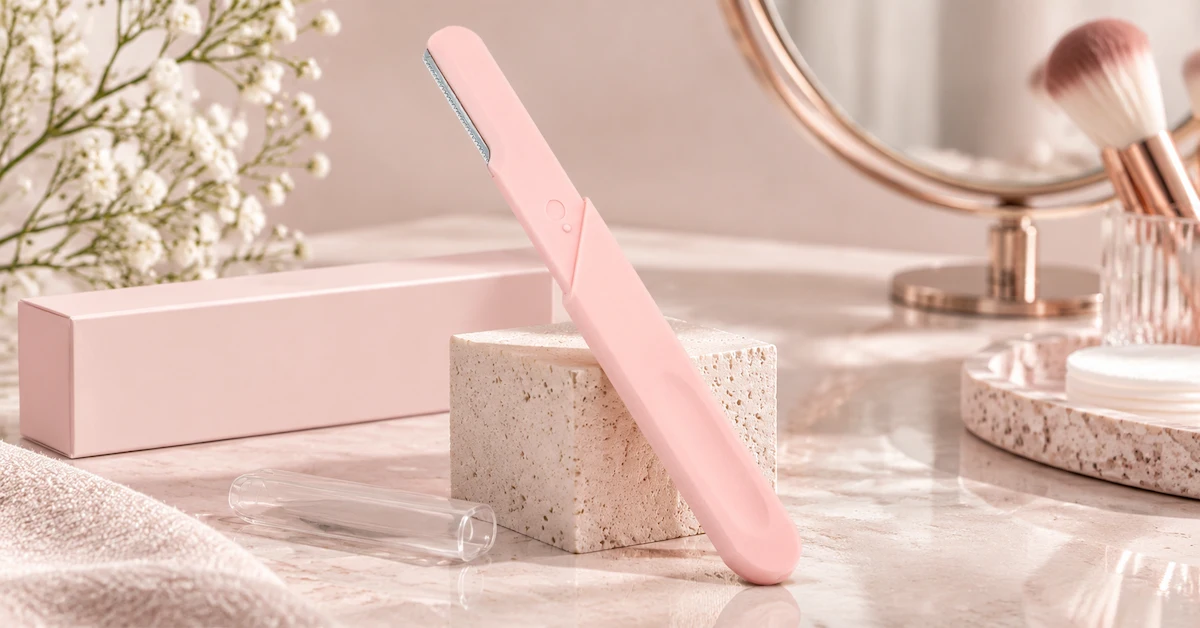
OLIMOR's ERF1020 folding eyebrow razor is one reference for the folding route. The public listing describes stainless steel and plastic, with a listed length of 137 mm and weight of 7 g. Confirm how the length was measured and request the current specification before designing a fitted package around those values.
The open-and-folded photograph helps a buyer understand the format. It does not prove hinge life, edge protection under transport loads, or any safety guarantee. If folding is the reason you selected the SKU, specify how that feature will be assessed rather than leaving it as a general description.
Blade Protection Is a Configuration Question, Not a Marketing Adjective
A label such as guarded blade can hide several different constructions. Ask where the guard sits, how the blade is supported, and which parts are accessible in normal use. Obtain close-up photographs of the actual head and inspect the sample under suitable lighting. Avoid drawing technical conclusions from a distant lifestyle image.
For a fixed model, determine whether a separate cover is included and whether it belongs to the quoted configuration. If a cover is proposed, check its retention, removal method, internal clearance, and behavior inside the retail pack. Do not assume that every catalog photograph shows all included components. For a folding model, check what the closed handle encloses and whether any edge remains accessible.
Separate storage protection from protection during use. A cover may protect the edge while stored, but it says nothing by itself about the cutting action. A guard does not justify promises such as no cuts, no irritation, or safe for every skin type. Those are substantive claims requiring evidence appropriate to the product and market.
Write the requirement in observable language: cover present in every retail unit; head seated in the agreed position; no loose blade component; no unintended contact between edge and package insert. Your inspection team can work with those descriptions. It cannot reliably inspect an undefined requirement such as premium safety.
The same discipline applies to product-page copy. State the format and the intended grooming purpose, then describe confirmed features. Where a detail is still being assessed, keep it out of the consumer claim. The buyer can discuss an unresolved design question privately with the supplier without turning it into a public performance promise.
Stainless Steel: Specify the Component Before Specifying the Claim
A request to a stainless steel eyebrow razor supplier should identify which part needs that material. Blade, head support, and handle are different components. A product may contain a stainless steel blade and a plastic handle; calling the entire product an all-steel razor would then be misleading.
Ask for a component-level material description. If a particular steel grade or finish is important to your specification, request written confirmation and suitable supporting documentation. The word stainless is not enough to establish a grade, corrosion performance in every environment, or compatibility with a particular cleaning method.
ERF1116 is a fixed-handle reference whose public attributes list stainless steel and dimensions of 159 by 12 mm. Its product photograph shows a dark, curved profile. Treat those facts as model-specific listing information, not as the specification for OLIMOR's whole eyebrow razor range. Finish choices and current availability still need confirmation.
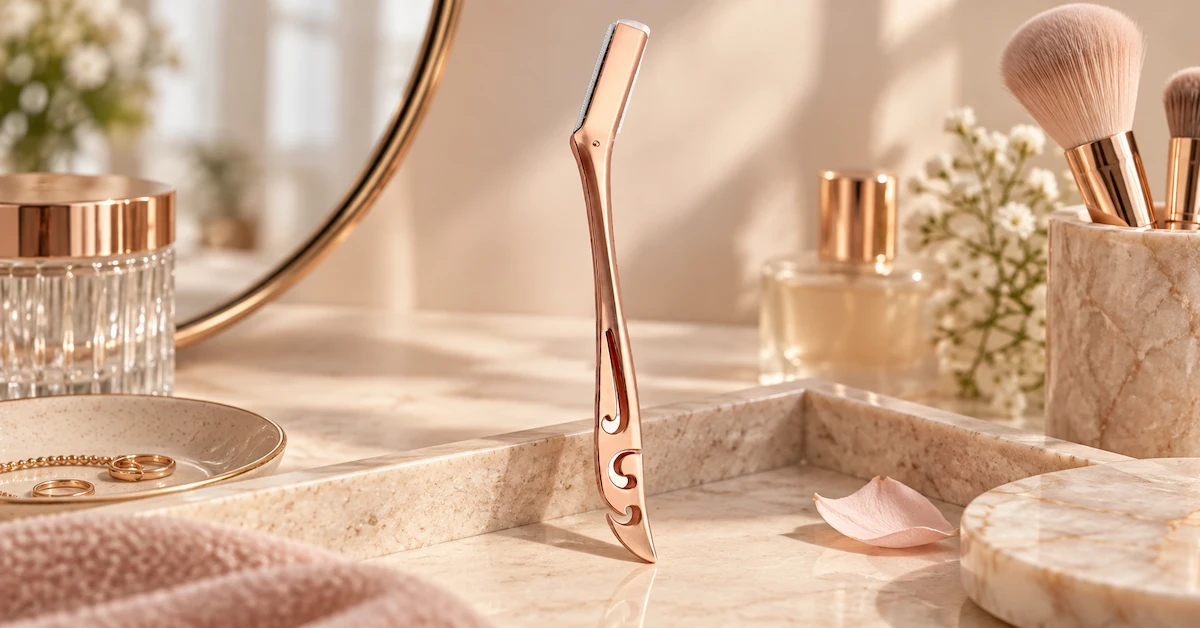
Surface appearance deserves its own check. A dark finish or a rose-gold appearance may be important to the range, but the photograph cannot establish the finishing process or wear resistance. Agree on the approved appearance and ask what evaluation is available for the selected finish. Do not describe a visible color as a particular coating technology unless that process has been confirmed.
Handle Design: Evaluate the Part the Customer Actually Holds
Retail teams often spend more time choosing a color than looking at the grip. During a format review, hold the tool in the intended orientation and inspect the gripping area, handle edges, balance, and visibility of the head. This is a handling assessment, not a substitute for a product-specific performance or safety evaluation.
Consider whether a logo would occupy the grip zone or sit elsewhere. A large decoration can look appealing in a render while leaving little space for handling. A cutout may distinguish the product visually but also change where fingers rest. Request a sample with the proposed branding so the final surface and logo position can be evaluated together.
For a folding tool, include opening and closing in the handling review. Establish whether the intended movement is obvious from the instructions, whether unintended looseness is present, and whether the head sits where the approved design requires it. Avoid specifying a subjective feeling such as perfect tension without an agreed comparison sample or method.
For decorative fixed formats, ERF1115 offers a visibly different reference: an ornate cutout handle with a rose-gold appearance. Its public attributes list stainless steel and dimensions of 157 by 12 mm. Ask which branding area and package support are practical on this particular profile.
These three references represent different design conversations. They are not a ranked list. Request the model that best matches your brief, or ask whether another existing model offers a closer fit before commissioning new development.
OEM, ODM, or Private Label: Choose the Development Route Deliberately
The terms OEM and ODM are used differently across supplier discussions. Settle the scope rather than relying on the label. An OEM eyebrow razor manufacturer inquiry should explain whether you are supplying a complete specification, modifying an existing tool, or simply applying branding to a catalog model.
An ODM eyebrow razor manufacturer discussion may involve selecting or developing a supplier-supported design, but ownership, exclusivity, and change rights still require agreement. A development route does not automatically grant exclusive rights to a shape or prevent similar catalog products from being sold elsewhere.
If you need private label eyebrow razors, start by choosing a product reference and then inquire about branding and packaging feasibility. The linked page illustrates a candidate tool; it does not independently confirm that every proposed private-label option is available for that model.
A custom eyebrow razor manufacturer brief should separate appearance changes from structural changes. Handle color, logo placement, and printed packaging are one set of requests. A different head, folding mechanism, guard, or handle outline may require a different engineering discussion. Quote and schedule implications should be explained for each item.
| Requested change | What to provide | What to confirm before approval |
|---|---|---|
| Logo or handle appearance | Artwork, placement reference, desired appearance | Practical marking method, usable area, appearance acceptance |
| Retail packaging | Pack concept, language, channel requirements, included items | Fit, storage protection, print proof, packing responsibility |
| Handle or head structure | Drawing or sample with the intended changes marked | Development scope, tooling responsibility, verification needs |
| Exclusive branded design | Commercial scope and territory requirements | Written ownership, use rights, confidentiality, change control |
Do not order a structural change solely to make the product look unlike a competitor's listing. First identify the user or merchandising problem it solves. A catalog model with well-defined packaging can be a more manageable first launch than a new structure with unresolved requirements.
Packaging Must Explain, Restrain, and Identify the Tool
An eyebrow razor package has three jobs: present the item, hold it in the intended position, and convey the information the buyer needs. A beautiful front panel is only one part of that work. Review the insert, closure, back panel, and packed tool as a complete retail unit.
Determine whether the customer can identify the razor format without opening the pack. For a folding model, consider whether the photography shows the stored form, the working form, or both. If a separate cover is supplied, the listing should make the included item clear. Do not show optional components as though they are standard.
Inside the package, look for unintended contact with the edge and movement that changes the intended presentation. Consider what happens when the customer removes the item rather than looking only at the closed box. Packing and unpacking questions belong in the design discussion, not in a complaint response after launch.
Prepare destination-market labeling requirements with your importer or compliance adviser. Brand identification, product traceability, warnings, instructions, and responsible-party details may depend on the market and supply arrangement. The European Commission's product safety information is an official starting point for reviewing EU obligations. A supplier quotation is not evidence that your branded retail unit meets every applicable requirement.
For instruction planning, OLIMOR's beginner eyebrow razor guide can provide topic context. It should not replace model-specific instructions, market review, or verified claims. The printed directions must match the actual product supplied.
How Much Will a Branded Eyebrow Razor Order Cost?
There is no useful universal unit price without a configuration. The quotation needs to identify the model, quantity, finish, branding, protective parts, retail pack, and shipment basis. Two offers can contain the same product name while covering different goods.
Ask your wholesale eyebrow razor supplier for the loose-tool cost and the complete retail-unit cost as separate lines where practical. Request separate disclosure of development, tooling, artwork, or other one-time charges when they apply. This makes the difference between a repeat order and a first launch easier to understand.
A useful landed-cost worksheet includes the goods, retail packaging, one-time project costs, inspection, freight, and applicable import charges. Define the scope of your own calculation; do not present it as an accounting formula for every business. Selling costs and local fulfillment may need their own lines in your commercial plan.
| Quote line | Configuration question | Common comparison error |
|---|---|---|
| Tool | Which exact model and finish are included? | Comparing different structures under one product name |
| Protection and retail pack | Are covers, inserts, labels, and printed packs included? | Comparing a loose razor with a finished retail unit |
| Customization | What is charged once and what is charged per unit? | Treating development costs as repeat-order unit costs |
| Inspection and shipment | What checks and delivery basis are included? | Ignoring inspection, freight, or import responsibility |
| Reorder | Will the same specification, finish, and package remain available? | Assuming the launch quote also covers future changes |
For example, compare a folding razor in a branded pack only with another quotation for that same folding model and pack specification. If you also request a decorative fixed model, keep it in a separate comparison. Otherwise a lower number can reflect a different product rather than a better commercial offer.
MOQ and lead time should be confirmed by model and customization scope. Ask whether color, printed packaging, and the tool itself carry different order constraints. A low quantity for an unbranded tool does not necessarily apply to a fully branded retail configuration.
Inspection: Turn the Product Brief Into Receiving Checks
When evaluating an eyebrow razor factory China sourcing project, ask how the agreed product and pack will be checked. Inspection should address the actual format: blade seating, head condition, handle finish, folding movement where applicable, protective components, marking, and packed quantity.
Separate appearance defects from functional and safety concerns. A minor print-position variation and a loose blade are not interchangeable findings. Define the defect descriptions, inspection method, and disposition with the parties responsible for quality and market compliance. Do not borrow a generic AQL number and assume it settles every issue with a sharp grooming tool.
ISO 2859-1:2026 provides an attribute-based acceptance-sampling framework for lot inspection. It does not supply an eyebrow-razor-specific defect list, establish product safety, or prove that OLIMOR holds a certification. A sampling plan and product acceptance requirements serve different purposes and must be agreed accordingly.
Keep the approved configuration accessible to the inspector. A model code without the finish, component list, packing method, and artwork revision leaves room for misunderstanding. The inspection instruction should identify which reference takes precedence if a drawing, photograph, and older sample differ.
Receiving checks should also verify that the retail pack and item can be traced to the supplied order. If a problem is reported later, the team needs a way to distinguish the affected shipment from another version. Agree on record retention and handling of rejected goods before the order is dispatched.
Build a Small Assortment That Can Be Reordered
A practical initial range can use one clearly defined format rather than several loosely specified alternatives. If you select a second SKU, make its role explicit: a folding option for a compact selection, for example, and a decorative fixed tool for a display-led collection. That is a proposed assortment logic, not a claim that either option will sell better.
Give each configuration its own identifier. Link the model, finish, logo artwork, packaging revision, and included components in one record. Product photography should use that same configuration. If a listing shows a rose-gold fixed razor while the packed SKU contains a pink folding razor, better copy will not fix the mismatch.
Ask about component substitutions and notification. A new handle resin, blade component, finish, or package insert may affect the appearance or requirements you previously reviewed. Your purchase terms should explain when a change needs approval and which documents or samples will be updated.
Reorder planning also needs a route for artwork changes. A revised barcode, warning panel, or distributor address should not accidentally trigger an uncontrolled product change. Keep product and packaging revisions separate where useful, while making clear which combination belongs to the final retail unit.
FAQ: Questions Retail Buyers Should Resolve Before Ordering
Is a folding eyebrow razor better than a fixed one?
Not automatically. Folding changes the stored shape and introduces a moving joint. Fixed models have different storage-protection requirements. Choose according to the retail brief, then evaluate the actual structure and complete package. A compact photograph alone is not enough to establish suitability.
Can I put my logo on an existing OLIMOR eyebrow razor?
Ask about the selected model, logo size, proposed position, and marking method. OLIMOR supports OEM and ODM projects, but model-specific feasibility requires confirmation. Send the artwork and request a branded sample or agreed proof that reflects the final surface.
What does stainless steel mean on an eyebrow razor listing?
It should be clarified by component. A blade can be stainless steel while the handle is plastic. Request the material description for the blade, support, handle, and any protective part. Do not assume the listing establishes a specific alloy grade or a cleaning compatibility claim.
Can the same tool be marketed as a dermaplaning product?
Do not make that extension automatically. Confirm the intended use, evidence, instructions, and market requirements for the exact model. The American Academy of Dermatology's exfoliation guidance notes that exfoliation choices depend on skin type and can cause harm if unsuitable. It is not a validation of any razor model or its proposed claims.
What quantity and lead time should I expect?
Request a project-specific answer after the model, branding, and packaging are defined. Ask for separate stages where development or printed packaging is involved. Avoid putting an unconfirmed MOQ or delivery date into your launch plan simply because it appeared in an unrelated quotation.
How do I protect a custom design?
Discuss confidentiality, ownership of supplied artwork and drawings, tooling rights, and any requested exclusivity in writing. Clarify the territory and commercial scope. A custom logo does not automatically make an existing catalog shape exclusive to your brand.
What should I send to get a meaningful quote?
Send your target market and channel, preferred model or format, requested quantity, branding artwork, package concept, included components, and delivery destination. Mark unresolved decisions clearly. A supplier can then compare alternatives without guessing which retail configuration you intended.
Next Step: Request a Configuration, Not Just a Catalog
Your first inquiry can be short: identify ERF1020, ERF1116, or ERF1115 as a reference; explain the retail channel; and describe the desired branding and package. Ask which elements are available on the existing model and which would require development.
Request a component specification, complete packed sample, configuration-based quotation, and explanation of inspection and reorder arrangements. Those items give your product, marketing, and purchasing teams a common basis for review. They also help the supplier answer the real question: which eyebrow razor configuration fits your range without leaving essential details unresolved?