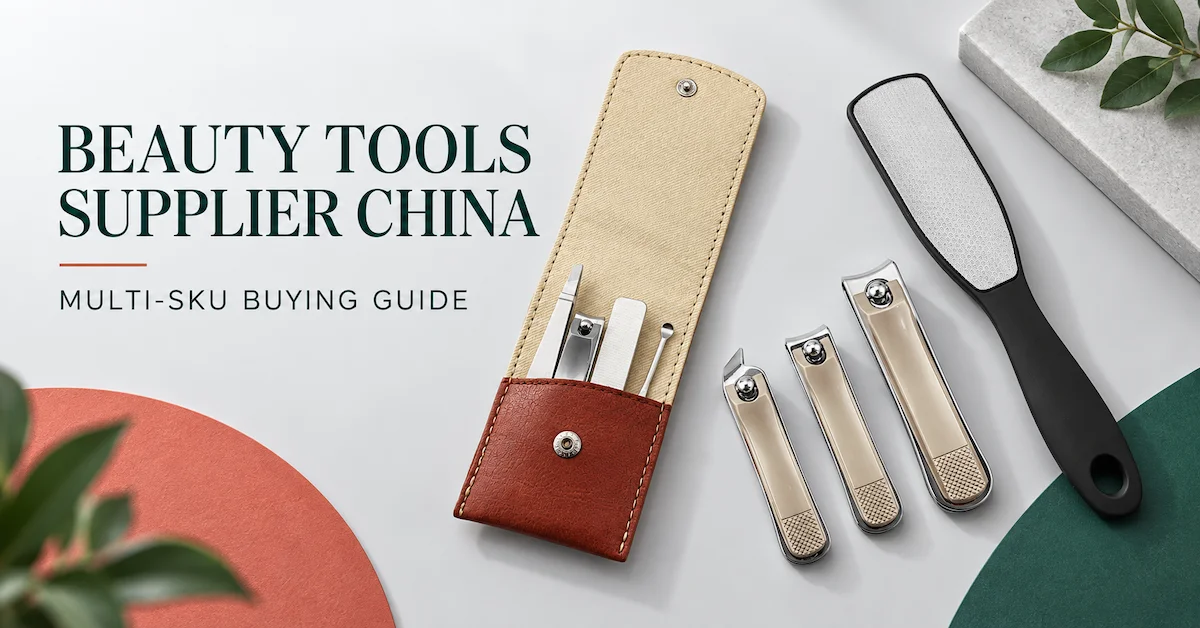
Quick Answer: Choose a beauty tools supplier China partner by checking whether it can manage the complete supply process for each SKU: product fit, material wording, decoration, packing, inspection, documents, and repeat ordering. A supplier may offer many categories, but manicure sets, nail clippers, and foot files still need different functional checks. Ask for model-specific samples, an itemized quote, a clear configuration record, and change-notification rules. Compare the same complete sellable unit across suppliers before judging price, lead time, or private-label suitability.
Introduction: Supplier Selection Is a Workflow, Not a Catalog Search
When a brand searches for a beauty tools supplier China partner, the first results often look similar: long product lists, polished photographs, and short claims about quality or customization. A catalog is useful for finding directions. It is not enough to decide whether a supplier can support a retail range through sampling, packing, inspection, shipment, and replenishment.
Beauty tools are physical products with different jobs. A manicure set contains several tools that must fit a case or package. A nail clipper has a cutting mechanism and a lever. A foot file has a working surface and a handle or backing. These products may share a brand color and a shipping carton, but they should not share one vague acceptance rule.
For importers, ecommerce brands, salon distributors, and retailers, the commercial risk often appears after the first order. A replacement component may not be recorded. A product image may show more pieces than the quotation includes. A new package revision may not match the warehouse item code. Or a reorder may use a finish that looks close on a screen but different in the hand.
This guide explains how to evaluate a China-based beauty-tool supplier through the whole buying path. It covers supplier fit, category selection, OEM and ODM scope, product evidence, materials, packaging, inspection, quotation, and reorder control. The examples use real OLIMOR products and avoid inventing prices, MOQs, certificates, test results, or customer cases.
What Is a Beauty Tools Supplier China Partner?
A beauty tools supplier China partner provides products and related sourcing support from China. The supplier may manufacture products, coordinate qualified production, provide existing models, support OEM or ODM development, and arrange assembly or packaging. The buyer should ask which responsibilities apply to the selected product instead of treating "supplier" as proof of a single factory process.
The term covers a wide product field: nail-care tools, brow tools, lash tools, facial accessories, manicure sets, pedicure tools, and other personal-care items. A supplier with a broad range can be valuable when a brand wants one purchasing relationship. The breadth also makes SKU-level records more important, because a different category may use a different material, process, inspection method, and pack.
"Professional" and "premium" are positioning words. They do not automatically establish a material grade, a performance result, a cleaning method, or regulatory compliance. A supplier conversation becomes more useful when those adjectives are converted into observable requirements and evidence requests.
OLIMOR BEAUTY supports OEM and ODM beauty-tool projects, including development from drawings, samples, appearance concepts, and structural requirements. The available company capability description includes metal stamping, heat treatment, plastic injection, polishing, deburring, assembly, inspection, and packaging. Product-specific feasibility, MOQ, lead time, and documents still require confirmation for each project.
Step 1: Write a Supplier Brief Before Requesting Prices
A short supplier brief prevents the quotation from becoming a guess. State the target countries, sales channel, product categories, desired launch sequence, and open decisions. You do not need a final engineering drawing for every catalog model. You do need enough context for the supplier to understand what a successful sellable unit looks like.
Describe the customer's task in one sentence. For a manicure set, the task might be portable nail grooming in a giftable case. For a nail clipper, it might be routine personal nail care in a compact retail pack. For a foot file, it might be a reusable pedicure accessory for a salon or ecommerce selection. The sentence guides product choice, imagery, packaging, and instructions.
Separate fixed requirements, preferences, and questions. The destination market and language may be fixed. A metallic finish may be preferred. The best decoration method may be an open question. This separation lets an OEM beauty tools supplier China propose a feasible route without quietly changing the core job.
| Brief section | Buyer should state | Supplier should clarify |
|---|---|---|
| Market and channel | Country, retailer, salon, ecommerce, or gift channel | Labeling, pack, and shipment assumptions |
| Product role | Customer task and reason for including the SKU | Closest existing model and alternatives |
| Brand identity | Logo, color direction, finish, and artwork status | Decoration method, area, and proof route |
| Commercial scope | Quantity by model and launch dependencies | MOQ, one-time charges, recurring cost, and calendar |
| Evidence | Documents or checks needed for approval | Available records and any limitations |
Ask for a shortlist rather than an unfiltered catalog. A shortlist of three to five models is easier to compare and gives the supplier an opportunity to explain the tradeoffs among structure, packaging, finish, and price.
Step 2: Choose the Right Category Mix
A range should have a reason to exist. A retailer may want a compact manicure collection, a salon distributor may need several nail-care formats, and an ecommerce brand may build a giftable personal-care set. Start with the category roles and then choose products. Starting with a finish or a color usually creates a visually consistent but commercially confusing range.
Use a category map with four columns: customer task, product family, pack format, and reorder priority. A manicure set may be a hero gift item. A nail clipper may be a repeat purchase or an add-on. A foot file may support a pedicure story. The map does not forecast sales; it makes the purpose of each SKU explicit.
Do not assume that one supplier's category label matches your product-page language. Ask what is included, what the tool is intended for, and how the model is identified. If an image shows several pieces, ask whether the quote covers one item or a set. Accurate content begins with accurate scope.
An ODM beauty tools supplier China can help select a platform or adapt a collection direction. Ask the supplier to label each recommendation as standard, configurable, or new development. That single distinction reduces confusion when the catalog photograph looks more customized than the actual quotation.
Step 3: Review a Manicure Set as a Complete Retail Unit
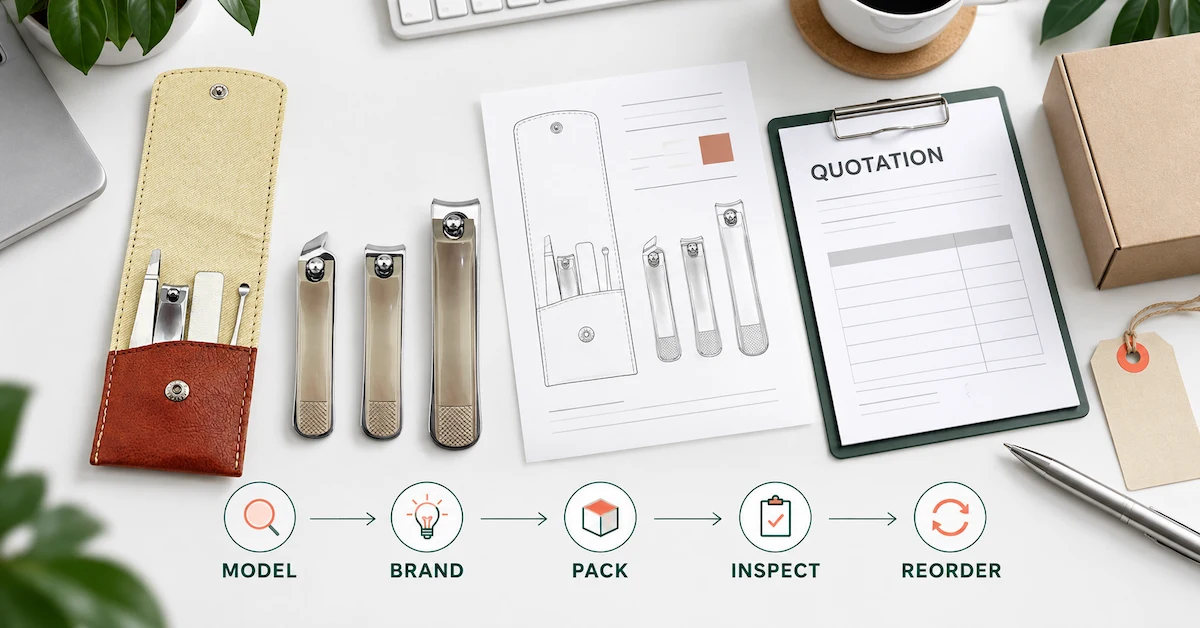
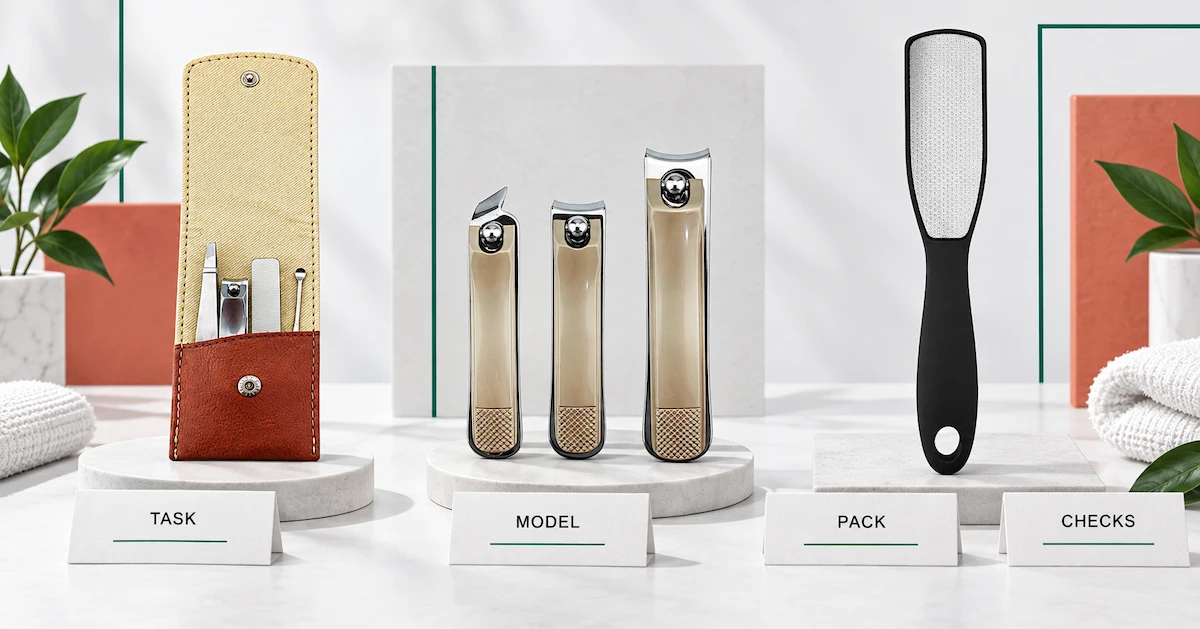
The OLIMOR professional manicure set is a useful reference for a multi-piece product. A set is not just a group of loose tools. It also includes the case or presentation, internal retention, item list, and customer-facing instructions. Every component must be identified before a buyer can compare a quotation.
Start by listing each included tool and its role. Ask how the tools are held in the case, whether any working ends need protection, and what the customer sees when the set is opened. If the supplier offers alternative case materials or colors, request a packed sample that shows the whole configuration rather than judging each tool separately.
A set can create a documentation problem if the package copy uses one material statement for every tool. Check whether the material, finish, and care instructions apply to the whole set or only to named components. Do not generalize a specification from one tool to the other pieces.
For private label, review the logo area on the case and on individual tools. A large case mark may be simple while a small metal tool has limited decoration space. Decide whether the brand experience comes from the case, the tools, the insert, or a combination. Record the intended answer before artwork production.
Step 4: Review a Nail Clipper by Its Mechanism and Pack
A nail clipper is a mechanism, not merely a shaped piece of metal. The cutting edges, lever, pivot, handle geometry, and storage presentation need a product-specific discussion. The OLIMOR nail clipper set can serve as a reference for comparing a set presentation and a stand-alone tool route.
Ask what the selected configuration is intended to cut and how the cutting action will be assessed. Define how the lever should move, how the cutting edges should meet, and what visible condition is acceptable at receiving. Do not substitute a generic quality phrase for a functional review.
Package design should protect the working edges and make the included configuration clear. If the set includes multiple clippers or accessories, list them. If the product image contains a scale or a diagram, do not use those visible marks as a final specification without supplier confirmation.
A professional positioning may require stronger records for material wording, edge condition, and care. Ask what evidence is available for the selected model. The supplier can explain its process, but the buyer remains responsible for ensuring that market claims and instructions match the actual product and destination requirements.
Step 5: Review a Foot File by Its Working Surface and Handle
A foot file introduces another type of inspection. The working surface, backing, handle, and edges interact with the user's hand and the intended foot-care routine. The OLIMOR professional foot file provides a real reference for discussing surface design and retail presentation.
Ask what the working surface is made from, how it is attached or formed, and how a buyer should assess its condition. Do not claim a particular abrasive performance, skin result, or wear life unless the project includes supporting evidence. "Nano" or "professional" in a product name does not replace a component description or a method of evaluation.
Storage and cleaning language should be checked against the actual surface and backing. A stainless component, a glass-like surface, and a coated handle can have different care considerations. Avoid copying the care paragraph from a different tool family into a foot-file package.
These three product examples show why a supplier assessment needs both range-level coordination and model-level checks. The brand may use one visual system. The purchase file still needs three separate product records.
Step 6: Separate Material, Finish, and Decoration
Many supplier comparisons become unclear because material and appearance are written as if they are the same. Material describes the component's construction. Finish describes the surface. Decoration describes a logo, print, or other brand mark. Write each request separately.
For a stainless steel beauty tools supplier inquiry, identify the component: clipper body, set tool, file part, handle, or another piece. Ask for the material wording for the exact model and any supporting record available. Do not infer a steel grade, corrosion result, or cleaning compatibility from a generic title.
Finish approval should use a physical or production-representative reference when the appearance is important. Reflective metal, painted plastic, coated glass, and textured surfaces can render the same digital color differently. Agree on the reference and review conditions before final artwork.
Decoration should be reviewed on the real surface. A logo that fits a case may not fit a small clipper lever or a narrow file handle. A custom beauty tools supplier China should be asked to distinguish a logo change from a structural change, because the two requests can affect tooling, samples, inspection, and schedule differently.
| Requirement | Specify | Do not assume |
|---|---|---|
| Material | Component, model, wording, and available supporting record | One material description covers every tool in a set |
| Finish | Surface reference, color direction, and acceptance view | Digital color values create identical metal and plastic surfaces |
| Decoration | Artwork, location, method, size, and proof approval | One logo location works on all products |
| Protection | Cap, case, insert, or other included component | A catalog photograph proves the accessory is included |
Step 7: Compare OEM, ODM, Private Label, and Wholesale Routes
Different buying routes can exist in the same supplier relationship. An OEM project may start with a drawing or a controlled sample. An ODM project may start with a platform and a collection direction. A private-label order may use an existing tool with new branding and packaging. A wholesale purchase may keep the standard product and pack.
Ask the supplier to identify which parts are standard, configurable, and newly developed. This is more precise than selecting one acronym and assuming that it describes the entire project. It also helps the buyer determine which costs are one-time, which evidence is needed, and which changes affect the reorder.
A private label beauty tools supplier should be asked about logo, finish, color, case, package, and instructions as separate scope lines. Existing products can reduce design decisions, but the final branded unit still requires approval.
If the buyer needs a professional beauty tools supplier China for a salon range, ask how the supplier manages multiple categories and whether the same documentation format can be used without copying the same functional criteria. Consistent records are valuable; identical acceptance rules are not always appropriate.
For wholesale, keep the product and pack specification visible. A standard item may still change over time. Ask how substitutions, component changes, or package revisions will be communicated before the next shipment.
Step 8: Packaging and Documentation
Packaging is part of the purchased product. It protects working parts, tells the customer what is included, creates a brand impression, and can affect warehouse handling. Request a complete packed sample for the intended retail unit.
For a set, the package should identify every included tool. For a clipper, the package should show the actual format and any accessory. For a foot file, the product image and care text should match the working surface. Do not let a lifestyle image imply a larger set than the quotation covers.
Use a controlled artwork file and connect it to the model code. Track language, barcode, warning, responsible-party, and contact details according to the destination market and importer advice. The European Commission product-safety information is an official starting point for reviewing EU obligations, but it is not evidence that any supplier's standard package satisfies your final market requirements.
Ask for a document list: product specification, approved sample reference, component list, package artwork, inspection record, and change log. The exact list will vary by project. A supplier's willingness to explain what is available and what still needs confirmation is more useful than a generic promise that documentation is complete.
Step 9: Inspection and Acceptance
Inspection should be connected to the tool's job. A manicure set needs a count and fit check as well as tool-specific checks. A nail clipper needs a mechanism and cutting-edge review. A foot file needs a working-surface, handle, and edge review. All three need packaging and marking checks.
| Product family | Functional checks to define | Pack and appearance checks |
|---|---|---|
| Manicure set | Included tool count, tool condition, case fit, closure behavior | Set list, logo, case finish, insert, and protective parts |
| Nail clipper | Lever movement, edge meeting, body condition, agreed cutting review | Finish, pack identity, edge protection, and included accessories |
| Foot file | Working-surface condition, handle attachment, edge condition | Surface appearance, care information, pack and barcode |
Define what counts as a critical, major, or minor finding for your product and market. Do not copy an unrelated AQL value and assume it resolves every question about a sharp or abrasive tool. ISO 2859-1:2026 provides acceptance-sampling procedures by attributes, but it does not create a beauty-tool defect list, prove safety, or certify a supplier.
Keep the approved sample traceable. The record should state model, finish, logo revision, package version, included components, and controlling drawing or photograph. If a sample, product page, and later artwork differ, state which document controls the delivered configuration.
Step 10: Quote the Complete Sellable Unit
Request an itemized quotation from a wholesale beauty tools supplier China. Compare the same product, quantity, finish, branding, packaging, inspection, and shipment basis. A loose clipper cannot be compared fairly with a decorated boxed clipper, and a manicure set cannot be compared with one loose tool.
Separate one-time charges from recurring costs. Development, tooling, artwork setup, and packaging setup may apply differently from the unit cost. Ask for a model-by-model view so an expensive new-development item is not hidden in an average price for a mixed range.
| Quote line | Question | Why it matters |
|---|---|---|
| Base product | Which exact model, material, finish, and included items? | Prevents unlike products being compared |
| Branding | Which mark, position, method, and proof? | Defines the decorated item |
| Packaging | Which case, card, carton, insert, and protection? | Defines the retail unit |
| Development | Which charges are one-time and who owns assets? | Clarifies launch economics and rights |
| Inspection and freight | What checks and delivery assumptions? | Builds a meaningful landed-cost comparison |
Step 11: Reorder and Change Control
The first shipment creates a reference. Give every SKU a stable identifier that connects the model, materials, finish, decoration, package, included components, and approved sample. This makes a reorder a controlled request rather than a memory of a photograph.
Ask when the supplier must notify you about substitutions. A different spring, finish, plastic component, insert, or case can change the customer experience while leaving the product name unchanged. Agree on who approves the change and what sample or document is required.
For a beauty tools factory China supply plan, clarify whether individual SKUs can be replenished separately and whether packaging carries separate order constraints. A combined first order does not automatically establish the conditions for a later single-item reorder.
Log issues by model and shipment. A problem with a clipper lever should not be recorded only as a general range complaint. Model-specific records help purchasing and quality teams identify the affected configuration and decide whether a corrective action is needed.
FAQ: Beauty Tools Supplier China Sourcing
How do I choose between two beauty tools suppliers in China?
Compare the same complete sellable unit and review the evidence trail: model-specific specifications, samples, functional checks, decoration feasibility, package, inspection plan, change communication, and reorder terms. Price should be compared after scope is normalized.
Can a supplier provide both standard and custom beauty tools?
Ask the supplier to classify each item as standard, configurable, or new development. A range may combine an existing manicure set with a custom package or a developed clipper. The quotation and schedule should show the difference.
Is a China supplier suitable for private label?
It can be, when the supplier can explain the selected model, branding area, packaging, approval sample, and reorder conditions. Private label does not mean that a buyer can skip the final decorated and packed sample.
What does stainless steel mean on a beauty tool listing?
Clarify the component and the exact model. Request the supported material wording and any available record. Do not assume the phrase establishes an alloy grade, cleaning compatibility, or applies to every item in a set.
How can I avoid receiving the wrong number of items?
Use a component list and photograph the complete sellable unit. The quotation, package artwork, product page, and inspection record should use the same item count and model code.
What should a first inquiry include?
Send the market, channel, customer task, product shortlist, quantity by SKU, brand artwork, package concept, desired material wording, and open questions. Ask for a model-by-model quote and a clear sampling route.
What if I want to change the design after sampling?
Describe the change and ask whether it affects tooling, components, inspection, package, ownership, cost, or schedule. Treat a structural change differently from a color or logo change, and update the controlled sample record.
Next Step: Send a Supplier Brief That Can Be Compared
A beauty tools supplier China partner is easier to evaluate when the inquiry contains a real buying scenario. Start with a shortlist of products, explain the channel and customer task, and separate range-level identity from model-level function. Ask for product evidence, a complete quote, a packed sample, inspection questions, and reorder terms.
This process helps you build a range that purchasing can reorder, marketing can describe accurately, quality can inspect, and customers can understand. It also gives OLIMOR a practical basis for recommending existing products or explaining where OEM and ODM development is necessary.