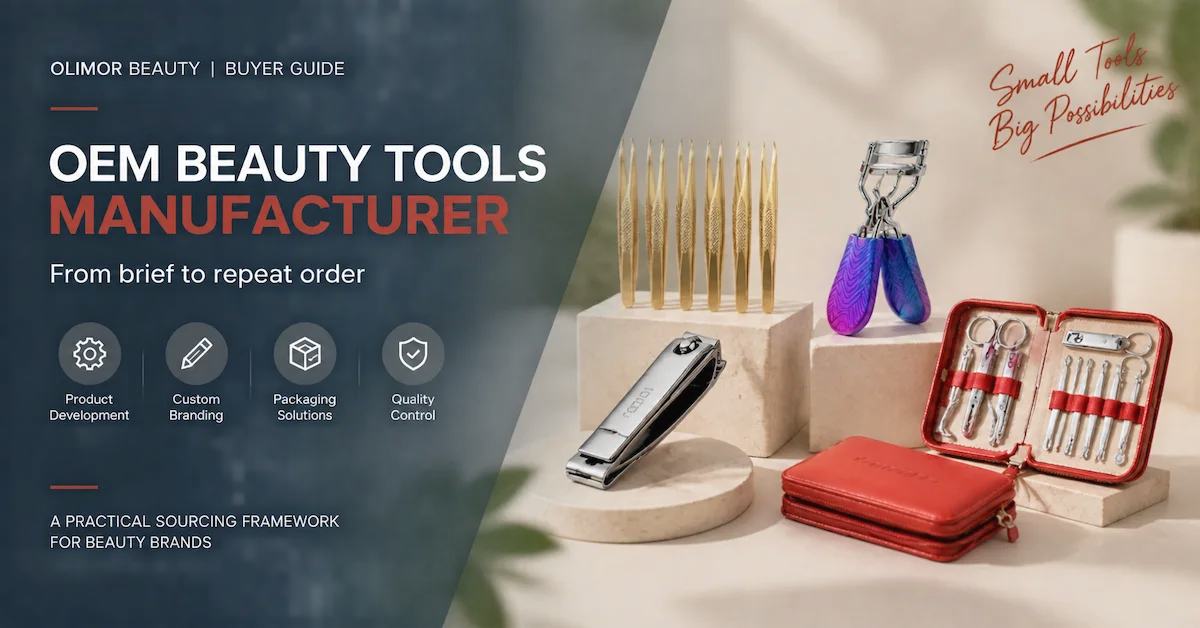
Quick Answer: Give a prospective beauty scissors manufacturer one grooming job and one reference model. Cut the same fine material with several coded samples, watching the blade contact and tips while feeling the pivot and finger loops. Next, inspect the finished logo and protective pack. Put that exact configuration on every quotation. The resulting sample and notes give brow, facial-hair, salon, retail, and grooming-kit buyers something concrete to use when production starts and when stock is reordered.
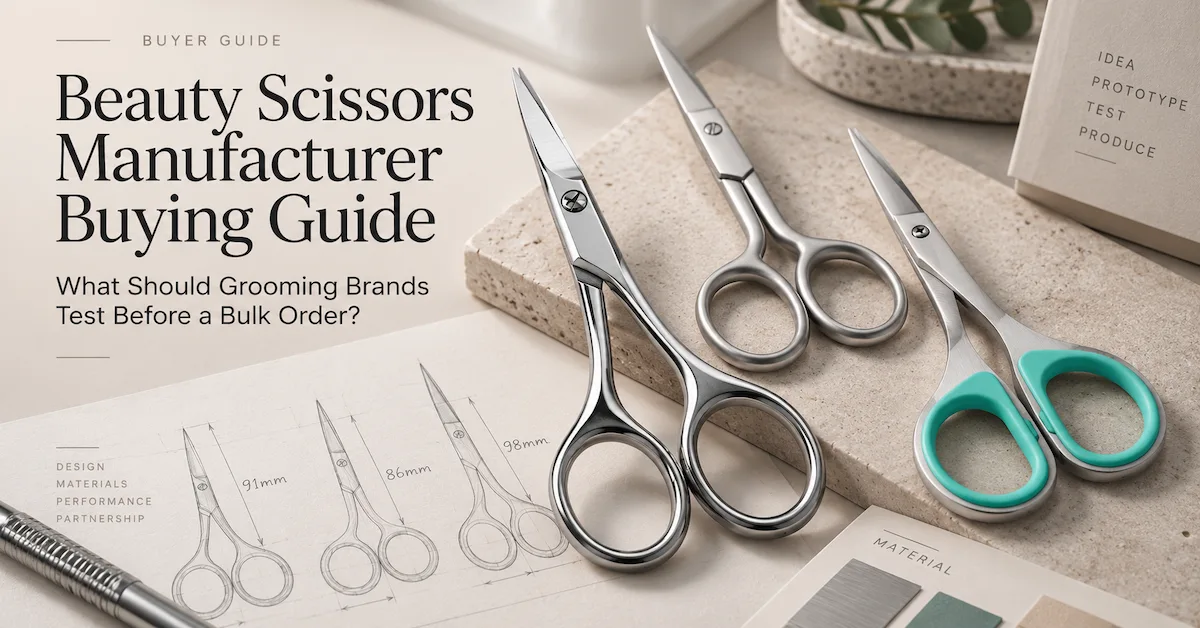
Introduction: A polished scissor can still fail the first trim
Beauty scissors are often selected from a clean product photograph. The image may show an elegant curve, bright finish, and compact finger loops. It cannot show whether fine hair folds between the blades, whether the pivot feels gritty, whether the tips block the user's view, or whether one loop creates pressure during repeated use. Those details appear when the tool reaches a brow station, grooming kit, or customer's hand.
That gap between appearance and use creates a purchasing problem. A quotation may call the scissors sharp, precise, professional, ergonomic, and stainless steel. Ask what each word means for the model in your hand. Which material is cut? Where should the blades meet? How should the pivot move? Which finish and pack are included? Without those answers, two suppliers can use the same adjectives for very different tools.
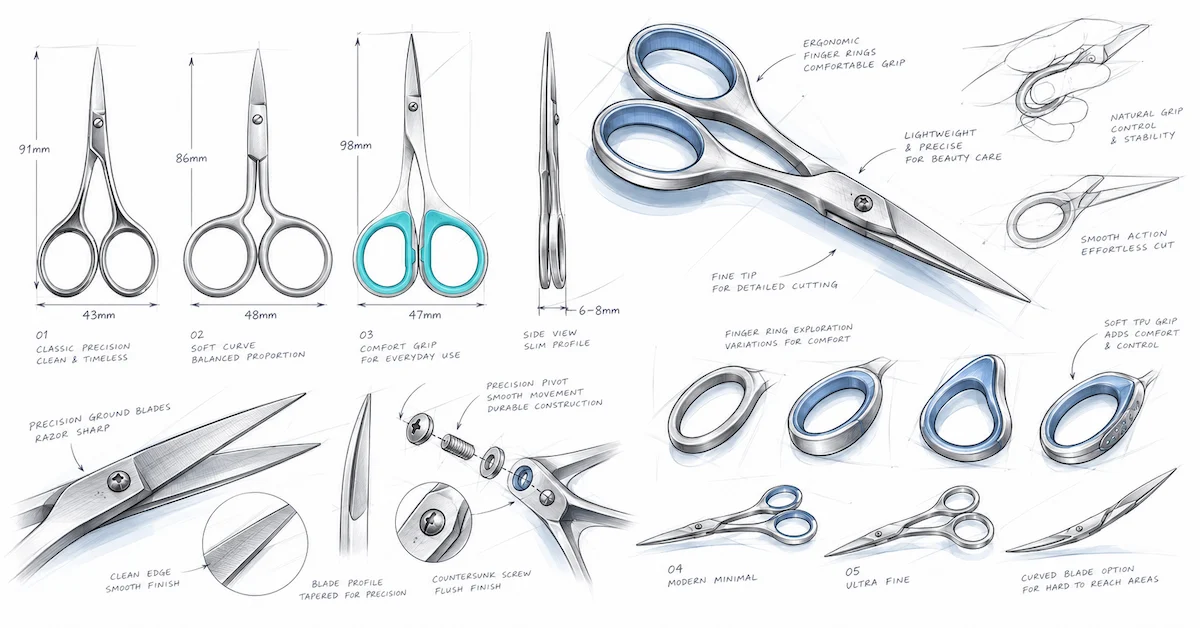
The following checks suit a brand creating a brow or facial-grooming range, a retailer adding compact scissors, a salon distributor, or an importer planning private label. OLIMOR BEAUTY pages provide real examples. Any size, weight, material, or colour shown for SXS5005, SCB3057, or SCB3058 belongs only to that listed SKU.
What is a beauty scissors manufacturer?
A beauty scissors manufacturer makes or coordinates compact cutting tools intended for controlled grooming tasks. One model might pass through blank preparation, forming, grinding, pivot assembly, blade adjustment, polishing, inspection, decoration, and packing. Heat treatment, coating, or handle-component assembly may also be relevant. Ask the supplier to map the route for the SKU on the quotation.
The manufacturer's job is not simply to create two shiny blades. It must reproduce a relationship among the cutting edges, pivot, tips, handles, and finger loops. A change to one part can alter the others. Tightening a pivot can remove looseness but create drag. A thicker coating can affect contact. A plastic grip can improve comfort for one customer while changing cleaning, colour matching, and pack dimensions.
For procurement, the word manufacturer should also identify responsibility. Ask who owns the current drawing, who prepares and adjusts the blades, who sets the pivot, who inspects cutting action, who manages an outside coating or plastic component, and who releases the packed unit. A clear answer for one quoted model is more valuable than a general factory slogan.
1. Define what the scissors will cut
Begin with the intended material and location. Eyebrow hair, moustache detail, false-lash adjustment, small cosmetic materials, and a loose thread are not automatically the same task. A product positioned for brow trimming may need short, visible tips and controlled snips. A grooming set may need a rounded or protected presentation appropriate to its intended user. A craft use should be separated from personal grooming for hygiene and edge-maintenance reasons.
Put the user, task, working area, frequency, and storage into one brief. For example, ask for compact curved scissors used for occasional brow touch-ups and stored in a travel pouch. That sentence tells the supplier far more than "premium beauty scissors." For repeated salon work, add the expected grip and session pattern.
| Buying scenario | Question to answer | Product discussion | Approval evidence |
|---|---|---|---|
| Brow retail | Can the user see and isolate the intended hairs? | Tip shape, blade curve, length, loop fit | Coded sample reviewed in the intended position |
| Salon supply | Does opening and closing remain controlled during repeated work? | Pivot feel, loop comfort, weight, surface | Several samples tested with one method |
| Travel kit | How are the tips protected after use? | Compact body, cap, pouch, insert | Complete packed-unit handling check |
| Multi-tool grooming set | Does each included tool have a distinct purpose? | Scissor role, companion tools, naming, pack position | Set map, item count, and final pack sample |
A buyer evaluating a professional beauty scissors manufacturer should replace the word professional with this task description. It gives the sampling and inspection teams something they can observe instead of an adjective they cannot measure.
2. Choose straight, curved, pointed, or protected tips by use
Blade profile changes access and visibility. A slight curve may follow a brow contour for some users. A straight blade may give another visual reference. A pointed tip can reach a small area but needs careful handling and protection. A rounded or guarded form can suit a different customer or kit position. No single style is best for every use.
Look at the tips while the scissors are open and while they close. Do they remain in the expected plane? Does one tip pass the other cleanly? Is the user able to see the intended hair or material? Does a decorative shape hide the working end? Take sample photographs in the orientation used during grooming, not only flat on a table.
Keep public descriptions specific. If the model has curved eyebrow-trimming blades, say that. Do not turn the curve into a promise of perfect results or universal safety. The final experience still depends on alignment, edge condition, pivot action, handling, user technique, and care.
3. Watch the cutting contact move along the blades
Closed scissors may look perfectly aligned and still behave poorly. Move the handles slowly and watch where the edges begin to touch. Note any catch, gritty movement, looseness, or section where fine material bends instead of separating. Use several coded pieces so one unusually good sample does not decide the order.
Use a review material relevant to the stated task. Keep the material, position, grip, and movement consistent across candidates. Record whether the scissors cut at the intended region, push the material away, snag, or require repeated pressure. A test for brow hair does not establish performance for fabric, nails, wire, or another material.
Ask how blade relationship is created and maintained in production. The answer may cover forming, grinding, heat treatment where applicable, pivot assembly, adjustment, fixtures, and final checks. Do not prescribe a process you have not verified. Instead, ask how the supplier reproduces the approved sample and catches a piece that differs.
Distinguish edge problems from pivot problems
A pulling result may come from edge condition, blade meeting, pivot tension, material position, or a sample that does not fit the task. Feedback should identify the model, test material, cutting region, and observed result. "Not sharp" is not enough to locate the cause.
4. Evaluate the pivot as a functional setting
The pivot holds the two blades in a working relationship. Too loose, and the blades may separate or feel unstable. Too tight, and the user may force the loops or experience uneven movement. The correct feel depends on the model, blade geometry, task, and intended user.
Compare samples using the same grip. Open and close each pair through its normal travel, note any stick point, and check whether the setting remains consistent after repeated sample movements. If a measurable torque or force is required, agree the fixture, instrument, position, travel, and acceptance range. A number without a method is not a useful control.
Ask whether the pivot is adjustable, fixed, riveted, screwed, or built another way for the selected model. Each arrangement can have different assembly, service, appearance, and packaging considerations. Do not advertise adjustability unless the product is designed and documented for it.
5. Fit the handle to the actual hand and session
Finger loops that look symmetrical may not feel the same to every user. Review loop dimensions, edges, rests, plastic inserts, surface texture, and the angle between the handle and blades. Note whether the user's fingers shift during a short grooming movement and whether the tips remain visible.
SCB3058, for example, is listed with stainless steel plus plastic and visible comfort-grip components. That product detail is useful for a buyer considering a colour-led or comfort-oriented range. It does not prove that every user prefers the grip or that the plastic has a particular chemical or heat resistance. Those questions require model-specific evidence.
For repeated salon use, invite reviewers with relevant hand sizes and routines. Keep subjective comfort notes separate from measurable dimensions. A small group can identify pressure points and visibility issues, but it cannot justify a universal ergonomic claim.
6. Confirm material and finish separately
A stainless steel beauty scissors supplier should identify the material wording for the quoted model and the supporting records available. "Stainless steel" does not, by itself, name an alloy grade, hardness, heat-treatment condition, corrosion result, or approved cleaning method.
Finish is a separate decision. Polished silver, satin, coloured coating, patterned surface, and plastic grip components create different appearance and handling questions. Ask whether finishing touches the cutting edge or pivot, whether the scissors are adjusted again afterwards, and how the final surface is protected in the pack.
Approve a physical finish sample under lighting appropriate to the brand. Check colour, reflectivity, texture, logo contrast, visible marks, and contact with the insert. Care wording should suit the actual material and finish. Avoid copying sterilization or chemical-resistance claims from another model.
7. Decide how much development the brand needs
OEM route
An OEM beauty scissors manufacturer can review a buyer drawing, reference sample, dimensional envelope, blade concept, handle idea, or written brief. Mark the features that must remain fixed and the areas where the manufacturer may propose changes. Clear ownership reduces the chance that an attractive concept becomes impractical at the pivot or pack stage.
Request feasibility feedback before approving artwork. New blade curvature can affect grinding and alignment. A new handle can change finger position and packaging. A plastic insert can require moulding, colour matching, and assembly controls. The supplier should list assumptions, open questions, and sample gates.
ODM route
An ODM beauty scissors manufacturer can shortlist established platforms for the intended task. Have the supplier label every option: standard feature, finish or decoration change, tooling change, or new functional review. A shortlist selected for the stated task is easier to compare than a large catalogue export.
Record why a platform was selected. "SCB3057 direction chosen because the pointed blade and compact loops suit the approved brow brief" is more useful than "sample B looked better." The reason helps the next buyer understand the range and prevents silent substitutions.
Private-label route
Private label beauty scissors connect the selected platform with a brand's finish, logo, protector, pouch, card, insert, box, instructions, and carton. Approve the actual branded and packed version. A digital logo proof does not approve cutting action, and a bare-metal sample does not approve a coated production tool.
Discuss Your Beauty Scissors Project
8. Use sample stages to remove uncertainty
A form sample can answer questions about size, curve, loops, and pack envelope. A functional sample can answer blade meeting, cutting action, pivot movement, tip control, and hand position. A decorated sample can answer finish and logo questions. A packed sample can answer protection, identity, printed content, and component count.
Label every sample by purpose and revision. Write what it approves and what remains open. If a prototype uses temporary material or finish, put that note beside the sample code. If a buyer changes the blade after artwork approval, open a new revision rather than relying on a chat message.
When the final configuration is ready, establish a golden sample. Connect it to the drawing, material wording, finish master, logo artwork, packaging files, inspection plan, and accepted deviations. Protect it from casual cutting, sharpening, adjustment, or display handling.
9. Place logos where they remain visible and comfortable
A scissor offers limited decoration space. A mark placed too close to the pivot can compete with hardware or be distorted by the surface. A mark on a narrow handle may become unreadable. A logo under the fingers can wear differently or affect grip. Review the actual decorated tool from product-photo, shelf, and use positions.
Supply vector artwork, maximum area, orientation, colour reference, preferred method, and a revision code. Ask how etching, printing, stamping, coating, or another process interacts with the surface. Do not claim a mark is permanent or scratch-proof without a relevant method and result.
For a coordinated range, define a branding rule rather than forcing one logo size on every model. The rule may identify orientation, clear space, relative scale, and approved exceptions. Keep the physical proof with the release file.
10. Protect blades and tips in retail packaging
Scissors can pass inspection and arrive damaged if the pack lets the tips strike a carton, another tool, or a hard insert. The packaging must suit the exact blade profile and opening. A cap that fits a straight model may press against a curved model. An insert that holds the loops loosely may allow the blades to move.
Test the final scissors in the final protector, pouch, card, tray, or box. Remove and replace the tool several times. Check tip contact, blade movement, pivot pressure, finish rubbing, logo visibility, item count, barcode position, and printed model name. For sets, ensure every tool has a clear role and stable position.
| Packaging decision | What the buyer should check | Why it matters |
|---|---|---|
| Tip and blade protection | Contact points, opening restraint, removal direction | Prevents damage after final inspection |
| Retail presentation | Model identity, use statement, finish, barcode, languages | Keeps the shelf promise aligned with the tool |
| Set insert | Scissor position, companion tools, item count | Stops metal pieces from rubbing or being substituted |
| Shipping carton | SKU marks, quantity, inner-pack support, carton reference | Retail packaging alone may not withstand export handling |
11. Put inspection checks at the right production stage
Begin with the failure a customer would notice. Fine material that folds instead of cutting, rough pivot movement, misaligned tips, a sharp burr on a loop, wrong finish, incorrect logo, or missing protector can all affect the product promise. Describe each defect in language an inspector can apply.
Incoming material, first-piece, in-process, final-tool, and packed-unit checks serve different purposes. Review forming and blade setup before decoration adds cost. Check the first assembled scissors before a run continues. Use in-process checks to detect drift. Inspect the final surface and cutting action. Then verify the complete pack.
Teams that use lot sampling can consult the official ISO 2859-1:2026 page, which covers acceptance-sampling schemes indexed by acceptance quality limit. The standard does not decide your defect classes, inspection level, AQL, or legal duties. Those choices belong in the purchase agreement after competent review.
| Control point | Example question | Possible record | Decision |
|---|---|---|---|
| First piece | Do blade meeting, pivot, tips, loops, and finish match the current reference? | First-piece approval by model and revision | Run, adjust, or stop |
| In process | Are cutting feel, movement, and appearance remaining stable? | Patrol inspection sheet | Continue, contain, or correct |
| Final tool | Does the finished scissor meet functional, visual, and identity requirements? | Final inspection report | Accept, sort, rework, or reject |
| Packed unit | Are the correct model, protector, artwork, and components together? | Pack release record | Release or correct packing |
Ask a beauty scissors factory China contact how nonconforming work is identified, separated, reviewed, corrected, and rechecked. Sorting can contain a shipment, but it does not explain the cause or reduce recurrence by itself.
12. Compare suppliers with one shared brief
Send each candidate one shared brief covering the task, model, sample method, finish, logo, pack, inspection, quantity, and trade term. Then ask the contact to mark work performed on site, work managed through partners, and the person who signs off the finished order. Keep the answer beside the score.
Review product fit, communication, development discipline, quality controls, packaging, change management, export readiness, and price. A cheap quotation for a different blade, plain finish, simple pouch, or undefined inspection scope is not the same offer.
A custom beauty scissors manufacturer should explain the effect of requested changes. New blade geometry can change grinding and protection. New finger loops can change tooling, comfort, and pack dimensions. New finishes can change logo contrast and reinspection needs.
13. Put the saleable configuration on every quotation
Ask the quotation to name the model and its blade, tips, size, material statement, surface, colour, pivot, and handle components. Add the logo method and location, development charges, samples, pack, inspection, quantity, currency, trade term, destination assumptions, and validity. If a line remains undecided, mark it open instead of letting the supplier assume a standard option.
Keep tooling and setup away from the recurring unit price. For several colours or models, ask how the minimum and price apply to each SKU and the combined order. Check the list of included packaging components instead of assuming the product photograph defines the quote.
There is no responsible universal MOQ, unit cost, or lead time for all scissors. These depend on the platform, blade, material, finish, plastic components, logo, tooling, pack, quantity, approvals, capacity, and shipment route. Ask which event starts each milestone and how revisions affect the calendar.
A wholesale beauty scissors supplier should quote the same defined configuration across quantity bands. For international delivery, state the Incoterms rule and named place. The International Chamber of Commerce provides official Incoterms resources; a trade term does not replace the product specification, quality agreement, insurance decision, or market review.
Request a Beauty Scissors Quotation
14. Handle market documents and claims carefully
Confirm who prepares the commercial invoice, packing list, carton marks, shipping instructions, and product descriptions. Keep the model code, material wording, finish, pack contents, and quantity consistent across documents. If scissors are included in a larger grooming set, identify every component accurately.
Company-level certifications do not automatically certify every scissor or market claim. Request current documents where relevant and check holder, site, scope, validity, product identity, and method. Have qualified parties review destination requirements. Do not print medical grade, sterilizable, FDA approved, CE certified, or universally safe unless current evidence for the exact product and claim supports the wording.
Care and storage language should match the actual material and finish. Separate grooming scissors from craft use where hygiene or edge condition matters. Use clear warnings and instructions appropriate to the destination and customer, subject to qualified review.
15. Use a pilot order to test the full customer experience
A pilot should test more than cutting action. Give a sample carton to a warehouse or retail colleague who has not seen the factory instructions. Ask that person to identify the scissors, finish, logo, protector, insert, printed copy, barcode, and order reference. Any hesitation may reveal a naming or packing problem.
Observe removal and replacement. Do the tips remain protected? Does the finish rub? Does the loop insert remain seated? Is the product name accurate? Can the customer understand the intended use without an exaggerated claim? These details connect product performance to the brand experience.
At pilot close, record changes and accepted exceptions. If the logo moves, update the artwork. If the cap needs clearance, update the pack file. If the blade profile requires different public copy, update the listing. The controlled release package should reflect what was learned.
16. Protect repeat orders from silent changes
Retain the current drawing, model code, golden sample, cutting-task method, blade and pivot notes, material statement, finish master, logo artwork, packaging files, inspection plan, accepted deviations, and change history. Before replenishment, ask whether material source, forming, heat treatment, grinding, pivot component, plastic insert, finish, decoration, protector, or carton has changed.
Not every change requires full redevelopment, but each deserves an impact review. Decide whether cutting action, comfort, appearance, protection, public content, or required evidence could change. Define which events trigger a new sample or first-piece approval.
Keep the product page synchronized. Model number, blade shape, material, colour, size, weight, pack contents, image, and care wording should describe the released SKU. Consistency helps purchasing teams, customers, search engines, and answer engines understand the same product.

17. What should the first supplier inquiry include?
Send the target market, customer, grooming task, reference model or drawing, blade and tip preference, handle notes, material request, finish, logo files, packaging direction, quantity range, launch window, required evidence, and destination. Mark fixed requirements separately from open questions.
If blade direction is undecided, ask for two or three models matched to one task. If packaging is conceptual, explain the protective job and channel. If the pivot method is open, describe the desired hand experience and request the supplier's proposed verification approach.
Do not hide uncertainty behind copied figures. Request model-specific MOQ, sampling, production, and shipping conditions. A clear unknown gives the supplier a question to solve; a false requirement can send development in the wrong direction.
Frequently Asked Questions
How do I choose a beauty scissors manufacturer?
Define the grooming task, compare coded samples, review blade meeting, tips, pivot movement, loop comfort, material and finish, inspect the packed unit, and compare quotations for the same configuration. Check who controls each process and how changes are approved.
What makes beauty scissors different from household scissors?
Beauty scissors are selected for short, controlled cuts in grooming areas. Compact proportions, visible tips, blade profile, pivot feel, and finger-loop fit can differ from general scissors. Suitability still depends on the exact task and model.
Are curved scissors better for eyebrow trimming?
A curve can follow a brow contour for some users, while another user may prefer a straight visual reference. Compare samples in the intended position. The curve alone does not prove cutting quality or safety.
What should buyers inspect at the pivot?
Check for looseness, excessive resistance, grinding, stick points, and stability through normal opening and closing. If a numerical setting is required, define the instrument, position, travel, and acceptance method for the model.
What is the difference between OEM and ODM beauty scissors?
OEM usually begins with more buyer-controlled input, such as a drawing or defined blade and handle concept. ODM usually begins with an existing supplier platform. Both routes require a released specification and approved packed sample.
Can I add my logo and custom packaging?
Private-label projects may include finish, colour, logo, cap, pouch, card, insert, box, and instructions. Feasibility and quantity conditions depend on the model. Approve the physical decoration and final packed unit.
Does stainless steel identify the exact material grade?
No. Stainless steel is a broad material description. Request model-specific grade or supporting evidence if it matters to the product claim, customer, or destination. Do not infer hardness or corrosion results without a relevant method.
What is the MOQ for custom beauty scissors?
MOQ depends on model, material, blade, finish, plastic components, logo method, tooling, packaging, and order configuration. Ask for the minimum associated with the complete written SKU.
How much do wholesale beauty scissors cost?
Price depends on geometry, material, finish, components, development, decoration, packaging, inspection, quantity, and trade terms. Compare the same scope and separate setup charges from recurring unit cost.
How long does an OEM scissors project take?
Timing depends on feasibility, tooling, sample rounds, buyer approvals, materials, finishing, assembly, inspection, packing, and dispatch. Ask for milestones and define the event that begins each period.
How should scissors be protected during shipment?
Use a cap, sleeve, pouch, insert, or box suited to the actual tip and blade profile. Test removal, replacement, movement, finish contact, and carton support on the final packed sample.
Which product data should appear online?
Use the current model name, code, intended task, blade and tip style, material wording, finish, dimensions, weight, components, pack, care information, and inquiry link. Keep each fact scoped to the correct SKU.
Turn cutting control into a repeatable product
A strong sourcing decision begins with the grooming task and follows the cutting system. Choose the blade and tip, examine how the edges meet, review the pivot and handle, confirm material and finish, select the development route, protect the tool in its pack, and connect inspection to a coded reference.
OLIMOR BEAUTY product pages provide starting references including SXS5005, SCB3057, and SCB3058 for curved, pointed, and comfort-grip directions. Send the intended use, model reference, finish, branding, packaging idea, quantity range, and destination. The team can discuss feasible platforms, sample information, and a configuration-specific quotation.