











Why wholesale foot care tools still matter in a crowded personal-care market
Wholesale foot care tools sit in an awkward but reliable part of the personal-care market. They are not glamorous, and they do not get the same attention as skincare devices or high-end hair tools, but buyers keep coming back to them for a simple reason: feet need maintenance, and the maintenance is usually repetitive. For sourcing managers, spa operators, retail buyers, and private-label teams, wholesale foot care tools can be a low-drama category with steady turnover if the assortment is built sensibly.
The practical question is not whether people use these products. They do. The real question is what kind of set, finish, and feature mix will move in your channel without creating returns, complaints, or shelf clutter. A pedicure kit that looks good in a photo but feels flimsy in the hand will not hold up in salons or hospitality kits. A more durable set can support home grooming, salon resale, and bundled wellness programs, especially when it includes several useful tool types instead of one isolated item.
This article looks at the category from a buyer’s angle: what is typically included, how these tools are used, what to watch for when sourcing bulk foot care tools, and where the common quality problems tend to show up.
What is usually inside a foot care set
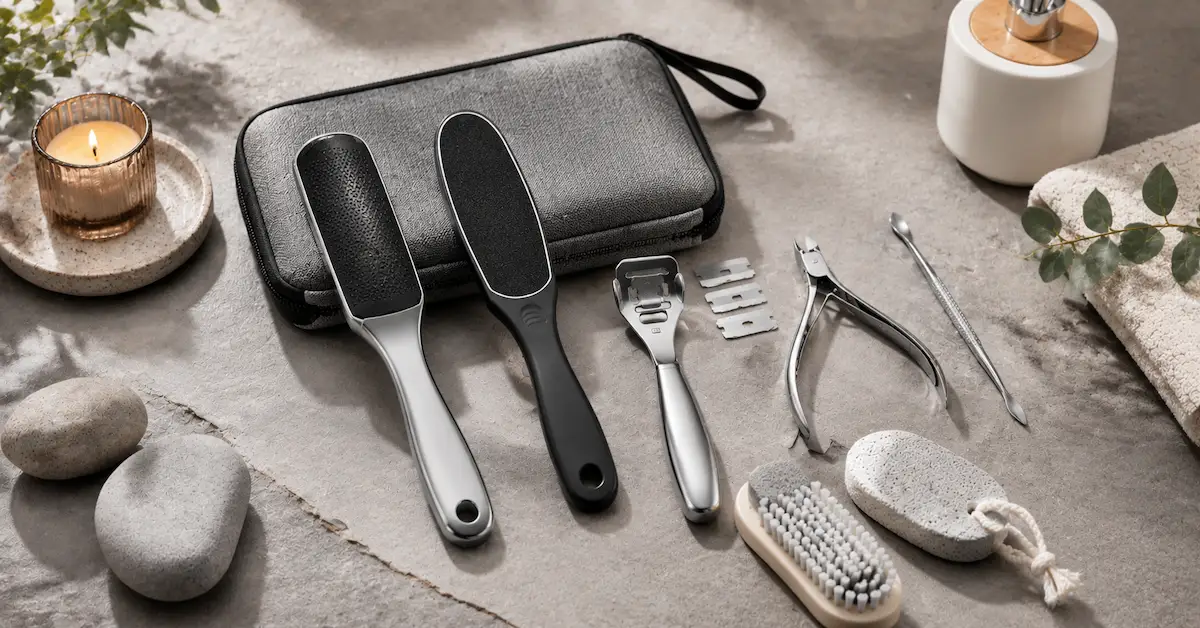
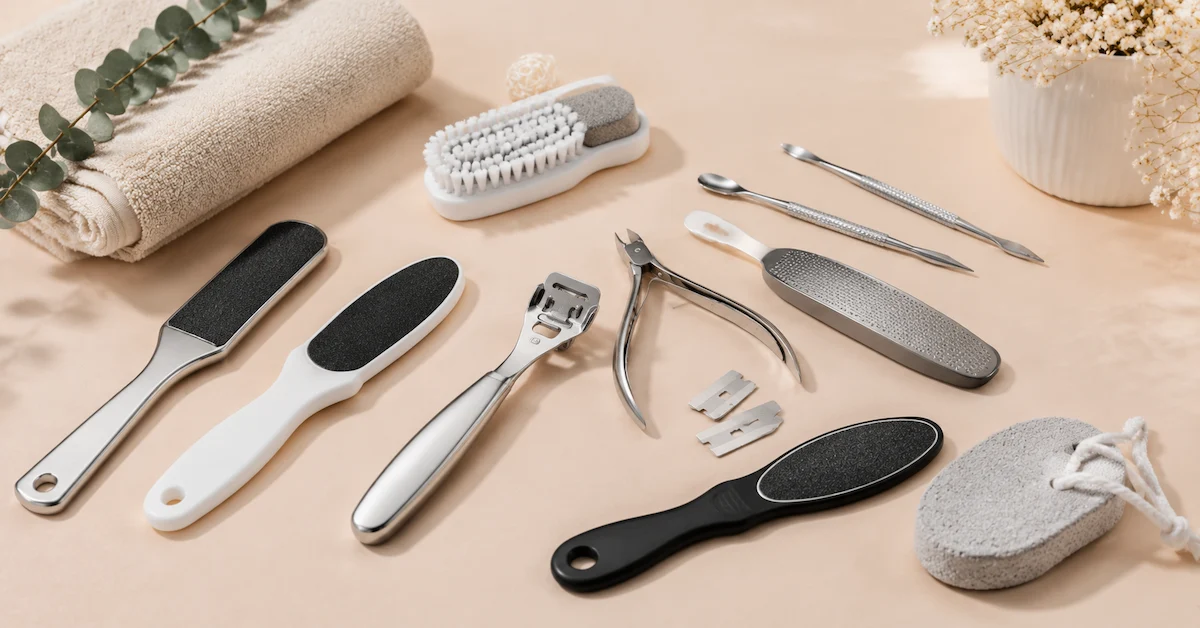
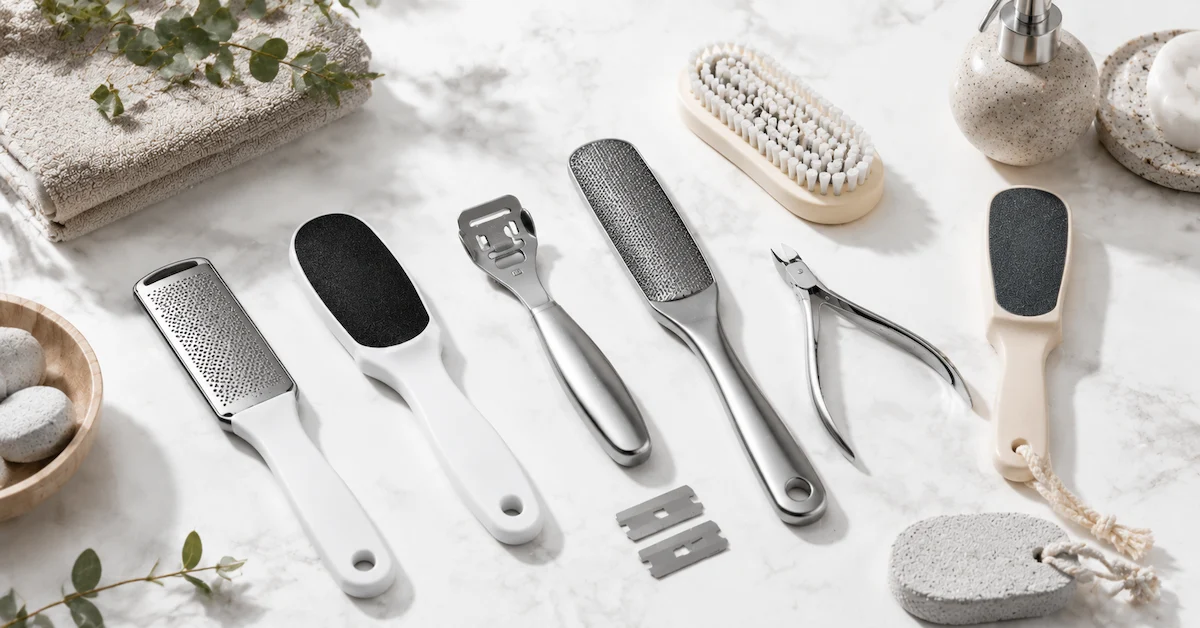
The product group shown here is a coordinated foot care / pedicure tool set built around basic grooming and callus management. It appears to include a foot file or rasp, a pumice-like scrub stone, cuticle or nail nippers, a metal foot scraper or plane, and a dual-ended or interchangeable blade-style callus remover with spare blades. That mix is useful because it covers several routines in one package: smoothing rough heels, removing dead skin, trimming cuticles or nails, and handling thicker callused areas.
For wholesale buyers, the value is partly in that variety. A customer who buys a single rasp may still need a nipper or scraper. A set that combines them can support retail bundling, spa amenity programs, or gift-ready packaging without forcing the buyer to source each part separately.
Quick buyer takeaway
If your channel wants everyday grooming rather than specialized treatment, a mixed set usually has broader appeal than a single-purpose tool. If your channel is more professional, you may want to separate lighter home-use items from sturdier salon-oriented tools so the assortment feels intentional instead of overpacked.
Materials and construction: what is visible, and why it matters
The visible surfaces suggest a common personal-care hardware approach: stainless steel or metal working heads, plastic or coated handles in white and matte silver, abrasive pads or strips in black or gray, and a porous light-gray stone that resembles a pumice-style abrasive. One brush in the group has white bristles in a cream-colored base, which suggests the set also includes a finishing or cleaning step, not just abrasion.
That combination is not unusual. In this category, buyers often want a balance between hygiene, durability, and cost control. Metal working surfaces are easy to present as sturdy and reusable, while molded handles help keep the tool light and comfortable. Abrasive elements add function, but they also introduce variability. If the abrasive surface wears too quickly, the user notices. If it is too aggressive, the tool can feel harsh. Either way, the product experience changes fast.
There is a small but important caution here: visual quality and actual performance are not always the same thing. A polished metal rasp can still feel rough in the wrong way, and a neatly assembled handle can still flex more than expected. Buyers should ask for samples, then test how the tool behaves after a few uses, not just on first impression.
Where wholesale foot care tools fit in the market
Bulk foot care tools are sold into several channels, and the best assortment depends on the channel’s expectations.
For home care, customers want simplicity, portability, and obvious value. The handheld, slim, lightweight shapes shown in this category fit that use case well. For salons and spas, the decision shifts toward consistency and how the tools support repeated workflows. For hospitality or amenity kits, compact size and a clean presentation matter more than aggressive performance. Retail beauty bundles often need a set that looks complete in the package, because the buyer is choosing with the eyes before they ever touch the product.
That is why foot care tools wholesale is not a single buying decision. It is a small portfolio decision. The same product family can be positioned as a travel grooming set, a pedicure accessory bundle, a wellness kit component, or a basic retail personal-care item. The packaging and assortment tell the story as much as the tools themselves.
How to evaluate the set before placing a bulk order
When reviewing wholesale foot care tools, start with the basics: does the set cover a sensible routine, and do the individual tools feel coherent as a group? The image here shows a coordinated mix rather than a random bundle, which is a plus. A buyer should still confirm whether the set is actually sold together or whether it is only displayed as a styled group. That detail matters more than people admit, especially when comparing supplier photos to packed-out cartons.
Check the working surfaces first
The functional face of each tool should be easy to understand. A foot file should have a clear abrasive area or textured surface. A scraper or plane should be visually and physically distinct from a rasp. A nipper should open and close cleanly without sloppy hinge movement. A replaceable-blade callus remover should make the blade system easy to inspect and replace safely. If the tool’s purpose is not obvious to a first-time buyer, shelf conversion usually suffers.
Check the handle geometry
Ergonomic handle shapes and hanging holes or loops are not glamorous features, but they do help. The user wants control during a grooming task that may already be awkward. A tool that is too slick or too narrow can be annoying in wet conditions. Small details like grip texture, balance, and edge finish often separate an acceptable item from one that gets repeated orders.
Check replacement parts and packaging logic
The visible spare blades are a useful sign, because they suggest the set can support extended use rather than a one-and-done experience. For the buyer, that also creates a packaging question: are the spare blades secured well enough to avoid rattling, losing, or damaging the product presentation? Small loose parts are where many otherwise decent grooming kits go wrong.
Common sourcing mistakes in this category
One mistake is over-specifying the set for a channel that does not need it. If you add too many parts, the package may look impressive but feel confusing. Another mistake is underestimating the importance of finish. Foot-care products are handled closely; rough edges, uneven coating, or poor polishing are noticed immediately, even by casual buyers.
A third issue is assuming all abrasive surfaces are interchangeable. They are not. A porous pumice-like stone, a black abrasive strip, and a metal rasp each create a different tactile result. They do not necessarily compete with each other. In a good assortment, they complement each other. In a bad one, they overlap without adding much value.
There is also the storage problem. If the set has multiple small parts, buyers will want a way to keep them together. For retail and hospitality uses, that matters almost as much as the tools themselves. A neat set is easier to display, easier to pack, and less likely to generate post-purchase complaints about missing pieces.
Practical advice for engineers and product teams
For engineers and product teams, the key decisions are usually around geometry, material stack-up, and repeatability. These are consumer personal-care tools, so the tolerances are not the same as a precision industrial component, but inconsistency still shows up quickly in hand feel and tool performance. The stamped metal parts, polished surfaces, molded handles, and abrasive coatings all need to sit together cleanly.
For sourcing teams, the better question is whether the supplier can keep the set visually and functionally consistent across batches. A one-off sample can look excellent. A larger lot may expose variation in coating, blade fit, handle finish, or abrasive alignment. That is why a bulk order should be reviewed with actual use in mind, not just packaging and carton counts.
If you are building a private-label line, think about how the set will be explained on pack. A clear, plain-language description usually helps more than fancy claims. Customers want to know what each tool does, how the set supports routine care, and whether it is meant for home grooming, spa use, or travel.
FAQ for wholesale buyers
Are these tools suitable for both retail and salon channels?
Potentially yes, but the assortment should be matched to the channel. Lightweight, compact sets are often better for retail and travel. More durable or more complete assortments may fit salon resale or spa kits.
Should buyers prefer more tools in one set?
Not automatically. More tools can help if each one has a clear function. If the kit becomes crowded or repetitive, the extra pieces may not add perceived value.
What should be confirmed before purchase?
Confirm what is actually included, how the replaceable blades are packaged, whether the set is sold together, and whether the finish and handle style are consistent across the shipment. Exact dimensions, blade material, grit level, and safety claims should be requested directly from the supplier if they matter to your program.
Choosing the right wholesale foot care tools for your channel
The best bulk foot care tools are rarely the flashiest. They are the ones that look clean, make sense in the hand, and solve a practical grooming need without making the buyer overthink the purchase. In this category, the combination of a foot file, abrasive stone, nipper, scraper, and replaceable-blade remover creates a straightforward value proposition: a simple kit for routine foot maintenance.
For sourcing managers, the decision is whether that value proposition matches the channel. If you need a portable, low-complexity grooming bundle, this kind of set is a strong fit. If your customer expects a premium spa experience or a medical-grade claim, you will need a different product strategy entirely. That distinction is easy to miss in catalog browsing, and it is usually where a sourcing program goes sideways.
When you are ready to narrow the field, ask suppliers for samples, confirm the exact contents, and test the feel of the tools as a set. A good foot care kit should look coordinated, work predictably, and survive the kind of handling real buyers give it. If it does that, it can earn a stable place in retail, salon, hospitality, or wellness assortments without much drama.
Next step for buyers
If you are sourcing wholesale foot care tools for a private-label line, retail bundle, spa kit, or amenity program, start with a sample review and a content checklist. That is usually the fastest way to separate a usable assortment from a nice-looking photo. Ask for the exact included items, confirm how the blades or abrasive parts are packed, and check whether the set is meant for home use, salon resale, or broader personal-care distribution.