

Nail Clipper Blade Grinding: A Buyer Quality Guide
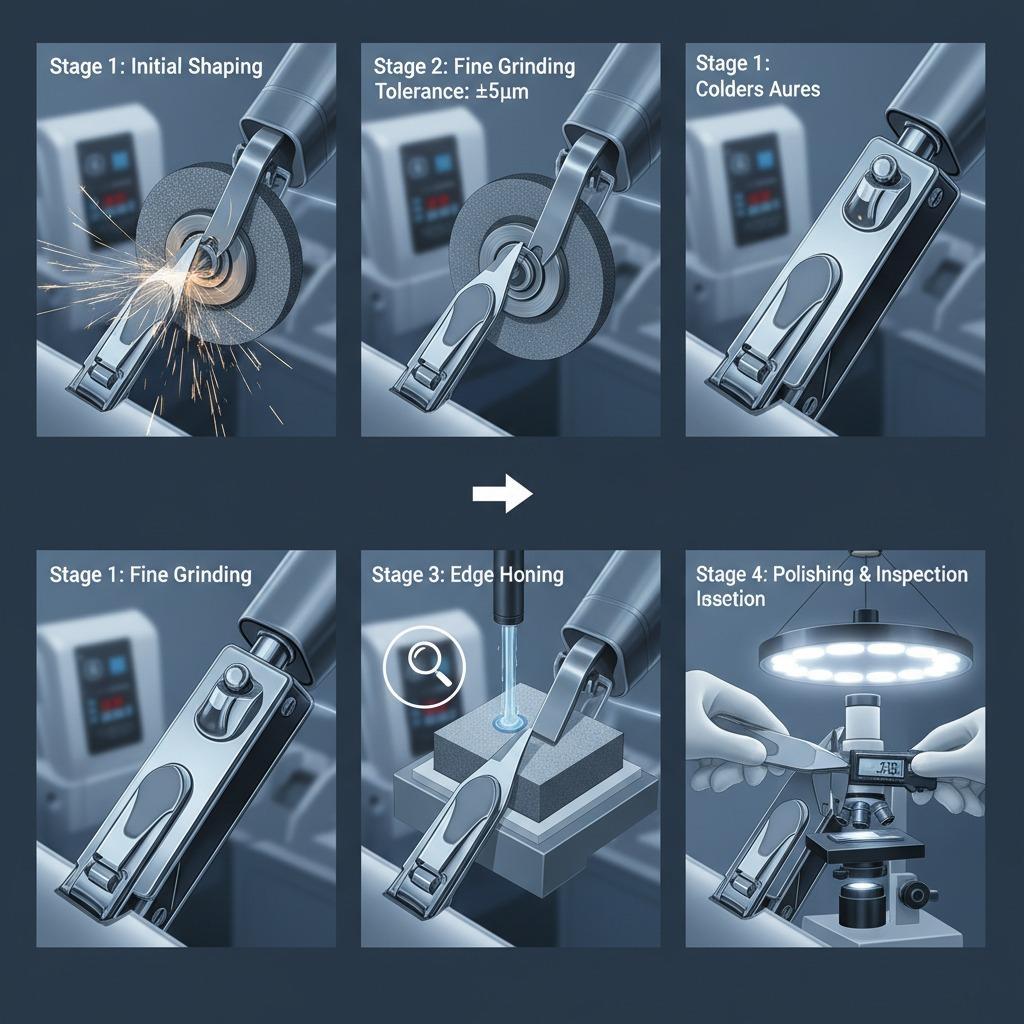
Nail clipper blade grinding should create two controlled cutting edges that meet in the intended place without burrs, rolling or unwanted gaps. Buyers should approve the resulting geometry and consistency, not a broad claim that an edge is "extra sharp."
The grinding method can be manual, automated or a combination, but the label does not prove quality. A useful sourcing review connects the method to measurable edge contact, sample testing and documented process control.
Why Edge Geometry Matters
A clipper cuts when the upper and lower edges close through the nail. If contact begins at the wrong point, one side may compress the nail before the other side completes the cut. If the edge is rough or carries a burr, the user can feel drag and the trimmed edge may be uneven.
Grinding must therefore be reviewed with the formed body, blade curve, pivot and lever. An edge can look polished under casual inspection but still meet unevenly after assembly.
Do Not Treat Process Names as Proof
Automated equipment can improve repeatability when setup, wheel condition, part location and inspection are controlled. Manual work can support adjustment or finishing when the operator follows a defined reference. Neither route is automatically superior.
Ask the supplier which operations are used for the selected SKU and which result each operation controls. Confirm the actual Olimor grinding sequence, equipment, inspection frequency and acceptance limits for the chosen model against current process records.
Link Grinding to Earlier and Later Operations
Blade performance is affected by more than the final pass on an abrasive surface. Review these interfaces:
- Forming: establishes the body and initial cutting profile.
- Heat treatment: may affect hardness and how the material responds to later finishing; require the selected material and process record.
- Grinding: establishes the working edge and contact geometry.
- Polishing or coating: must not round, contaminate or hide the cutting edge.
- Assembly: can change how the two edges meet under lever load.
- Cleaning and packaging: should keep abrasive residue and contact damage away from the finished tool.
This sequence is a buyer review framework, not a statement that every Olimor model uses one identical route.
Build a Practical Sample Test
Use several samples from the same proposed configuration. One hand-selected unit cannot show process variation.
- View the closed edges from the front and side under consistent light.
- Look for gaps, offset contact, chipped areas and visible burrs.
- Open and close the lever repeatedly and check for movement at the pivot.
- Compare cutting feel on an appropriate, controlled test medium or approved use test.
- Inspect the resulting cut for crushing, tearing or an incomplete section.
- Repeat the check across the sample set and record differences.
The test medium, method and acceptance rule should be agreed before a purchase order. Do not improvise a test after a shipment arrives and then apply an undocumented standard.
Classify Defects by Function and Appearance
Separating functional and cosmetic findings makes disposition clearer.
| Finding | Classification | Buyer response |
|---|---|---|
| Cutting edges do not meet across the working area | Functional | Reject or investigate against the approved limit |
| Burr on a handled or cutting surface | Functional/safety relevant | Stop approval and review deburring control |
| Incomplete cut during the agreed test | Functional | Review edge geometry, assembly and test setup |
| Slight color variation within approved range | Appearance | Compare with the signed range sample |
| Polishing mark outside the cutting area | Appearance, unless sharp or deep | Apply the documented visual standard |
| Residue near the blade or pivot | Cleanliness | Review final cleaning and pack protection |
Avoid a single instruction such as "no defects." A workable inspection plan defines what is checked, how it is classified and what happens when a limit is exceeded.
Ask for Change Control
Grinding results can shift when a fixture, wheel, program, operator instruction, material or upstream forming process changes. Ask the supplier to identify which changes require buyer notification or a new sample.
Keep a production-approved sample and a revision-controlled specification. If a new lot feels different, these references help both parties compare facts instead of relying on memory.
Review Heat Treatment Carefully
Heat treatment articles often make broad durability claims. Buyers should request the material grade, target property, method and supporting test for the selected SKU. A heat-treatment label without those details cannot establish cutting life or corrosion performance.
Do not write a hardness number into a specification unless the supplier and buyer have agreed on the measurement method, location and acceptable range. Confirm the documented material grade and hardness criteria for the selected Olimor clipper against the current technical record.
Keep Sharpening Advice Separate From Manufacturing Approval
Consumer sharpening methods are not a substitute for factory edge control. Altering a finished edge can change geometry, damage a coating or create a burr. For retail instructions, advise users to clean, dry and store the tool correctly and to replace a damaged clipper according to the brand's care guidance.
Professional servicing, if offered, should follow a documented method for that product. Do not promise that every clipper can or should be resharpened.
Questions for a Supplier Review
- Which grinding operations are used on this SKU?
- How is edge contact checked after assembly?
- How many samples should be tested at approval and during production?
- What controls burrs and abrasive residue?
- Which finish operations occur after grinding?
- What process changes trigger a new sample?
- Can the supplier show a defect reference and inspection record?
FAQ
Does a sharper-feeling edge always indicate better quality?
No. Buyers need controlled cutting, correct contact, smooth non-cutting surfaces and consistency across samples. An aggressive edge with poor alignment is not a reliable result.
Is automated grinding always more consistent?
Automation can support repeatability, but setup, maintenance, part location and inspection still matter. Review evidence from the actual process rather than the equipment name.
What should be included in the RFQ?
Include the intended nail type, reference model, edge and alignment expectations, sample quantity, finish, packaging and inspection method. Mark unknown technical values as pending supplier confirmation.
Request Process Evidence
Review the Olimor nail clipper range, compare a professional nail clipper reference, and request grinding and sample details. Ask for information tied to the selected SKU rather than a generic process claim.
Tag: