

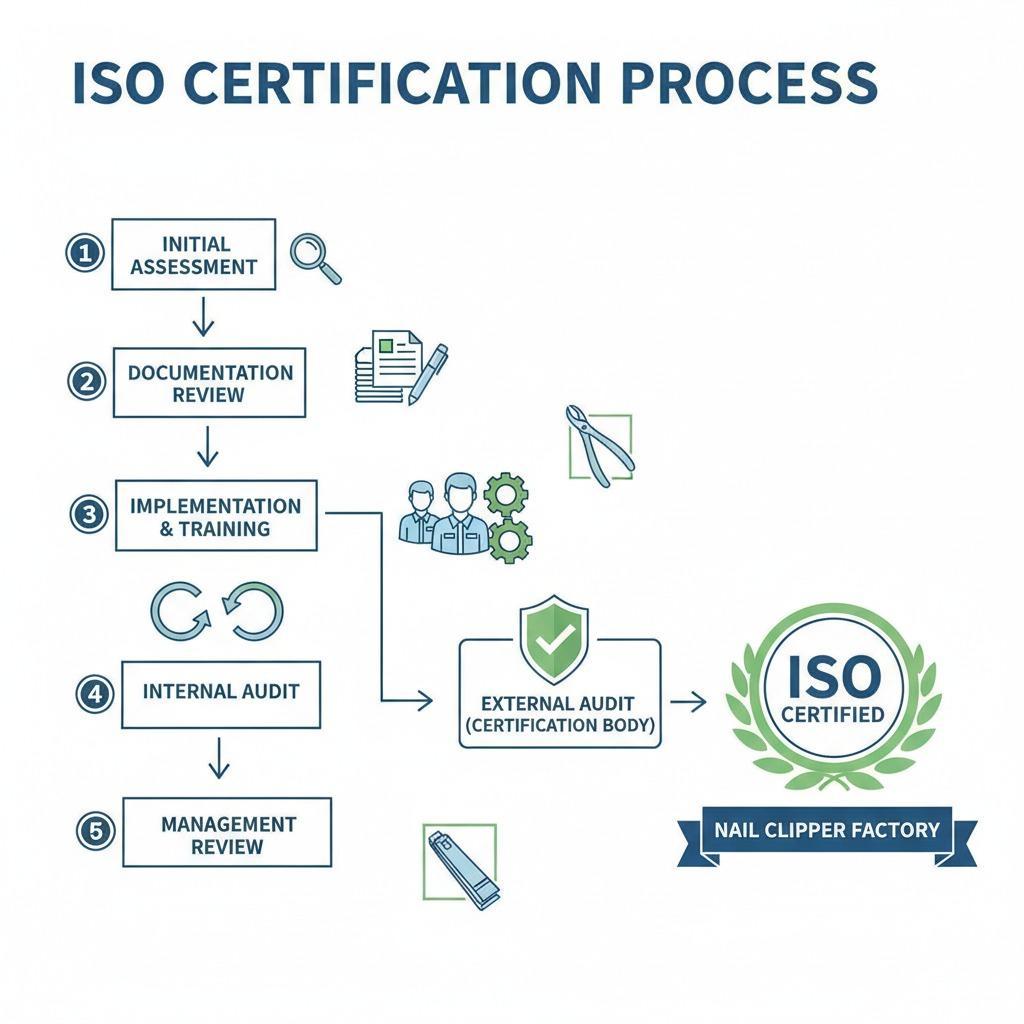
Why ISO Certification Matters When Choosing a Nail Clipper Factory
For buyers sourcing nail clippers, ISO certification is not just a framed document on a factory wall. It is a signal that the manufacturer has built a repeatable quality management system around materials, production steps, inspection records, corrective actions, and customer feedback. In a product category as precise as nail care tools, small inconsistencies can affect cutting performance, comfort, safety, and the perceived value of the finished product.
A nail clipper may look simple, but its quality depends on several controlled details: blade alignment, spring tension, lever strength, surface finishing, edge sharpness, rivet stability, packaging protection, and batch-to-batch consistency. ISO certification helps buyers understand whether a factory has a structured way to manage these details instead of relying only on final inspection.

What ISO Certification Means in Nail Clipper Manufacturing
ISO standards are internationally recognized frameworks used to manage quality, safety, consistency, environmental practices, or other operational areas. For a nail clipper factory, the most relevant idea is not only whether a certificate exists, but whether the factory uses a documented system to control how products are made and checked.
In practical terms, an ISO-based quality system usually encourages a factory to define responsibilities, record process requirements, monitor supplier inputs, inspect production outputs, handle nonconforming products, and improve recurring problems. This matters because nail clippers are often produced in large batches, and a small process change can affect thousands of finished pieces.
Buyers should treat ISO certification as one important part of supplier evaluation. It does not replace product testing, sample approval, or clear purchase specifications. However, it can make those steps more reliable because the factory is expected to operate with documented procedures and traceable records.
Why Nail Clippers Need Process Control, Not Only Final Inspection
Final inspection can catch visible defects, but it cannot fully compensate for weak process control. A nail clipper with poor blade geometry, inconsistent hardening, unstable assembly, or rough edges may pass a quick visual check but still disappoint the end user. For beauty brands, distributors, salons, and retailers, these problems can lead to returns, complaints, or loss of trust.
An ISO-oriented factory is more likely to define checkpoints across the production flow. Instead of waiting until the finished carton stage, the factory can monitor raw material condition, component forming, sharpening, polishing, plating or surface treatment, assembly, functional testing, and packing. This helps reduce variation before it becomes expensive to correct.
For buyers reviewing beauty tool products, this approach is especially useful when comparing similar-looking nail clippers from different suppliers. Two tools may appear nearly identical in photos, yet differ greatly in cutting feel, durability, finish uniformity, and edge protection. A documented quality system helps explain how the factory maintains these differences consistently.
Quality Areas Buyers Should Connect to ISO Certification
When discussing ISO certification with a nail clipper factory, buyers should focus on how the quality system affects the actual product. A certificate is easier to evaluate when it is linked to concrete controls. The following areas are worth reviewing during supplier selection or sample development:
- Material control: How incoming metal components or sheets are identified, stored, and checked before production begins.
- Blade alignment: How the factory checks that the two cutting edges meet correctly without excessive gap or overlap.
- Edge sharpness and smoothness: How cutting performance is assessed without creating burrs or harsh edges that may scratch the nail.
- Lever and rivet strength: How the assembled clipper is checked for stable movement, firm pressure, and long-term usability.
- Surface finish: How polishing, cleaning, coating, or other finishing steps are controlled to reduce stains, scratches, and inconsistent appearance.
- Packaging protection: How finished tools are packed to avoid movement, moisture exposure, or abrasion during storage and transport.
- Traceability: How batches are recorded so the factory can investigate issues if a defect pattern appears after shipment.
These points help buyers move the conversation from a general claim of quality to measurable manufacturing controls. They also make it easier to compare quotations fairly. A lower price may not be attractive if it removes inspection steps, weakens packing, or creates inconsistent finish quality.
How ISO Certification Supports Private Label and Retail Programs
Private label and retail buyers often need more than a good sample. They need repeatable production that matches the approved sample across multiple orders. ISO certification can support this need by requiring clearer documentation around product requirements, change control, corrective action, and customer communication.
For example, if a buyer approves a nail clipper sample with a specific finish, cutting feel, handle shape, and packaging format, those requirements should be documented before mass production. If the factory later changes a polishing process, packaging insert, supplier input, or inspection method, a controlled system should help identify the change and manage approval. This reduces the risk of receiving a shipment that looks different from the confirmed sample.
Buyers exploring product collections may also need consistency across related tools, such as nail clippers, cuticle tools, tweezers, or grooming accessories. A quality management system helps align inspection logic across a wider beauty tool range, making the full assortment more predictable for the end customer.
Questions to Ask Before Relying on a Factory Certificate
ISO certification is valuable, but buyers should verify how it is applied. A practical review does not need to be complicated. The goal is to understand whether the factory’s daily work reflects the system described by the certificate.
- Confirm the certificate scope. Check whether the certificate applies to the relevant manufacturing site and product category, not only a trading office or unrelated process.
- Review the validity period. Make sure the certificate is current and issued by a recognized certification body.
- Ask how nail clipper specifications are documented. Product drawings, approved samples, packaging files, and inspection criteria should be controlled.
- Discuss incoming inspection. The factory should be able to explain how raw materials and components are accepted or rejected.
- Look at in-process control points. For nail clippers, this may include shaping, sharpening, finishing, assembly, and function checks.
- Understand nonconformance handling. The factory should have a method for isolating defective items and preventing mixed batches.
- Review corrective action habits. If the same issue repeats, the factory should investigate root causes rather than only sorting finished goods.
This checklist is useful whether you are placing a trial order or planning long-term sourcing. It helps turn ISO certification into a working selection tool rather than a simple marketing statement.
What ISO Does Not Guarantee
It is important to be realistic. ISO certification does not automatically define the best blade design, the most comfortable lever shape, the most suitable packaging, or the ideal price point for your market. It also does not replace your own brand requirements. A buyer still needs clear specifications, approved samples, artwork confirmation, packaging instructions, and shipment inspection plans.
ISO also does not mean every product from a factory is identical in quality level. Factories may produce different grades for different markets, budgets, and distribution channels. The buyer’s role is to define the expected standard clearly, including cutting performance, appearance, acceptable defect limits, packaging format, labeling needs, and any market-specific compliance requirements.
For this reason, ISO certification works best when combined with practical product evaluation. Test samples with real use cases. Compare cutting comfort on different nail thicknesses. Check whether the lever feels stable. Inspect the finish under good lighting. Open and close the clipper repeatedly. Confirm that the packaging protects the cutting edge and presents the product appropriately for your sales channel.
Using ISO as Part of a Smarter Sourcing Decision
For importers, beauty brands, wholesalers, and retailers, choosing a nail clipper factory is not only about finding a supplier that can produce a familiar tool. It is about reducing uncertainty. ISO certification helps because it points to a system for controlling work, recording decisions, and improving problems. That system can make communication clearer and production results more consistent.
When evaluating Olimor Beauty for nail clipper sourcing, buyers can use ISO-related questions alongside sample review, packaging discussion, and product range planning. Share the intended market, user expectations, finish preference, packaging style, and inspection priorities early in the project. This allows the product conversation to focus on measurable requirements instead of vague quality expectations.
If you are comparing options or preparing a new nail care tool program, you can contact Olimor to discuss product details, or send an inquiry with your project requirements. A well-prepared inquiry should include target product type, expected order destination, packaging needs, preferred finish, and any quality concerns from previous sourcing experience.
Key Takeaway for Nail Clipper Buyers
ISO certification matters because nail clipper quality depends on repeatable control, not just attractive product photos or one good pre-production sample. A factory with a structured quality management approach is better positioned to manage materials, inspection points, documentation, defect handling, and continuous improvement.
For buyers, the best use of ISO certification is practical: verify the scope, connect the certificate to real nail clipper production controls, define your requirements clearly, and evaluate samples carefully. This balanced approach helps protect your brand, improve customer satisfaction, and build a more dependable beauty tool supply chain.
Tag: