

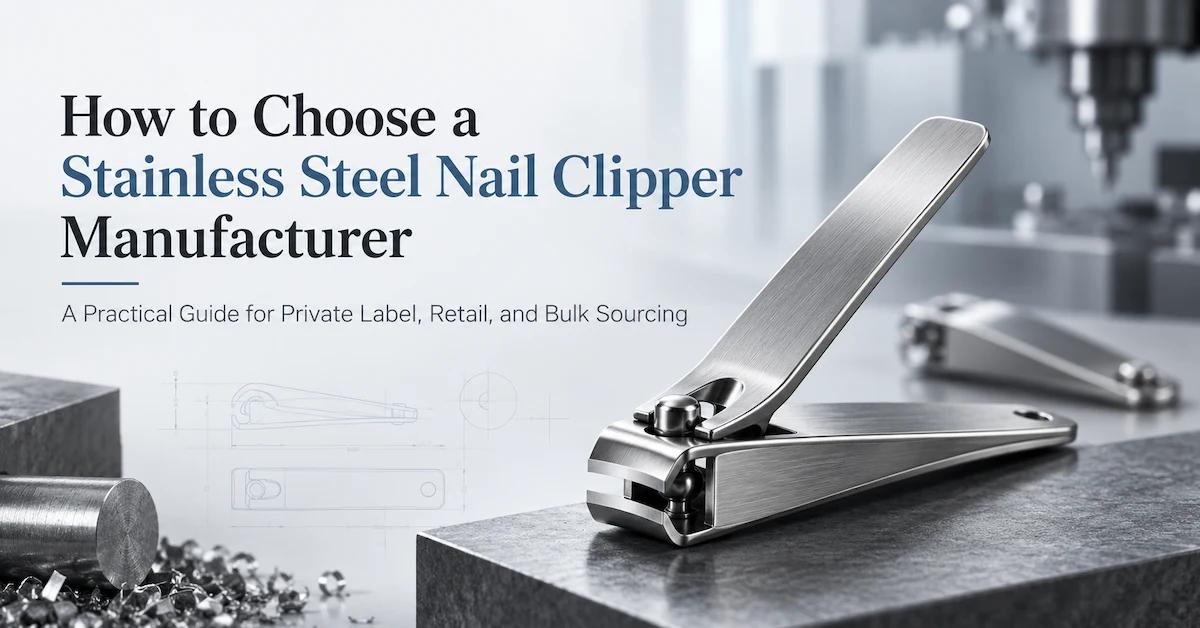
A reliable stainless steel nail clipper manufacturer should be able to explain far more than the material printed on a specification sheet.
For a brand, importer, distributor, retailer, or e-commerce seller, the real question is not simply, “Is this nail clipper stainless steel?” The more useful questions are: How consistently do the cutting edges meet? How is blade alignment controlled? What happens when the lever is pressed repeatedly? How are surface scratches, burrs, loose pins, poor assembly, and packaging damage prevented? What is approved before mass production, and how does the supplier make sure the next order matches the first one?
Those details determine whether a nail clipper feels precise and dependable in the user's hand or becomes a source of complaints, returns, inconsistent reviews, and costly rework.
For B2B sourcing, the best manufacturer is therefore not necessarily the supplier with the lowest initial quotation. It is the supplier that can translate a product requirement into a measurable specification, develop and approve a representative sample, control critical features during production, inspect the finished product against an agreed reference, and repeat that result across future orders.
For buyers developing a private-label nail care line, OLIMOR offers a broader range of nail clippers and related beauty and personal-care tools that can be evaluated according to product structure, finish, branding, packaging, and target sales channel.
What Should a B2B Buyer Expect From a Stainless Steel Nail Clipper Manufacturer?
A professional supplier should help a buyer answer four basic questions before production begins:
- What exactly are we manufacturing?
- Which product features affect performance and user experience?
- How will those features be inspected?
- What reference will both parties use when evaluating mass production?
These sound simple, yet many sourcing problems begin because one or more of them remains undefined.
A purchase order may say “stainless steel nail clipper, silver, logo printed, individual box,” but that still leaves many important questions unanswered.
What is the clipper size?
What style of cutting head is required?
How wide should the jaw opening be?
What cutting feel is expected?
What lever shape is acceptable?
Should the surface be highly polished, satin, matte, or another finish?
Where will the logo appear?
How large should it be?
What packaging prevents the clipper from moving or scratching during transportation?
What cosmetic defects are unacceptable?
Which approved sample will production be compared against?
A capable nail clipper manufacturer turns these vague commercial descriptions into production and inspection criteria.
That is especially important for private-label programs because the buyer is not simply purchasing a metal tool. The buyer is putting its brand name on the user's entire experience with that tool.
Stainless Steel Matters, but Material Alone Does Not Define Nail Clipper Quality
“Stainless steel” is one of the most common phrases buyers encounter when sourcing nail clippers.
It is important, but it does not tell the full story.
Two clippers can both be described as stainless steel yet feel very different in actual use because performance depends on a combination of material selection, component geometry, forming accuracy, edge preparation, heat treatment where applicable, polishing, assembly, pivot behavior, lever design, and final inspection.
This is why a serious sourcing conversation should not stop at:
What material is it?
It should continue with:
- Which components use the specified material?
- Is the material confirmed for this exact model?
- What surface treatment or finish is used?
- What dimensions and tolerances matter to performance?
- How are the cutting edges prepared?
- How is alignment inspected?
- What reference defines acceptable cutting performance?
- How will future production be compared with the approved sample?
Buyers should also avoid assuming a specific stainless-steel grade unless it has been confirmed for the selected product.
Different nail clipper models can use different materials, thicknesses, component constructions, finishes, and process routes. A responsible manufacturer should identify the specification applicable to the actual SKU rather than presenting one generic material statement for an entire category.
The Parts of a Nail Clipper That Actually Affect Performance
A nail clipper looks mechanically simple. From a manufacturing perspective, however, several interacting parts determine whether it performs well.
Cutting Jaws and Cutting Edges
The upper and lower cutting edges are among the most important functional areas.
When the user applies pressure, the edges need to meet in a controlled way. If they do not align properly, the clipper may:
- require excessive force;
- leave an incomplete cut;
- pull rather than cut cleanly;
- feel uneven from one side to the other;
- create an inconsistent user experience.
This is why blade or jaw alignment should be treated as a measurable QC point rather than an assumed result of assembly.
Lever
The lever affects mechanical advantage and user comfort.
A small change in its geometry, thickness, position, or movement can influence how much force a user feels is required.
For private-label projects, buyers often pay attention to appearance first. Yet lever action deserves just as much attention during sample evaluation.
A polished clipper with attractive packaging will not produce repeat orders if the lever feels unstable or requires awkward pressure.
Pivot and Pin Assembly
The components must move together correctly.
Poor assembly can lead to:
- excessive looseness;
- stiff movement;
- unstable cutting contact;
- inconsistent opening and closing;
- rattling;
- reduced perceived quality.
A buyer inspecting a sample should therefore open and close it repeatedly rather than judging it only from photographs.
Surface and Edges
The product is handled directly by the consumer.
Sharp unintended edges, burrs, rough transitions, polishing marks, scratches, stains, or inconsistent surface appearance can affect both usability and shelf presentation.
The inspection standard should distinguish between the functional cutting edge, which must perform accurately, and other exposed edges and surfaces, which should feel properly finished.
Optional Nail File or Additional Features
Some nail clipper designs include an integrated file or related function.
When a secondary function is added, it creates additional inspection points. Buyers should evaluate whether that feature genuinely improves the product for the target market or simply adds complexity.
For a retail program, every additional component can affect:
- cost;
- assembly;
- packaging;
- inspection;
- perceived value;
- failure risk.
Good product development is not about adding as many features as possible. It is about selecting features that make sense for the user and sales channel.
How a Stainless Steel Nail Clipper Is Manufactured
The exact process depends on the selected model, structure, material, finish, and supplier setup. Buyers should therefore avoid assuming that every factory or every nail clipper follows an identical production sequence.
A typical metal nail clipper project may involve several stages.
OLIMOR's company-level manufacturing capabilities include processes such as metal stamping and forming, cutting-edge heat treatment, grinding and polishing, water deburring, assembly, inspection, and packaging support. The exact route should always be confirmed for the chosen SKU.
1. Material and Component Preparation
The production process begins with the material and components required by the approved specification.
At this stage, a buyer should be clear about:
- material requirement;
- component dimensions;
- surface requirement;
- appearance standard;
- any purchased parts or accessories.
Incoming checks matter because later inspection cannot fully compensate for incorrect starting material or inconsistent components.
2. Stamping and Forming
Metal components must be formed into the required geometry.
This step influences the shape and consistency of the clipper body and related parts.
Variation at this stage can later affect:
- alignment;
- assembly;
- lever movement;
- cutting contact;
- overall appearance.
This is one reason dimensional control is important even for a product that appears relatively simple.
3. Cutting-Edge Preparation
The cutting area must be prepared to achieve the intended cutting action.
A buyer does not necessarily need to prescribe every production parameter. That is the manufacturer's responsibility.
The buyer does, however, need a clearly approved result.
That result may be defined through:
- approved sample;
- cutting test;
- alignment inspection;
- visual reference;
- functional acceptance criteria.
4. Heat Treatment Where Required by the Product
Heat treatment may form part of the cutting-edge manufacturing process for applicable designs.
Buyers should avoid writing a generic statement that every component or model uses the same treatment.
The important purchasing question is:
What process is required for this specific model, and how is the resulting performance verified?
5. Grinding, Deburring, and Polishing
Metal forming and cutting operations can leave rough areas that require further finishing.
Grinding, deburring, and polishing can affect:
- edge smoothness;
- surface uniformity;
- appearance;
- hand feel;
- logo presentation;
- perceived retail quality.
For visually driven beauty and personal-care brands, this stage deserves particular attention.
A nail clipper may be mechanically functional yet still be rejected by a buyer because of inconsistent polish lines, surface scratches, marks, or poor cosmetic finishing.
6. Assembly
Components are brought together and adjusted into a working product.
This is where several individual manufacturing variables become one user experience.
Assembly should be evaluated through:
- lever movement;
- cutting-edge contact;
- opening and closing;
- stability;
- component fit.
7. First-Piece and In-Process Inspection
Waiting until the entire order is finished to discover a functional problem is expensive.
For this reason, a stronger manufacturing system checks important characteristics earlier.
A first-piece approval can be particularly useful when:
- a new model starts production;
- tooling is changed;
- material changes;
- process settings change;
- important components change.
In-process checks then help identify drift before it affects a large quantity.
8. Branding and Packaging
For private-label orders, manufacturing does not end when the metal clipper is assembled.
The product still needs to become a retail-ready branded item.
That can involve:
- logo application;
- color or finish verification;
- labels;
- retail card;
- box;
- pouch;
- case;
- barcode;
- insert;
- instruction material;
- protective packaging.
9. Finished-Product Inspection
Before shipment, the finished clipper should be evaluated against the agreed standard.
The key point is agreed standard.
“Good quality” is too subjective.
An approved sample, confirmed specification, artwork approval, packaging approval, and inspection checklist create a more practical reference.
Nail Clipper Quality Control: What Buyers Should Actually Inspect
Quality control becomes more useful when it is product-specific.
A generic factory statement such as “100% strict quality inspection” tells a buyer very little.
For nail clippers, the following areas are more meaningful.
| QC Point | What to Check | Why It Matters |
|---|---|---|
| Cutting-edge alignment | Whether both cutting sides meet correctly | Directly affects cutting performance |
| Cutting action | Clean, controlled clipping during use | Influences customer satisfaction |
| Lever movement | Smooth and stable operation | Affects effort and perceived quality |
| Pivot / assembly | No excessive looseness or abnormal stiffness | Supports consistent operation |
| Product geometry | Components match approved shape and dimensions | Prevents assembly and alignment issues |
| Surface finish | Scratches, stains, polishing consistency, coating appearance | Important for retail presentation |
| Exposed edges | No unintended burrs or rough handling surfaces | Affects usability |
| Logo | Position, appearance, legibility, consistency | Protects brand presentation |
| Packaging | Correct artwork, fit, protection, labeling | Reduces shipping and retail problems |
| Product identity | Correct SKU, size, finish, pack and quantity | Prevents order-mixing errors |
A buyer should use this table as a starting framework, not as a substitute for a model-specific inspection specification.
The final QC checklist should reflect the product actually ordered.
Why Sample Approval Is One of the Most Important Steps
A surprisingly common sourcing mistake is treating the sample as a sales demonstration instead of a production control tool.
The better approach is to approve the sample systematically.
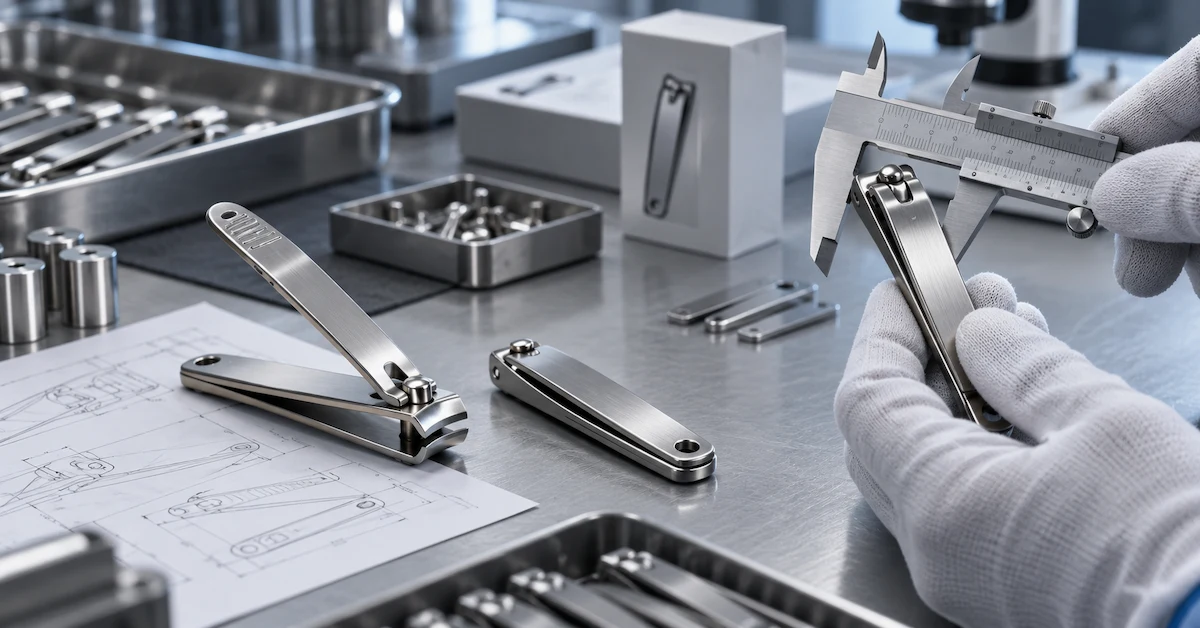
At OLIMOR, a useful sample review can be divided into three parts.
Functional Review
Check:
- cutting performance;
- edge alignment;
- lever movement;
- opening and closing;
- assembly stability;
- hand feel.
Do not approve a sample only because it looks good in photographs.
Use it as a real consumer would.
Cosmetic Review
Check:
- finish;
- polish;
- color;
- visible marks;
- scratches;
- edges;
- logo size;
- logo position;
- logo appearance.
Cosmetic acceptance is especially important for products sold through beauty retail and e-commerce because customers often judge quality before using the tool.
Packaging Review
Check:
- product orientation;
- insert fit;
- pack closure;
- movement inside the package;
- surface protection;
- artwork;
- barcode;
- labels;
- instruction card;
- carton arrangement if relevant.
Once approved, the final sample or master reference should be retained together with revision information.
That helps answer an important question six months later:
What exactly did we approve?
Without a stable reference, repeat-order discussions can become subjective.
OEM, ODM, or Private Label: Which Route Is Better?
A stainless steel nail clipper manufacturer may support several development routes, but buyers often use these terms too loosely.
Understanding the difference makes quotation and product development more efficient.
Private Label Nail Clippers
Private label is usually the fastest route when a buyer is comfortable with an established product structure.
The buyer may customize areas such as:
- logo;
- finish;
- packaging;
- color options where available;
- set combination;
- labels;
- retail presentation.
Private label is well suited to:
- emerging beauty brands;
- e-commerce sellers;
- retailers;
- distributors testing a new category;
- brands adding nail-care accessories.
The advantage is that the buyer is not starting from a blank page.
ODM Nail Clippers
ODM becomes useful when the buyer wants to begin with an existing product platform but make more meaningful changes.
These may involve:
- appearance;
- component selection;
- handle or lever details;
- finish;
- size direction;
- accessories;
- packaging system.
ODM can offer a balance between speed and differentiation.
OEM Nail Clippers
OEM is more appropriate when the buyer already has:
- an existing sample;
- detailed specification;
- drawing;
- defined geometry;
- particular structure;
- product benchmark.
The manufacturer then evaluates manufacturability and production requirements.
For buyers who are still deciding which route fits the project, reviewing the broader OLIMOR product range can help identify whether an existing platform can meet the requirement before investing in deeper product development.
How to Evaluate a Nail Clipper Sample Like a Professional Buyer
Do not inspect one sample for thirty seconds and approve it.
Use a repeatable procedure.
Step 1: Check the Product Before Operating It
Look at:
- symmetry;
- visible alignment;
- polish;
- scratches;
- surface marks;
- assembly;
- lever position;
- logo;
- edges.
Step 2: Open and Close the Lever Repeatedly
The movement should feel consistent.
Look for:
- abnormal resistance;
- looseness;
- rubbing;
- instability;
- rattling.
Step 3: Inspect Cutting-Edge Contact
Observe how the two cutting sides meet.
Do not focus only on the center. Check the overall contact.
Step 4: Perform a Functional Cutting Test
Use a suitable and consistent test method.
The purpose is not to create a dramatic demonstration. It is to determine whether the sample behaves consistently.
Step 5: Compare Multiple Samples
One good unit does not prove manufacturing consistency.
If possible, compare several samples for:
- cutting feel;
- lever force;
- appearance;
- alignment;
- component fit.
Step 6: Review Branding
The logo should be evaluated on the actual product finish.
A digital artwork approval cannot fully show how a logo will appear on a curved, polished, coated, or reflective surface.
Step 7: Review Packaging as a Shipping System
Ask whether the package still protects the surface after transportation.
Beauty tools frequently have finishes that can be scratched if products or accessories move during transit.
The pack must therefore serve both marketing and protection.
Customization Options for Private-Label Nail Clippers
Buyers often think customization begins and ends with adding a logo.
That is a missed opportunity.
A nail clipper can be positioned differently depending on the combination of product form, finish, branding, pack, and target channel.
Possible project areas include:
Logo
Potential methods can include laser marking, engraving, printing, or labeling depending on the product material, finish, surface geometry, and durability requirements.
The final method should be confirmed on the selected SKU.
Surface Finish
The appearance can influence brand positioning.
A polished metallic clipper may communicate a different value from a softer satin or colored finish.
Do not choose a finish from a catalog image alone.
Ask for an actual sample where appearance matters.
Packaging
Possible formats can include:
- retail box;
- card;
- blister-style solution where applicable;
- pouch;
- case;
- gift box;
- set packaging;
- e-commerce protective packaging.
The right format depends on sales channel.
Nail Care Sets
A clipper can also be combined with other tools such as:
- nail file;
- tweezers;
- cuticle tools;
- scissors;
- grooming accessories.
This is useful when a brand wants to sell a complete nail-care or grooming set rather than a single low-value accessory.
OLIMOR's broader beauty and personal-care tool portfolio supports this kind of multi-SKU planning.
Retail, E-Commerce, Distributor, and Salon Buyers Need Different Products
One nail clipper specification does not automatically suit every customer channel.
Retail Brands
Retail buyers often care strongly about:
- shelf appearance;
- clear product function;
- barcode;
- retail pack;
- price positioning;
- color consistency;
- replenishment.
A technically good product with weak packaging may still perform poorly on shelf.
E-Commerce Brands
E-commerce buyers should pay particular attention to:
- visual differentiation;
- product consistency;
- packaging protection;
- customer review risks;
- bundle opportunities;
- unboxing experience.
A small cosmetic defect that might be overlooked in bulk distribution can become highly visible in close-up marketplace photography and customer review images.
Importers and Distributors
Importers often need:
- stable repeat supply;
- multiple SKUs;
- consistent specifications;
- export coordination;
- efficient packaging;
- predictable quality;
- manageable supplier communication.
For them, supplier reliability across multiple orders can matter more than a one-time low price.
Professional Nail and Beauty Channels
Professional users tend to notice functional inconsistency quickly.
They may pay more attention to:
- cutting feel;
- ergonomics;
- durability;
- repeat use;
- ease of handling.
This is why the target user should be discussed before the product specification is finalized.
What Determines the Cost of a Stainless Steel Nail Clipper?
The lowest quoted unit price is not necessarily the lowest final sourcing cost.
Several variables can influence pricing.
Product Size and Construction
Larger, heavier, or more complex designs may require different material usage and processing.
Material Specification
The selected material and component requirements affect cost.
Do not compare two quotations unless the material scope is genuinely comparable.
Surface Finish
Some appearance requirements involve additional processing or more demanding cosmetic inspection.
Logo Method
Branding cost can vary by:
- method;
- size;
- location;
- number of logo positions;
- surface;
- color.
Packaging
Packaging can make a significant difference.
A simple bulk arrangement and a premium gift box are different products from a commercial costing perspective.
Quantity
Quantity can affect process efficiency, packaging purchasing, setup allocation, and the economics of customization.
However, MOQ should not be assumed from a generic website statement.
For OLIMOR projects, quantity and MOQ should be confirmed according to the selected model, customization scope, packaging, and order requirements.
Inspection Requirements
More demanding inspection, sorting, documentation, or market-specific requirements can affect project cost and lead time.
Tooling or Development
If a project moves beyond existing products into substantial structural modification, tooling or engineering work may be required.
This should be discussed before comparing a development quotation with a standard private-label quotation.
How to Compare Nail Clipper Quotations Correctly
A quotation is only useful when you understand what it includes.
Before comparing suppliers, put the offers into the same framework.
| Item | Supplier A | Supplier B | Supplier C |
|---|---|---|---|
| Product model / reference | |||
| Material | |||
| Size | |||
| Weight | |||
| Finish | |||
| Logo method | |||
| Packaging | |||
| Sample basis | |||
| Quantity | |||
| Inspection requirements | |||
| Tooling / setup | |||
| Shipping basis | |||
| Confirmed lead-time basis |
Without this comparison, a supplier offering a lower price may simply be quoting:
- different material;
- simpler finish;
- no logo;
- cheaper packaging;
- different size;
- lower inspection scope.
Price comparisons should be specification comparisons first.
MOQ and Lead Time Should Be Confirmed by Project, Not Assumed
Buyers frequently search for:
“low MOQ nail clipper manufacturer”
or:
“fast delivery private label nail clippers.”
These are legitimate commercial concerns, but there is no responsible single answer that applies to every nail clipper project.
MOQ can depend on:
- selected model;
- existing stock or production status;
- finish;
- logo;
- custom color;
- packaging;
- carton requirement;
- component purchasing;
- level of customization.
Lead time can similarly depend on:
- sample approval;
- artwork confirmation;
- packaging development;
- materials;
- production schedule;
- order quantity;
- inspection;
- shipping arrangement.
A better sourcing approach is to send the manufacturer the full specification and ask for a project-specific MOQ and timeline.
You can review OLIMOR's FAQs for general purchasing information and confirm final commercial conditions for the actual project.
Why Repeat-Order Consistency Matters More Than the First Sample
A perfect first sample does not create a successful product program.
The business value begins when the manufacturer can reproduce the approved result.
Imagine a brand launches a clipper, receives good feedback, builds product reviews, and places a second order.
If the second batch has:
- a different lever feel;
- more visible polishing marks;
- inconsistent logo appearance;
- changed packaging;
- weaker cutting performance;
the problem is no longer just a factory problem.
It becomes a brand problem.
Repeatability is therefore one of the most important criteria when evaluating a manufacturer.
Ask:
- Is a master sample retained?
- Are specification revisions controlled?
- Is the packaging version recorded?
- Are logo details recorded?
- Are key functional checks repeated?
- What happens if a component or process changes?
- How is the second order compared with the first?
This is where structured sampling and QC create commercial value.
Common Red Flags When Choosing a Nail Clipper Manufacturer
Certain warning signs deserve attention during sourcing.
“All Stainless Steel Is the Same”
It is not enough to use a broad material term without model-specific information.
No Clear Sample Approval Process
If the supplier cannot explain what is being approved, mass production becomes difficult to judge objectively.
Quality Is Described Only as “High Quality”
Ask what is inspected.
A useful answer should mention actual product characteristics.
Price Changes Without Specification Changes Being Explained
A cheaper quote may reflect a change in material, finish, packaging, or product construction.
Logo Approval Is Only Digital
Branding should be reviewed on the real product where possible.
No Packaging Protection Discussion
Metal beauty tools can scratch during transportation. Packaging has to protect appearance as well as display the brand.
MOQ Is Promised Before the Product Is Defined
Very low MOQ claims can be misleading if they are not tied to a model and customization scope.
Certifications Are Mentioned Without Scope
Always confirm what a certificate applies to, who holds it, whether it is current, and whether it is relevant to the product or market.
Do not assume that a company-level certificate means every nail clipper has a specific product certification.
Questions to Ask Before Approving a Manufacturer
A serious RFQ should generate serious answers.
Ask your shortlisted supplier:
- Which nail clipper models are closest to our target product?
- What material is used for the selected model?
- Which characteristics affect cutting performance?
- How is cutting-edge alignment controlled?
- What manufacturing processes are used for this model?
- How is the surface finished?
- Which defects are checked during production?
- How are first pieces approved?
- How should we evaluate samples?
- Which logo methods are suitable for this surface?
- Which packaging formats are recommended for our sales channel?
- How is the product protected from scratching?
- What is the MOQ for this exact configuration?
- What is the expected sample and production schedule?
- Which details are recorded for repeat orders?
- What happens if a component or material changes?
- Which inspection records can be provided?
- Can related nail-care tools be sourced in the same collection?
The answers reveal far more than a factory introduction.
They show whether the supplier understands the product as a manufacturing program or simply as an item to quote.
What to Include in a Stainless Steel Nail Clipper RFQ
The better your RFQ, the more useful the quotation.
Include:
Product Reference
Provide:
- photo;
- website reference;
- physical sample if available;
- existing SKU;
- sketch or drawing.
Target Size
If dimensions matter, state them.
Material Requirement
If confirmed, include it.
If not confirmed, ask the manufacturer to propose options rather than guessing.
Target Market
Explain whether the product is intended for:
- United States;
- Europe;
- another regional market;
- global retail;
- e-commerce;
- professional use.
This does not replace compliance assessment, but it gives the supplier essential project context.
Sales Channel
Specify:
- retail;
- Amazon / marketplace;
- DTC;
- distributor;
- salon;
- gift;
- travel.
Finish
Provide actual references where visual appearance matters.
Logo
Send:
- vector artwork where possible;
- target position;
- approximate size;
- preferred method if known.
Packaging
Provide:
- reference image;
- dieline if available;
- dimensions;
- barcode needs;
- insert;
- retail requirements.
Order Quantity
Give a realistic target quantity and, where helpful, a forecast.
Quality Expectations
Identify important functional and cosmetic characteristics.
Required Timeline
Separate:
- sample target;
- approval target;
- production target;
- shipping requirement.
This gives the manufacturer enough context to identify potential risks before the project starts.
Building a Complete Private-Label Nail Care Collection
A single nail clipper can be a useful starting SKU, but many brands eventually want a broader category.
Once the core product is validated, buyers can consider complementary products such as:
- nail files;
- cuticle nippers;
- cuticle pushers;
- tweezers;
- manicure scissors;
- manicure sets.
OLIMOR's full product collection covers nail, brow, lash, grooming, facial, foot-care, and other personal-care tools, which can be useful for buyers trying to reduce the complexity of building a coordinated assortment.
The value of multi-SKU sourcing is not simply purchasing several products from the same place.
A stronger program tries to coordinate:
- finish;
- color;
- logo;
- packaging language;
- retail positioning;
- inspection approach;
- master artwork;
- brand presentation.
A silver nail clipper, rose-gold tweezer, matte-black nipper, and unrelated packaging may all be individually acceptable products, yet they may not look like one brand.
Collection planning should start with the consumer proposition, not the supplier catalog.
Why a Manufacturer's Broader Capability Matters
Nail clippers require several disciplines to work together.
These can include:
- metal forming;
- edge preparation;
- finishing;
- assembly;
- branding;
- packaging;
- inspection.
When evaluating a supplier, buyers should therefore look beyond one showroom sample.
Ask whether the company understands the entire flow from product requirement to repeat shipment.
OLIMOR positions itself as a beauty and personal-care tool supplier supporting product selection, sampling, customization, branding, packaging, production, inspection, and repeat-order programs.
The company has operated in the beauty-tools field since 2011 and currently presents a portfolio covering nail clippers, nippers, tweezers, beauty scissors, eyelash curlers, manicure sets, nail-care tools, nail files, foot files, eyebrow razors, tongue scrapers, and facial tools.
You can learn more about the company's development and manufacturing positioning on the About OLIMOR page.
The important distinction for a buyer is that company-level capability should still be translated into model-specific confirmation.
If a manufacturer has polishing equipment, that does not mean every product requires the same polishing process.
If a company has heat-treatment capability, that does not mean every component uses an identical treatment.
If the supplier works with multiple materials, that does not mean every SKU uses the same stainless steel.
Professional sourcing keeps these levels separate.
How Packaging Changes the Commercial Success of a Nail Clipper
Packaging deserves its own sourcing discussion because it affects several commercial outcomes at once.
It protects the tool.
It presents the brand.
It communicates the product function.
It influences logistics.
It affects perceived value.
It may affect how easily the product can be displayed or fulfilled.
For Physical Retail
Consider:
- hanging or shelf display;
- visible product presentation;
- barcode placement;
- pack dimensions;
- anti-scratch protection;
- clear product information.
For E-Commerce
Consider:
- movement inside the parcel;
- cosmetic surface protection;
- compact shipping dimensions;
- unboxing experience;
- packaging durability.
For Gift or Premium Positioning
Consider:
- case structure;
- insert;
- finish coordination;
- product arrangement;
- brand presentation.
A premium nail clipper in weak packaging can look inexpensive.
A well-designed package cannot rescue poor cutting performance either.
The product and packaging need to be developed together.
Should You Choose a Factory Based on Price, Capability, or Service?
The strongest answer is: all three matter, but at different stages.
At the beginning, capability matters most.
Can the manufacturer make the product you actually need?
During development, communication and service become critical.
Can the supplier identify missing specifications, respond to sample feedback, and document revisions?
Before mass production, quality control becomes the priority.
Can the factory define and inspect critical features?
Once the product is selling, repeatability and supply reliability become increasingly important.
Only after those questions are answered does the quoted price become fully meaningful.
A $0.05 saving per piece has little value if it produces higher returns, additional inspection, customer complaints, relabeling, repacking, delayed launches, or lost reviews.
For professional buyers, total sourcing risk is usually more useful than unit price alone.
A Practical Supplier Evaluation Scorecard
B2B buyers can use a simple weighted approach when shortlisting suppliers.
| Evaluation Area | Suggested Weight | What to Evaluate |
|---|---|---|
| Product performance | 20% | Cutting, alignment, lever action, handling |
| Manufacturing control | 15% | Process understanding, consistency, first-piece control |
| Quality system | 15% | Incoming, in-process, final and shipment inspection |
| Sample quality | 10% | Functional and cosmetic match |
| Customization | 10% | Logo, finish, packaging, SKU flexibility |
| Communication | 10% | Accuracy, response quality, revision control |
| Repeat-order control | 10% | Master sample, records, specification consistency |
| Commercial terms | 5% | MOQ, pricing structure, payment terms |
| Delivery planning | 5% | Realistic lead-time management |
The exact weights can change.
A value retailer may put more weight on commercial terms.
A premium DTC beauty brand may place more weight on surface finish, packaging, and sample consistency.
A distributor may prioritize repeat supply and multi-SKU capability.
The point is to avoid choosing a supplier based on one number.
Why OLIMOR Can Be Considered for Private-Label Nail Clipper Projects
For buyers sourcing nail clippers as part of a broader beauty or personal-care program, OLIMOR's value is not limited to one product listing.
The company supports a development path that can include:
- product selection;
- specification discussion;
- sampling;
- customization;
- logo branding;
- finish confirmation;
- packaging development;
- mass production;
- quality inspection;
- repeat-order reference.
For nail clipper projects specifically, buyers should focus discussions on:
- blade contact and alignment;
- cutting action;
- lever movement;
- assembly;
- surface finish;
- branding;
- packaging protection.
OLIMOR's broader beauty-tool manufacturing capabilities also make it possible to discuss coordinated assortments rather than sourcing every item separately.
That can be especially useful for:
- private-label beauty brands;
- importers;
- retail chains;
- distributors;
- e-commerce brands;
- grooming-kit programs.
The final specification, MOQ, material, finish, packaging, timeline, inspection criteria, and other commercial details should still be confirmed for the selected model and project.
For buyers with an existing sample, target product, packaging reference, or specification, the most efficient next step is to contact OLIMOR with the project details so feasibility, sample requirements, customization, and quotation scope can be reviewed against the actual product rather than a generic catalog description.
Frequently Asked Questions
What should I look for in a stainless steel nail clipper manufacturer?
Focus on cutting-edge alignment, cutting performance, lever movement, component assembly, surface consistency, sample approval, product-specific QC, customization support, packaging capability, and repeat-order control. Price matters, but it should be compared only after the specification is aligned.
Are all stainless steel nail clippers basically the same?
No. Even when two products are described as stainless steel, differences in material specification, geometry, edge preparation, forming, finishing, assembly, lever design, and inspection can create very different performance and user experiences.
What is the most important QC point for a nail clipper?
There is no single QC point, but cutting-edge contact and alignment are among the most important because they directly affect clipping performance. Lever movement, assembly stability, finish, logo, and packaging should also be inspected.
Can I add my logo to stainless steel nail clippers?
Private-label branding may be possible through methods such as laser marking, engraving, printing, or labeling depending on the model, surface, material, finish, and durability requirement. The final method should be tested and approved on the actual product.
What is the MOQ for private-label nail clippers?
MOQ should be confirmed for the selected model and project. It can vary according to product configuration, finish, logo, packaging, custom components, and quantity requirements. Buyers should avoid assuming that one MOQ applies to an entire category.
How long does custom nail clipper production take?
Lead time depends on sample development, sample approval, logo artwork, packaging, material preparation, production quantity, inspection, and production scheduling. A reliable timeline can only be given after the project scope is defined.
Should I order a sample before placing a bulk nail clipper order?
Yes. For a customized or private-label project, sample approval is one of the most important risk-control stages. Buyers should evaluate function, appearance, branding, and packaging before mass production.
What should be included in a nail clipper sample approval?
At minimum, review cutting performance, edge alignment, lever movement, assembly, surface finish, dimensions where relevant, logo, color or finish, packaging structure, artwork, and product protection.
Can nail clippers be combined with other manicure tools?
Yes. Depending on the product program, nail clippers can be combined with nail files, tweezers, cuticle tools, scissors, nippers, and other grooming accessories to create manicure, travel, gift, or personal-care sets. Relevant options can be explored through OLIMOR's product categories.
How can I reduce quality problems in repeat orders?
Use a confirmed specification, approved or master sample, revision records, artwork approval, packaging reference, and product-specific inspection criteria. When placing repeat orders, verify whether any materials, components, finishes, packaging, or processes have changed.
Conclusion
Choosing a stainless steel nail clipper manufacturer is ultimately a quality-control and product-definition decision, not simply a price comparison.
The strongest sourcing programs begin by defining the product clearly: who will use it, where it will be sold, what cutting feel is expected, how the cutting edges should meet, how the lever should operate, which finish and branding support the desired positioning, and how the product should be protected and presented in its packaging.
From there, the buyer can evaluate whether a supplier has a disciplined process for turning those requirements into an approved sample and then reproducing that sample during mass production.
For private-label brands, retailers, distributors, and e-commerce businesses, the most important supplier qualities are usually consistent cutting performance, controlled alignment, reliable assembly, stable surface finishing, practical customization, effective packaging, clear quality inspection, and repeat-order consistency.
Stainless steel is important, but it is only one part of that system.
If you are developing a new nail clipper line, replacing an inconsistent supplier, expanding an existing nail-care collection, or preparing a private-label retail program, start with a complete product reference rather than a request for a generic price. Share the target model, dimensions or sample, expected quantity, finish, logo artwork, packaging concept, sales channel, and quality priorities.
That gives both buyer and manufacturer a much better foundation for evaluating feasibility, building the right sample, identifying potential risks, and creating a product that can be produced consistently beyond the first order.
To discuss a stainless steel nail clipper project with OLIMOR, submit your product reference, sample requirements, branding needs, expected quantity, and packaging concept through the OLIMOR contact page.
Tag: