Quick Answer: A brand team can make a private-label decision easier by starting with one model and one grooming job. Ask the tweezers manufacturer China contact to walk through the model's forming, finishing, adjustment, inspection, and packing steps, including work handled by partners. Approve a coded sample that shows the real tip, surface, logo, and pack. Compare quotations only after those details are written down. The result is a reference the brow, lash, retail, or private-label team can use when the order moves from samples to production.
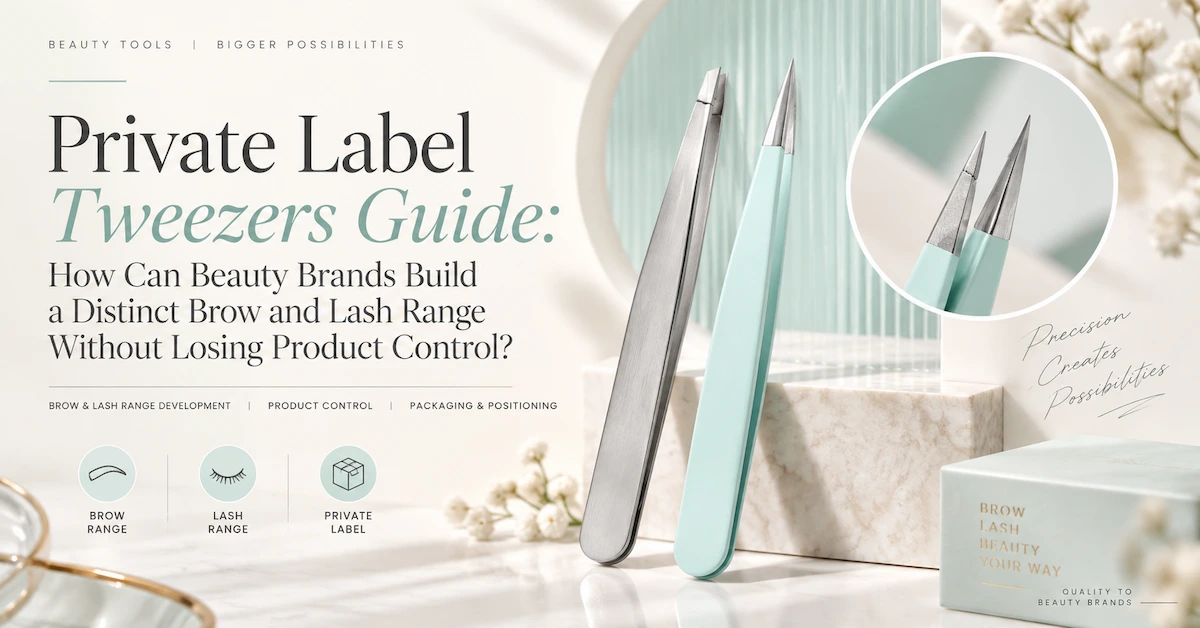
Introduction: Private label is a product system, not a logo sticker
Adding a brand mark to an existing tweezer is easy to imagine and surprisingly easy to get wrong. The logo may be attractive while the tool is uncomfortable for the intended user. The selected slant may look familiar while its useful contact area does not suit the way a customer approaches a brow. A printed card may photograph well while the insert lets the tip touch the carton during shipping. The remedy is to treat each visual choice as part of a product decision.
A private-label range creates a promise that customers can recognize across a shelf, a web page, and a repeat purchase. That promise includes the task the tool supports, the way it feels in the hand, the visual language, the pack, and the confidence that a replenishment will match the first order. Each part can affect the others. A new coating changes the appearance and may alter grip. A thicker insert changes the pack size. A smaller logo area can change the balance of the artwork.
The practical route is a sequence of controlled decisions. Start with the customer and the job. Select a platform. Define what may be changed. Build samples that reveal open decisions. Approve the finished packed unit. Then link inspection and repeat orders to the same references. The method below is written for B2B buyers and uses OLIMOR BEAUTY product pages as model references, not as a claim that one SKU automatically fits every market.
What are private label tweezers?
Private label tweezers are grooming tools produced for sale under a buyer's brand. The underlying product may be an existing supplier platform, a modified platform, or a new design developed from a drawing, sample, or concept. The brand owner normally controls some combination of product choice, tip geometry, material wording, colour, surface finish, logo, packaging, instructions, and market positioning.
The finished item is more than the metal body. It includes the working tips, opening and closing behaviour, handling surface, decoration, protection, and the information presented to the customer. A private-label manufacturer should therefore receive a brief that explains the intended use and the commercial context. "Make a premium tweezer" is an invitation to guess. "A compact slant tool for routine brow grooming in a travel kit, with a matte grip zone and a protected point" gives the team something it can evaluate.
Private label also differs from simple wholesale resale. In resale, the buyer generally accepts the supplier's existing identity and pack. In a private-label project, the buyer is responsible for making the branded version coherent and accurate. That responsibility is why model code, final sample, artwork revision, pack reference, and claims review belong in the same project file.
1. Define the customer job before choosing a model
Begin with the moment in which the customer uses the tool. A brow specialist may need a predictable approach angle and a comfortable repeated squeeze. A home user may value a short learning curve and a protective cap. A lash professional may need a different access direction and a stable hold on the intended material. A travel retailer may care about a slim pack and a clear distinction between pieces in a set.
Write the job as an observation a reviewer could understand. Identify who holds the tool, what it needs to grip or position, where the grip starts, and how the finished item will be stored. Do not make a medical or therapeutic claim from an ordinary beauty-tool brief. Keep specialist applications separate until their evidence and market requirements are reviewed.
| Customer segment | Useful brief question | Possible platform discussion | Evidence to approve |
|---|---|---|---|
| Brow retail | Is the tool for routine shaping, detail work, or both? | Slant, pointed, or paired set | Task handling and tip-contact review |
| Salon or studio | What repeated motion and grip position should feel controlled? | Body length, surface, and working angle | Several coded samples reviewed consistently |
| Lash range | Where does the user approach and hold the intended material? | Straight, angled, or curved form for that task | Use-specific handling check |
| Travel kit | How will the tool be protected after opening and repacking? | Compact body with cap, pouch, or insert | Packed-unit drop and handling discussion as required |
This first decision prevents a common private-label error: choosing a colour before choosing a job. Colour can differentiate the range, but it cannot correct a tip that is wrong for the customer's motion. A buyer looking for a custom private label tweezers project should send the use statement with the reference image or model number.
2. Build a small range architecture customers can understand
A recognizable assortment usually needs contrast. If every tool has the same tip and body, the customer may not understand why the range contains several SKUs. If every piece is radically different, the brand may look uncoordinated and the buyer may create unnecessary inventory. Start with a role for each tool.
A practical launch might contain one routine brow option, one detail option, and one lash-related option, subject to the brand's actual audience. A kit can combine those roles if its insert, naming, and instructions make the distinction obvious. The choice is not a recommendation for a fixed number of pieces; it is a prompt to make the assortment earn its space.
Use a range map with four columns: customer task, visible difference, functional reason, and pack position. If a buyer cannot explain the functional reason, the SKU may be decorative duplication. Keep each public name aligned with the approved tool. Search and answer systems can extract product information more accurately when the names, images, and descriptions agree.
3. Choose OEM or ODM input with a clear boundary
When an OEM route is useful
An OEM tweezers manufacturer can begin with a buyer drawing, a physical reference, or a written product brief. This route suits a brand that has a distinct contour, a proprietary handle idea, a defined working end, or a range architecture it wants to control closely. Put the non-negotiable features in the brief and mark where the manufacturer may propose alternatives.
Before artwork is finalized, request a feasibility review. A new contour can affect forming, grinding, adjustment, closing feel, logo area, sleeve dimensions, and protective inserts. Ask which characteristics require new development, which can use an existing platform, and which decisions remain open. The purpose is not to slow the project; it is to prevent a decorative proof from becoming the accidental product specification.
When an ODM route is useful
An ODM tweezers manufacturer can shortlist established models that already have a production route. This can reduce design uncertainty when the brand wants a differentiated finish, logo, colour, or pack more than a new metal geometry. Ask what is standard, what can be adjusted, and what would require a new tool or additional sample work.
Compare the shortlisted models with the same task statement. Do not compare one candidate in a finished colour with another candidate as a bare metal sample and then call the visual difference a functional conclusion. Record the reason for selection and the features that remain subject to confirmation.
Private label can combine both routes
Private label is the commercial result, not a substitute for a technical route. A brand may use an ODM base with OEM-level artwork and packaging controls. It may also develop a custom body and then use a standard protective sleeve. Write the route in the project record so marketing, purchasing, and the supplier share the same expectation.
Discuss Your Private Label Tweezer Concept
4. Turn tip geometry into a customer-facing product promise
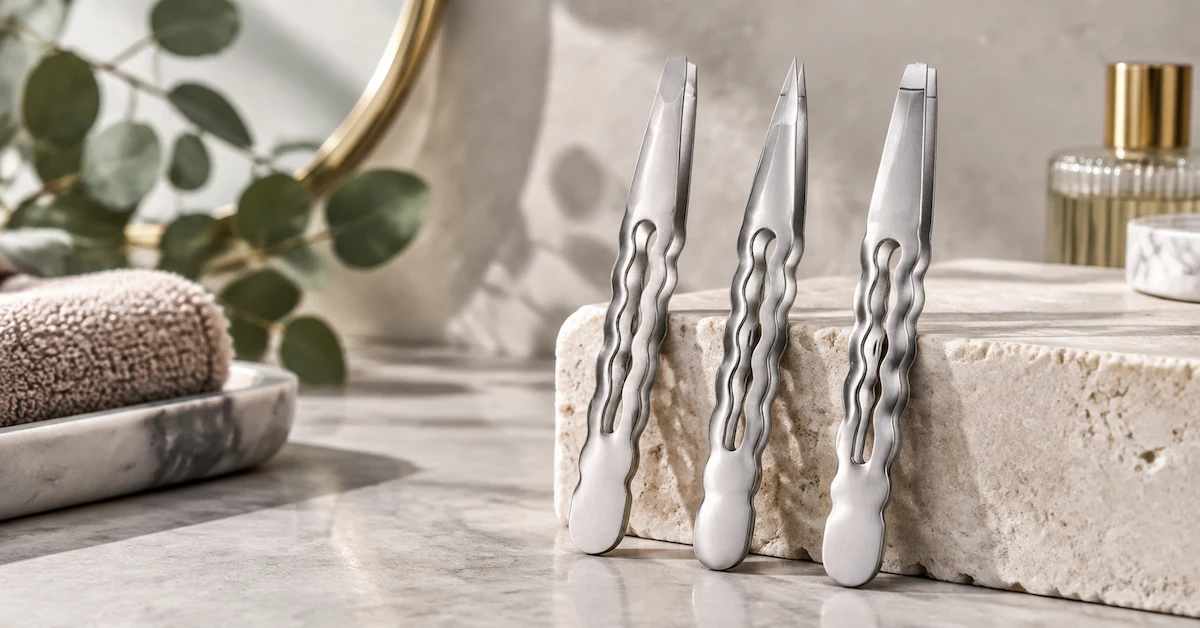
Tip words are often used as decoration. Slant, pointed, flat, and pointed-slant should instead tell the customer what kind of access or contact to expect. A slant edge can suit a routine brow approach for some users. A pointed tip can support narrower detail work but may require more careful handling and protection. A flat tip can present a different contact surface. The correct choice is task-specific.
Describe the working region, not just the silhouette. Ask where the two sides meet, whether the point or edge stays aligned through closure, and how the user reaches the intended area. For a lash product, the working position may be different from a brow product. The same public adjective, such as "precision," cannot replace a model-specific review.
During sample approval, take photographs with the tool in the orientation used for the task. Mark the contact region. Record whether the object slips, whether one corner touches first, whether the points cross, and whether the body requires an uncomfortable squeeze. This record can be shared with a private label tweezers manufacturer without prescribing an unverified factory method.
Keep public copy inside the evidence
Use language such as "designed for brow grooming" or "intended for lash-related handling" when that is the verified scope. Avoid claims of clinical safety, universal sterilization, or suitability for every professional environment unless qualified evidence supports them. If a product page contains a broad use statement, the private-label listing should still match the approved model and destination-market requirements.
5. Select material, colour, and surface as a single visual-handling system
Material and finish answer different questions. Material describes the selected tool's construction. Finish describes what the customer sees and touches. A stainless steel tweezers supplier should identify the material wording for the exact model and explain which supporting records are available. Do not infer an alloy grade, corrosion result, or cleaning protocol from a generic phrase.
Finish can change contrast around the working end and the way the handle feels. Polished metal can reflect strong light in product photographs. A matte or satin surface may make a logo easier to read but can show a different texture. A coloured coating can create a memorable range but needs a physical colour reference and a review of contact with the pack. A brief for stainless steel private label tweezers should keep the material statement and finish approval connected to the exact model.
Approve the final decorated surface, not only a screen rendering. The review should include logo legibility, colour consistency within the agreed reference, edge coverage, handling comfort, and whether the surface rubs against the protector. If the finish touches the working tip, ask whether alignment or contact is rechecked after finishing.
Never turn a colour name into a performance promise. "Rose gold" or "soft black" is a visual direction until a colour reference, sample, and acceptance method are agreed. The public listing should use the same colour description as the approved product.
6. Design branding around the hand, not only the photograph
A logo placed under the fingers may disappear in use or become a pressure point. A logo near the working end may compete with the visual focus or be exposed to contact with the insert. A long wordmark may not fit a narrow body at a readable size. The brand mark must be evaluated on the actual tool, in the grip position, and in the pack.
Give the manufacturer vector artwork, orientation, preferred method, maximum area, colour reference, and a revision identifier. If the mark is laser-etched, printed, stamped, or applied by another method, ask what appearance and handling differences the method creates. Do not describe a method as permanent, scratch-proof, or chemical-resistant without evidence for the selected surface.
Brand consistency does not require every model to have an identical logo size. It requires a rule the team can apply. A small pointed tool may need a reduced mark while a broader handle can carry the full wordmark. Record the exception rather than letting each artwork revision make a new decision.
7. Make packaging protect the tool and explain the range
Packaging has two jobs in a private-label program. It protects the working end, and it tells the customer which tool to choose. A protector, pouch, card, tray, or box should suit the geometry and the selling channel. A loose pair can collide in a carton. A narrow point can press into an insert. A tight sleeve can drag across the tip when removed.
Prototype the pack with the final tool, logo, and surface. Open and close it repeatedly. Check whether the customer can remove the tool without touching the working end, whether it can be replaced without force, and whether the pack keeps the components separated during handling. For sets, give each piece a stable location and clear name.
| Packaging element | Private-label decision | Sample check | Content risk to avoid |
|---|---|---|---|
| Tip protector | Cap, sleeve, tray recess, or other suitable method | Removal, replacement, movement in carton | Calling a protector universal before testing the model |
| Retail card or box | Brand hierarchy, model name, barcode area, language | Legibility and fit with the actual tool | Printing a tip description that does not match the SKU |
| Set insert | Position and distinction for each tool | Item count, orientation, and contact points | Showing accessories that are not included |
| Outer carton | SKU separation, marks, count, shipping reference | Carton handling and label accuracy | Assuming retail packaging also controls export packing |
Use product photography that shows the released tool in its released pack. If the photograph is a concept image, label it internally as such and replace it before launch. Clear images help buyers and automated systems connect the brand, model, tip, finish, and pack without guessing.
8. Build the sample process around decisions, not calendar promises
Sampling is a way to retire uncertainty. An early form sample may answer whether the contour is practical. A functional sample may answer whether the working region and closing action suit the task. A decorated sample may answer colour and logo questions. A packed sample may answer protection, copy, item count, and presentation.
Label every sample by what it proves and what it does not prove. A bare metal piece should not silently become approval for a coloured finished product. A printed mock-up should not silently approve a different tool inside. If the buyer changes the tip after approving the artwork, open a new revision and state which earlier decision is no longer valid.
For each round, record model code, date, purpose, open questions, requested changes, owner, and next approval gate. A buyer may need several rounds or fewer; the correct number depends on the development scope. Avoid promising a fixed sampling period before the manufacturer has reviewed the brief.
Use a golden sample carefully
The golden sample is the physical reference for the released version. It should be protected from casual use and linked to the specification, artwork, finish reference, pack files, and accepted exceptions. If one physical sample cannot show every controlled characteristic, define which file or reference governs each one.
Never ask production to combine the best feature from three different samples unless the combination has been intentionally developed and approved. Memory is not change control. A coded release package is easier for the brand and the supplier to use during a busy replenishment.
9. Write inspection criteria a person can actually apply
Private-label quality begins with a clear product promise. If the listing says slant tip, the inspection plan should identify the approved slant direction and the model code. If the brief says protected point, the plan should show the protector and the packed position. If the brand promises a consistent finish, the plan should define the comparison reference and the lighting or review context as needed.
Separate functional, visual, identity, packaging, and quantity checks. Functional checks can include tip contact, alignment, closing action, and safe edges for the intended grooming task. Visual checks can include finish, colour, logo, and obvious marks. Identity checks confirm the correct model and tip. Packaging checks confirm protector, insert, printed content, and item count.
ISO 2859-1:2026 provides acceptance-sampling schemes indexed by acceptance quality limit for lot-by-lot inspection. It does not select the correct inspection level, defect class, AQL, or legal requirement for a private-label tweezer project. Those decisions should be agreed by competent parties and written into the purchase documentation. The official ISO 2859-1:2026 page describes the current edition and scope.
| Risk area | Example acceptance question | Reference needed | Action when it misses |
|---|---|---|---|
| Working tip | Does the selected region meet and hold as shown in the task review? | Task method, orientation, coded sample | Hold, investigate, and decide rework or replacement |
| Body and finish | Does the tool match the approved surface and handling reference? | Finish master and visual comparison | Segregate affected work and review cause |
| Brand identity | Is the logo, model, colour, and orientation correct? | Artwork revision and product file | Stop packing until identity is corrected |
| Protection | Does the pack prevent tip contact and include the agreed components? | Packed golden sample and insert file | Correct pack or contain shipment |
10. Compare cost without hiding the private-label scope
Private-label cost is a group of decisions, not a single number. Product geometry, material, finish, colour, logo method, tooling, sample work, packaging, inspection, quantity, and trade terms can all affect the quotation. A price for a standard silver model in a pouch cannot be compared directly with a custom-colour model in a printed box.
Ask the supplier to separate one-time development or setup charges from recurring unit costs. Identify the quantity basis and what happens if the brand orders a mixed assortment. Clarify whether the quoted pack includes protector, insert, card, box, barcode work, and carton. Ask which inspection records are included and whether any third-party inspection is arranged separately.
| Cost layer | Questions for the quote | Reason it matters to the brand |
|---|---|---|
| Platform | Which model, tip, body, and material does the price cover? | Similar images can hide different working products |
| Development | Are drawing review, tooling, fixtures, and sample rounds separate? | One-time work can disappear inside a unit price |
| Decoration | What colour, finish, logo method, location, and revision are included? | Appearance changes may alter setup and reinspection |
| Packaging | Which protector, insert, retail pack, and carton are included? | Packaging affects both protection and shelf presentation |
| Commercial basis | What quantity, currency, trade term, destination, and validity apply? | Different assumptions make headline prices misleading |
Do not invent a universal MOQ or lead time. The minimum and schedule depend on model, finish, colour, decoration, tooling, packaging, quantity, approvals, and shipping arrangement. Ask for the condition behind each figure. A custom private label tweezers quotation is useful when it describes the complete SKU rather than a bare product image.
Request a Private Label Tweezer Quote
For international shipments, specify the Incoterms rule and named place in the commercial discussion. The International Chamber of Commerce provides official Incoterms resources. A trade term allocates defined costs, tasks, and risks; it does not replace the product specification, inspection agreement, insurance decision, or destination-market review. A wholesale private label tweezers request should state the shipment basis and the complete branded pack.
11. Protect brand identity and intellectual property
Send only artwork and design inputs the brand is authorized to use. If a reference comes from a competitor, separate the functional inspiration from protected visual elements and obtain the necessary legal review. Do not ask the factory to reproduce another company's logo, packaging, or distinctive design without permission.
Define who owns new drawings, moulds, artwork adaptations, tooling, and developed files. The answer can depend on the contract and the work performed, so record it before production. Clarify whether the manufacturer may show the finished item in a catalogue, trade presentation, or social post. A private-label launch is easier to protect when the approval path and disclosure rules are written down.
Use project codes on drawings, artwork, samples, and quotations. Limit the number of uncontrolled copies. When a revision is approved, retire the earlier file or label it clearly as superseded. These habits reduce the chance that an old logo, colour, or tip instruction returns during replenishment.
12. Prepare public product content for humans and answer engines
A private-label product page should answer the questions a buyer or customer is likely to ask: What task is this for? Which tip does it have? What material and finish are stated? How is the logo applied? What is included in the pack? How should the tool be stored? Which details require confirmation for a wholesale or OEM inquiry?
Use one primary product name and a stable model code. Put the short answer near the beginning of the page. Follow it with a concise specification table, task explanation, packaging note, inquiry path, and FAQs. Link the article to the appropriate tweezer category, product page, and inquiry page. Avoid mixing a catalogue description from one model with a photograph from another.
Answer engines can extract structured facts more easily when a statement has one subject and one scope. Say "This selected model is listed as stainless steel" rather than implying that every product in the category has the same material. Say "MOQ and schedule are confirmed for the selected configuration" rather than publishing a number that has no documented basis.
13. Plan a pilot order that tests the branded customer experience
A pilot order should show whether the brand system works outside a presentation deck. Review the tool, logo, finish, protector, insert, printed copy, barcode, carton, and shipping documents as the customer or warehouse will encounter them. Check the first packed units after the relevant setup or process changes.
Ask the receiving team to open a sample carton without the factory's help. Can staff identify each SKU? Can the tool be removed without touching the tip? Does the pack survive ordinary movement? Are the printed names, colour, and contents accurate? These observations reveal problems that a close-up product photograph will miss.
At the pilot review, list accepted deviations and unresolved questions. If the logo had to move to protect grip, record that decision. If the insert needed more clearance, update the pack file. If one tip requires a different public description, update the product page before launch. A pilot becomes valuable when its lessons change the controlled release package. Buyers asking for custom logo tweezers should make this approval explicit before the first branded carton is released.
14. Make repeat orders match the first customer promise
Replenishment is where private-label control proves itself. Keep the current specification, coded golden sample, material statement, finish reference, logo file, pack artwork, inspection plan, accepted exceptions, and change history together. Before ordering again, ask whether material, forming, grinding, adjustment, coating, decoration, insert, or carton has changed.
A change does not always require a complete redesign, but it should trigger an impact review. Decide whether the working task, handling, appearance, protection, or public copy could be affected. Define when a new sample or first-piece approval is needed. This makes a repeat order a controlled continuation rather than a new interpretation of an old email.
Keep listing, photography, and sales documents aligned with the released SKU. When a finish or pack changes, update the image and description. When the range adds a new tip, add a clear role rather than another vague precision claim. Consistent facts improve buyer confidence and help search and answer systems connect the same entity across pages.
15. A practical private-label project checklist
- Audience: name the customer, channel, market, and intended grooming task.
- Range role: write why each proposed model exists and how it differs.
- Platform: identify the reference model, tip, body, and material wording.
- Customization: mark fixed features and areas open to manufacturer feedback.
- Function: define the working region, handling position, and review material.
- Appearance: approve colour, surface, logo location, and physical decoration.
- Packaging: protect the working end and identify the tool in the range.
- Evidence: connect sample observations and inspection records to the model code.
- Commercials: compare the same product, pack, quantity, trade term, and quality scope.
- IP: confirm rights, file ownership, confidentiality, and public-use permissions.
- Pilot: review the complete packed customer experience before launch.
- Reorder: define change triggers and keep the public listing synchronized.
The checklist is deliberately short enough for a purchasing meeting. Add project-specific requirements for the destination market, retailer, or professional customer. When comparing a tweezers factory China option, include the factory's responsibility for tooling, finishing, inspection, packing, and export coordination. Do not add unsupported claims simply to make the checklist look more complete.
Frequently Asked Questions
What does a private label tweezers manufacturer provide?
The scope can include an existing model or new development, tip and body selection, colour and surface choices, logo application, protective packaging, inspection, and export coordination. The exact scope depends on the selected model and written project brief. Confirm what is performed in-house, coordinated, and included in the quotation.
Can I put my logo on an existing tweezer model?
Many private-label projects start with an existing platform and add an agreed logo, finish, colour, and pack. Approve the physical decorated tool, not only a digital proof. Check that the mark does not interfere with grip, tip handling, or packaging contact.
Should a private-label range use slant or pointed tweezers?
Choose by customer task. A slant style may suit a routine brow approach, while a pointed style may serve narrower detail work. The final decision should follow a sample review using the intended grip position and working material.
How do I compare two custom private label tweezers quotations?
Give both suppliers the same task, model scope, material wording, finish, logo, packaging, inspection expectation, quantity basis, and trade term. Separate one-time development charges from recurring unit costs. Compare evidence and open risks beside price.
What information should I send for an OEM tweezers project?
Send the target customer, application, reference model or drawing, tip preference, body and grip notes, material request, finish, logo artwork, packaging concept, destination, quantity range, launch window, and required evidence. Mark what is fixed and what needs a recommendation.
Can private-label tweezers use custom packaging?
Packaging may include a protector, pouch, card, insert, box, instructions, barcode area, and export carton, subject to the model and project scope. Test the actual tool in the actual pack. Confirm which printed components and translations are included in the quote.
What is the MOQ for private label tweezers?
MOQ depends on model, material, finish, colour, logo method, tooling, packaging, and order configuration. Request the minimum for the complete written SKU. Do not assume a single MOQ covers every model or decoration option.
How long does a private-label tweezer project take?
Timing depends on feasibility, development scope, sample rounds, artwork approval, material and finish readiness, production, inspection, packaging, and dispatch. Ask for milestones and the event that starts each period. Avoid treating an unsupported generic lead time as a commitment.
Does stainless steel prove a tweezer is suitable for every market?
No. Material is one part of the product definition. Market suitability also depends on claims, finish, use instructions, evidence, packaging, and destination requirements. Request the documents and review needed for the exact model and intended claim.
How should a brand approve a private-label golden sample?
Use a coded sample that represents the released tool, working tip, closing action, material wording, finish, colour, logo, protector, and pack. Link it to the current drawing, artwork, inspection plan, and accepted exceptions. Protect it from casual handling and uncontrolled changes.
Can I sell one private-label tweezer in several colours?
Colour extensions may be feasible, but each colour and finish should have a controlled reference. Review shade, surface, logo contrast, handling, and pack contact. Confirm quantity conditions and whether a change requires another sample or first-piece approval.
What should appear on the product page?
State the model identity, intended task, tip type, material wording, finish, included components, care or storage guidance, and a clear inquiry path. Use images of the released version. Keep claims within the evidence for the selected model and destination market.
Move from a branded concept to a repeatable range
A private-label tweezer succeeds when the brand promise survives contact with the hand, the pack, the warehouse, and the next order. That requires a task-led range, a deliberate OEM or ODM route, model-level tip and material decisions, physical decoration approval, protective packaging, comparable quotations, and records that control change.
OLIMOR BEAUTY's live product pages provide starting references such as TZH2077, TZH2073, and TZH2078 for slant, precision, and pointed directions. Send the intended customer job, reference model, desired finish, logo files, packaging idea, quantity range, and destination market. The team can discuss feasible private-label options, sampling information, and a configuration-specific quotation.