

Private label beauty tools: what buyers really need to know before placing an order
Private label beauty tools sit in an awkward but important corner of the personal care market. They are small, familiar, and easy to underestimate, yet they carry a lot of weight for a brand. A nail nipper or cuticle pusher is not just a utility item; it is part of the customer’s first tactile impression of your line. If the finish feels cheap, the hinge is loose, or the packaging looks generic, the brand takes the hit. That is why sourcing private label beauty tools is less about finding “something that trims” and more about choosing a product family that can support retail positioning, salon use, and repeat sales.
For sourcing managers, salon buyers, and product teams, the real decision is usually not whether these tools can be made. It is how to spec them so they look consistent, work smoothly, and hold up in daily use without creating returns or complaints. That is where a little process knowledge saves time and avoids the usual trap: ordering on appearance alone.
What counts as a private label beauty tool line
In this category, the core items are often manicure and pedicure implements and other small hand tools for grooming. The product set commonly includes nail nippers, cuticle nippers, tweezers, and similar precision tools. Some versions are sold individually; others arrive as boxed sets or in matching cases and pouches.
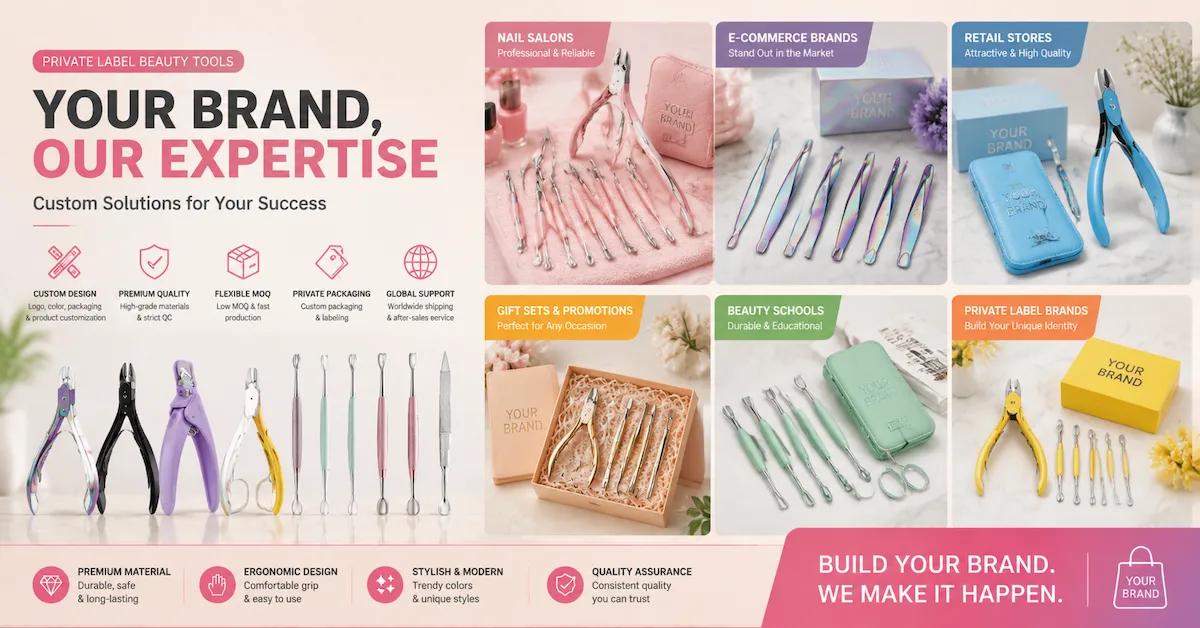
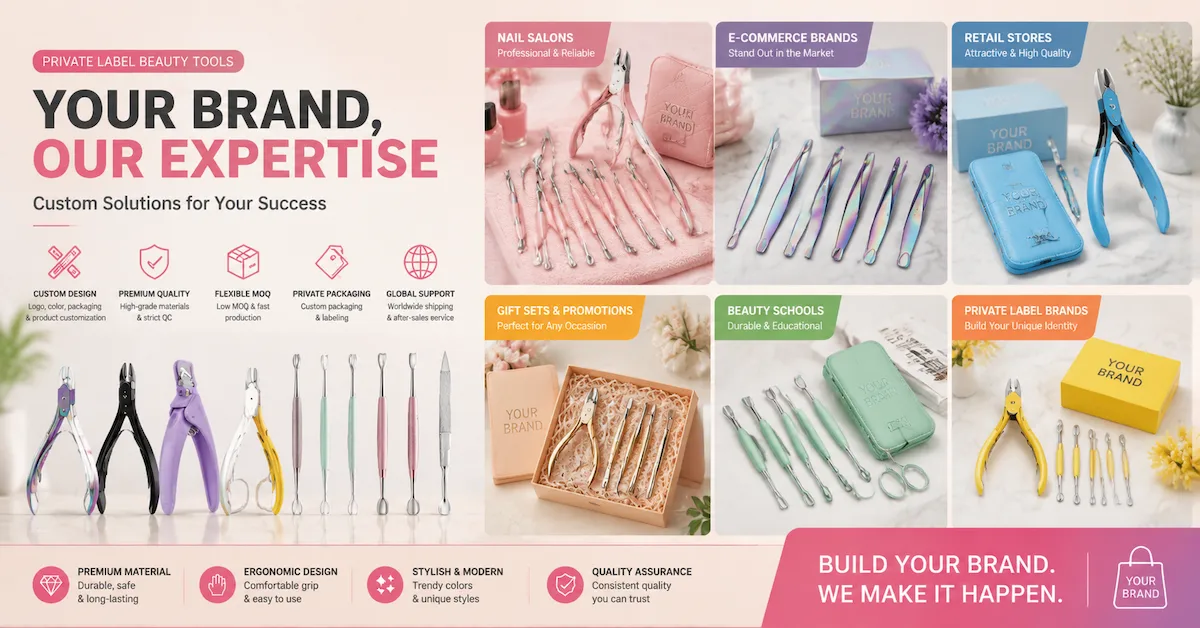
The image-based product cues suggest metal construction with polished reflective finishes, plus colored coatings or plated finishes in shades such as pink, purple, blue, green, yellow, and silver. Handles may vary: some are slim tweezer-style arms, while others use plier-style spring handles. That mix matters because the user experience is different. A tweezer form may suit brow, lash, or fine-grip tasks, while plier-style tools are more at home in nail-care trimming and edge control.
Private label beauty accessories in this space are often bought for several channels at once: salons, beauty schools, retail beauty stores, e-commerce brands, and gift or promotional sets. The product has to travel well through all of them, which means packaging and presentation are not a side note. They are part of the product.
Why this category is harder than it looks
Small grooming tools are unforgiving. A customer does not need a long tutorial to judge them. If the jaws do not align cleanly, if the grip is awkward, or if the coating chips in the first few uses, the defect is obvious. That makes QC and consistency central to the buying decision.
There is also a branding problem that many first-time buyers miss. Because the tools are compact, the product itself offers limited surface area for logo work and decoration. That pushes more of the brand story into packaging, color system, and set composition. A well-chosen case or box can make a modest tool line feel polished. A poor one can make a good tool feel like a bargain-bin item.
Common manufacturing elements behind custom beauty tools
While exact factory routes vary, the likely process chain for custom beauty tools in this category usually includes metal stamping or forming, grinding or sharpening, polishing, plating or color coating, assembly, and private-label packaging. That sequence matters because the order of operations affects both appearance and function.
Shaping and edge work
Nippers and similar trimming tools depend on controlled forming and careful edge finishing. Buyers should pay attention to the way the cutting surfaces meet, the feel of the spring action, and whether the tool closes with a clean, repeatable motion. A visually attractive finish cannot rescue poor alignment.
Surface finish and coating
The appearance of polished metal is still a staple, especially for salon-facing products. Color coatings and plated finishes can help a brand differentiate SKUs or build a recognizable range. That said, decorative finish should not obscure the practical question: does the coating hold up under handling, cleaning, and transport? Buyers should ask how the finish is applied and whether the vendor can maintain consistency across production runs.
Assembly and packaging
For private label beauty tools, assembly is often where final quality either tightens up or slips. Hinges, springs, grips, and alignment are all visible to the end user. Packaging then becomes the last check before the product reaches a shelf or shipping carton. Custom packaging and labeling are especially useful when the same base tool needs to serve different channels with different price points.
How to evaluate suppliers without getting distracted by the mockup
A polished render or attractive sample set can make the buying decision feel easier than it is. In practice, buyers should focus on a small number of questions.
First, does the supplier offer genuine customization, or only surface-level branding? Custom logo placement, color selection, and packaging changes are useful, but they are not the same as tooling flexibility. Ask what can be modified without affecting performance.
Second, how does the supplier handle QC? The graphic claims strict QC, and while that is a common sales phrase, it is still the right thing to ask about. For this product type, QC should address blade alignment, spring tension, finish consistency, cosmetic defects, and packaging integrity.
Third, what is the MOQ really tied to? Low MOQ can be valuable for new brands and test launches, but buyers should confirm whether minimums differ by color, packaging style, or logo method. A low entry order is helpful only if the repeat order path is manageable.
Fourth, what does “fast production” mean in practical terms? Some factories can turn simple packaging or stock items quickly, but custom coating, logo work, and nested box sets can extend the timeline. It is better to ask for the production steps that consume time rather than relying on a headline promise.
Selection criteria that matter on the shelf and in the hand
For this product category, the most useful selection criteria are usually tactile and visual.
A buyer should look at balance first. A nail nipper that feels nose-heavy or too stiff will frustrate users, especially in salon settings where repetition matters. Handle geometry also matters; ergonomic grip claims are worth verifying with real handling, not just photos.
Then look at finish durability. Reflective metal and colored coatings both need to survive display, shipping, and routine use. If the product is meant for retail, shelf appeal should last longer than the unboxing moment.
After that comes presentation. Matching cases, pouches, and boxed sets can raise the perceived value quickly, especially in gift-oriented or private-label retail channels. But presentation should fit the use case. An elaborate box for a low-priced commodity tool may look out of place, while a bare tool in a premium channel can feel underdeveloped.
Finally, think about assortment logic. A line that includes nail nippers, cuticle nippers, tweezers, and related grooming pieces can work well if the naming, colors, and packaging are consistent. If the line looks assembled from unrelated parts, the brand loses cohesion.
Common buyer mistakes
One common mistake is choosing based on appearance alone. Small metal tools photograph well, especially with bright plated finishes, but the hand feel and edge quality are what users remember.
Another is under-specifying packaging. Many buyers treat packaging as a late-stage add-on, then discover that the box dimensions, insert fit, or labeling method are not ready when the product is.
A third issue is overloading the line with too many variants before the first sell-through. It is tempting to offer every color and every tool type at once, especially when private label beauty accessories are visually easy to merchandise. But too many variants can complicate forecasting and make inventory harder to move.
One small caution: when a vendor says a tool is suitable for both salon and retail use, ask how that is reflected in the finish and packaging. Those are not interchangeable markets, even if the tool itself is the same.
Practical buyer advice for a cleaner launch
If you are launching private label beauty tools, start with a narrow core set. Choose the few items that best fit your customer profile, then build around them with color, logo, and packaging.
Ask for samples that represent the actual production route, not only display pieces. Compare how the tool closes, how it feels after repeated opening and closing, and whether the finish shows handling marks quickly.
If you are targeting e-commerce, prioritize visual consistency across the whole page. If you are targeting salons, prioritize function and durability. If you are targeting gift sets, prioritize packaging protection and perceived value. The same tool can serve all three channels, but not with the same priorities.
FAQ
Are private label beauty tools only for nail care?
No. Nail and cuticle tools are the main focus here, but similar precision grooming tools can also be used for general personal care, brow grooming, and small-detail tasks depending on the design.
Can these tools be customized with logos and color?
Yes, custom logo, color, and packaging are common private-label options in this category. The exact method depends on the supplier and the tool surface.
Do low MOQ and fast production apply to every order?
Not always. They may depend on whether the order uses stock items, custom coatings, special packaging, or other modifications. Buyers should confirm the details before committing.
What should I ask for before approving a sample?
Ask about alignment, finish consistency, packaging fit, customization options, and whether the sample reflects the final production method.
What a sensible next step looks like
If you are sourcing private label beauty tools for a new line or a refresh, the smartest next step is to separate the visual brief from the functional brief. Decide what the tool must do, what it must look like on shelf, and how much packaging supports the brand story. Then compare suppliers on those terms.
That approach usually leads to better decisions than chasing the brightest finish or the lowest MOQ. In this category, a clean closing action, a comfortable grip, and a well-matched box often matter more than a long feature list. If your supplier can deliver those pieces consistently, you are in a better position to build a line that sells and gets reordered.
Tag: