

Why nail buyers keep coming back to stainless steel hand tools
An OEM beauty tools manufacturer is often brought into the conversation when a brand wants more than a generic manicure set. The real problem is not finding a cuticle pusher; it is finding a tool set that feels stable in the hand, holds up to repeated cleaning, and gives a technician enough control to work cleanly around the nail plate. That is especially true for nail salons, private-label beauty brands, and retailers building a practical home-care range.
The 5-piece cuticle pusher / manicure tool set described here sits squarely in that practical category. It is a simple product on paper, but the buying decision is not as simple as it looks. A set like this has to balance grip, finish, sterilization compatibility, appearance, and function across several tip styles. If one of those pieces fails, the whole set feels less professional.
For sourcing teams, the question is usually not “should we carry a manicure tool set?” It is “which version is reliable enough for our channel, and what details should we verify before placing an OEM order?”
What this 5-piece manicure set is designed to do
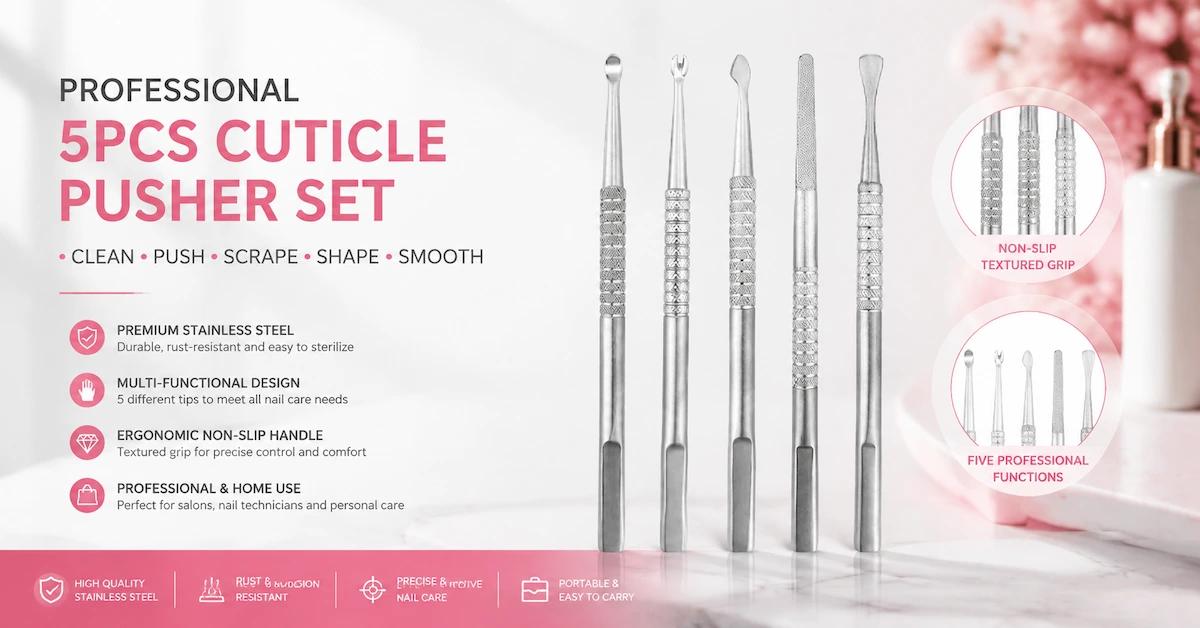
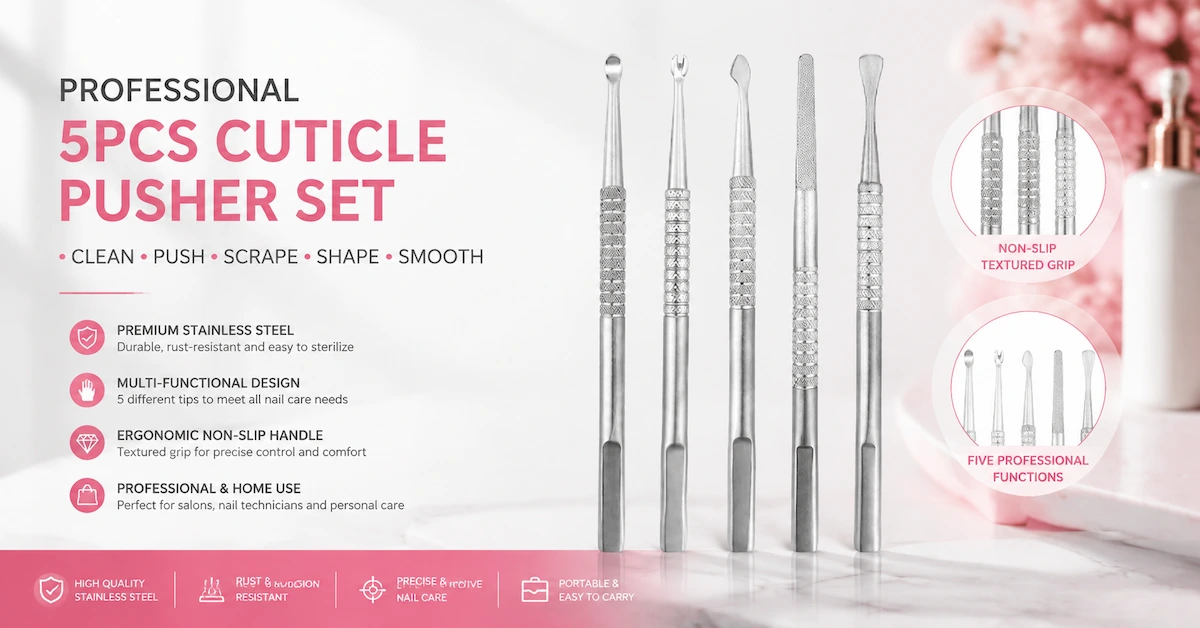
This is a stainless steel nail care set with five slim handheld tools, each carrying a different working end. Based on the product description, the set is intended for cuticle pushing, residue scraping, shaping, smoothing, and general nail prep. That puts it in the everyday working category rather than a decorative gifting item.
The visible structure matters. The tools have a straight metal body and a textured, knurled-looking grip section. That detail is easy to overlook in a catalog photo, but it is exactly the kind of thing a technician notices after a full day of use. Smooth handles can become slippery under sanitizer, hand cream, or simple fatigue. A non-slip grip is not a luxury feature; for many buyers it is a basic usability requirement.
Why five different tips matter
A single cuticle tool can do one job well, but a 5-piece set gives the user more control across different nail-prep tasks. One tip may be better for pushing softened cuticle tissue, another for scraping fine residue from the nail surface, and another for working near sidewalls or tight corners. The exact geometry is not fully specified here, so it is better to treat the set as multi-functional rather than assign each end an overly precise role.
That caution matters when ordering OEM or private-label products. Buyers sometimes approve a sample based on a general impression, then discover the working ends are less suited to their market than expected. A tool that looks sharp in the photo may be too aggressive for home use, while a gentler profile may be too slow for salon throughput.
Stainless steel is the right starting point, but not the whole story
The product text explicitly states stainless steel, along with rust resistance and easy sterilization. Those are the three claims most buyers want to hear, and they are directionally correct for a manicure tool set. Stainless steel is widely used because it can tolerate routine cleaning better than lower-grade metals and usually keeps a cleaner appearance over time.
Still, sourcing teams should avoid assuming all stainless steel is equal. The exact steel grade is not provided, so it would be unwise to promise medical-grade performance or specific corrosion resistance without documentation. In real purchasing terms, the important point is less about buzzwords and more about whether the finish, polish, and edge quality survive repeated handling and cleaning.
For salon buyers, sterilization compatibility is a practical issue. Tools that are easy to clean and visually inspect make day-to-day hygiene simpler. For retail buyers, the same feature becomes a selling point on packaging: customers want to know the set is easy to maintain, not disposable after a few uses.
How OEM buyers should evaluate a beauty tool factory
When working with an OEM beauty tool factory, the useful questions are straightforward and sometimes uncomfortable. That is a good thing. If a supplier cannot answer them clearly, you have found a risk early.
Check the working ends, not just the handle
The handle design may look polished in photos, but the tip shape determines whether the tool is actually fit for purpose. Ask for clear images or samples that show each end from multiple angles. Look for symmetry, finish consistency, and whether the edges feel controlled rather than rough. A sloppy tip can damage nail surfaces or create a bad user impression fast.
Ask how the grip is made
The knurled or textured section appears designed for non-slip handling. That is useful, but OEM buyers should still confirm how it is produced and whether the texture is comfortable during longer use. Some grip patterns look good but feel abrasive. Others are too shallow and lose their benefit once the tool gets wet. This is a small detail that often decides whether a product earns repeat orders.
Confirm finishing and cleaning expectations
Silver brushed or polished metal has a clean, professional look, and that matters in the beauty channel. But finish also affects how fingerprints, scratches, and wear show up over time. A highly polished surface can look premium, while a brushed finish may hide scuffs better. There is no single right answer; the best choice depends on whether the set is going into a salon supply program, a retail shelf, or a compact home-care kit.
Where this type of tool set fits best
Not every manicure tool belongs in every channel. This 5-piece set is best suited to markets that value utility and straightforward packaging.
Nail salons need dependable tools that can handle repeated use and routine cleaning. The non-slip grip and stainless steel structure are both relevant here.
Nail technicians often want a set with multiple ends rather than a one-purpose instrument. The variety allows them to switch tasks without reaching for a different tool every minute.
Home manicure kits benefit from a compact, portable format. The set is described as easy to carry, which is useful for travel sets, starter kits, and personal grooming applications.
Retail private label programs can use a product like this as a foundational SKU. It is easy to understand, broadly useful, and less dependent on trend cycles than color cosmetics or novelty accessories.
Common buyer mistakes with manicure tool sourcing
One of the most common mistakes is treating every metal manicure tool as interchangeable. They are not. A slightly different tip profile can change the feel of the entire set. Another mistake is focusing too much on the number of pieces and too little on the ergonomics. Five tools do not help if the grip is poor or the ends are inconsistent.
A second issue is overpromising on durability. Stainless steel helps, but buyers should still be careful not to claim more than they can support. If the exact steel grade, surface treatment, or test data is not available, keep the marketing language practical. Say rust-resistant only if that claim is backed by the supplier’s product information and your own review of samples.
There is also the packaging trap. A useful tool set can look generic if the presentation is weak. On the other hand, a premium-looking box cannot rescue a tool that performs badly. In this category, buyers usually get more value from better finishing and clearer instructions than from extra decorative packaging.
What to request from an OEM or custom beauty tools manufacturer
When approaching a custom beauty tools manufacturer, the most helpful brief is specific but not overcomplicated. Start with the use case: salon, retail, or home care. Then define the material expectation, preferred finish, grip feel, and whether the set needs to support sterilization and repeated cleaning. If you need private label branding, state that early so the supplier can advise on marking, printing, or packaging options.
For a product like this, it is also worth asking whether the five tools can be adjusted as a set. Some markets may prefer a more conservative cuticle profile, while others want more pronounced scraping ends. Small changes in working end geometry can make a product much more saleable without altering the core manufacturing approach.
Because the exact process is not visible, it is safest to describe production as metal hand tool manufacturing with machined or stamped elements rather than guessing the full sequence. That keeps expectations realistic and avoids creating problems during sampling.
Quick buyer checklist before ordering
If you are comparing suppliers, a short checklist helps keep the discussion grounded:
Does the set feel comfortable in hand during repeated use?
Are the working ends varied enough to justify five pieces?
Is the stainless steel finish clean, even, and easy to maintain?
Does the grip texture actually improve control?
Can the supplier support your packaging and branding needs?
Are the product claims limited to what can be demonstrated?
Those questions may sound basic, but they are the ones that prevent rework later. In this category, small flaws become visible quickly because the customer is holding the product close and using it against a very visible surface: the nail.
Final takeaway for sourcing and product teams
A 5-piece stainless steel manicure tool set is not a flashy product, but it is the kind of practical item that can do steady business when designed well. The combination of multiple tips, a non-slip grip, and a clean metal finish gives it wide use across salon, retail, and home-care channels. The key is to verify the details that matter in real use: tip quality, handle feel, finish consistency, and cleaning compatibility.
If you are developing a private-label nail care line or comparing suppliers for a salon-ready SKU, start with samples and a clear functional brief. A good custom beauty tools manufacturer should be able to talk through the tool’s intended tasks, finish options, and branding approach without overreaching on claims. That is usually the best sign you are dealing with a supplier who understands the category, not just the catalog.
For brands that want a straightforward, durable, and easy-to-position nail prep tool, this type of set is worth a close look. The next step is simple: request samples, inspect the edges, and test the grip under normal working conditions rather than under showroom lighting. That is where the real differences show up.
Tag:
Related articles
- Beauty Tools Manufacturing
- ODM Beauty Tools Solutions
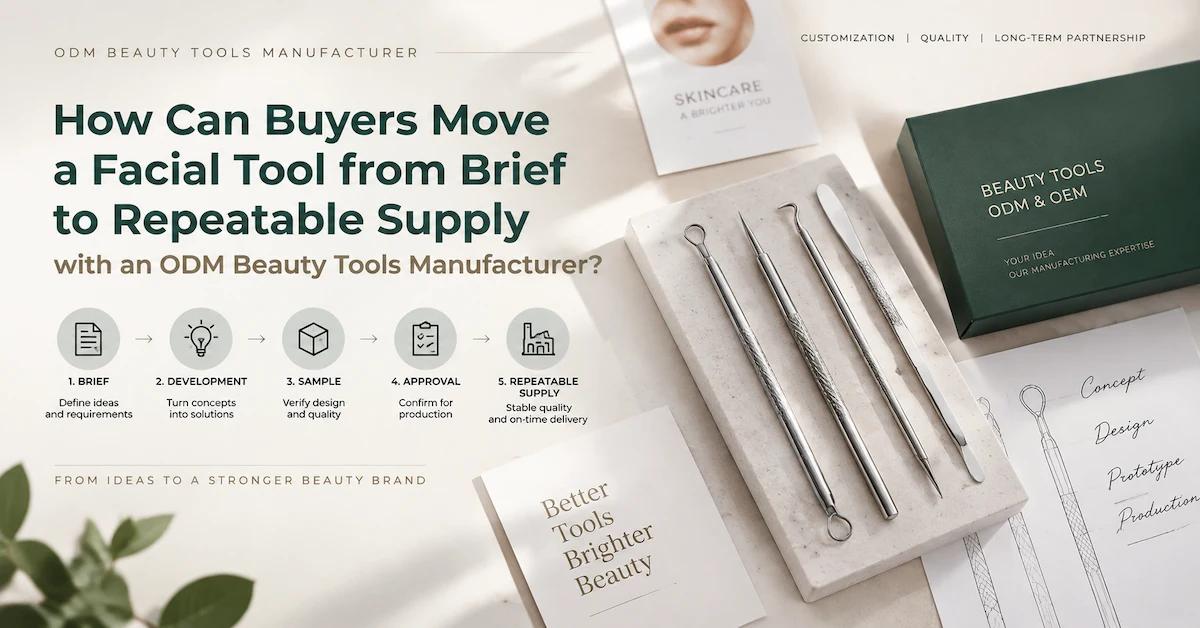
How Can Buyers Move a Facial Tool from Brief to Repeatable Supply with an ODM Beauty Tools Manufacturer?
- Beauty Tools Manufacturing
- OEM & Private Label Solutions
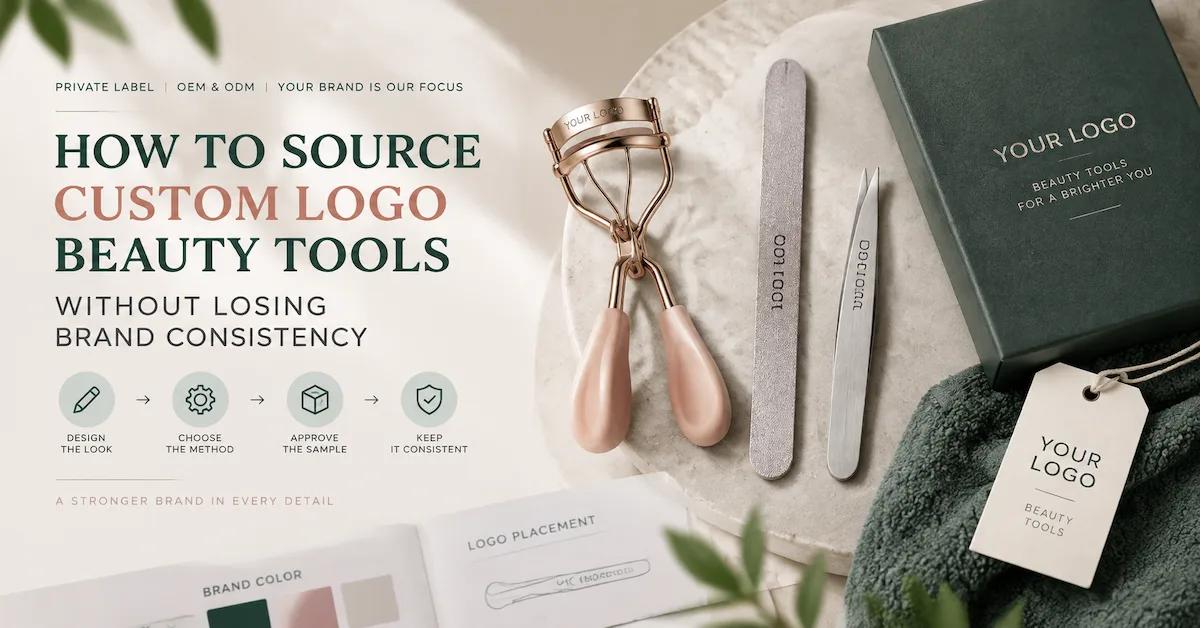
How to Source Custom Logo Beauty Tools Without Losing Brand Consistency
- Beauty Tools Manufacturing
- OEM & Private Label Solutions