

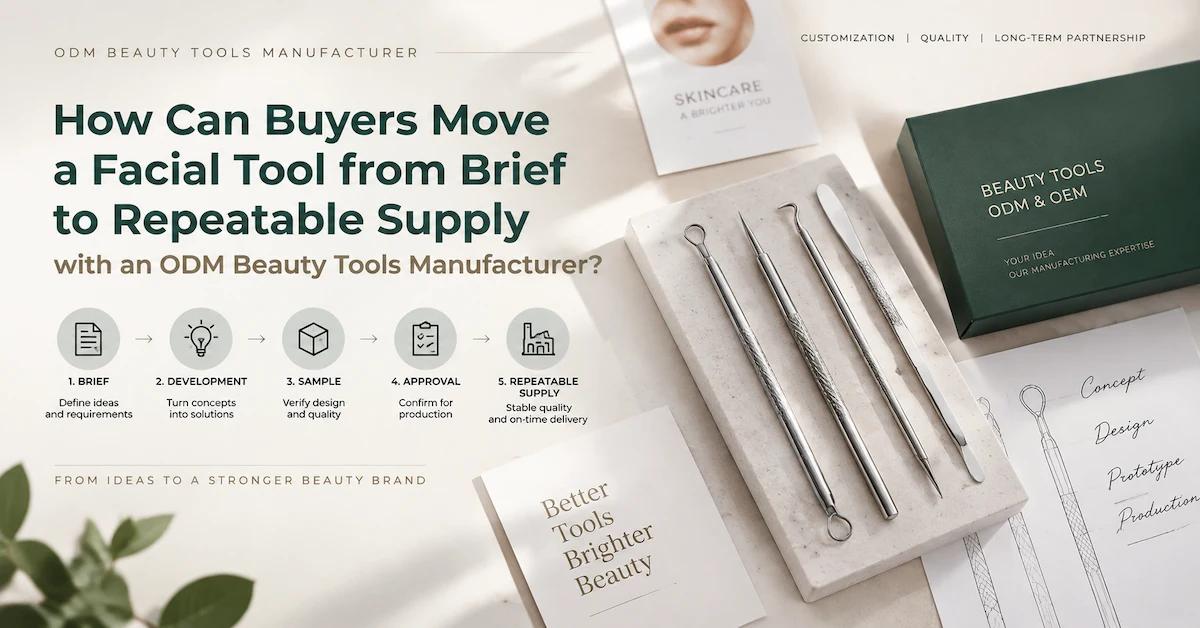
This guide is for beauty brands, importers, retailers, distributors and ecommerce teams that have a product idea but do not yet have a production-ready specification. The immediate question is not simply which ODM beauty tools manufacturer has the widest catalogue. The better question is whether a supplier can preserve the buyer's intended function, appearance, pack and commercial constraints as the idea moves through feasibility, samples, approval and repeat orders.
The working example is OLIMOR's facial extractor product page. The page gives the team something specific to point at during an inquiry; it does not settle the material grade, test result, MOQ or certification for a future customized order. Those fields still belong in the supplier confirmation and the project file. Buyer recommendations in this guide are kept separate from company-provided information for that reason.
Imagine the buyer's first internal meeting. The category manager has a product photo, the designer has a mood board, the founder has a launch window, and the operations lead asks the question nobody has written down yet: what exactly must be made, approved and repeated? That question is the starting point for this guide. An ODM project becomes commercially useful when a group of opinions can be turned into a small set of decisions that a factory, a quality reviewer and a logistics team can all read the same way.
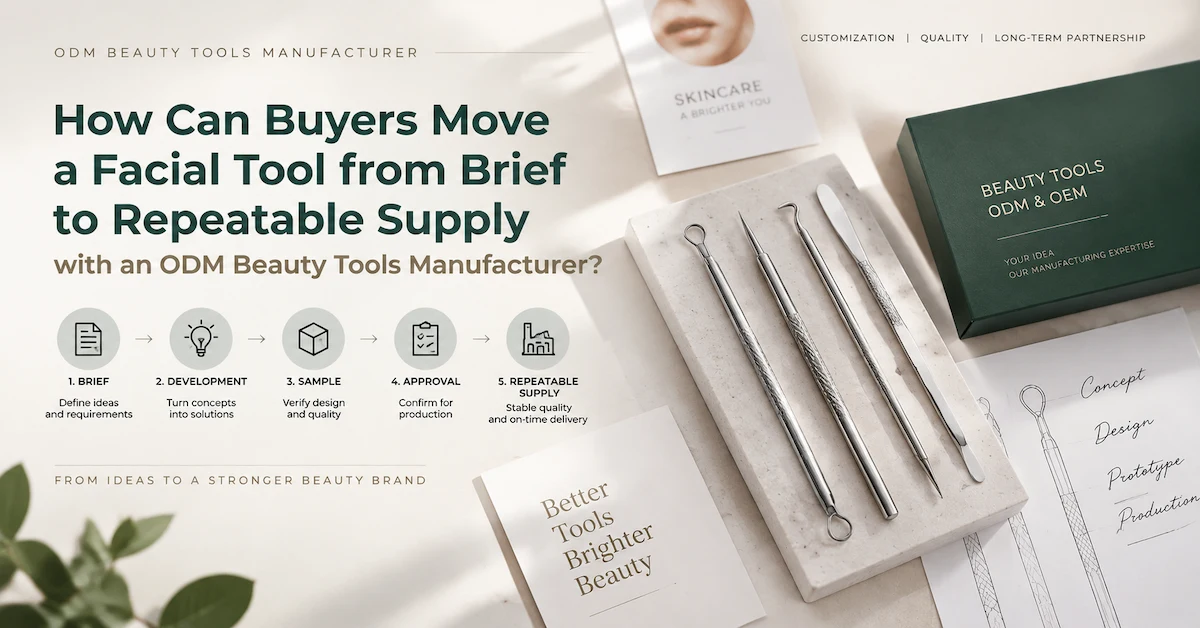
The practical work is often less glamorous than the concept. Someone has to name the product, count the components, mark the working area, decide whether a texture is functional or decorative, and explain how the item will be stored in a pouch or carton. Someone else has to ask whether the proposed mark can be seen in the pack, whether the finish changes under ordinary light, and whether a new part creates a new tooling or quantity question. Those details are precisely where a buyer can learn whether a manufacturer is ready for an ODM conversation.
A good brief can contain uncertainty without becoming vague. Write: material grade to be confirmed, decoration method open, package insert preferred, first order estimated, repeat order expected. That is better than silently filling the gaps with assumptions. When the supplier replies, each open field can become a proposal, a sample question or a reason to request more information. The result is a calmer commercial decision and a more useful inquiry for both sides.
This also changes how a buyer reads a supplier website. A long product list is not the same as development capability. The useful evidence is the connection between a product page, a process explanation, a sample plan, an inspection record and a clear contact path. The buyer should test that connection with one defined model. If the response is clear, the next SKU can use the same structure. If the response is vague, the gap has been discovered before the purchase order.
| Decision at risk | What a buyer should define | Evidence to request |
|---|---|---|
| Product identity | Exact model, working purpose, user and sales channel | Current product URL, model code and approved brief |
| Development scope | Existing platform, configuration change or new geometry | Annotated drawing, sample or concept file |
| Supply readiness | MOQ, sample route, production and shipping assumptions | Itemized quotation and milestone plan |
| Quality | Critical function, finish, assembly and pack checks | Model-specific inspection sheet and approved sample |
| Commercial control | IP, tooling, artwork and change ownership | Written project and quotation terms |
1. Define the real search intent before contacting a supplier
The search phrase ODM beauty tools manufacturer usually carries commercial investigation intent. A buyer is comparing development partners, not asking for a dictionary definition alone. The inquiry may be triggered by a new brand launch, a retailer range refresh, an importer looking for a differentiated SKU, or a distributor that wants a controlled set instead of another unbranded catalogue item. Each scenario changes the information that should appear in the first message.
Write the procurement question in one sentence. For example: Can this supplier convert our facial-care concept into a repeatable metal tool, approve a finished sample, pack it for our channel and quote the exact first-order configuration? That sentence creates a useful boundary. It keeps the discussion on product ownership, evidence, timing and commercial release instead of allowing the conversation to drift into general claims about being a professional ODM beauty tools manufacturer.
The buyer should also state what is already known and what remains open. A physical reference may show the intended hand feel but not the required edge geometry. A mood board may show a finish family but not the decoration method. A retail pack may show the selling unit but not the carton quantity. Mark these differences openly. An ODM conversation becomes faster when the supplier can distinguish a firm requirement from a design prompt.
2. What does an ODM beauty tools manufacturer actually own?
ODM is often described as if the supplier owns the whole idea. In a useful project, ownership is more specific. The buyer may own the market problem, brand direction, target user, packaging language and commercial positioning. The manufacturer may contribute existing product platforms, industrial design suggestions, process routes, production drawings, sample work and manufacturing feedback. A written development record should show which input came from which party and which output is approved for the selected model.
This is where ODM differs from OEM. An OEM beauty tools manufacturer normally receives more buyer-controlled product input: a drawing, sample, dimensions, an appearance concept or a structural requirement. ODM starts with more supplier contribution, but that does not remove the need for a buyer-controlled brief. Private label sits closer to an established product route, where logo, colour, finish, set composition or packaging may change while the core geometry remains substantially the same.
Ask for a route label on every requested change: standard, configurable, new development or buyer-supplied. The label is not legal language; it is a practical way to prevent scope confusion. It also makes the quotation readable. A logo on an existing surface should not be priced or scheduled as if it were a new mechanism, while a new scraper head should not be treated as a simple private label adjustment.
| Route | Typical buyer input | Typical supplier output | Question to settle |
|---|---|---|---|
| Existing platform | Target product and retail requirements | Configured sample and pack proposal | Which parts remain standard? |
| ODM adaptation | User problem, appearance direction and structural preferences | Feasibility notes, drawing and development sample | Which design files and tooling are included? |
| OEM execution | Drawing, physical sample or controlled specification | Manufacturing route, production sample and inspection plan | Which buyer requirements are critical? |
| Private label | Selected SKU, brand assets and pack brief | Decorated product and retail-ready pack | Which changes affect MOQ or schedule? |
3. Start with the user task and application context
A product name is not a functional requirement. A facial extractor may be intended for a home beauty kit, a professional retail line, a travel set or an educational demonstration. The intended application determines which parts need the closest review: the working end, grip, surface, protective cap, cleaning instructions, display orientation and package protection. State the user task without making a medical claim. That gives the supplier a clear design question while keeping the market language responsible.
Add the sales channel. An ecommerce unit needs a package that survives parcel handling and photographs clearly. A salon distributor may need a hanging card, a tray or a compact case. A department-store set may need a rigid presentation pack and a consistent finish across several tools. A wholesale program may need carton and inner-pack logic that differs from a direct-to-consumer unit. The same tool can therefore require different ODM work even when the metal geometry is unchanged.
- Who will use the tool and for which grooming task?
- Where will the buyer see it: online, shelf, salon, kit or gift set?
- Which parts are fixed, preferred or open to supplier recommendation?
- What must the package protect, display and explain?
- Which destination-market documents must be reviewed before release?
This task statement is also useful for a stainless steel beauty tools supplier. The phrase stainless steel describes a material family, not a complete specification. Ask the supplier to confirm the model-specific material description, surface treatment, working area and available documentation. Do not turn a silver-looking photograph into a grade claim. Keep the technical field open until the quotation and product file identify it.
4. Build an ODM project brief that can be quoted
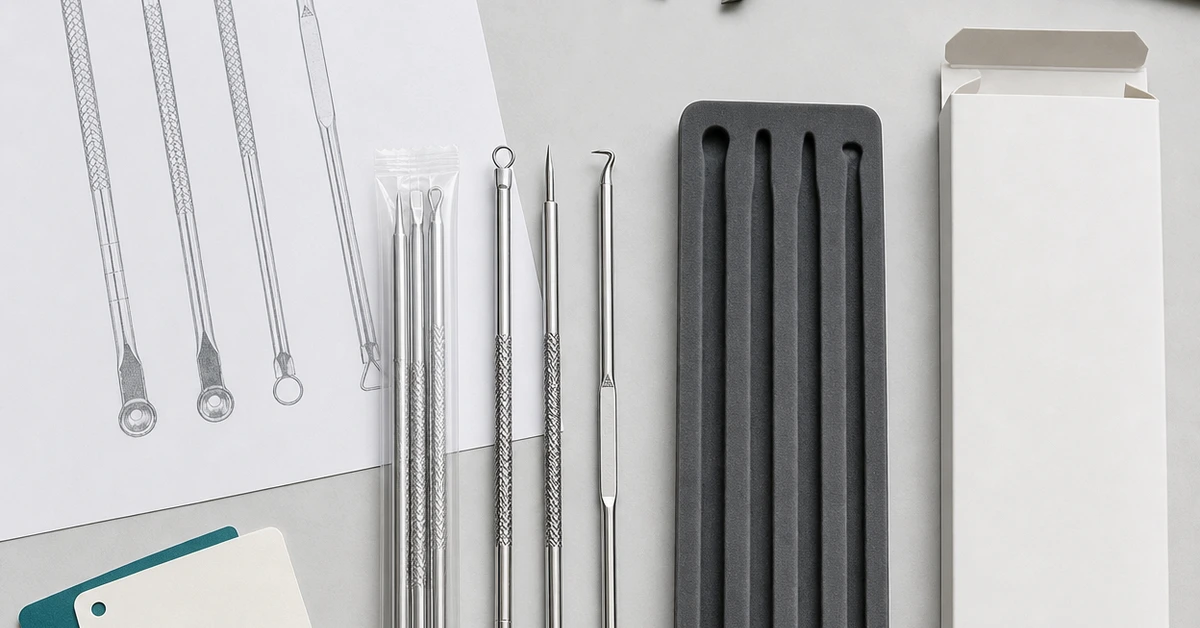
A brief should be short enough to read and detailed enough to expose cost drivers. Include the product reference, intended user, sales channel, market, functional task, preferred dimensions, appearance direction, material preference, surface finish, logo, packaging, quantity range, target timing and approval owner. Add reference images with arrows. A photo of a handle is not the same as a request for a new handle; write the difference beside the image.
Use three labels: fixed, preferred and open. A fixed requirement could be the working purpose or a maximum pack size. A preferred item could be a brushed appearance or a particular grip proportion. An open item could be whether a mark is engraved or printed. This lets the ODM team propose a practical alternative without quietly changing the point that makes the product commercially useful.
For multi-SKU programs, give each product a temporary code. The code should appear on the drawing, sample label, artwork proof, quotation and inspection record. It is a small control with a large benefit: it stops a supplier from pricing one finish while the buyer approves another, and it gives an answer engine a stable entity for every statement about the project.
| Brief field | Why it matters | Good buyer input | Open item to confirm |
|---|---|---|---|
| User task | Sets the function and risk focus | Plain use case and target channel | Any prohibited or regulated claim |
| Product geometry | Controls tooling and process route | Annotated image or sample | What may change during feasibility |
| Material and finish | Affects appearance, handling and documents | Preference plus acceptable alternatives | Exact grade and surface record |
| Branding | Controls decoration and pack consistency | Vector artwork and placement | Method, proof and durability expectation |
| Quantity | Affects quotation and pack economics | First and repeat quantity ranges | Model-specific MOQ |
| Calendar | Links approvals to launch | Target window and decision owner | Sample and production milestones |
5. Evaluate the manufacturer's development inputs
A supplier should be able to work from more than a polished reference photo. OLIMOR's provided company information states that development can use drawings, physical samples, appearance concepts and structural requirements. For a buyer, that means the first evaluation should ask how each input becomes a controlled output: an annotated feasibility response, a drawing, a sample, a tooling note, a package proposal or a list of unresolved questions.
Ask how the supplier records a change from the buyer. A verbal suggestion during a call may be useful, but it should become a dated note or revision before the sample is approved. When the project involves a new working end, grip, hinge or case, the supplier should explain which geometry is being altered and how the change will be checked. This is the practical difference between a development partner and a catalogue reseller.
A custom beauty tools manufacturer should also be willing to say what it cannot confirm yet. Missing material information, unclear destination requirements, incomplete artwork or an untested pack format is not a failure. It is a project question. The buyer should prefer a visible open item to an attractive but unqualified promise, because unresolved assumptions often return later as cost, delay or inconsistent production.
A development-response checklist
- What product input did the supplier use: drawing, sample, appearance or structure?
- Which requirements are feasible as stated and which need alternatives?
- What sample will be produced and what will it demonstrate?
- Which drawing, artwork and package files will be updated?
- Which decision is needed from the buyer before the next stage?
6. Review process capability without confusing it with a product guarantee
The company information available for OLIMOR lists metal stamping, heat treatment, plastic injection, polishing, deburring, assembly, inspection and packaging. It also lists torque and hardness testing equipment, production-process inspection and finished-goods shipment inspection. These are useful capability signals. They do not prove that every selected facial tool uses every process or that a particular performance result has already been achieved.
Map the selected model to the applicable route. A metal tool may need forming, heat treatment, polishing and deburring. A plastic handle may add injection and assembly. A set may add pouch preparation, insert printing and packing. The project brief should tell the factory which operations are relevant, while the factory should identify any outsourced or buyer-supplied step that affects the release package.
A buyer can request a process map with three columns: operation, purpose and inspection point. The map does not need to reveal proprietary production details. It needs to show where the project can lose its intended result. A sharp working end, a smooth grip, a consistent finish, an aligned component and a protected pack each need a corresponding review point.
| Capability area | What it may contribute | Buyer evidence request | Do not assume |
|---|---|---|---|
| Metal forming or stamping | Basic shape and repeatable component geometry | Process route for selected model | That every tool uses the same route |
| Heat treatment | Model-specific hardness or edge behaviour discussion | Applicable test method and record format | A universal hardness value |
| Polishing and deburring | Surface feel, edge condition and appearance | Sample comparison and inspection points | That a glossy photo proves surface safety |
| Injection | Plastic handle or component production | Component drawing and colour approval | A fixed resin or colour without confirmation |
| Assembly | Relationship between parts and moving elements | Assembly sample and functional check | That a catalogue image proves assembly fit |
| Inspection and packaging | Release evidence and protection in transit | Inspection sheet, packed sample and carton plan | That a general QC statement covers all SKUs |
7. Use the real OLIMOR facial extractor page as a product reference
The linked OLIMOR facial extractor page gives a buyer a concrete object to discuss. The visible set contains several slim metal tools with different working ends and textured grip zones. That visual is useful for a brief because it lets the team point to a specific tool, not merely say facial tool. It is still not a substitute for a current drawing or for written confirmation of the selected configuration.
For this product family, review each working end separately. The tool that appears to have a loop, the pointed tool and the angled tool may have different inspection questions. Ask the supplier to name the intended use of each component, the acceptable finish and the pack position. If a retailer wants to remove one component or add another, treat the set as a new configuration for quotation and approval purposes.
The textured grip areas are also a useful discussion point. A grip is not only decorative; it can influence handling, cleaning language, appearance and packaging contact. Ask whether the grip is formed, machined or otherwise finished, and what visual reference controls it. Keep the question model-specific. A generic statement about a stainless steel beauty tools supplier cannot replace a selected SKU record.
The product image should be linked from the blog to the product page so a buyer can inspect the current public reference. The inquiry should then go to the contact page with the model URL, target market, quantity range, branding and pack request. That creates a clear handoff from informational content to a commercial conversation.
8. Sample approval should answer function, appearance and pack questions
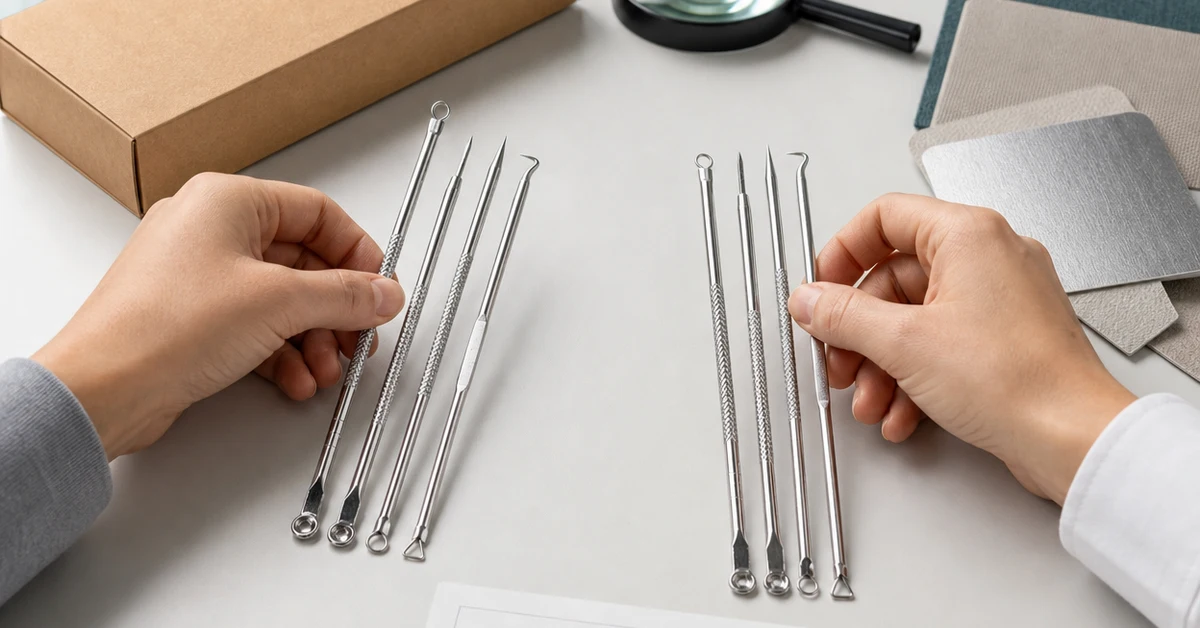
A sample is not merely a photograph for internal approval. It is a physical checkpoint between the brief and repeatable production. For a facial extractor, the buyer can review the tool identity, working-end geometry, grip, finish, assembly, protective treatment and pack fit. Record what the sample is meant to prove. If it is only an appearance sample, do not treat it as final evidence for every production characteristic.
Use a staged approval sequence. Review the unbranded or standard platform when geometry is still open. Review the material and finish on the intended component. Review the decorated product if custom logo beauty tools are part of the brief. Review the complete retail pack. Finally, approve a packed master with the current drawing, artwork, product copy and inspection plan attached.
When the buyer requests a change, record the reason rather than only the new preference. A narrower grip may serve a user scenario. A different finish may improve shelf consistency. A new insert may protect a sharp end. The reason helps the manufacturer evaluate side effects and helps the buyer decide whether a later alternative still meets the original objective.
| Approval stage | Buyer reviews | Output to retain |
|---|---|---|
| Brief alignment | User task, model identity and open questions | Dated brief and question log |
| Feasibility | Process route, risks, alternatives and assumptions | Supplier response and marked drawing |
| Development sample | Geometry, function and hand feel | Sample code and review notes |
| Brand proof | Logo method, position, finish and pack visibility | Artwork proof and decorated sample |
| Packed master | Unit of sale, insert, protection and carton logic | Signed or otherwise traceable master record |
| Production release | Current files, deviations and inspection plan | Release package with revision and date |
9. Control custom logo beauty tools across surfaces and packaging
Branding is a system, not a single artwork upload. A logo on a slim metal tool may need a different method and size from a mark on a carton or pouch. The buyer should define the intended mark, placement, orientation, clear space, surface, finish, proof stage and acceptable variation for every SKU. If a mark sits near a working end or grip, check that it does not change handling or become hidden in the pack.
The phrase custom logo beauty tools should therefore be linked to a placement sheet. Keep the master logo file, model drawing, decoration proof, package artwork and approval note together. When an ODM adaptation changes the available flat area, update the placement sheet rather than letting the old artwork silently travel into the new version.
| Brand control | Question | Evidence |
|---|---|---|
| Surface | Where will the mark sit and what finish surrounds it? | Decorated sample on the intended surface |
| Method | Which process provides the required contrast or relief? | Method proof and supplier limitation note |
| Placement | Could the mark touch a working edge, grip or package contact area? | Annotated drawing and packed view |
| Revision | Which artwork and product files are current? | Revision number and approval date |
| Reorder | How will the same result be requested next time? | Master sample, inspection reference and file archive |
10. Inspect the product and the supply file at the same time
Quality control becomes useful when it connects the physical item to the correct project record. A production-process inspection may look at the applicable operation; a finished-goods shipment inspection may look at the complete product and pack. For the buyer, the question is whether the report identifies the model, revision, quantity, sample method, result, deviation and disposition. A photograph without identity is weak evidence.
Use a model-specific inspection plan. For the facial extractor, that might include component count, working-end shape, surface condition, grip condition, assembly, logo location, protective pack and carton marks. The exact acceptance limits must be agreed for the product. Do not copy a nail clipper edge check or a tweezer tip check into a facial extractor plan simply because all are beauty tools.
OLIMOR's supplied information lists torque and hardness equipment. Ask whether either test applies to the selected model, what method is used, what unit is recorded and who reviews the result. If the test is not applicable, say so in the project file. This is more credible than adding a generic test label to every product page.
11. Compare MOQ, lead time and cost without inventing numbers
A buyer needs a commercial answer, but a universal MOQ or fixed delivery promise is not reliable before the configuration is known. Existing platforms, new geometry, colour, surface finish, logo method, injection components, printed packaging and carton requirements can all change the commercial scope. Ask OLIMOR to confirm MOQ and schedule for the exact model and customization level.
Request an itemized quotation. Separate one-time development or tooling charges from recurring unit cost. Identify decoration, packaging, inspection, freight and trade-term assumptions. Ask what quantity controls the quoted price and which element controls the MOQ. If the supplier offers an alternative, ask which requirement changes and how that affects the sample and approval record.
| Quotation line | Buyer question | Why it matters |
|---|---|---|
| Product unit | Which model, material and finish are included? | Stops a standard item being compared with a custom configuration |
| Development | Are drawing, tooling and sample charges one-time? | Separates launch investment from repeat cost |
| Decoration | Which logo method and proof are included? | Prevents mark changes after approval |
| Packaging | What is the unit of sale and carton assumption? | Connects the quote to the retail or wholesale channel |
| Inspection | Which checks and documents are included? | Makes quality evidence comparable |
| Shipping | Which trade term, destination and carton data apply? | Prevents a low unit price hiding logistics scope |
| Validity | How long is the quotation valid? | Allows material and freight changes to be managed |
12. Protect IP, tooling and revision history in practical terms
Intellectual-property protection begins before a contract is signed. Mark drawings and artwork with an owner, revision and date. Share only the files needed for the current stage. Keep a list of samples, tooling decisions, package files and open questions. Ask which development output is retained by each party and how obsolete files are controlled.
Do not assume that the word ODM answers ownership. A supplier platform may pre-exist the buyer's project, while the buyer's mark, packaging and market positioning may be new. A changed handle or working head can create a different question. Put the commercial arrangement in writing and use qualified legal advice for confidentiality, IP, tooling and market-specific contract terms.
A change log should show what changed, who requested it, why it changed, which file is current, whether a new sample is required and whether the quotation or schedule must be reconfirmed. This protects both the buyer and the manufacturer. It also makes a repeat order much easier because the commercial team can see which version was actually released.
13. Build the export and destination-market handoff
OLIMOR's company-provided material describes export markets including Japan, the United States, France, Germany, Australia, Brazil, Argentina, India, Southeast Asia and the Middle East. This supports a conversation about export coordination, not a blanket compliance conclusion for every market or product. The buyer remains responsible for identifying the destination requirements and checking the selected product and claims with a qualified adviser.
For the handoff, align product name, model code, materials description, package copy, country-of-origin information, importer details, barcode, carton marks and required documents. If the buyer needs a certificate or test report, name the exact document, issuing entity, scope and validity. The knowledge base currently treats ISO and BSCI as client-provided facts but notes that standard, entity, number and validity still need project-level verification.
An importer may also need to understand its own role in product safety and traceability. The European Commission explains that businesses placing products on the EU market have product-safety obligations, while the U.S. CPSC provides importer resources for consumer-product compliance. These external sources are guidance, not proof that a specific OLIMOR product is certified for a market.
14. Create an inquiry that produces an actionable answer
A strong first inquiry is concise but complete. Start with the company, market, channel, product task and target timing. Add the model URL, reference image or sample, preferred materials and finish, branding, packaging, quantity range and required documents. End with the questions that turn a catalogue conversation into a project response: feasible route, sample scope, MOQ, schedule, inspection evidence, IP terms and quotation assumptions.
- Product URL or temporary SKU code
- User task, target market and sales channel
- Reference sample, drawing or annotated image
- Fixed, preferred and open requirements
- Logo artwork and packaging direction
- First-order and repeat quantity ranges
- Required inspection or destination documents
- Requested sample, tooling, MOQ and milestone details
- Contact owner for technical and commercial approval
When the inquiry includes a product image, use the real OLIMOR page as the visual reference and state what still needs confirmation. That honesty improves the odds of a useful reply. It also helps the supplier decide whether the project belongs in an ODM, OEM or private-label workflow. A wholesale beauty tools supplier may be the right route for a standard assortment, but a new working end needs a development conversation.
15. Frequently asked questions
What is an ODM beauty tools manufacturer?
It is a manufacturing partner that can contribute product development input in addition to producing the selected tool. In practice, the buyer should define the user's task and commercial requirements, while the supplier explains feasible product routes, samples, process steps, quality checks, packaging and quotation assumptions.
Can OLIMOR support both ODM and OEM?
OLIMOR's company-provided information states that it supports OEM and ODM beauty-tool projects, including development from drawings, physical samples, appearance concepts and structural requirements. The selected model, material, MOQ, schedule and customization scope still need confirmation in an inquiry.
What is the difference between ODM and private label beauty tools?
ODM usually involves more supplier-side product development input. Private label often begins with an established product and changes the brand, finish, set or packaging. The quotation should identify whether geometry, tooling or only decoration is changing.
How much is MOQ for an ODM facial tool?
There is no responsible universal number. MOQ depends on the selected model, finish, decoration, tooling, packaging and order configuration. Request a model-specific MOQ with the quotation.
How long does an ODM project take?
Sampling and production schedules depend on development scope and order details. Ask for milestones from brief, feasibility, sample and approval through production, inspection and shipment, and ask how buyer revisions affect the dates.
What material is the OLIMOR facial extractor made from?
The public product image is a visual reference. The model-specific material grade and documentation should be confirmed with OLIMOR before publication, quotation approval or market claims.
What evidence should a buyer request?
Request the current drawing or specification, sample code, process route, inspection plan, approval record, packaging proof, quotation assumptions and any destination-specific documents that apply to the selected model.
Can I request custom logo beauty tools?
Yes, branding can be discussed as part of the project brief. Define the artwork revision, surface, method, location, finish, proof and package contact. Ask the supplier to confirm feasibility for the selected model.
Is a generated scene image factory evidence?
No. The two wide images in this article are editorial visualizations created to explain a brief and a sample review. They should not be used as factory, test, customer-case or certification evidence.
How do I start an inquiry?
Send the product URL, user task, market, sales channel, quantity range, reference files, branding and packaging idea to the OLIMOR contact page. Ask for feasibility, sample scope, MOQ, schedule, QC evidence and an itemized quote.
16. Sources and trust notes
- OLIMOR BEAUTY About Us and company-provided knowledge-base facts: OEM/ODM support, listed processes, inspection and export context.
- OLIMOR facial extractor product page: current public product reference image and page context.
- ISO 9001 official overview: quality-management context; not a product certificate.
- European Commission product safety guidance: destination-market responsibility context.
- U.S. CPSC importer resources: importer and consumer-product compliance context.
17. A practical handoff worksheet for the launch team
The purchasing manager, designer, quality reviewer and logistics owner should see the same release summary. Put the product URL, temporary SKU, approved sample code, current drawing, artwork revision, package version, quantity assumption and open commercial questions on one page. This does not replace the detailed files. It gives every internal reviewer a shared index and makes it easier to spot a mismatch before a purchase order is issued.
Add a decision column beside every open item. Use words such as buyer decision, supplier proposal, legal review, market review or not applicable. A blank cell invites a late assumption. A named next action makes the project move. For example, the material grade may be a supplier confirmation, the product claim may require regulatory review and the carton quantity may require a logistics calculation.
Keep the handoff factual. Do not write that a sample passed a test if the report is not attached. Do not write that a finish is corrosion resistant unless the applicable evidence and wording have been reviewed. Do not use a generated editorial scene as a factory record. A clean evidence boundary strengthens the inquiry because the manufacturer can see exactly which facts still need to be supplied.
Before release, compare the quotation with the latest brief line by line. Confirm that the model URL, quantity, package and logo method refer to the same version. Ask the supplier to identify every assumption that affects MOQ or timing. If a line is excluded, decide whether it is removed from the scope or added as a priced option. This prevents a commercial gap from appearing after sample approval.
After the first order, capture the questions that came up during production and packing. They become useful inputs for the repeat order and for the next SKU. A mature ODM program learns from small corrections: a pocket that needs more clearance, a logo that needs a different viewing direction, an insert that should be thicker, or a carton mark that needs a new position.
The result is a repeatable decision trail. A buyer can explain why the selected route was chosen, what the supplier promised, what the sample proved, what remains market-specific and which file controls the next run. That trail is more valuable than a generic claim that a supplier offers one-stop service, because it can be inspected by a new team member months later.
Use the worksheet again when a buyer asks for a second finish or a second package. The purpose is not to slow down a good idea. It is to show whether the change is cosmetic, structural, commercial or market-specific. A transparent change classification lets the manufacturer respond with an option, a new sample requirement or a reason to keep the approved configuration unchanged.
For a facial extractor, the project file can stay compact while still being precise: selected product URL, component list, working-end notes, grip and surface reference, logo placement, package sketch, quantity range, inspection questions and approval owner. That compact file is easier for a buyer to send with an inquiry and easier for a manufacturer to repeat when the brand returns for a reorder.
A purchasing team should also record the questions it deliberately did not answer. For example, the exact material grade may wait for supplier confirmation, while the brand colour can wait for a physical finish sample. Open questions are not weaknesses when they are named. They become risks only when a quote, sample or webpage presents them as settled facts.
When the project moves to packaging, keep the product and package reviews together. A protective tray can change the visible logo area. A smaller carton can change the tool orientation. A new insert can change the information hierarchy. Reviewing the packed unit protects the commercial promise and reduces the chance that a correct tool arrives in an unsuitable retail presentation.
The final buyer action is simple: send the current brief and ask OLIMOR to identify the suitable route, missing information, sample scope, model-specific MOQ, proposed schedule and quotation assumptions. The more clearly the inquiry separates facts from preferences, the easier it is for an ODM beauty tools manufacturer to return a useful answer.
Tag: