

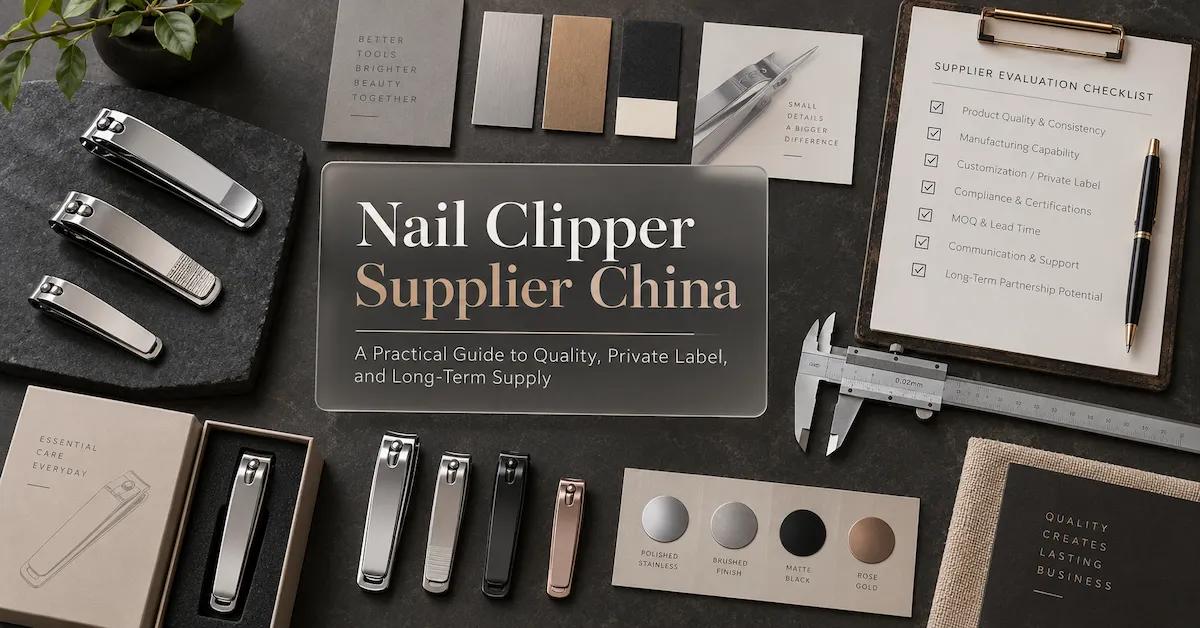
Finding a nail clipper supplier China buyer can depend on is not mainly a search problem. It is a qualification problem.
A buyer can find hundreds of product listings within minutes. The difficult part is determining which supplier can consistently reproduce the cutting performance, finish, packaging, branding, and quality level required after the first sample has been approved.
For importers, distributors, retail chains, e-commerce sellers, and private-label beauty brands, this distinction is critical.
A supplier may provide an attractive sample and a competitive quotation, yet still create problems during mass production if cutting-edge alignment, lever movement, polishing, assembly, logo placement, packaging protection, or revision control are not clearly managed.
The most reliable sourcing approach is therefore to evaluate a supplier as a complete production partner rather than as a price source.
Before placing an order, buyers should answer five questions:
- Can the supplier make the nail clipper specification you actually need?
- Can the supplier explain which product features control performance?
- Can those features be inspected consistently?
- Can the supplier reproduce an approved sample during mass production?
- Can the same result be repeated on future orders?
If the answer to those questions is unclear, a low quotation should not be treated as a sourcing advantage.
Buyers reviewing potential products can begin with the OLIMOR nail clipper collection and compare available structures, finishes, branding possibilities, and packaging requirements against their target market.
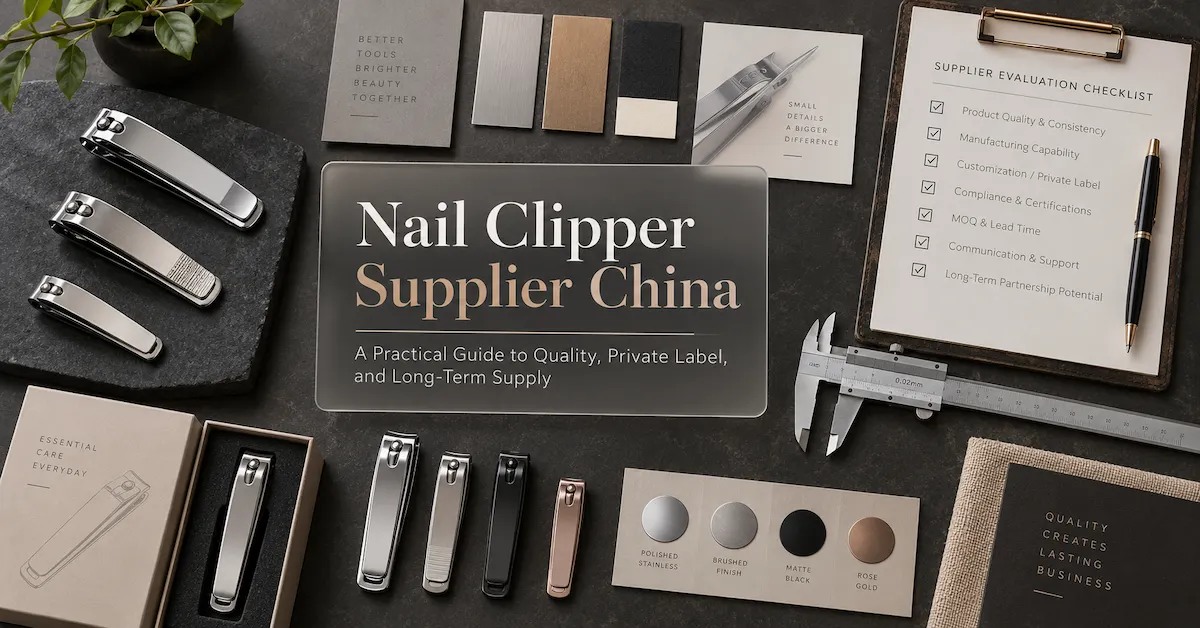
What Should You Expect From a Nail Clipper Supplier in China?
A professional nail clipper supplier should do more than send a catalog and quote a unit price.
The supplier should help convert your commercial idea into a production specification.
For example, a buyer may initially say:
We need a stainless steel nail clipper for our private-label beauty brand.
That description is not yet a production requirement.
A supplier still needs to understand:
- target product size;
- intended user;
- retail or professional positioning;
- cutting-head style;
- lever design;
- surface finish;
- product weight;
- branding;
- packaging;
- order quantity;
- target market;
- quality expectations;
- shipment destination.
The supplier's ability to ask the right questions is often one of the earliest indicators of technical and commercial maturity.
If the conversation remains limited to:
“Which color?”
“How many pieces?”
“Send logo.”
the project may still be underdefined.
A stronger supplier will identify the product features that can affect performance and repeatability before production begins.
Manufacturer, Supplier, or Trading Company: What Should Buyers Actually Care About?
Buyers frequently search for a “factory” because they assume direct manufacturing automatically guarantees lower prices and better quality.
The reality is more nuanced.
What matters most is control.
A B2B buyer should understand who controls:
- product development;
- sample preparation;
- critical manufacturing steps;
- purchased components;
- assembly;
- quality inspection;
- packaging;
- change management;
- corrective action;
- repeat-order records.
A company may coordinate multiple specialist processes and still offer strong control.
Another business may own equipment but have weak specification management or inconsistent inspection.
Instead of asking only:
“Are you a factory?”
ask more useful questions:
- Which processes are handled internally?
- Which are outsourced?
- Who inspects outsourced parts?
- Who approves first pieces?
- Who controls final assembly?
- Who performs finished-product inspection?
- How are changes documented?
- What happens if one production step fails inspection?
These questions reveal more about sourcing risk than a simple factory label.
OLIMOR's broader manufacturing positioning and product-development background can be reviewed on the About Us page.
Define the Nail Clipper Before You Compare Suppliers
The quality of your supplier comparison depends on the quality of your specification.
A common sourcing mistake is sending the same one-line inquiry to ten suppliers and assuming the returned prices are comparable.
They usually are not.
A professional RFQ should define the product in enough detail that suppliers are quoting roughly the same thing.
| Specification Area | Buyer Should Define or Confirm |
|---|---|
| Product type | Standard, compact, large, travel, set |
| Dimensions | Overall length, width, jaw area |
| Material | Confirmed model-specific material |
| Structure | Lever, pivot, body, additional functions |
| Cutting performance | Expected contact and clipping action |
| Surface | Polished, satin, matte, coated, colored |
| Logo | Method, size, location |
| Packaging | Bulk, card, box, pouch, gift pack, set |
| Quantity | Trial order and expected repeat volume |
| Market | Retail, online, distributor, salon, travel |
| QC priorities | Functional and cosmetic requirements |
| Shipment | Destination and packing expectations |
This specification prevents a common procurement error: selecting the cheapest quotation when the suppliers are actually offering different products.
Why Nail Clipper Cutting Performance Should Be Your First Technical Priority
Consumers see a nail clipper as a simple tool.
Manufacturers see a set of interacting metal parts.
Performance depends on how accurately those parts are formed, finished, assembled, and adjusted.
The most important area is the cutting interface.
Cutting-Edge Alignment
The upper and lower cutting edges need to meet correctly.
If alignment is poor, a clipper can:
- cut only part of the nail;
- require excessive force;
- pinch rather than cut cleanly;
- feel inconsistent across the edge;
- create poor reviews despite an attractive appearance.
Alignment problems may originate earlier in production from forming variation, assembly position, edge preparation, or component geometry.
For this reason, a serious nail clipper supplier China buyer should ask how alignment is evaluated rather than accepting “sharp blade” as the entire quality explanation.
Cutting Contact
A cutting edge may look sharp but still perform poorly if the two sides do not contact correctly.
Functional inspection needs to evaluate the completed mechanism.
Lever Action
The lever controls mechanical advantage.
A poor lever can make a technically sharp clipper feel weak or uncomfortable.
Buyers should compare:
- required pressure;
- movement;
- stability;
- surface grip;
- repeated operation.
Pivot and Assembly
The pivot must allow controlled movement without excessive looseness.
Common problems include:
- rattling;
- lateral movement;
- stiff opening;
- unstable blade contact;
- inconsistent closing.
A strong sample review therefore requires actual use, not just photography.
Material Matters, but “Stainless Steel” Is Not a Complete Specification
Stainless steel is widely used for nail clippers, but the phrase alone does not tell the buyer enough.
Two products described as stainless steel may differ in:
- specific material selection;
- thickness;
- hardness where relevant;
- component geometry;
- finishing;
- treatment;
- polishing;
- edge preparation.
Buyers should avoid assuming that every nail clipper within a supplier's catalog uses exactly the same material.
The correct question is:
What material and manufacturing specification applies to the exact model I am evaluating?
If a particular steel grade or performance requirement is important to your market, it should be confirmed in writing for the chosen SKU.
Do not allow an unverified marketing description to become part of your product specification.
What Manufacturing Capabilities Matter for Nail Clippers?
The exact route depends on the product. At company level, nail clipper manufacturing may involve several capabilities.
OLIMOR's beauty-tool production framework includes processes such as metal stamping and forming, cutting-edge treatment, grinding, polishing, deburring, assembly, inspection, and packaging support.
These capabilities become meaningful only when translated into product-level control.
Metal Stamping and Forming
The basic components need accurate geometry.
Small dimensional deviations can later affect:
- edge contact;
- lever movement;
- assembly;
- visual symmetry.
A supplier should be able to maintain stable forming rather than correcting every problem during final assembly.
Grinding and Edge Preparation
The cutting area requires controlled processing.
Buyers do not need to specify every machine parameter, but they should define the expected result.
That result can be approved through:
- sample;
- cutting test;
- alignment reference;
- functional criteria.
Deburring
Unintended burrs can affect comfort and product appearance.
Beauty and personal-care tools are handled closely, so rough exposed areas can quickly undermine perceived quality.
Polishing and Surface Finishing
Polishing influences the first impression of the product.
Common cosmetic concerns include:
- scratches;
- drag marks;
- uneven polish;
- stains;
- inconsistent reflectivity;
- visible edge defects.
For private-label products, surface quality also affects how the logo appears.
Assembly
Assembly brings all previous process tolerances together.
A well-formed body and sharp cutting edge can still become a poor clipper if the mechanism is assembled incorrectly.
Inspection
Inspection should cover both mechanical function and cosmetic appearance.
This is one of the clearest differences between a supplier that understands retail beauty tools and one that treats the product only as stamped metal.
How to Audit Nail Clipper Quality Control
The phrase “strict QC” is almost meaningless unless the supplier can explain what is checked.
For nail clippers, a useful control plan can include several stages.
Incoming Material and Component Checks
Components entering production should match the agreed requirements.
These may include:
- metal parts;
- pivot components;
- packaging;
- inserts;
- labels;
- accessory items.
Incoming checks are important because final inspection cannot fully correct the wrong component.
First-Piece Approval
At the beginning of production, early finished units should be reviewed before large-scale output continues.
First-piece approval is especially useful when:
- starting a new product;
- changing tooling;
- changing components;
- changing finishing;
- restarting after a long gap.
In-Process Inspection
Waiting until every piece has been produced creates unnecessary risk.
Critical features can be checked while production is still running.
Examples include:
- geometry;
- alignment;
- assembly;
- surface quality.
Finished-Product Inspection
Completed nail clippers should be evaluated against the approved standard.
A practical final inspection checklist may include:
| QC Point | Buyer Concern |
|---|---|
| Cutting-edge alignment | Correct contact |
| Cutting action | Clean and controlled clipping |
| Lever movement | Smooth and stable operation |
| Pivot | Correct movement without excessive play |
| Product geometry | Matches approved sample |
| Surface | Acceptable polish or finish |
| Exposed edges | No unwanted roughness |
| Logo | Correct location and appearance |
| Packaging | Correct product protection |
| SKU | Correct model, finish and pack |
Shipment Inspection
Before goods are released, verify:
- quantity;
- carton contents;
- packaging;
- SKU identities;
- shipment condition.
The goal is to prevent avoidable commercial errors from reaching the buyer.
Sample Approval: The Best Time to Prevent Future Problems
Sample approval is one of the highest-value stages in the entire sourcing process.
A sample should not be approved with a simple message:
“Looks good.”
Approval should cover three separate areas.
1. Functional Approval
Check:
- cutting performance;
- edge alignment;
- lever force;
- opening and closing;
- assembly;
- handling.
Use the product repeatedly.
A nail clipper is a functional mechanism, not a decorative object.
2. Cosmetic Approval
Inspect:
- polishing;
- scratches;
- color;
- coating if applicable;
- visible marks;
- logo;
- edges.
Reflective products should be examined under consistent lighting.
3. Packaging Approval
Review:
- fit;
- artwork;
- product position;
- movement inside the package;
- barcode;
- labels;
- inserts;
- instructions;
- protection.
The final approved sample should then become a master reference.
This is critical for repeat orders.
Why One Good Sample Is Not Enough
A supplier can usually produce one attractive sample.
The harder challenge is consistency.
If possible, ask for multiple pre-production or confirmation samples and compare:
- lever feel;
- cutting contact;
- surface;
- dimensions;
- logo;
- packaging.
If five samples already vary noticeably, mass production deserves closer attention.
Professional buyers are not trying to find one perfect clipper.
They are trying to find a production process capable of making thousands of similar clippers.
Private Label Nail Clippers: What Can Be Customized?
Private-label development allows a buyer to differentiate an established product without necessarily creating a new mechanism.
Possible customization areas include:
Logo
Potential methods may include:
- laser marking;
- engraving;
- printing;
- labels.
The appropriate method depends on material, geometry, finish, and durability requirements.
Approve the logo on the physical product rather than only on artwork.
Surface Finish
Possible visual directions can include polished, satin, matte, metallic, or colored finishes depending on the model.
Surface choice influences:
- brand positioning;
- photography;
- perceived value;
- logo visibility.
Packaging
Packaging often creates more visible differentiation than the tool itself.
Possible formats include:
- retail box;
- paper card;
- pouch;
- case;
- gift box;
- kit;
- e-commerce protection.
Set Combination
The clipper can be paired with related nail-care tools.
Buyers planning a collection can review additional OLIMOR beauty tool categories, including nail-care accessories, nippers, tweezers, beauty scissors, and manicure sets.
OEM, ODM, or Private Label?
These terms are often used interchangeably in sourcing discussions, but they represent different development levels.
Private Label
Suitable when an existing product platform already works.
Common changes:
- logo;
- finish;
- packaging;
- color where available;
- bundle configuration.
This is generally the simplest route for launching a branded nail clipper.
ODM
Suitable when the buyer wants an existing concept adjusted more substantially.
Changes can involve:
- appearance;
- structural details;
- components;
- size direction;
- finish;
- packaging system.
OEM
Suitable when the buyer already has:
- drawing;
- sample;
- dimensional requirements;
- specific structure;
- established design.
OEM projects usually require deeper engineering and manufacturability discussion.
The correct choice depends on how different your target product needs to be from existing designs.
MOQ Should Be Evaluated by Project
Buyers frequently search for “low MOQ nail clipper supplier China.”
That is understandable, particularly for new brands.
However, MOQ is not one universal number.
It can depend on:
- existing product availability;
- finishing;
- logo;
- packaging;
- custom color;
- special components;
- carton requirements;
- production planning.
A standard product with simple branding may have a different commercial threshold from a customized OEM structure.
The same principle applies to lead time.
Buyers can review the OLIMOR FAQ page for general purchasing information, but final MOQ and timing should be confirmed for the actual project.
What Determines Nail Clipper Pricing?
Comparing two prices without comparing specifications is dangerous.
Major cost drivers can include:
Product Size
Larger products may use more material and require different tooling or processing.
Material
Different specifications create different cost structures.
Structure
Additional components or functions can increase processing and assembly.
Finish
Premium visual finishes may require extra production control and cosmetic inspection.
Logo
Cost depends on:
- method;
- size;
- number of positions;
- setup.
Packaging
A bulk pack and a premium gift box cannot be evaluated as the same product.
Quantity
Volume affects purchasing, setup allocation, production efficiency, and packaging economics.
Inspection Requirements
Additional inspection or sorting can affect cost.
Tooling and Development
A custom OEM project may require engineering or tooling that a private-label project does not.
Use Total Sourcing Cost, Not Unit Price Alone
Consider two suppliers.
Supplier A: $0.08 cheaper per unit.
Supplier B: higher price but more consistent quality.
If Supplier A creates additional sorting, customer returns, surface defects, delayed shipments, or repacking, the apparent saving disappears quickly.
Total sourcing cost can include:
- unit price;
- freight;
- inspection;
- rework;
- replacement;
- customer returns;
- repacking;
- delayed launches;
- lost reviews;
- internal management time.
This is why experienced buyers evaluate commercial risk alongside price.
A Supplier Evaluation Scorecard
Create a weighted score before making the final decision.
| Category | Suggested Weight |
|---|---|
| Cutting performance | 20% |
| Quality-control process | 15% |
| Sample consistency | 10% |
| Manufacturing capability | 10% |
| Customization ability | 10% |
| Packaging support | 10% |
| Communication | 10% |
| Repeat-order control | 10% |
| Commercial terms | 5% |
Adjust the weights based on your business.
A premium private-label brand may give more weight to finish and packaging.
A distributor may prioritize replenishment and repeat-order stability.
An e-commerce seller may care strongly about cosmetic consistency and return risk.
Communication Quality Is a Manufacturing Risk Indicator
Supplier communication is sometimes treated as a customer-service issue.
It is actually part of quality control.
Ask yourself:
- Are specifications confirmed in writing?
- Are changes documented?
- Does the supplier identify contradictions?
- Do they answer technical questions clearly?
- Do they separate confirmed facts from assumptions?
- Do they update artwork and packaging revisions properly?
Poor communication before an order often becomes poor change control during production.
A supplier that says “no problem” to everything without asking questions may not be reducing risk.
It may simply be postponing the problem.
How to Check Repeat-Order Capability
Repeatability is one of the most important qualities of a long-term nail clipper supplier.
Ask:
- Is a master sample retained?
- Is the product specification saved?
- Is packaging artwork controlled by version?
- Is logo placement recorded?
- Are changes reported before production?
- Are key functional checks repeated?
- Are finish references retained?
A good second order should not depend on one employee remembering what happened on the first order.
The process should carry the information forward.
What to Ask During a Factory or Supplier Audit
Whether auditing remotely or in person, focus on evidence rather than presentation.
Useful questions include:
Product
- Which nail clipper models are produced regularly?
- Which characteristics most often cause quality variation?
- How is cutting alignment checked?
- How is lever movement evaluated?
Manufacturing
- Which processes are performed internally?
- Which steps are outsourced?
- How are outsourced components inspected?
- How are nonconforming parts controlled?
Quality
- What is checked during production?
- What is checked at final inspection?
- How are defects recorded?
- Who approves first pieces?
Customization
- Which finishes are available?
- Which branding processes are suitable?
- How is artwork controlled?
- How is custom packaging approved?
Reorders
- How are previous specifications retrieved?
- What happens when a process changes?
- Is the customer notified of material or component changes?
This creates a much clearer supplier picture than a factory video alone.
Common Red Flags When Choosing a Nail Clipper Supplier in China
Several patterns should trigger additional questions.
Red Flag 1: The Supplier Quotes Immediately Without Asking About Specification
Fast quotation is helpful, but a precise quotation requires product information.
Red Flag 2: Every Product Is Described as “High Quality”
Ask for measurable inspection points.
Red Flag 3: No Clear Sample Approval Process
Without a reference, disputes become subjective.
Red Flag 4: Material Descriptions Are Generic
Confirm the material for the selected SKU.
Red Flag 5: Supplier Cannot Explain Cutting Alignment
A nail clipper supplier should understand the feature that directly affects clipping performance.
Red Flag 6: Logo Method Is Selected Without Reviewing the Surface
Branding should suit the actual finish and geometry.
Red Flag 7: Packaging Is Treated as an Afterthought
Polished metal can be scratched if the package does not control movement.
Red Flag 8: Very Low MOQ Is Promised for Every Type of Customization
MOQ varies with process and packaging.
Red Flag 9: Certification Claims Are Vague
Ask:
- certificate holder;
- scope;
- validity;
- relevance to your product.
Red Flag 10: No Repeat-Order Reference
A supplier should be able to explain how future production is compared with the original approval.
How Retailers Should Choose a Nail Clipper Supplier China Partner
Retailers require more than product function.
The product must work on the shelf.
Priorities can include:
- consistent appearance;
- packaging dimensions;
- barcode placement;
- product visibility;
- finish;
- customer instructions;
- replenishment.
For many retailers, an established clipper design with strong private-label packaging can be more commercially sensible than an entirely new tool.
How E-Commerce Brands Should Evaluate Suppliers
E-commerce buyers face a different quality environment.
Close-up product photography exposes small finish variations.
Customer reviews expose functional inconsistencies.
Parcel delivery exposes weak packaging.
Important areas include:
- scratch resistance during shipping;
- visual uniformity;
- packaging fit;
- product movement;
- logo consistency;
- repeat batch matching.
A few cents saved at production can be insignificant compared with poor online ratings.
What Importers and Distributors Should Prioritize
Importers usually manage broader supply-chain concerns.
They may prioritize:
- stable capacity;
- multiple SKU availability;
- export coordination;
- repeat supply;
- specification control;
- carton consistency;
- supplier responsiveness.
For these buyers, broader product capability can create additional value.
Instead of managing separate suppliers for nail clippers, nippers, tweezers, scissors, and manicure sets, buyers may choose to evaluate whether several categories can be sourced within one coordinated program.
OLIMOR's complete product range includes multiple beauty and personal-care tool categories suitable for this type of sourcing discussion.
How to Build a Private-Label Nail Care Collection
A nail clipper can be the entry product for a larger line.
Related products may include:
- nail files;
- cuticle nippers;
- cuticle pushers;
- nail cleaners;
- tweezers;
- scissors;
- manicure sets.
The commercial advantage of a collection comes from consistency.
Try to coordinate:
- finish;
- branding;
- color;
- packaging design;
- retail positioning;
- inspection standards.
Five unrelated products with the same logo are not necessarily a coherent collection.
Start with the end customer's needs, then build the assortment.
What Information Should Be in Your RFQ?
A detailed RFQ makes it easier for the supplier to quote correctly.
Send:
Product Reference
Provide a photo, sample, sketch, drawing, or existing item.
Approximate Dimensions
State length and other critical dimensions if known.
Material Requirement
If confirmed, include it.
If not, ask for product-specific information.
Target Quantity
Provide realistic order volume.
Sales Channel
Retail, e-commerce, distributor, salon, gift, travel, or another market.
Destination Market
This helps identify market-specific packaging or compliance questions.
Finish
Attach references when appearance matters.
Logo
Provide vector artwork when possible.
Packaging
Send:
- example;
- dieline;
- dimensions;
- barcode requirement;
- pack style.
Quality Expectations
List the characteristics important to your customers.
Timeline
State:
- sample deadline;
- desired production schedule;
- required shipment timing.
A detailed RFQ allows the supplier to identify risks before they become production problems.
Questions Every Buyer Should Ask Before Placing an Order
Use these questions as a practical qualification checklist.
- What material is used for this exact model?
- Which production steps are most important for cutting performance?
- How is blade alignment checked?
- How is lever movement controlled?
- How are scratches and surface defects inspected?
- Which processes are performed internally?
- Which components are outsourced?
- How are outsourced components inspected?
- How are first pieces approved?
- What is included in final inspection?
- Which branding methods suit this model?
- What packaging protects the surface best?
- What is the MOQ for this exact configuration?
- What is the sample timeline?
- What is the production timeline after approval?
- What information is retained for repeat orders?
- How are specification changes communicated?
- Which supporting documents can be provided for the selected product?
The quality of the answers often tells you more than the catalog.
Why OLIMOR Can Be Evaluated as a Nail Clipper Supplier in China
OLIMOR focuses on beauty and personal-care tools, with product categories including nail clippers, nippers, tweezers, beauty scissors, eyelash curlers, eyebrow razors, manicure sets, nail files, nail-care tools, facial tools, foot files, and tongue scrapers.
According to its current company profile, OLIMOR traces its business development to 2011 and supports international B2B buyers across product selection, sampling, customization, packaging, quality inspection, and repeat-order programs.
For nail clipper projects, the most valuable discussion areas include:
- cutting-edge alignment;
- cutting action;
- lever movement;
- assembly;
- polishing and finish;
- logo;
- packaging;
- batch consistency.
Buyers can review the current nail clipper products, learn more about OLIMOR, or browse its broader beauty tools catalog.
The important point is that company-level capabilities should still be confirmed at the SKU level.
Do not assume that every model uses the same material, process, MOQ, finish, or production timeline.
How to Make Your First Supplier Conversation More Productive
Instead of sending:
Send nail clipper price.
send something closer to:
We are sourcing a private-label stainless steel nail clipper for an e-commerce nail-care brand. Our target order is 10,000 pieces. We need a polished silver finish, logo on the lever, individual retail packaging, and consistent cutting performance. Please recommend suitable models and advise sample requirements, material, branding method, packaging options, MOQ, and production timing.
That message gives the supplier enough context to make a useful recommendation.
If you have an existing sample, send photos and dimensions.
If you are changing suppliers, explain why.
Examples:
- cutting performance varies;
- too many surface scratches;
- packaging damage;
- inconsistent logo;
- delivery instability;
- limited customization.
A new supplier cannot solve a problem it does not know exists.
Frequently Asked Questions
How do I find a reliable nail clipper supplier in China?
Start by defining the exact product, then compare suppliers on sample performance, blade alignment, lever movement, material confirmation, finishing, QC, customization, packaging, communication, and repeat-order control. Avoid selecting a supplier based only on unit price.
Is a nail clipper manufacturer always better than a trading company?
Not automatically. Buyers should evaluate who actually controls production, inspection, components, packaging, specification changes, and repeat orders. Operational control is more important than a business label alone.
What quality problems are common in nail clippers?
Typical issues can include poor cutting-edge contact, inconsistent cutting action, excessive lever force, loose assembly, rough edges, scratches, polishing defects, inconsistent branding, and weak packaging protection.
What material should a nail clipper use?
Stainless steel is common, but the appropriate material should be confirmed for the selected model. Do not assume one grade applies to every product in a supplier's range.
Should I order samples before placing a bulk order?
Yes. For private-label, OEM, ODM, or large wholesale programs, sample approval is an important risk-control step. Evaluate function, appearance, branding, and packaging before production.
Can a nail clipper supplier add my logo?
Depending on the product, private-label branding may include laser marking, engraving, printing, or labels. The appropriate method depends on the material, finish, surface shape, and desired appearance.
What is the usual MOQ for a nail clipper supplier China project?
There is no universal MOQ. Quantity depends on the selected model, finish, branding, packaging, customization, components, and production planning. MOQ should be confirmed after the project is defined.
How long does nail clipper production take?
Lead time depends on sample development, approvals, logo, packaging, materials, quantity, inspection, and production scheduling. Buyers should request separate sample, production, and shipping timelines.
How can I control repeat-order quality?
Keep an approved master sample, final specification, artwork version, packaging reference, finish reference, and product-specific inspection criteria. Ask the supplier to notify you before changing materials, components, processes, or packaging.
What should I send when requesting a quotation?
Send the product reference, dimensions, target material if known, order quantity, destination market, sales channel, finish, logo, packaging requirement, quality priorities, and desired timeline. Buyers can submit project details through the OLIMOR contact page.
Conclusion
Choosing a nail clipper supplier China partner is ultimately about controlling product risk before that risk reaches your customer.
Price is important, but price alone cannot tell you whether the clipper will cut consistently, whether the lever will feel stable, whether polished surfaces will arrive without unacceptable scratches, whether packaging will protect the tool, or whether the second order will match the first.
Those outcomes depend on a much wider system.
The strongest supplier relationships normally begin with a clear product definition. The buyer explains the target market, user, size, material requirement, finish, branding, packaging, order quantity, and quality priorities. The supplier then converts those commercial requirements into a workable specification and sample.
The sample should be evaluated functionally, cosmetically, and as a packaged product.
After approval, the same reference should guide first-piece inspection, in-process checks, finished-product inspection, and future repeat orders.
That sequence creates something much more valuable than a cheap first purchase: repeatable supply.
For retailers, this means more consistent products on the shelf.
For e-commerce brands, it means fewer negative reviews and returns.
For distributors, it means more dependable replenishment.
For private-label brands, it means a product that continues to represent the brand correctly after the first launch.
When comparing suppliers, therefore, focus on the questions that reveal real control:
How is blade alignment checked?
How is cutting performance evaluated?
How are lever movement and assembly controlled?
How are finishes inspected?
How is a logo approved?
How is packaging tested?
What reference is retained for repeat orders?
What happens if a material, component, or process changes?
A supplier that can answer those questions clearly is much easier to evaluate than one that simply offers a low price and promises “good quality.”
If you are currently sourcing a new nail clipper, replacing an inconsistent supplier, developing private-label packaging, or building a broader nail-care range, start with the product requirement rather than a request for the lowest price.
Review available OLIMOR nail clipper models, compare related beauty and nail-care products, and send your target product, quantity, branding, packaging, and sample requirements through the contact page for a project-specific evaluation.
Tag: