

Why manicure tools for nail salons deserve more attention than they usually get
When buyers talk about manicure tools for nail salons, the conversation often drifts straight to price or appearance. That is a mistake. In practice, these tools shape the client’s first impression, the technician’s speed, and the salon’s ability to keep workstations orderly and sanitary. A cuticle nipper that closes cleanly, a pusher that fits the nail plate without scraping, or a file that finishes smoothly can save time on every appointment. Multiply that across a busy day, and the difference is hard to ignore.
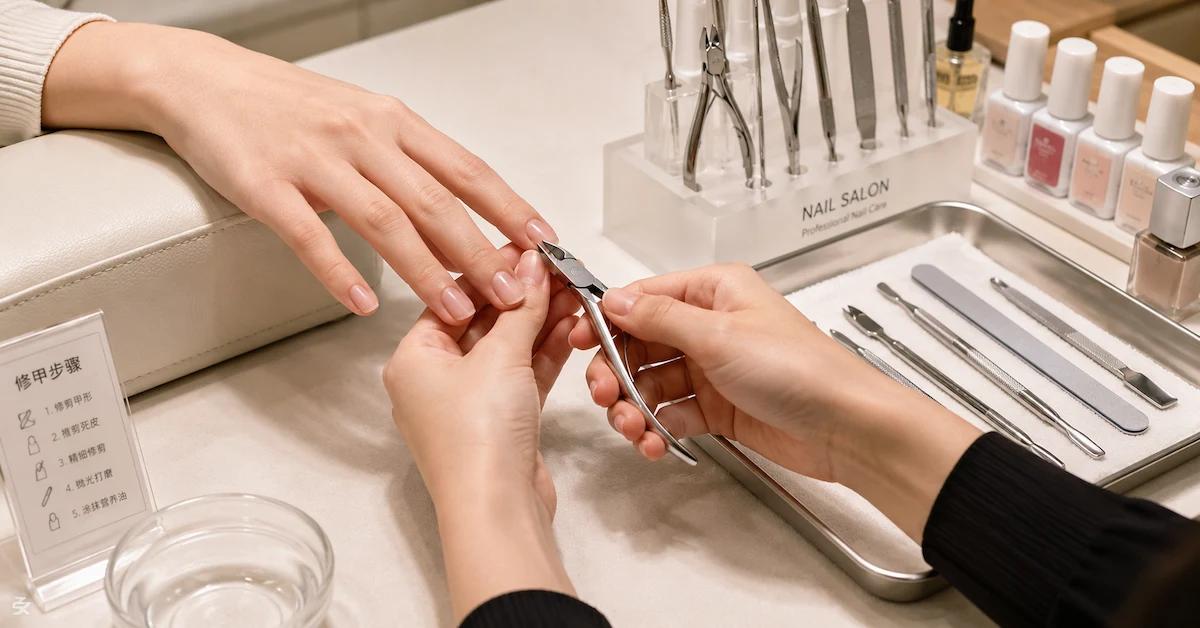
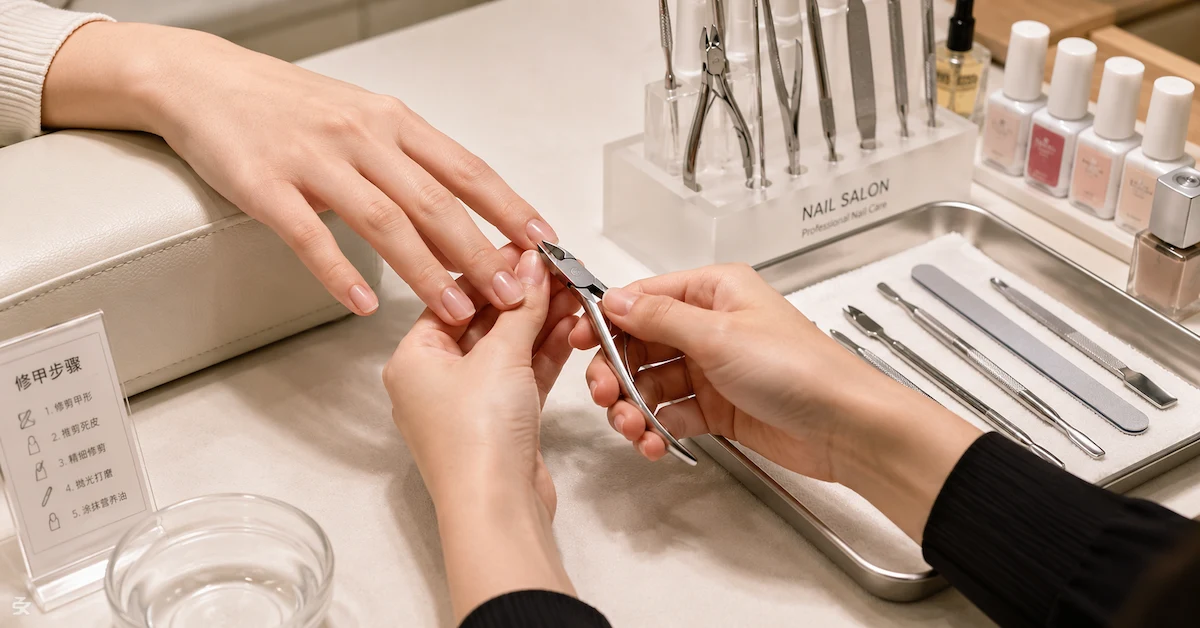
The visible product setup here is the kind many salons recognize immediately: a metal cuticle nipper or plier in use, several slender stainless-steel hand tools arranged on a tray, and an acrylic organizer stand holding extra instruments. It is a practical presentation, not a decorative one. That matters, because salon teams usually need tools that are easy to reach, easy to separate by task, and easy to keep in a condition that supports hygienic work.
What a salon really needs from a nail care tool set
A nail care tools set for professional use is not just a bundle of shiny implements. It should cover the core manicure workflow: trimming, cuticle work, edge cleaning, shaping, and surface preparation before polish or treatment. The exact mix varies by service menu, but the basic logic stays the same. The technician needs a tool that fits the task, does not fight the hand, and can be returned to the workstation without creating clutter.
From the product details provided, the visible components appear to include cuticle pushers or spatulas, tweezers, clippers or nippers, and a flat nail file or emery board. That is a sensible spread for a salon station. The individual tools are slim and elongated, which is typical for precision hand instruments. The tray and clear stand also suggest a workstation approach rather than a drawer-full-of-miscellany approach, which is usually better in real operations.
Core tasks these tools support
Trim length when needed, clean up cuticle edges carefully, push back surrounding skin without overworking the nail plate, remove small hangnails, and finish the edge so the next step in the service can proceed cleanly. In training environments, this is especially useful because students can see how each instrument belongs to a specific part of the process instead of using one tool for everything.
Why stainless steel is the default choice in salon instruments
The tools shown appear to be metal, likely stainless steel, with a polished or brushed silver finish. That is no surprise. In salon environments, stainless steel is widely used because it offers a balance of durability, precision, and cleanability. A manicure instrument needs a firm working tip and a body that resists bending under normal use. Soft or poorly finished metal creates problems quickly: dull edges, inconsistent action, and a short service life.
There is also a manufacturing angle here. Professional salon tools are usually associated with precision metal tool manufacturing, where cut-and-form, forged, or stamped components are then finished and polished. The exact process for these items is not confirmed, but the general principle is straightforward: the working end must be accurate, and the surface must be refined enough to feel controlled in the hand. Rough edges or sloppy geometry are more than cosmetic defects; they make the tool harder to use and harder to trust.
One practical caution: “stainless steel” is not a magic phrase. Buyers should still ask about the tool’s intended cleaning method, any maintenance limits, and whether the finish is designed for repeated professional use. Those details matter more than a glossy product photo.
Hygiene is not a side issue
Salons that handle multiple clients in a day need sanitizable manicure tools as part of a disciplined workflow. Reusable metal tools can be a strong fit here because they are easier to clean than many disposable alternatives, but only if the salon follows a consistent process. Cleaning, disinfection, drying, and storage should be treated as a system, not as isolated tasks done when someone remembers.
The acrylic organizer stand shown in the product information is a small detail, but a useful one. Tools that live in a dedicated stand are easier to separate from used items, easier to count, and less likely to end up mixed with products that should have been cleaned first. That kind of workstation organization can sound minor from afar. In a real salon, it helps prevent avoidable confusion.
Still, a buyer should not assume that a metal tool is automatically compatible with every sterilization method or chemical routine. Exact compatibility was not supplied, so it should be confirmed before purchasing in volume. That is especially true for salons with strict internal procedures or training programs that need consistency across multiple stations.
How to choose tools that will actually work in service
When comparing manicure tools for nail salons, start with the service menu instead of the catalog photo. A nail bar focused on quick maintenance may need a tighter, simpler assortment than a spa offering detailed cuticle care and more elaborate prep work. Training centers, meanwhile, often need more redundancy so students can practice the same motion with the same instrument shape over and over.
Look closely at the working tip
The tip matters more than the handle finish. For a pusher or spatula, the edge should feel controlled rather than sharp in the wrong way. For a nipper, the closure should look precise and the jaws should align cleanly. For clippers, the action should feel predictable. None of that can be confirmed from a photo alone, but those are the points a buyer should inspect in samples or ask a supplier to explain.
Pay attention to grip, balance, and reach
Salon technicians spend long periods holding small tools. A comfortable tool is not necessarily the heaviest or the thinnest; it is the one that stays stable in the hand during real work. Tool balance affects control, and control affects both speed and client comfort. This is one reason experienced buyers often ask for samples before placing larger orders.
Think about the workstation, not just the tool
A nail care tools set that comes with a tray or display stand can improve workflow. Tools are easier to see, faster to reset between clients, and less likely to be misplaced. For a salon with several technicians, that organization can also support standardization. If every station is arranged similarly, new staff members learn the layout faster.
Common mistakes buyers make when sourcing salon tools
One common mistake is buying for appearance alone. A polished metal finish looks professional, but finish is not the same as function. Another is overbuying tools that duplicate one another but leave gaps in the actual service flow. A third is ignoring maintainability. If a tool is awkward to clean, awkward to store, or unclear in its intended use, it becomes a problem later.
There is also a habit of assuming all reusable tools are interchangeable. They are not. A salon that does heavy cuticle work may need a different emphasis than one focused on quick polish changes. Training programs may prefer tools with simpler geometry so learners can build technique first. Buyers who match the tool set to the service model usually end up happier with the purchase.
What to ask a supplier before ordering
If you are evaluating suppliers for manicure tools for nail salons, ask about the exact tool mix, the visible metal finish, the intended cleaning method, and whether replacement pieces are available. If the product is presented as a multi-tool salon kit, ask what is included and what is only shown for display. The provided information does not confirm exact tool count, steel grade, dimensions, or origin, so those details should be requested directly rather than assumed.
It is also fair to ask how the tools are manufactured, even if the answer is broad rather than technical. Many buyers do not need a factory lecture, but they do need confidence that the pieces are made for repeated professional handling rather than short-term retail display. A supplier who can discuss finish quality, edge consistency, and packaging for workstation use is usually more useful than one who only talks about images.
FAQ: practical questions salon buyers often ask
Are metal manicure tools better than disposable alternatives?
Not universally. Reusable metal tools are often the better choice for professional stations because they support precision and can be maintained over time. But they require a disciplined cleaning and storage routine.
Do I need a full set for every station?
That depends on your service volume and workflow. Busy salons often prefer a consistent station setup. Smaller teams may keep a core set and rotate tools more carefully. The right answer is operational, not theoretical.
Should I prioritize the stand or the tools themselves?
The tools come first. The stand is useful for organization, but it should support the work rather than distract from it. A tidy station cannot compensate for awkward cutters or poorly shaped pushers.
What a good next step looks like
If you are sourcing manicure tools for nail salons, start with samples or a clear specification sheet and compare the items against your actual service workflow. Check whether the set covers trimming, cuticle work, shaping, and prep. Confirm whether the metal finish, cleaning method, and workstation display match your salon routine. Then decide whether you need a compact station kit, a broader training-oriented assortment, or a replenishment program for existing tools.
For buyers, the real goal is not simply to purchase a shiny sanitizable manicure tools package. It is to put dependable instruments on the table so technicians can work faster, cleaner, and with fewer interruptions. That is the difference between a tool purchase and a usable salon system.
Tag:
Related articles
- Manicure & Nail Tools
- OEM & Private Label
Gift Business Manicure Kit Supplier Guide: Custom Nail Care Sets for Brands and Retailers
- Manicure & Nail Tools
- OEM & Private Label
OEM Nail Clipper Manufacturer: Complete Guide to Custom Nail Care Solutions
- Manicure & Nail Tools
- OEM & Private Label