

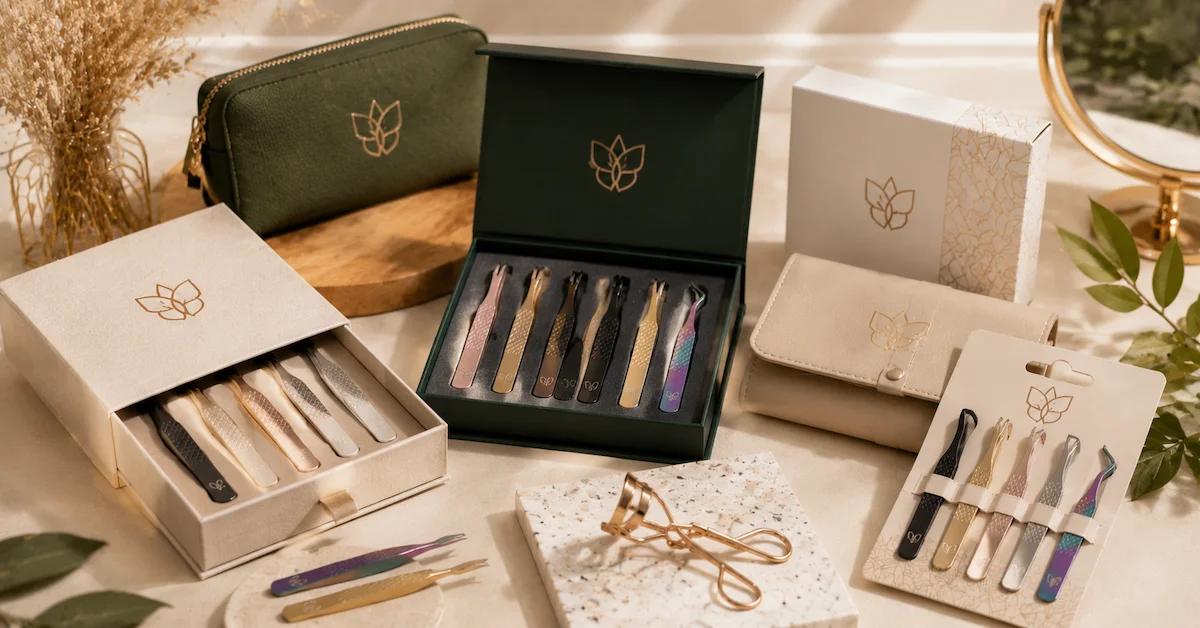
For brands building retail kits, salon giveaways, or private-label grooming lines, logo printed beauty tools do more work than a plain accessory ever will. A pair of tweezers or a compact lash tool already solves a practical problem; once it carries a logo and arrives in a branded box, it also becomes a small piece of shelf presence, repeat exposure, and perceived value. That matters because beauty buyers rarely choose these items on utility alone. They are comparing presentation, finish, portability, and whether the set feels like something a customer would keep on a vanity rather than toss in a drawer.
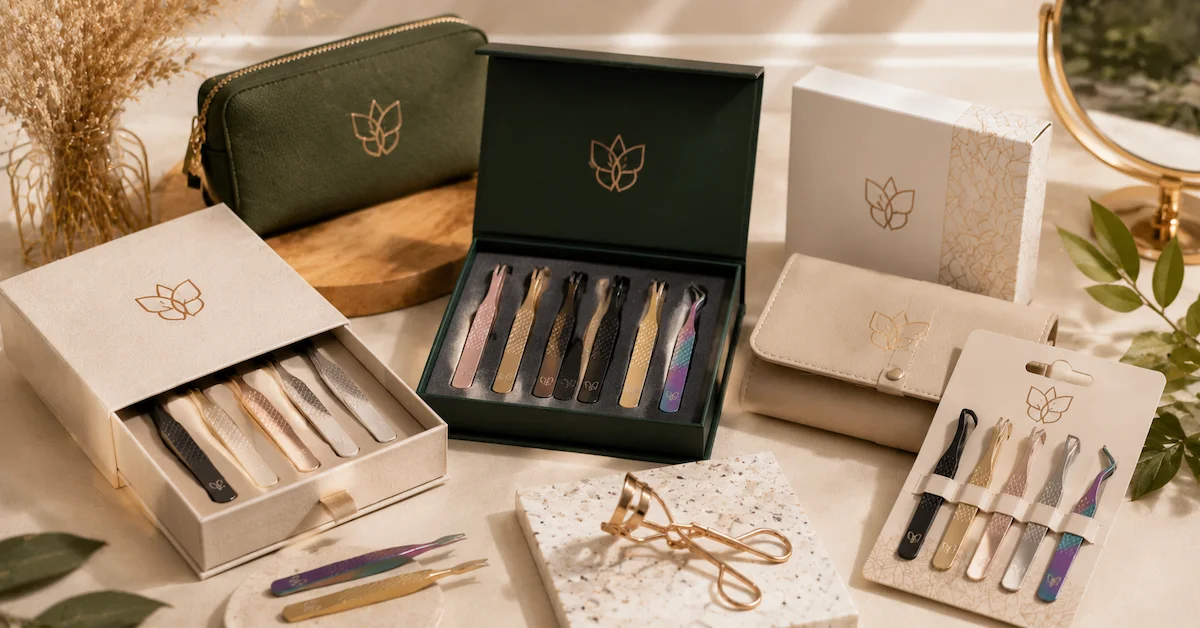
The sample product direction here is familiar to anyone sourcing promotional grooming items: metal precision tools, likely tweezers in several tip styles, arranged as sets of four to six pieces, with rigid paperboard gift boxes, insert trays, and small cases for storage. Some pieces show matte black, gold, rose gold, silver, green, or iridescent-looking finishes. That mix is not just decorative. It gives a buyer room to build a giftable assortment, a private-label set, or a branded retail package without having to redesign the whole category from scratch.
Why branding matters on small beauty tools
Beauty tools live in a crowded part of the shelf. A consumer may not spend much time comparing one tweezer to another, but they will notice if the set looks coherent, premium, and easy to recognize. That is where branded beauty accessories earn their keep. A logo on the box, and sometimes on the tool itself, helps the item feel like part of a line rather than a loose commodity.
For sourcing teams, the practical benefit is simpler than the marketing story. Branded presentation can support retail pricing, reduce the sense of generic sourcing, and make a set easier to place in gift bundles, e-commerce listings, or salon counters. If you are working with personalized beauty tools, the branding decision is not an afterthought. It affects packaging construction, finish choice, and even how the tools are stored in transit.
What is usually in a branded tool set?
Based on the product type described, the assortment appears to center on precision grooming tools, most likely tweezers with different tip styles for brow shaping, lash handling, or general cosmetic use. Some sets may include multiple profiles so a buyer can choose between fine-point precision and broader gripping surfaces. An eyelash curler is visible in the foreground, although it is not clear whether it belongs to the same SKU. That kind of ambiguity is common in product photography, so buyers should confirm exactly what is included before approving artwork or inserts.
Packaging is doing real work here as well. Rigid paperboard gift boxes with foam or molded inserts help keep multiple tools aligned and visually tidy. A zippered pouch or fold-over wallet-style case makes the set easier to travel with and gives the brand another surface for logo placement. In other words, the packaging is not just protection; it is part of the product.
Materials, finishes, and what they signal to the buyer
The visible tools appear to be metal, most likely stainless steel or a similar alloy used for precision grooming. That is a common choice because it supports thin tool geometry, repeatable shaping, and a clean look on retail packaging. The finish variations matter almost as much as the base material. Matte black reads modern. Gold and rose gold push the set toward giftable or fashion-led positioning. Silver feels more clinical and classic. Green or iridescent finishes can make the line stand out online, especially in thumbnail images where plain metal can disappear.
Still, buyers should be careful not to overread appearance. A colored or coated finish does not automatically mean better durability. If a line will ship through e-commerce channels, sit in display trays, or live in makeup bags, ask how the finish handles abrasion and repeated handling. A pretty surface that scuffs in the first week is expensive in a different way.
Common logo application methods to ask about
On sets like these, logo printing may happen on the outer box, the case, or occasionally on the tool itself. The exact method is not always obvious from a photo. It could be foil stamping, screen printing, embossing, or another branding method suited to cosmetic packaging. For the tools, the logo might be printed, laser-marked, or finished in a contrasting treatment, but you should not assume that from appearance alone.
When requesting samples or quotations, ask a supplier to separate the decoration options by surface: rigid box, insert card, pouch, and metal tool body. That is where many projects get delayed. A mark that looks sharp on paperboard may not hold up well on a curved metal handle, and a design that is elegant on the case may be too small to read on the actual tool. The best logo printed beauty tools usually keep branding visible without fighting the shape of the product.
How to choose the right assortment for your market
Start with use case, not color
A salon promotional kit, an influencer mailer, and a retail gift set do not need the same assortment. If the goal is everyday brow maintenance, a focused tweezer selection may be enough. If the goal is gifting, presentation matters more, and a broader combination of tool styles and finishes may be worth the added complexity.
Check the tool geometry
Even in a branding-led purchase, the tip shape and tension of the tool still matter. Precision grooming tools should align cleanly and feel consistent in hand. If the jaws do not meet properly, the logo and packaging will not save the customer experience. That is a small detail on paper, but it is the one buyers remember after opening the box.
Match the case to the channel
A rigid box works well for retail or gifting. A zippered pouch is more travel-friendly. A fold-over wallet-style case can sit between those two, giving a neat branded presentation without adding too much bulk. For e-commerce, the right case may reduce movement inside the carton and help protect coated finishes during shipping.
What buyers often miss during sourcing
One common mistake is treating packaging and product as separate purchases. They are not. If the insert does not fit the tools securely, a set that looks polished in a mockup can arrive with tools shifted out of place. Another issue is assuming all metal finishes will photograph the same. Black, gold, and iridescent surfaces can behave very differently under studio lighting and on phone screens.
A more subtle problem is overloading the set with too many variations. A large assortment can feel impressive, but if the buyer cannot tell why one tip style is included, the line becomes noisy. For branded beauty accessories, clarity usually beats quantity. A set that is easy to understand sells more cleanly than a crowded tray full of similar tools.
Practical buying advice for OEM and private label teams
Before approving artwork, ask for pre-production samples or at least decorated mockups of both the box and the tool. Confirm whether the logo is applied to the packaging only or also to the metal surface. If the package will be sold in a gift box, check the insert alignment and the closure feel. Small alignment issues are common in rigid packaging, especially when multiple tools need to sit flat and visible.
It is also worth confirming the finish tone under normal retail lighting. A rose gold that looks warm in a sample room can read much cooler under store LEDs. The same is true for textured grips or patterned surfaces; they may be attractive in hand, but they need to remain clean-looking in product photography. That is especially important for personalized beauty tools sold through marketplaces where the thumbnail has to do most of the selling.
FAQ
Are logo printed beauty tools only for gift sets?
No. They are also used for retail shelf programs, salon resale, influencer kits, and promotional bundles. Gift sets are only one use case.
Can the logo go on the tool itself?
Sometimes, yes, but it depends on the tool shape, the finish, and the decoration method. Many projects place the logo on the box or case for a cleaner result.
What should I confirm before ordering?
Confirm the exact tool count, tool style mix, packaging structure, logo application method, and whether the finish is meant to be decorative, protective, or both. If the product includes an eyelash curler or another curved tool, make sure it is actually part of the same SKU and not just part of the display.
What to do next
If you are planning a line of logo printed beauty tools, start by deciding where the branding needs to live: on the box, the case, the tool, or all three. Then build the assortment around the actual use case. A sharp-looking set that matches the channel, protects the tools, and reads clearly on a shelf or screen will usually outperform a more complicated package that tries to do everything at once.
For buyers comparing options, the smartest next step is to request decorated samples that show both the metal finish and the printed packaging together. That is the fastest way to see whether the line feels like a real product, not just a branded concept.
Tag: