Why foot file sourcing is more complicated than it looks
When buyers search for foot files for spa suppliers, they are usually not just comparing shapes and finishes. They are trying to decide which tools will hold up in repeated pedicure work, feel comfortable in a technician’s hand, and give consistent results without becoming a complaint item after a few weeks on the shelf. That sounds simple until you start looking at the range of foot rasps, stainless steel foot file options, and double-sided foot file designs now circulating through the beauty supply market.
The market is broad for a reason. Foot care sits at the intersection of professional service and retail impulse purchase. A spa wants tools that look polished and work reliably. A wholesaler wants products that are easy to merchandise. A salon manager wants something technicians can use quickly without awkward hand strain. And if the same item is being sold for at-home use, the design has to make sense for non-professionals too. Buyers who understand those differences usually make better sourcing decisions.
What a good spa foot file set is expected to do
A foot file is a manual exfoliation tool, but in a professional setting it is also part of the service experience. It needs to remove rough skin on heels and along pressure points, then leave the surface smooth enough that the client feels a visible difference. A set with multiple file styles can be useful because not every foot callus responds the same way. Some skin is dry and flaky. Some is thick and hardened. Some areas need a more aggressive rasp first, followed by a finer finishing surface.
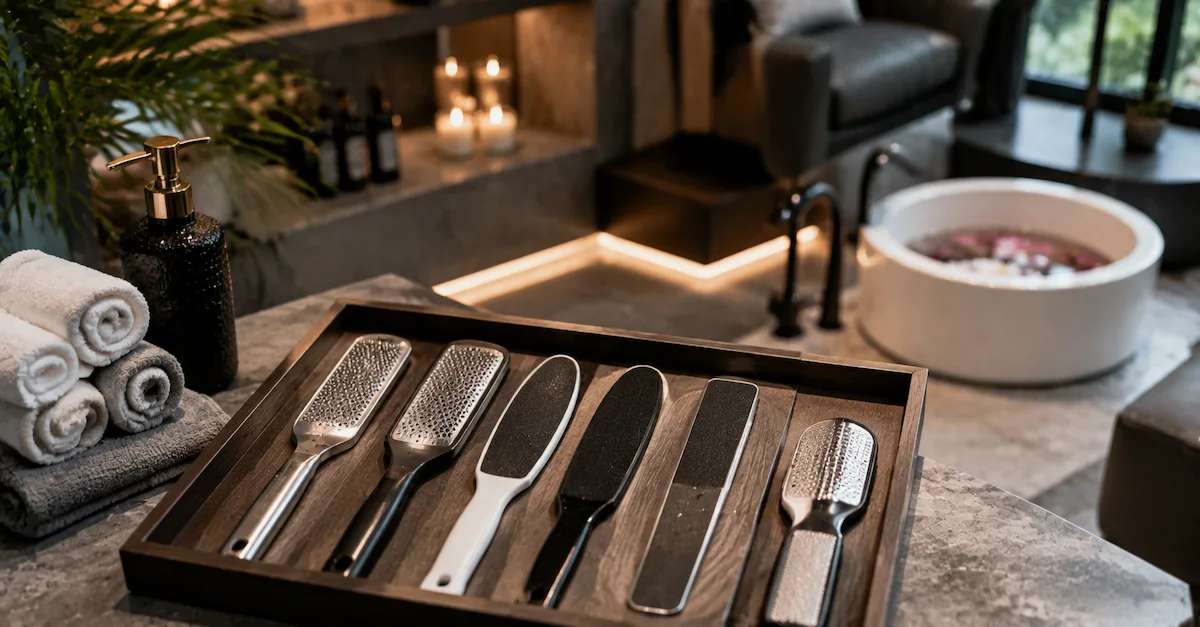
The product set described here appears to reflect that logic. Several handheld files are arranged together, with varied head shapes and surface types. Some look metal-based, with a brushed or polished finish. Others appear to use darker abrasive surfaces on a backing plate. That mix is exactly what many spa buyers want: one assortment that covers different stages of the pedicure process instead of a single-purpose tool.
Quick reference: what buyers usually compare
1. Surface type
A stainless steel foot file is often chosen for durability and for the firm feel it gives during use. It can project a more professional appearance as well. Abrasive-coated surfaces, on the other hand, may offer a different bite and are sometimes preferred for specific callus removal tasks or for a more forgiving finish.
2. Sidedness
A double-sided foot file is useful when a technician wants a coarser side and a finer side in the same tool. That saves time and reduces clutter at the work station. It is also appealing for retail kits because the value proposition is easy to explain.
3. Handle and grip
Slim, straight handles are common in this category. They look clean, take up little space, and are easy to store. But the handle shape should still be examined carefully. A pretty silhouette is not enough if the tool feels slippery or awkward during a full day of use.
4. Presentation
A set that is visually organized in a tray can help on a wholesale shelf or in a spa display. Buyers often underestimate how much presentation matters in beauty supply. In practice, a neat assortment can sell better than a technically similar loose mix.
Materials and construction: what is visible, and what is still uncertain
Based on the product information provided, this set appears to include a combination of metal-looking foot rasps and darker abrasive-surface files. Some pieces may use stainless steel or similar metal parts with a brushed or polished finish. Others may be coated abrasive tools on metal or plastic-backed bodies. That is a reasonable reading of the visible structure, but it would be a mistake to overstate it without a spec sheet.
For procurement teams, the important question is not just what the tool looks like, but how the construction supports repeated use. Stamped or formed metal parts can be efficient to manufacture and are often favored for their rigid feel. Coated abrasive surfaces can give a different texture and may be easier to tailor to a particular job. The trick is to match the build to the intended use case.
A spa doing high-volume pedicures may care more about consistency and comfort under repeated use than about a particularly aggressive rasp. A retailer selling to consumers may need a broader mix, including a tool that looks simple enough for someone to use at home without much explanation. Those are not the same buyer problem, even if the product category is identical.
Why multiple file shapes matter
The set described includes elongated rectangular heads, rounded-end oval and paddle-like shapes, and at least one compact rectangular file. That variety is not just visual. Shape affects control.
A longer file head can cover larger areas quickly, which is practical for heels or the outer edge of the foot. A narrower or smaller head can be helpful around tighter areas where precision matters. Paddle-like shapes often offer a balanced compromise, giving enough surface area without feeling bulky. Buyers who source for salons should think about technician workflow here, because small differences in geometry can become meaningful over a busy day.
There is also a practical caution: if a file looks unusually aggressive or overly rigid, it may be great in the hand of an experienced technician but too much for casual retail customers. That mismatch can lead to returns or awkward user feedback. Not every strong-performing tool is a strong retail product.
Selection criteria for spa suppliers and wholesalers
If you are sourcing foot files for spa suppliers, the right evaluation framework is usually a blend of performance, durability, and commercial presentation.
First, look at how the abrasive surfaces are laid out. A genuinely useful double-sided foot file should offer a clear difference between the two faces, not two textures that feel nearly identical. The point is to create a workable progression from rough removal to finishing.
Second, inspect the handle comfort. Even a slim handle should allow confident grip without forcing the hand into an awkward angle. This matters more than many first-time buyers think. A tool that saves a technician a few seconds per client can quietly become a favorite.
Third, consider whether the product reads as professional or disposable. That is a branding question as much as a mechanical one. A stainless steel foot file often signals repeat use and a more premium position, while some coated designs may lean toward lightweight convenience. Neither is inherently better, but they should match the channel.
Fourth, ask how the set will be sold. A spa back-bar kit, a wholesale beauty supply assortment, and a retail foot-care product each need different emphasis. One may prioritize function. Another may need a cleaner shelf appearance. The third may need simple instructions or a less intimidating look.
Common sourcing mistakes
One frequent mistake is buying on appearance alone. A polished tool in a tray can look convincing, but look is not the same as service life. Another mistake is assuming every foot file should be maximally abrasive. In practice, aggressive tools are not always the best choice. They can remove too much too quickly, which is not what many services or consumers actually want.
A second error is ignoring balance. A foot file that feels top-heavy or too narrow in the grip can be tiring during longer sessions. That is the kind of issue buyers sometimes discover only after the product has already moved through a few accounts.
A third mistake is treating professional and retail needs as interchangeable. The salon floor and the home bathroom are different environments. The first rewards efficiency and repeatability. The second rewards clarity and ease of use. Suppliers who try to serve both with a single undifferentiated item often end up serving neither well.
Practical buyer advice before placing an order
Ask for close images of the working surfaces, not just the front-facing product shot. Texture matters in this category, and small manufacturing differences can change performance. If possible, request samples from more than one style in the set. A mix that looks redundant in photos may feel very different in practice.
Also check whether the supplier can explain the intended use of each file type. A capable vendor should be able to tell you, at least in broad terms, how the assortment is meant to be used in pedicure service. If the response is vague, that is not necessarily a deal breaker, but it is a sign to slow down and inspect more carefully.
For private label or wholesale beauty supply programs, think about merchandising early. The same foot care tools can be positioned as salon-grade, spa-ready, or everyday foot-care essentials. The language, packaging, and assortment logic should align with the channel. Buyers often focus on the item and forget the shelf story; that is an expensive oversight.
What this product type is best suited for
The foot file set described here seems best suited for spa and salon supply environments, as well as broader pedicure kit and retail foot-care programs. The variety of shapes suggests flexibility. The presence of metal-looking pieces suggests a more professional tone. The mixed surface types suggest a practical assortment rather than a single rigid design.
That combination can work well for wholesalers who want to give customers several options in one presentation. It can also work for salons that prefer a small bench set rather than a drawer full of similar-looking tools. The key is to position the assortment honestly: this is a manual care tool set, not a miracle solution, and buyers will respect that more than exaggerated claims.
FAQ for sourcing teams
Is a stainless steel foot file always better?
Not always. It can be durable and visually premium, but the right choice depends on the intended user and the desired feel during use.
Why choose a double-sided foot file?
Because it gives the user two textures in one tool, which is practical for staged callus removal and finishing.
Should salons and retail buyers use the same product?
Sometimes, but not automatically. Salon buyers usually care more about repeated use and hand feel. Retail buyers care more about simplicity and clear presentation.
What should I confirm before ordering?
Confirm the surface type, the number of sides, general build quality, and whether the assortment matches your customer base. If material details are not fully verified, keep your description careful and avoid overpromising.
The next step for buyers
If you are sourcing foot files for spa suppliers, start by deciding whether you need a professional-use set, a retail-friendly kit, or a mixed assortment that can serve both channels. Then compare surface texture, handle comfort, and presentation as a package, not as separate features. In this category, the product that looks simplest on paper is often the one that causes the most trouble later.
A good supplier should be able to discuss the visible construction, the likely use cases, and the differences between the file styles without drifting into hype. That is usually the mark of a better sourcing conversation, and it tends to save time on the back end.