Quick Answer: A cosmetic tools manufacturer China partner should be evaluated by the finished range it can document, not by a broad catalog alone. Buyers should match each tool to a defined cosmetic task, then confirm component materials, functional checks, decoration, packaging, destination-market information, and reorder control. An OEM or ODM project can use existing platforms or new development, but the scope must be written for each SKU. Compare quotations for complete sellable units, approve a traceable sample, and ask how a future change will be identified before placing a branded order.
Introduction: A Cosmetic Range Is a System of Decisions
Beauty brands often begin sourcing with a product mood board: polished metal, soft color, a compact package, and a consistent logo. That is useful for direction, but it is not yet a purchasing specification. A cosmetic tool is used through a physical task. A facial extractor, an eyelash curler, and a pair of tweezers have different contact points, movement, and storage questions. A common visual identity cannot replace those differences.
For an importer, salon distributor, retailer, or ecommerce brand, the practical challenge is to make a range that remains understandable after it leaves the supplier's catalog. The product page should describe the real item. The package should hold and identify the actual configuration. The warehouse should be able to distinguish a finish or set change. The next order should refer to an approved version rather than a photograph remembered by one person.
This guide takes a buyer's view of sourcing from a cosmetic tools manufacturer China partner. It focuses on range architecture, OEM and ODM scope, product-specific review, materials, logo and packaging decisions, inspection, quotation, and replenishment. It uses three real OLIMOR product references so that the discussion stays connected to actual tools rather than invented specifications.
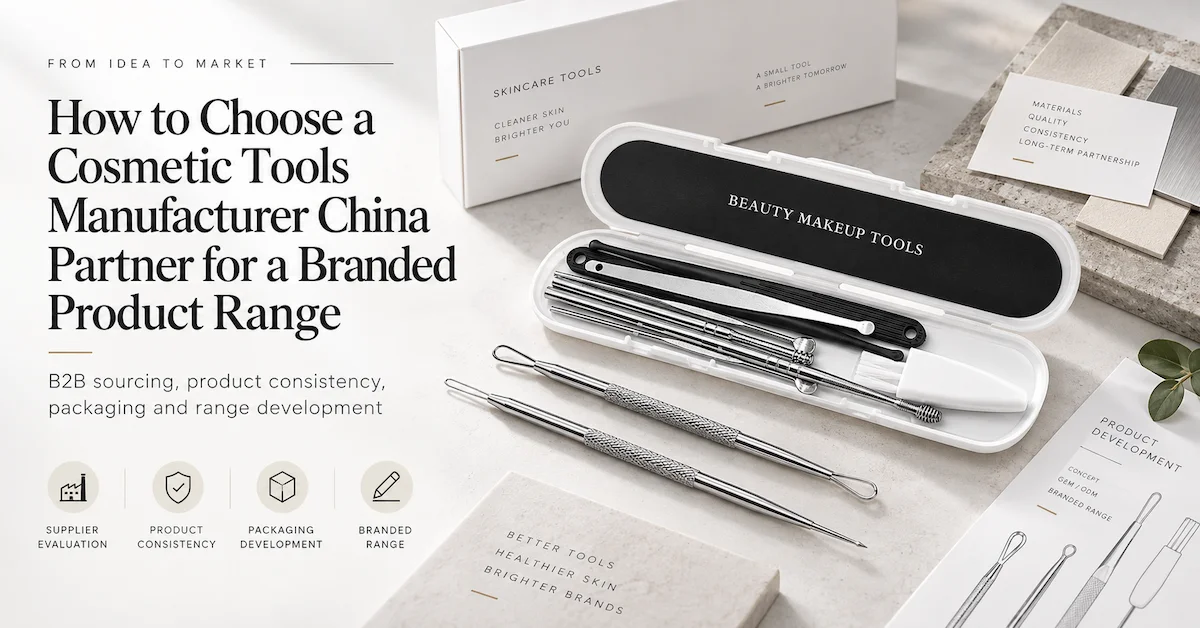
What Does Cosmetic Tools Manufacturer China Mean?
The phrase describes a China-based manufacturing partner that makes or coordinates tools used in cosmetic and personal-care routines. Depending on the product, the work may include metal forming, heat treatment, injection molding, polishing, deburring, assembly, surface finishing, inspection, and packaging. A buyer should confirm which operation applies to the chosen SKU and which responsibilities are handled by qualified partners.
Cosmetic tools can include tools for brow, lash, facial, nail, and makeup routines. The category is broad enough that a factory's capability statement is only an entry point. The buyer still needs to identify the construction and the intended use of every model. A supplier that can discuss several categories may be useful; it does not mean all categories share one process, material, or acceptance rule.
The word professional is a positioning choice, not proof of a universal standard. Likewise, stainless steel describes a material claim that should be tied to a component and a confirmed model. Neither phrase alone proves a performance result, a cleaning method, a certification, or suitability for every skin type.
OLIMOR BEAUTY supports OEM and ODM beauty-tool projects, including development from drawings, samples, appearance concepts, and structural requirements. That makes it reasonable to ask whether an existing product can be configured for a brand or whether a requested change needs development. The final answer remains model-specific and should be recorded in the quotation and approval documents.
Start With the Customer Task and the Sales Channel
Before comparing suppliers, write the job the customer needs to perform. A facial extractor might be positioned as a compact skincare accessory. An eyelash curler may be part of an eye-makeup line. Tweezers may serve brow grooming, makeup application, or detail work. These descriptions do not need exaggerated benefit claims. They need a clear task, user, and context.
Then describe how the item will be sold. A hanging retail card has different presentation and protection needs from a boxed gift set. An ecommerce listing needs photographs and text that explain what is included. A salon distributor may require product records that can be shared with professional buyers. A subscription box may prioritize compact packing and a simple unboxing experience.
Write fixed requirements, preferences, and open questions separately. For example, the selling channel and language may be fixed. A rose-gold appearance may be preferred. The marking method may remain open until the supplier reviews the surface. This simple separation prevents a supplier from treating a preference as a hard engineering constraint or treating a missing requirement as permission to guess.
| Brief element | Example buyer question | Evidence to request |
|---|---|---|
| Customer task | What motion or cosmetic routine is the tool intended to support? | Use statement, annotated reference, and model-specific description |
| Sales channel | Will it be sold online, in a salon channel, at retail, or in a set? | Pack concept, product images, and included-component list |
| Brand direction | Which appearance elements must be shared across the range? | Artwork, color reference, finish sample, and placement proof |
| Commercial scope | Which models, quantities, destination, and launch dependencies apply? | Itemized quotation and model-by-model schedule |
| Open decisions | Which items need a supplier feasibility recommendation? | Written alternatives, assumptions, and approval gates |
Build a Range Architecture Before Choosing the Finish
A coordinated cosmetic range has two layers. The first layer is shared identity: logo rules, package hierarchy, naming conventions, artwork control, and a change-notification process. The second layer is the individual product record: construction, material wording, dimensions, included parts, intended task, and functional inspection.
Keeping those layers separate makes a range easier to expand. You can use one brand style on a facial tool, lash tool, and tweezer without claiming that they have the same material or the same cleaning instructions. You can also ask for a single quotation format while preserving a different acceptance matrix for each product family.
Do not start with every catalog item. Choose a short group whose roles are distinct. A range of nearly identical tools creates more item codes and more opportunity for confusion without necessarily giving the customer a clearer choice. A smaller set with a clear purpose is easier to photograph, package, describe, and reorder.
Ask your professional cosmetic tools supplier China contact to map the shortlist into standard, configurable, and new-development items. Those labels reveal whether a proposed launch is mostly a private-label exercise or a genuine product-development project.
OEM Versus ODM: Define the Work, Not Just the Acronym
When buyers search for an OEM cosmetic tools manufacturer China, they may mean several different things. One buyer supplies a drawing. Another selects a catalog item and adds a logo. A third brings a physical sample and requests a structural change. Each request needs a different feasibility discussion.
An OEM brief should state what the buyer controls: dimensions, materials, mechanism, appearance, package, or only the branding. Mark each item as fixed, preferred, or open. Ask the supplier to identify what can be achieved on an existing model and what would require tooling, additional samples, or a different process route.
An ODM cosmetic tools manufacturer China project may begin with a product platform or collection concept. The supplier can help shortlist an existing structure and suggest ways to differentiate the presentation. That does not automatically grant exclusivity or ownership of the geometry. Discuss confidentiality, drawings, tooling, and commercial rights separately.
For an existing product with a brand identity, a private label cosmetic tools manufacturer route may be the most direct. Confirm whether your request covers logo, finish, color, package, instructions, or set composition. The phrase private label does not mean that a decorated sample, final pack, or reorder specification can be skipped.
A custom cosmetic tools manufacturer inquiry should describe the change in practical terms. A new handle contour, tip shape, hinge, head, or accessory is different from a new carton color. Ask what each change affects: material selection, tooling, sample rounds, inspection, lead time, cost, and future ownership.
Product Reference One: Facial Extractor and Contact-Point Review
The OLIMOR facial extractor is a useful reference for a skincare accessory discussion. Its product image can help a buyer identify the general form and the visible working ends. The buyer should still request the current material, dimensions, finish, and included protection for the exact configuration before using those details in a listing or package.
Review the tool by contact point. Ask how the working end is formed, what condition it should arrive in, and how the relevant function will be checked. Do not turn a general phrase such as precision into a performance promise unless the project has an agreed evaluation method and evidence.
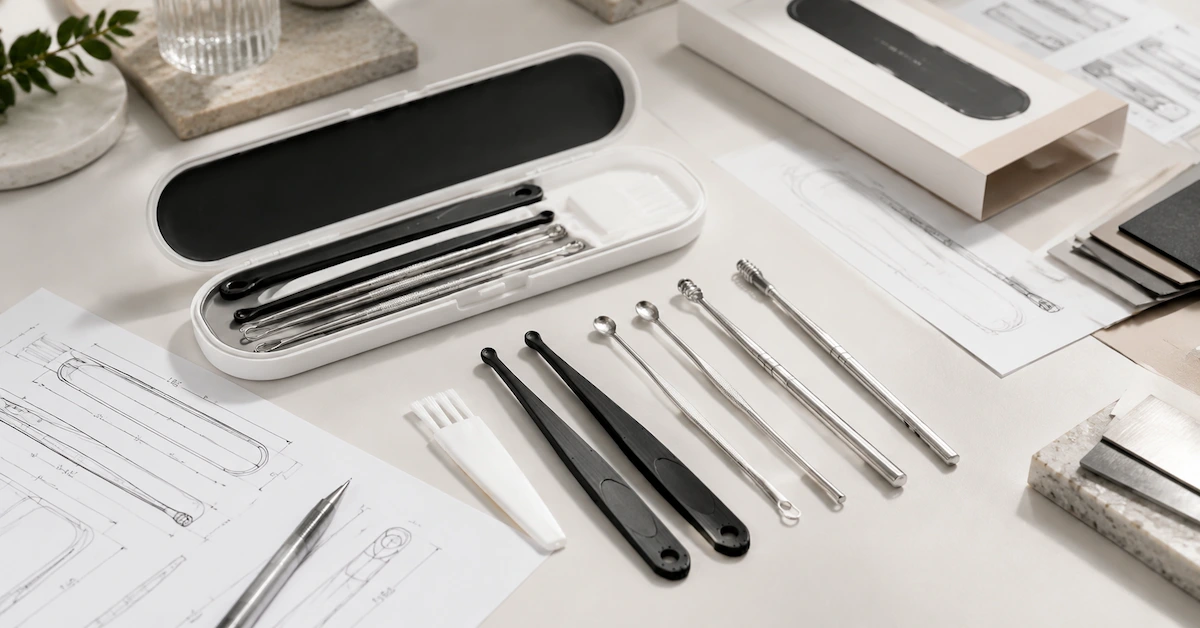
Packaging should keep the working ends protected and make the included item unambiguous. If a protective cap or insert is proposed, identify it as part of the complete retail unit. Do not assume that an accessory pictured on a related product page belongs to this model.
For skincare positioning, keep claims within the evidence available for the product. Avoid promises about removing all blemishes, treating a condition, or being safe for every skin type. Your market, instructions, and customer-support team should use wording that accurately reflects the actual tool and its intended routine.
Product Reference Two: Eyelash Curler and Geometry Review
An eyelash curler creates a different engineering conversation. The frame, curve, pad area, hinge, handles, and storage arrangement work together. A brand searching for a cosmetic tools factory China should ask for the exact model and inspect the complete configuration instead of applying a generic "eye tool" check.
Review the frame and contact area against the intended eye-makeup routine. Confirm how the working surface is positioned, what replacement or protective components are included, and how the tool is packed. Do not infer comfort, suitability for sensitive eyes, or a lasting curl from a catalog photograph.
Test the decorated sample, not just the plain sample, when finish or logo placement is part of the brief. A coating, print, or large mark can change the touch points and the appearance of a curved frame. Record the approved visual reference alongside the functional sample.
If a package includes a replacement pad or another accessory, list it explicitly. Product images that show several components can be interpreted differently by a buyer or consumer. The package copy should state what is included in the final retail unit and what is not.
Product Reference Three: Tweezers and Tip-Contact Review
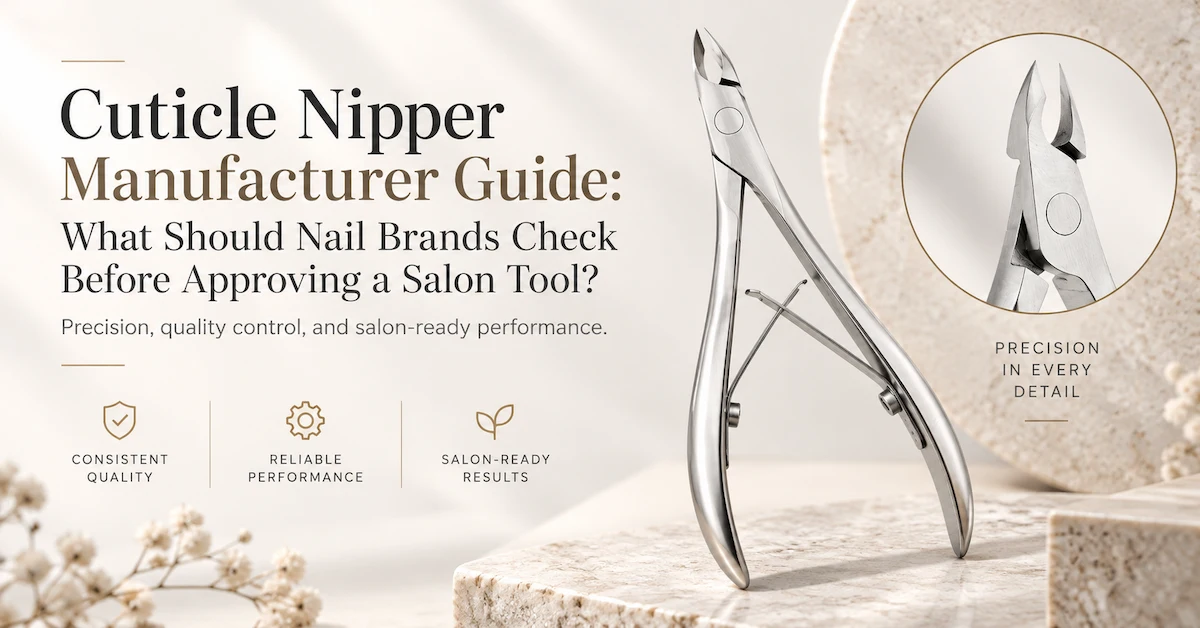
The OLIMOR precision stainless steel tweezers provide a reference for a hand-held gripping tool. The public photograph shows slant-tip geometry and a metallic appearance. It does not, by itself, establish a steel grade, tip-force profile, or whether the quoted SKU is one tool or a multi-piece configuration.
Ask how tip contact, alignment, arm movement, and the intended gripping task will be assessed. Use the approved sample as a traceable reference. A general statement that a product is precise should not replace a model-specific inspection question.
Material wording should be component-specific. A listing that names stainless steel should be checked against the exact tool and its supporting information. Do not copy that material phrase to the extractor or curler without separate confirmation.
A stainless steel cosmetic tools supplier inquiry can use this product as a starting point, then ask for the current specification, finish options, branding area, packaging, and inspection criteria. That is more useful than asking only whether the supplier has "premium tweezers."
Materials and Finishes: Separate Construction From Appearance
A buyer may request stainless steel, a soft-touch handle, a polished surface, or a metallic color. These are not interchangeable requirements. Material describes the component's construction. Finish describes the surface the customer sees and touches. Decoration describes the brand mark or printed information.
Write the requirement by component: working head, handle, spring, pad, cap, case, or insert. Ask which documents or records are available for the chosen material wording. If a steel grade matters, request written confirmation. Do not infer an alloy grade, corrosion result, or cleaning compatibility from a general product title.
Finish review should include the approved color or appearance reference, the surface area, and the acceptable variation. A digital swatch may not represent a reflective metal surface accurately. Ask for a physical or production-representative reference when appearance is central to the brand.
Color consistency across categories can also be difficult. A coating on a curler frame, a finish on tweezers, and a surface on an extractor may reflect light differently. The commercial goal can still be a coherent family, but the acceptance language should recognize the actual substrate and process.
| Requirement | What to specify | What not to assume |
|---|---|---|
| Material | Component, material wording, supporting record, and model | That one SKU's material applies to the whole range |
| Finish | Surface appearance, reference sample, and review conditions | That a digital color code creates identical metal appearance |
| Decoration | Logo artwork, position, method, and proof approval | That a logo fits every tool in the same place |
| Protection | Cap, pad, insert, case, or other included part | That a pictured accessory is part of the quote |
Custom Logo Cosmetic Tools: Make Branding Practical
Brands looking for custom logo beauty tools should send vector artwork, preferred placement, size limits, and the intended appearance. Ask the supplier to show the mark on the actual material and finish. A logo proof on white artwork is not enough if the final surface is curved, reflective, or textured.
One logo position may not work across every product. The working end, hinge, spring, finger loop, or gripping surface can limit available space. A coordinated identity can come from the same artwork, typography, and package system even when each tool uses a different practical marking area.
Keep the artwork revision linked to the model revision. If the tool changes but the mark stays the same, the approved placement may no longer apply. If the package changes but the product does not, the retail unit still needs a new controlled record.
Discuss confidentiality and ownership if the project includes original drawings or a new structure. A custom logo alone does not make an existing catalog geometry exclusive. Define the territory, rights, tooling, and use of supplier-supported designs in writing.
Packaging and Product Information
The package should identify the tool, explain the intended routine, protect the working components, and make the included configuration visible. That requires more than a beautiful front panel. Review the back panel, insert, closure, and unpacking sequence with the actual product.
For ecommerce, make sure the primary image and the first lines of copy answer the same question: what is in the box? If a photograph shows a set but the quote is for one item, the listing can create a preventable expectation gap. Use model codes and component lists to keep the page factual.
For retail, consider hanging arrangements, barcode position, package footprint, and whether the tool can be inspected without exposing a working end. For salon distribution, consider how instructions and material wording will be shared with professional buyers. For a gift range, review how several different tool types sit together and whether the package supports the intended presentation.
Destination-market requirements should be reviewed with the importer or compliance adviser. The European Commission product-safety information is an official starting point for EU obligations. It is not proof that a supplier's standard packaging meets every requirement for your branded unit.
Inspection: Use One Range File and Several Functional Matrices
Inspection should connect the approved sample, the product description, and the packed unit. The range file can establish common responsibilities and revision control. The functional matrix should remain specific to each product family.
| Tool family | Functional questions | Visual and packing questions |
|---|---|---|
| Facial extractor | What is the intended contact point and how is its condition reviewed? | Are working ends protected and correctly identified in the pack? |
| Eyelash curler | How are frame alignment, movement, and included working components checked? | Does the package protect the frame and identify any pad or accessory? |
| Tweezers | How are tip contact, alignment, and gripping action reviewed? | Is the finish approved and is the pack for one tool or multiple pieces? |
Define defect language before production. A print-position difference, a missing accessory, and a damaged working end should not be treated as the same finding. Agree on inspection responsibility, records, and disposition with the supplier and your quality team.
ISO 2859-1:2026 provides acceptance-sampling procedures by attributes. It does not provide a cosmetic-tool-specific defect list, prove product safety, or establish a certification for OLIMOR. Use a sampling framework only alongside clear product requirements and agreed inspection responsibilities.
Keep the approved reference accessible to the inspector. The record should identify the model, finish, logo revision, package version, included parts, and any drawing or sample that controls. If a photo and a later drawing differ, specify which document takes precedence.
Quotation and Total Cost
Ask the wholesale cosmetic tools supplier China to quote the complete retail unit. A loose tool, a decorated tool, and a packed product are different commercial configurations. Compare like with like: same model, quantity, material wording, finish, logo, protection, packaging, inspection, and shipment basis.
Request one-time and recurring charges separately where possible. Development, tooling, artwork, packaging setup, and other initial costs may not behave like repeat-order unit costs. A model-by-model quotation is more useful than a blended average for a collection with different structures.
| Quote line | Question to clarify | Why it matters |
|---|---|---|
| Base tool | Which exact model, material, finish, and included parts are covered? | Prevents different products being compared under one name |
| Branding | Which marking method, area, proof, and revision are included? | Shows the real decorated configuration |
| Retail packaging | What carton, card, insert, cap, or set components are included? | Defines the sellable unit and protection |
| Development | Which charges are one-time, and who owns drawings or tooling? | Clarifies launch economics and rights |
| Inspection and freight | What inspection and delivery assumptions apply? | Helps calculate a meaningful landed cost |
MOQ is confirmed by model, finish, packaging, and order configuration. Do not apply an unbranded catalog quantity to a fully customized set. Lead time should be discussed after the development and artwork scope is known; a mixed range may contain different approval dependencies.
Reorder Control: Protect the Approved Brand Experience
A first order can look perfect and still be difficult to repeat if its records are scattered. Give each SKU a stable identifier and connect it to the model, component list, finish, logo artwork, package revision, and approved sample. This makes a reorder a controlled request rather than a verbal memory.
Ask when the supplier must notify you about substitutions or changes. A new spring, revised finish, different plastic, or changed insert may affect the customer experience even if the sales name remains unchanged. Agree on the evidence and approval needed before the change enters production.
For a cosmetic tools factory China project, clarify whether individual items can be replenished separately and whether packaging has its own quantity constraints. A combined first order does not automatically establish the terms for every future single-SKU order.
Keep complaints model-specific. A problem with a curler hinge should not be logged as a generic beauty-range issue. A traceable record helps both sides identify the affected item, review the matching sample, and decide whether packaging, process, or product requirements need adjustment.
FAQ: Questions to Ask Before Selecting a Supplier
Can one manufacturer make all cosmetic tools?
A supplier may support several tool families, but each product still needs its own feasibility and acceptance review. Ask which operations and partners apply to the exact model. Do not assume that capability for one metal tool proves capability for a different mechanism or cosmetic task.
Is OEM better than ODM for a new beauty range?
Neither route is automatically better. OEM suits a buyer with a controlled specification or sample. ODM can suit a buyer selecting a platform or adapting a supplier-supported design. Choose the route that matches the decisions you need the supplier to make, and document rights and scope.
Does stainless steel mean the tool is suitable for every cleaning process?
No. Confirm the component, grade or material wording where relevant, finish, and supported care instructions. Cleaning, disinfection, or sterilization claims require product-specific and market-specific review. A general stainless-steel phrase is not enough.
How should I compare cosmetic tool suppliers in China?
Compare evidence and configuration control: model-specific specifications, samples, functional checks, logo and packaging feasibility, inspection records, communication of changes, and reorder terms. Compare prices only after those items are normalized.
Can I use the same logo position on every product?
Not always. Curves, hinges, finger rests, working ends, and gripping areas can limit practical marking space. Keep the artwork and brand rules consistent, but approve placement on each physical model.
What should I send in the first inquiry?
Send the target market and channel, customer task, reference products, quantity by SKU, branding artwork, package concept, desired materials, and unresolved questions. Ask the supplier to identify standard, configurable, and new-development elements.
How can I avoid receiving a different product on reorder?
Use a controlled SKU record and approved sample. Include finish, component list, logo revision, package version, and change-notification terms. Confirm the current specification before each repeat order.
Next Step: Send a Range Brief That Can Be Quoted
A serious sourcing conversation starts with a defined range, not a request for the "best" cosmetic tools. Link each product reference, state the customer task, explain the channel, and mark which decisions are fixed or open. Ask for a model-by-model specification, branded sample route, packaging proposal, inspection approach, and complete quotation.
That process helps a brand use the strengths of a China manufacturing partner without confusing one product's features with another's. It also gives purchasing, marketing, quality, and customer-support teams a shared record of what the customer will actually receive.