Buy Tweezers in Bulk: How to Choose a Reliable Supplier, Wholesaler or Factory

Buying tweezers in bulk is not just a unit-price decision. For salons, brow specialists, lash technicians, beauty retailers, distributors, craft sellers, and precision-tool buyers, the real issue is whether each pair feels consistent, aligns correctly, and holds up in daily use. A small tool with uneven tips or weak tension can slow work, frustrate users, and create avoidable replacement costs.
Olimor Beauty supplies precision stainless steel tweezers for professional and commercial use. If you are comparing a supplier, wholesaler, or factory source, the smartest approach is to define the use case first, then compare tip shape, material, finish, grip comfort, inspection discipline, and packaging protection. That is how you reduce risk when you place a larger order.
Who should buy tweezers in bulk?
Bulk purchasing makes sense when tweezers are used repeatedly, issued to staff, included in kits, or resold as part of a beauty or grooming range. The most common buyers include brow bars, lash studios, salons, spa operators, beauty schools, kit assemblers, online beauty retailers, distributors, and some craft or technical users who need fine control on small parts.
The key is not to treat all tweezers as interchangeable. A tweezer for eyebrow shaping may not be the best choice for lash isolation, jewelry work, or a mixed retail assortment. Before ordering, identify the main task. Brow services usually need secure grip and accurate plucking. Lash work may need fine control and a tip angle that preserves visibility. Retail assortments often do better with a mix of tip styles so customers can choose based on their own use.
Choose the tip shape before you choose the price
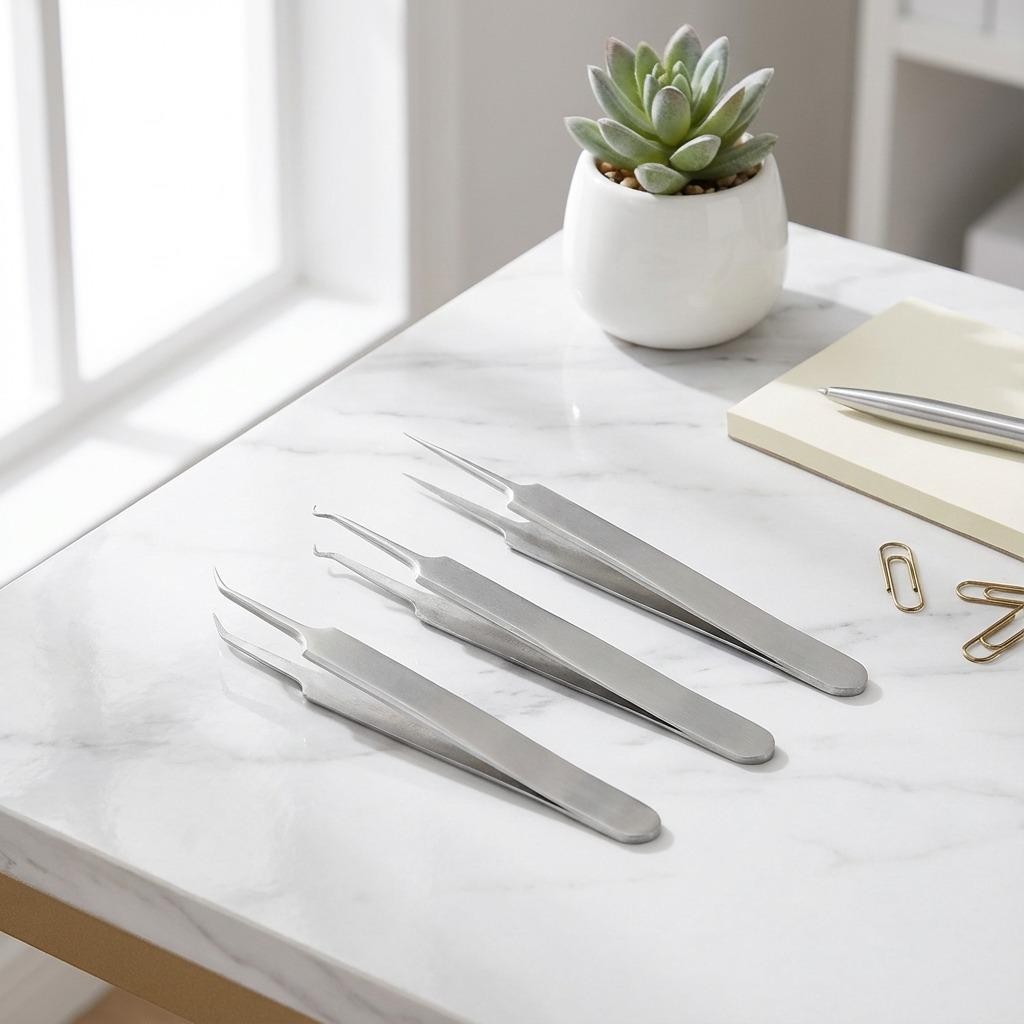
Tip design is one of the most important decisions in a bulk tweezer order. The supplied product information uses several common naming styles, including straight, curved, bent, angled, slant, needle-point, and flat-tip descriptions. Labels can vary by catalog, but the practical question is always the same: what job will the tool do?
| Tip style | Best fit | What to verify in samples |
|---|---|---|
| Straight | General precision work, brow grooming, direct gripping, kit inclusion | Even tip meeting, clean alignment, comfortable control |
| Curved | Lash-related work, delicate placement, tasks that need better visibility | Curve consistency, smooth edges, stable hand angle |
| Angled / slant / bent | Brow shaping, beauty detailing, and tasks where access is awkward | Angle repeatability, grip comfort, consistent closure |
| Needle-point / ultra-fine | Very detailed handling, tiny components, fine placement work | Tip protection, symmetry, resistance to bending in transit |
| Flat-tip | Firm holding and broader contact on small items | Flat contact surface, clean finish, no rough edges |
If you are buying for a salon or brow studio, slant or angled tweezers often deserve priority because they support controlled beauty work. If your buyers include craft, jewelry, or technical users, straight, curved, and needle-point styles may be more useful. If you are building retail stock, a balanced assortment can reduce the risk of over-ordering one shape that only serves a narrow audience.
Material, finish, and ergonomics matter more than they look
The supplied product descriptions focus on stainless steel tweezers for professional use. Stainless steel is widely valued in beauty tools because it supports durability, repeated handling, and easier maintenance when cleaned properly. Some product descriptions also mention polished, matte, rust-resistant, anti-static, or anti-magnetic characteristics. Those details may be useful depending on the end use, but buyers should verify which characteristics apply to the exact model they plan to order.
Ergonomics also matter. The supplied range includes examples such as a 115 mm tweezer at 12.6 g with a 9 mm width, a 116 mm tweezer at 14 g with a 10 mm grip, and a 118 mm tweezer at 13.4 g for extended reach. Those differences are small on paper, but they can affect comfort, balance, and hand fatigue during longer sessions. A lighter tool may suit extended use, while a slightly heavier one may feel more stable for precise work.
Finish should be consistent across the batch. A polished surface may look cleaner for retail display, while a matte surface may improve grip under bright workstation lighting. In either case, the finish should be even, with no visible burrs, rough patches, or scratches that affect handling or presentation.
Supplier, wholesaler, or factory: which route fits your business?
When comparing where to buy tweezers, it helps to match the sourcing route to the business need. Retail is useful for small tests, but it is rarely efficient for ongoing commercial buying. Wholesaling is better for repeat orders and mixed assortment planning. Factory-direct sourcing can be the best route when you need tighter control over packaging, product details, or long-term supply consistency.
| Buying route | Best for | What to check before ordering |
|---|---|---|
| Retail purchase | Small tests or one-off needs | Limited continuity, higher unit cost, less batch consistency |
| Wholesaler | Salons, stores, distributors, kit builders | Repeatability, product mix, packaging protection, reorder stability |
| Factory-direct source | Long-term planning, private label, packaging control | Clear specs, sample approval, quality control, communication speed |
For many buyers, the best source is the one that understands the use case, not just the quote. A brow studio may care most about slant-tip precision and hand comfort. A retailer may care more about appearance, labeling, and packaging consistency. A distributor may focus on carton planning, repeatable inspection, and stable reorder quality. That is why supplier evaluation should go beyond price alone.
What a reliable tweezers supplier should be able to explain
A dependable supplier or factory should be ready to talk about how the tweezers are made, checked, packed, and protected. The supplied Olimor Beauty information mentions internal quality control from raw materials to packaging. For bulk buyers, that matters because a tweezer can look simple while still failing if alignment, surface treatment, or finishing is inconsistent.
- Tip alignment: the two sides should meet evenly without crossing, twisting, or leaving a visible gap.
- Closure tension: the tool should open and close smoothly, without feeling too loose or too stiff.
- Edge smoothness: the outer surfaces should feel finished, not rough or sharp.
- Surface consistency: the finish should look uniform across the sample set and the shipment.
- Tip protection: fine points should be protected from bending or impact during transport.
- Packaging consistency: retail or professional packaging should stay neat and match the agreed presentation.
When reviewing samples, test more than one piece if possible. Bulk buying depends on repeatability, not a single perfect sample. If one pair performs well but the next pair slips or feels uneven, the order is not truly reliable.
A practical inspection checklist for bulk orders
Use this checklist when comparing samples or incoming goods:
- Confirm the exact tip style and make sure it matches the intended task.
- Check that the tips meet evenly under gentle closure.
- Look for scratches, stains, rough edges, or uneven finishing.
- Test grip comfort and hand fatigue over repeated use.
- Review packaging protection for tip safety and retail presentation.
- Verify that the carton contents match the agreed assortment.
If the tweezers will be sold into regulated markets, buyers should also ask for the applicable supplier paperwork and verify the relevant version of any referenced standard or rule. In some sourcing programs, that may include documentation linked to ISO 9001 or material and market-compliance requirements such as REACH, depending on where the goods are sold. Do not assume a reference is enough; always confirm the actual document set and the version that applies.
How to think about assortment, packaging, and resale value
For beauty retailers and distributors, the sale is not just about the metal tool. Packaging, labeling, assortment logic, and product clarity also affect conversion. A clean, well-presented tweezer is easier to place in a retail shelf, online listing, or kit bundle. A mixed assortment can also help you serve multiple customer needs without making the inventory too complex.
If you are building a broader tool range, it can help to review Olimor beauty tool products alongside the tweezer line so the assortment feels coordinated. For buyers comparing several options, the wider tool collection overview can also make it easier to match tweezers with related beauty tools. If you already know your intended use case, a clear bulk sourcing inquiry will help the team respond with more relevant product guidance.
Resale buyers should also think about the customer’s decision process. End users often compare the tool by feel first, then by appearance, and finally by tip style. That means the product page, carton label, and packaging need to make the differences easy to understand. A simple, accurate description of straight, curved, or angled use is often more useful than marketing language.
When Olimor is a sensible bulk sourcing option
Olimor Beauty focuses on precision stainless steel tweezers and related beauty tools for commercial buyers. If your team needs a tool line that supports salon work, retail assortment planning, or repeat procurement, Olimor can be a practical place to start. The best next step is to define the use case, confirm the tip style, review sample pieces, and align on packaging and inspection expectations before you commit to a larger order.
If you want to discuss a specific model, packaging need, or assortment plan, contact the Olimor team with your requirements. A restrained, specific inquiry usually gets a better sourcing response than a general request for “good tweezers.”
FAQ
Can I request samples before placing a bulk order?
Yes. Samples are the best way to check tip alignment, tension, finish, and packaging protection before committing to volume.
Is there a minimum order quantity?
MOQ depends on the exact model, finish, and any packaging or customization requirements. Confirm it directly during inquiry.
Can tweezers be customized?
Often yes, especially for packaging and assortment planning. Ask what can be adjusted before sample approval so expectations stay clear.
What quality checks should I ask the supplier about?
Ask about tip alignment, closure tension, edge smoothness, surface consistency, and how the tips are protected during packing and shipping.
How long is lead time?
Lead time varies by model, order size, and customization. Request a schedule after sample approval and order confirmation.
Tag: