

Why spa teams still use a blackhead extractor for spa use
A blackhead extractor for spa use solves a very ordinary but stubborn problem: congested pores that do not respond well to cleansers alone. In a facial room, that matters because the wrong approach can leave the skin irritated, the client dissatisfied, and the treatment looking rushed. A handheld comedone extractor gives an esthetician a more controlled way to address blackheads and similar blemishes when manual extraction is appropriate and the skin has been properly prepped.
For sourcing teams and product planners, the decision is not just whether the tool works in principle. It is whether the shape, finish, and handling suit real treatment-room habits. A well-made pore cleaning extractor tool should be easy to grip, simple to wipe down, and intuitive enough that a trained professional can move from one area of the face to another without fuss. That sounds small, but small details are what make a tool get used every day instead of sitting in a drawer.
Manual extraction versus suction: choosing the right method
There is a lot of interest in the vacuum blackhead remover category, and for good reason. Suction tools are familiar, marketable, and often appealing to clients who like the idea of a less tactile procedure. But suction is not a universal answer. On some skin types, or in some treatment sequences, a loop-style extractor offers more precision and less guesswork.
The practical difference is simple. A vacuum blackhead remover depends on suction level, seal quality, and the user’s ability to move it cleanly across the skin. A loop extractor depends on angle, pressure, and control. In a spa setting, control often matters more than speed. If the pore is ready and the skin has been softened, a manual loop can remove material with less surrounding disruption than a device that pulls more broadly across the surface. That is not a blanket rule, just a useful caution. The best choice depends on the client’s skin condition, the treatment protocol, and the operator’s skill.
What the double-ended design adds
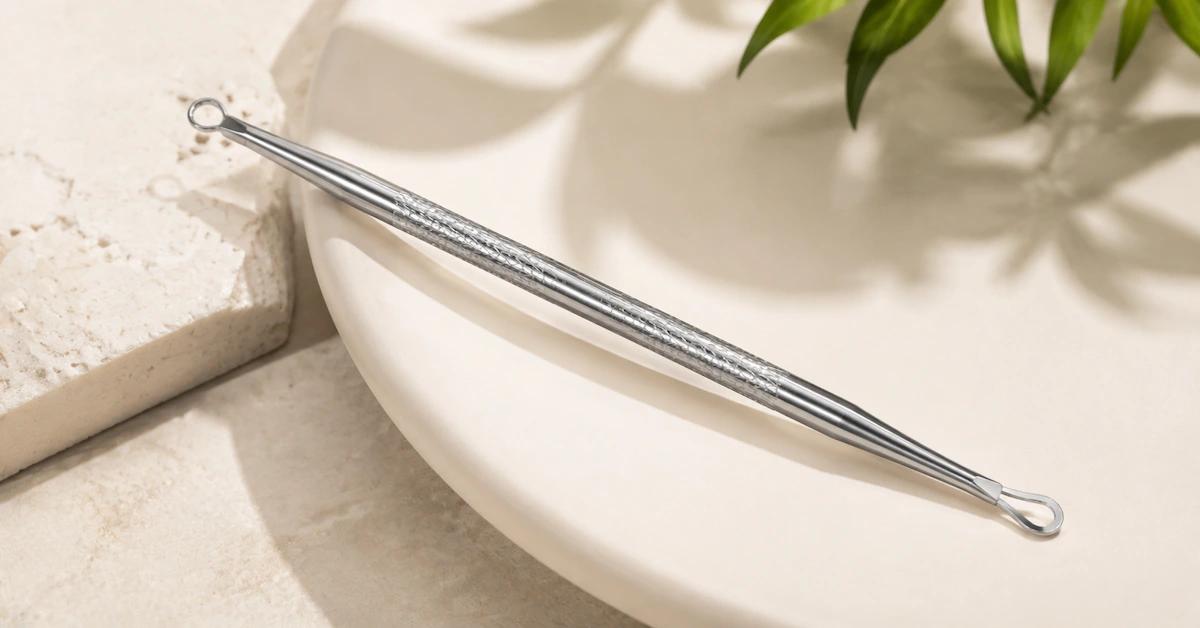
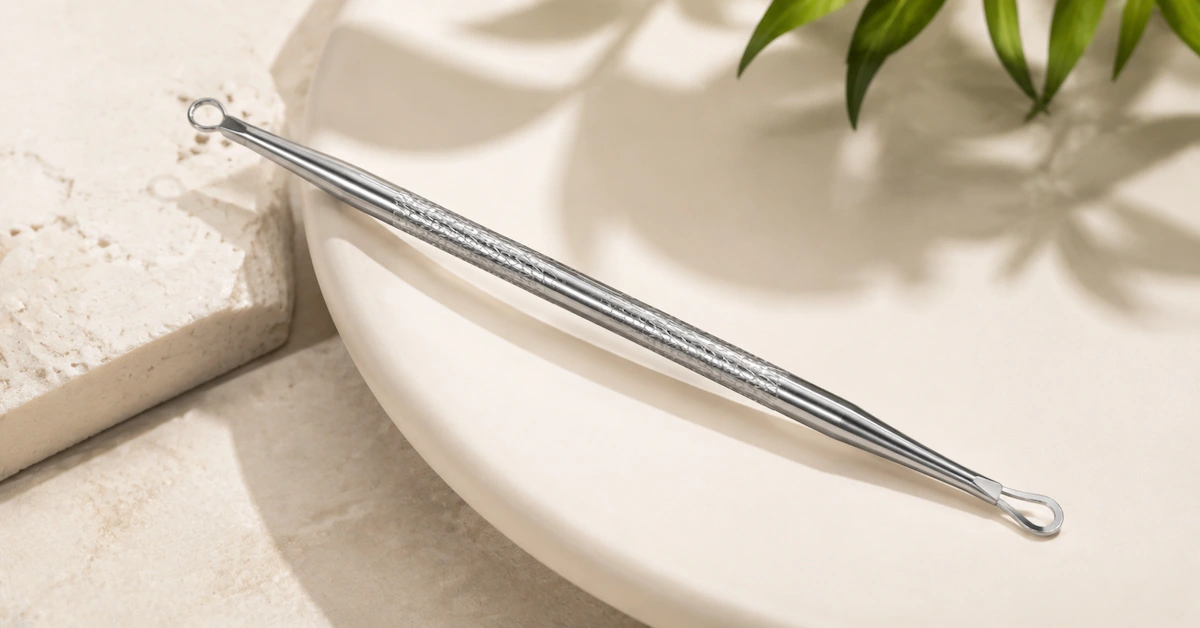
The product described here is a slim, double-ended metal tool with looped tips on both ends: one smaller circular loop and one larger oval loop. That layout is common for a reason. Different blemishes call for different contact sizes, and a single loop diameter can feel either too aggressive or too limited depending on the area being treated.
The smaller loop is typically better when precision matters, such as around tighter facial contours or for individual clogged pores. The larger oval loop can be more efficient on broader areas where the blemish is a bit larger or the operator wants to distribute pressure more evenly. In practice, the dual-ended format reduces tool swapping and keeps the workflow tidy, which is one reason professional kits often favor it.
The center grip also deserves attention. A textured, knurled grip section gives the hand something to hold when the room is warm, the tool has been disinfected, and gloves are in use. A smooth shaft can look elegant in product photos, but in the treatment room it is the grip that controls whether the tool feels confident or slippery.
Material and finish: what buyers should ask before they place an order
From the visible appearance, this tool looks like polished metal, likely stainless steel, with a reflective silver finish. That would be a sensible choice for a spa environment because metal tools are generally easier to wipe clean than many molded alternatives, and they tend to hold up better in repeated handling. Still, it is worth saying plainly: the exact metal grade is not something to guess at. A buyer should ask the supplier to confirm the material rather than assume every silver tool is the same.
Surface finish matters too. A smooth, polished exterior is easier to clean visually and gives the tool a more professional feel. The trade-off is that finish alone does not tell you everything about corrosion resistance or long-term durability. If the supplier has not stated the metal grade, coating, or testing basis, treat any strong claims with caution.
The likely manufacturing route is a mix of metal forming, machining, polishing, and perhaps knurling on the center section. That is not unusual for this kind of instrument. What matters to the buyer is whether the final result is consistent: no rough edges, no sharp transition at the loop, no burrs where the finger meets the grip, and no finish defects that could complicate cleaning. In a salon, a tiny defect is still a defect.
How to judge whether a pore cleaning extractor tool belongs in your service menu
Not every facial program needs the same extraction kit. A pore cleaning extractor tool makes sense when your menu includes deep cleansing facials, congestion-focused services, or skin prep work where manual extraction is part of the protocol. If your treatment philosophy leans toward minimal contact, or if your staff already relies on other methods, then a simple loop tool may be a support item rather than a headline product.
For private-label buyers and distributors, the bigger question is positioning. Is this a value tool for general salon use, or a premium implement for professional facial kits? The answer often depends on the details people notice in hand: the balance of the shaft, the smoothness of the loops, the comfort of the grip, and whether the tool looks sturdy enough to survive frequent sanitizing and transport between stations.
Packaging is also part of the decision, even though it is not visible here. A careful buyer should ask whether the tool is supplied individually, boxed for retail, or bundled with other facial accessories. If the package is unspecified, do not build a launch plan around assumptions.
Common mistakes that reduce performance in the treatment room
The first mistake is using the tool before the skin is ready. Extraction is not a shortcut for preparation. If the pores are not softened or the area has not been properly assessed, even a good blackhead extractor for spa use can end up creating unnecessary stress on the skin.
The second mistake is choosing the wrong loop size for the job. A larger loop is not automatically better, and a smaller loop is not always safer. The operator needs to match the tool to the blemish and the contour of the face. That sounds obvious, but in a busy room the obvious is what gets missed.
The third mistake is overconfidence. A loop extractor is a precise hand tool, not a force instrument. Pressing harder does not make the result cleaner; it often makes the area redder. For sensitive or inflamed skin, manual extraction may not be the right call at all. That is a clinical judgment, not a sales angle.
Finally, sanitation habits matter. Metal construction helps, but the tool still needs proper cleaning and handling between clients. Anyone buying for a spa, salon, or training room should insist on a process that fits the way the tool will actually be used, not just the way it looks on a product page.
Practical buyer advice for sourcing and product teams
If you are evaluating this category for procurement, start with the fundamentals: loop geometry, grip comfort, finish quality, and material disclosure. Then move to consistency. Are both ends aligned? Are the loops cleanly formed? Does the knurled grip feel deliberate or decorative? Those are the details that separate a dependable tool from a generic one.
It is also sensible to compare the loop extractor against a vacuum blackhead remover only after defining your customer use case. A suction device may sound more modern, but a hand tool can be better for smaller service environments, training programs, and kits where simplicity is preferred. The right answer depends less on trend and more on workflow.
If you are building a broader facial toolkit, this type of loop extractor can sit alongside cleansing brushes, tweezers, and other skin-care accessories. If you are building a focused extraction set, then the double-ended design is the main selling point. Either way, do not let the catalog description do all the work. Ask for the material specification, ask how the tool is finished, and ask what is included in the package.
Frequently asked questions
Is a loop extractor better than suction for every case?
No. A vacuum blackhead remover can be useful in some routines, but it is not automatically the better choice. Manual loops offer precise control, which many professionals prefer for targeted extraction.
Why does the tool have two different loop sizes?
Different pore sizes and facial contours benefit from different contact areas. The smaller loop supports precision work, while the larger oval loop can cover broader spots more comfortably.
Can the tool be cleaned easily?
The metal construction and smooth finish suggest straightforward wipe-down cleaning, but the exact cleaning protocol depends on the final material and your spa’s hygiene process. Buyers should confirm compatibility with their own sanitation method before purchase.
What to do next
If your treatment room needs a reliable blackhead extractor for spa use, focus on the parts that affect daily handling rather than flashy claims. A double-ended loop design, a secure center grip, and a durable metal finish are the features that tend to matter after the first week, not just on day one. For sourcing, ask for material confirmation and finishing details. For operations, match the tool to the service menu and the skill level of the team. That is usually how a simple instrument becomes a dependable one.
Tag: