

Beauty Scissors Bulk: A Salon and Hotel Buyer Guide
A beauty scissors bulk order should begin with the task, user and channel, not the lowest unit quotation. Salon teams may prioritize repeated handling and cutting control, while hotel and grooming-kit programs may prioritize compact presentation, protected tips and clear product identification. Buyers should approve the exact scissor and package together before ordering in quantity.
The retained Olimor source describes stainless steel beauty scissors for professional and commercial purchasing. That description is a starting point only. Confirm the selected SKU, material designation, blade form, dimensions and care instructions in the current product record and sample.

Define the Beauty Scissors Bulk Use Case
“Beauty scissors” can refer to different tools. A brow or facial-hair scissor, a grooming-kit scissor and a salon cutting tool do not share one universal specification. State the intended task before asking a supplier to quote.
Build the brief around:
- the material the scissor is expected to cut;
- the intended user and frequency of use;
- blade and tip style required for that task;
- dominant-hand or ambidextrous expectations;
- overall size and kit-space constraints;
- cleaning, drying and storage workflow;
- unit package, labeling and destination channel.
A hotel amenity scissor may be handled occasionally and stored inside a compact kit. A salon tool may be opened and closed repeatedly during a service. Those conditions change which sample checks deserve the most attention. Avoid positioning one generic scissor as ideal for every grooming task.
Compare Blade Contact and Movement
Appearance does not show whether the two blades work as a pair. Inspect several samples from the proposed bulk configuration. Open and close each tool through its full working range, observe where the blades meet and note any rubbing, looseness or abrupt resistance.
| Inspection point | Buyer check | Record to retain |
|---|---|---|
| Blade contact | Observe the closing path and intended contact | Photographs and approved reference sample |
| Pivot movement | Check for binding, side play or uneven resistance | Defined movement check and result |
| Cutting result | Test the material appropriate to the stated task | Test material, method and observations |
| Tips and edges | Check intended tip form and unintended sharp areas | Close-up images and defect boundary |
| Handles | Review finger fit, stability and contact surfaces | User feedback against the channel brief |
| Finish | Inspect scratches, stains and visible variation | Approved color and appearance sample |
Do not approve the full lot from one showroom piece. A controlled sample set gives the buyer more information about variation and creates a clearer baseline for final inspection.
Match Handle Comfort to Repeated Use
Handle comfort includes more than ring size. Balance, pivot position, surface finish and the angle of the hand all influence control. A scissor can feel comfortable for several openings but create pressure during extended use. Ask intended users to handle samples in movements that resemble the real task.
For a salon program, include technicians in sample review and record comments instead of relying on “ergonomic” as an unmeasured claim. For a hotel or retail kit, check whether the handles remain usable within the compact dimensions and whether the scissor can be removed from its insert without touching the working ends.
Plan Packaging for the Channel
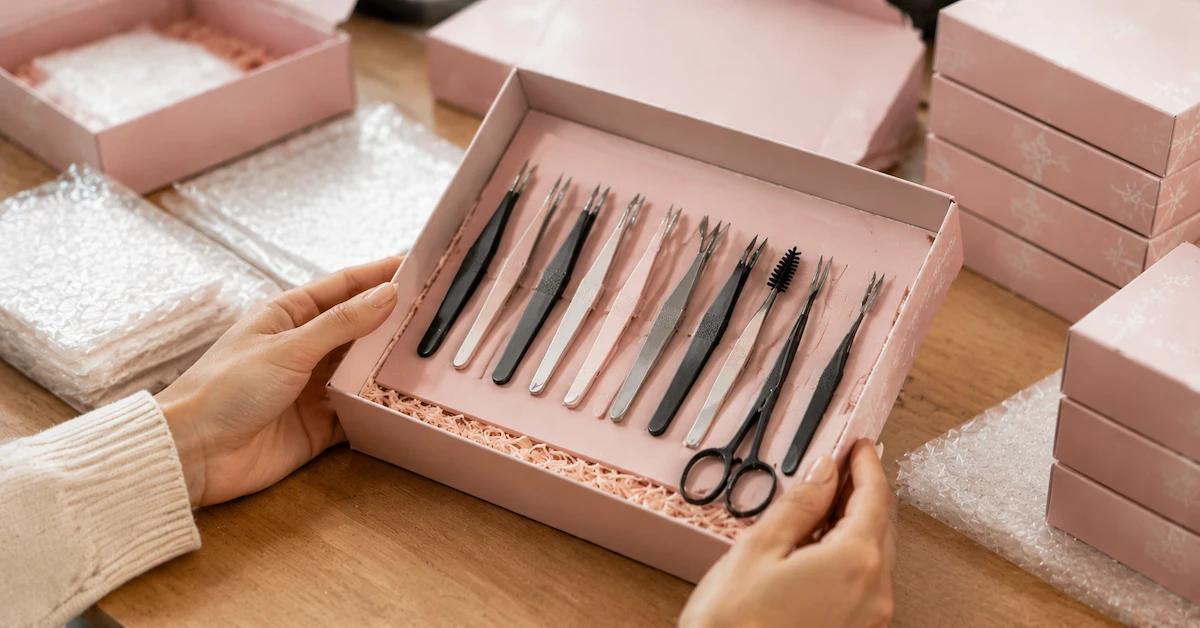
Packaging is part of product quality because it protects blade alignment, tips and finish before use. The pack should also make the product identity clear, especially when several grooming tools share one kit.
Check whether:
- the scissor is retained without forcing the handles or blades;
- tips cannot puncture the pack or contact another tool;
- metal surfaces are protected from rubbing during transport;
- the product can be removed and replaced as intended;
- artwork matches the exact model and included components;
- care information and required labels remain readable;
- the unit pack fits the agreed inner and master carton.
A salon backbar pack and a hotel presentation kit may need different solutions. Price them as separate configurations rather than assuming one package can satisfy both channels.
Build a Comparable RFQ
Send every shortlisted supplier the same request. Include the use case, reference model, dimensions, blade and tip style, finish, logo, package, quantity, destination and inspection expectations. Ask the supplier to identify assumptions and open items.
Separate product cost, decoration, packaging, inspection and logistics. A low tool price may not remain low after adding a protective insert or branded pouch. Conversely, an elaborate retail package may be unnecessary for an operational salon order.
Confirm the current MOQ, sample timing, production timing and available customization for the chosen Olimor scissor and pack. Do not copy these values from another model or an older quotation.
Control Reorders and Changes
The first approved sample should remain linked to its drawing or written dimensions, finish, logo and packaging revision. On a reorder, ask whether any blade, pivot, material, finish or package component is proposed to change. A supplier substitution should trigger written review rather than being treated as automatically equivalent.
Keep the following in the approval file:
- product and packaging photographs;
- approved sample identification;
- artwork and revision;
- functional and appearance checks;
- defect examples or boundary samples;
- carton and labeling information;
- change notice and approval owner.
This record makes repeat orders easier to compare and helps explain a problem without relying on memory.
Beauty Scissors Bulk Release Checklist
Before releasing the order, confirm that:
- one intended task and user are defined for each SKU;
- blade contact, movement and cutting method are documented;
- handles were reviewed for the intended use pattern;
- material and finish are tied to the selected model;
- tips, blades and finish are protected in the unit pack;
- logo and artwork do not interfere with handling;
- current commercial terms are confirmed in writing;
- inspection timing and acceptance rules are agreed;
- reorders will use the same approved reference.
FAQ
Can salons and hotels order the same scissor?
They can consider the same base model, but the use frequency, packaging and handling expectations may differ. Approve each channel configuration against its own written brief.
Does stainless steel prove scissor performance?
No. Confirm the material designation for the selected SKU, then evaluate blade contact, movement, finish and task-specific cutting on samples.
How many samples should a buyer review?
There is no universal number. Review enough pieces to observe variation during development, then agree a separate production sampling and acceptance plan.
What can be customized?
Logo, finish or packaging may be discussed depending on the selected model. Feasibility, quantity and timing must be confirmed for the exact request.
Can one scissor style serve every salon task?
No. Blade length, tip profile and handle geometry should match the intended trimming task and user.
What should buyers inspect at the pivot?
Check smooth opening, lateral play, rubbing and whether blade contact remains controlled through the stroke.
How should sharp tips be packaged?
The final package should prevent opening, tip impact and contact with users or adjacent products.
How many scissors should be checked before bulk approval?
There is no universal number. Use enough development samples to observe variation, then agree a production sampling plan and defect classification for the actual order.
Can one protector be approved for every scissor model?
Only after fit is verified for each blade and tip profile. A cover that holds a rounded model may move on a fine point or press against a curved blade, so pack approval must follow the exact SKU.
Send a Scissor Sourcing Brief
Review the Olimor beauty tool range and related grooming tool collections, then request beauty scissors samples. Include the task, user, model reference, dimensions, blade and tip direction, finish, branding, package and inspection criteria.
What Defines Salon-Quality Beauty Scissors?
Salon-quality does not have to mean complicated, but it should mean dependable. A professional user needs scissors that open and close smoothly, cut predictably, and remain comfortable during repetitive tasks. In manicure and personal care settings, beauty scissors are often used for small, controlled cuts, so accuracy matters more than size or decorative design.
The original Olimor Beauty article highlights beauty scissors with an ergonomic design, stainless steel material, a matte black finish, and handles shaped for control and comfort. It also references the EliteCraft Precision Metal Scissors as an example of a product designed with durability and performance in mind. These are useful points to consider when evaluating any bulk beauty scissors order: the tool should feel stable in hand, resist everyday wear, and support precise trimming without forcing the user to squeeze too hard.
A good buyer evaluation should include the following criteria:
- Cutting alignment: blades should meet evenly from pivot to tip without obvious gaps or twisting.
- Edge feel: scissors should cut cleanly for their intended use and not snag or fold the material being trimmed.
- Handle comfort: finger loops should be smooth, balanced, and comfortable for different hand sizes.
- Pivot movement: opening and closing should feel controlled, neither loose nor overly stiff.
- Surface finish: a matte black or polished finish should be even, clean, and free from rough edges.
- Batch consistency: units in the same order should look and perform alike, especially for resale or chain salon use.
Use Cases for Salon, Retail, and Home Care Buyers
Beauty scissors can serve different roles depending on the buyer. In a salon, they are working tools. In a retail environment, they are customer-facing personal care items. In a kit, they must be compact, safe to store, and suitable for broad use. Understanding the final use case helps determine which features matter most.
For professional manicure services, select scissors that support controlled trimming and feel comfortable for repeated handling. Technicians should be able to make small cuts without the blades slipping or the handles pinching. For retail sales, buyers may place more emphasis on appearance, finish, and clear product positioning. A matte black finish, for example, may suit modern beauty displays and coordinated personal care sets.
For home care kits, simplicity and reliability are key. Users may not have professional training, so the tool should feel intuitive, stable, and easy to clean. If scissors are sold with other personal care tools, they should fit the overall quality level of the kit. Mismatched tools can weaken the perceived value of the full set.
Buyers building a wider assortment can explore Olimor Beauty product collections to compare related tools and plan a consistent sourcing strategy. Matching scissors with complementary manicure tools can help create a more complete offer for salons, retailers, or kit builders.
Inspect Closure, Tips and Pivot Movement
Open and close each candidate in the bulk beauty scissors order slowly while observing where the blades begin to meet and how the tips align. Note gaps, crossing, scraping, side play, burrs, damaged points and abrupt resistance. Then use the buyer's approved cutting evaluation for the intended grooming task. A free-moving pivot is not sufficient if blade contact is inconsistent, and tight movement is not proof of better control.
Check finger openings, handle transitions and working angle with the users expected to handle the scissors. Record whether the sample is rounded, pointed, curved or straight and keep feedback attached to that exact profile. Comfort comments from one size should not be copied to every scissor in the assortment.
Separate cutting findings from appearance observations. Finish variation can be reviewed against an agreed visual range, while a chipped tip, loose pivot or poor blade meeting affects use and needs its own disposition. This distinction makes supplier feedback specific enough to investigate.
Separate Scissor SKUs by Tip and Task
A bulk range should explain why each scissor exists. A rounded tip can be positioned for a different grooming task from a fine pointed tip, while a curved blade changes visibility and cutting angle. Do not reduce these differences to fashion. Put the intended task, user skill level, blade and tip profile, overall size and protective cover in the assortment sheet.
During user review, observe visibility, finger comfort, opening range and control. A handle that suits a small precision scissor may not suit a longer grooming model. Ask testers to describe where the tool feels stable and where it becomes awkward. Keep that feedback with the exact sample rather than treating it as a universal statement about all scissors.
For transport, check that tips cannot puncture a pouch or move against another tool. A cover should fit the approved blade profile and remain attached during normal handling. If scissors are supplied in a manicure or grooming kit, approve the complete tray or case with production samples. Count and position errors are pack defects even when every individual scissor is functional. These controls make a wholesale assortment easier to explain, inspect and reorder.
Tag: