

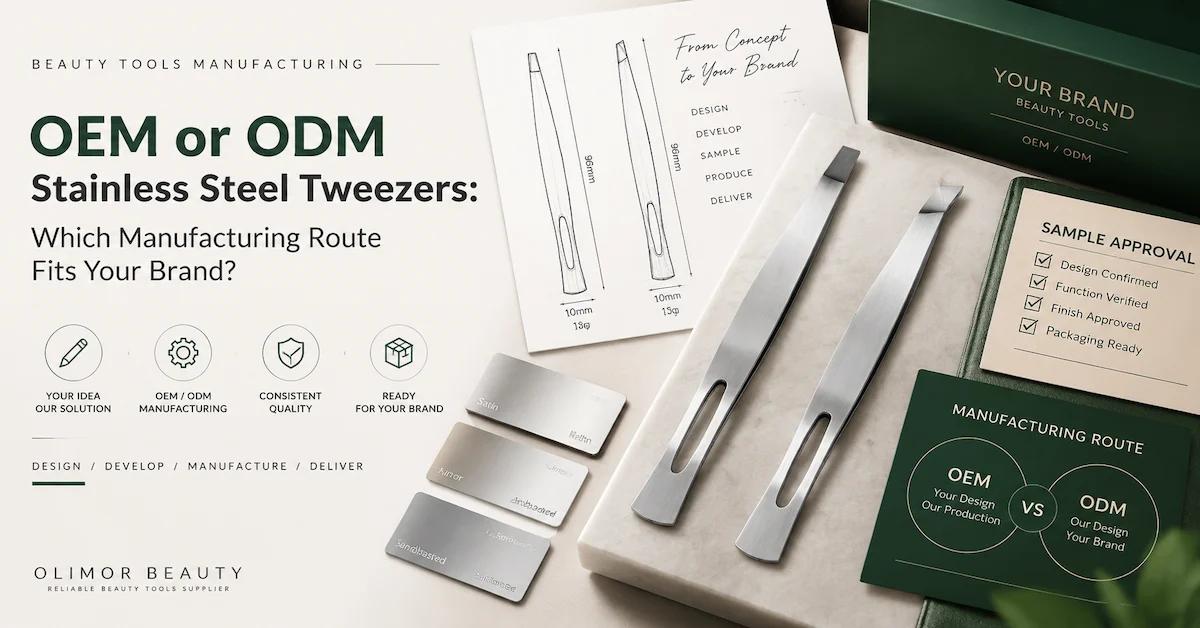
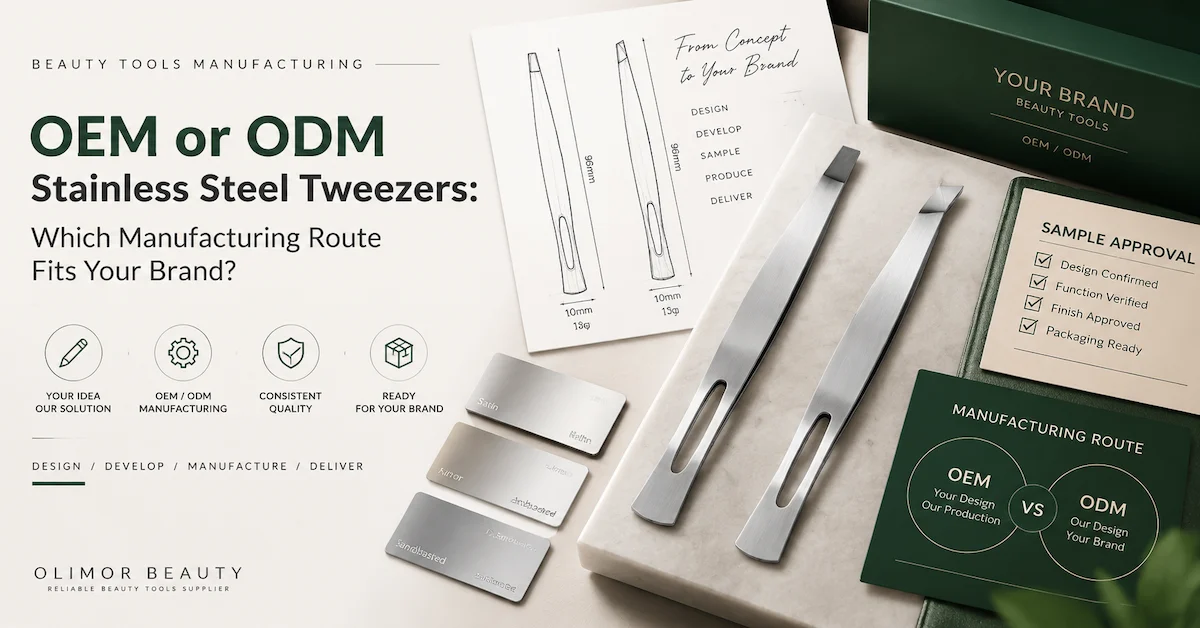
Quick answer: Choose the manufacturing route for stainless tweezers according to who controls the working-tip design. OEM fits a buyer with a controlled drawing or reference sample; ODM fits a buyer who needs the supplier to develop or adapt the product; private label fits an approved existing model with brand and packaging changes. For each route, approve tip contact, grip, finish and packed unit on the selected model, then confirm ownership, MOQ, timing and inspection evidence in writing. OLIMOR BEAUTY reports OEM/ODM and metal-tool manufacturing capabilities in Yangjiang, China, but no one route automatically proves a specific grade or performance result.
Define the user task before selecting OEM, ODM or private label
A tweezer that appears elegant in a catalogue may be unsuitable for the buyer’s specific task. Brow shaping, detail grooming, lash handling and a compact travel kit place different demands on the tips, arm stiffness, grip area and storage. Start with one sentence that describes the user and action. “An occasional retail customer needs a slanted-tip tool for controlled brow grooming” is a more useful brief than “premium stainless tweezers.” It gives the supplier a basis for choosing a reference model and proposing a test. If the project is for trained lash professionals, do not assume a general brow tweezer is an acceptable substitute.
The sales channel changes the package and proof. A salon distributor may want a replaceable single-tool unit with clear professional-use positioning. A beauty brand may need a logo, color system and consistent ecommerce photography. A retailer may care about hanging format, barcode placement and protection against a customer bending the tips before purchase. A travel-kit buyer may prioritize a protective sleeve and a compatible case slot. Put the market, application and unit of sale into the initial RFQ so the supplier does not quote a loose, unbranded tool when a retail-ready product is required.
OLIMOR BEAUTY’s client-provided information describes beauty and personal-care tool development and manufacture, including metal stamping, polishing, deburring, inspection, assembly and packaging, with a factory in Yangjiang, Guangdong. It reports support for drawings, samples, appearance concepts and structural requirements. These company-level facts explain why the supplier may be relevant to a tweezer project. They do not prove that the referenced model has a particular steel grade, tip tolerance, finish durability or fixed MOQ. Those belong to the product-specific conversation.
What does the actual OLIMOR product page establish?
If a buyer already has a reference sample, send it with a short note on what should be retained and what should improve. “Same tip, different finish” is a different job from “keep the color but redesign the tip.” If a drawing exists, identify its revision and who owns it. If neither exists, describe the user task and ask for two candidate products, not ten loosely related items. This reduces the risk that a polished sample impresses the brand team while the working behavior remains unsuitable.
For any route, request a physical approval sample in the intended finish. Tweezers are tactile products: arm movement and contact are difficult to approve from a rendering. The buyer should keep the approved sample in a protected sleeve and give it an identifier. If a later color or logo change is approved, it should not silently replace the functional reference unless the buyer deliberately signs off on the new version.
OEM: when the buyer controls the geometry
An OEM stainless steel beauty tools manufacturer project begins with buyer-controlled input: a drawing, a physical model, a detailed performance brief, or a combination. The manufacturer should review feasibility and propose a production route. The buyer should not expect a supplier to reproduce a competing product from one photograph and then treat the outcome as a fully defined OEM specification. Dimensions, tip shape, edge condition, permitted variation, surface treatment and packaging need an agreed reference.
OEM is appropriate when differentiation depends on something the buyer already understands and wants to own. A specific handle curve may be part of an established brand family. A tip profile may have been validated with its target users. A proprietary case may require exact fit. The buyer can supply those requirements and ask the supplier to identify process constraints, sample stages and one-time tooling or setup charges. A good feasibility response may recommend changing a detail to improve manufacturability; the buyer should decide whether the adjustment changes the user task.
Ownership must be written, not assumed from the label “OEM.” Identify which drawings were supplied by the buyer, which production drawings are created by the supplier, who owns new tooling, and whether the base design can be offered to other customers. State what happens if the project stops before production. Clarify whether a sample fee grants any right to drawings or merely covers sample work. These are commercial terms to resolve in a project agreement, not facts that a product-page image can answer.
Set a revision process before the first sample. A buyer may request a stronger grip, then a different logo, then a narrower sleeve; each change can affect cost or MOQ differently. Record change reason, affected drawing or sample, approval owner and whether a new functional exercise is required. Otherwise, the buyer and factory may quote different versions under the same product nickname.
ODM: when the supplier contributes a platform or development work
An ODM stainless steel beauty tools manufacturer route fits a buyer who can describe the application and commercial target but needs supplier input on form, mechanism or manufacturability. It can start from an existing platform and adapt a feature, or involve a deeper development proposal. Ask the supplier to separate the existing base from newly developed elements. A proposal may include a standard slanted-tip form, an alternative arm texture and a custom retail sleeve; that is different from a new tip geometry requiring fresh engineering.
ODM does not mean the supplier owns everything or the buyer owns everything. The proposal should identify background designs, buyer-provided artwork, newly created project files, tooling, and any exclusivity request. A brand may not need exclusive ownership of a standard platform, but it may need exclusive use of its logo and packaging artwork. If the manufacturer proposes a new feature and the buyer pays for development, decide whether the buyer receives rights to use that feature elsewhere. These questions are easier before work begins than after a sample succeeds.
ODM can shorten a route when an established model already performs the target task; it can also become costly if the project drifts from “adapt an existing product” into “invent a new one.” Ask for a written scope at each stage. A concept image is not a functional sample. A functional sample is not proof of a stable production process. A production-intent sample is not the same as an approved retail pack. Separate what each stage establishes and price the next decision only after the previous one is clear.
For an ODM comparison, request at least one alternative and its tradeoff. Why does the supplier favor a slanted, straight or pointed tip for the stated user? What does a different arm width change in handling or decoration area? Which package protects the working end? A thoughtful explanation is more valuable than a page of near-identical models with no application rationale.
Private label: when the base tool is already acceptable
Private label stainless steel beauty tools can be a sensible first move when the buyer approves an existing tweezer’s function and wants to change the brand presentation. The project still needs a current product identifier and protected master sample. Confirm whether the logo is on the tool, the sleeve, the carton or a combination. Confirm the method, position and legibility. A mark near a gripping surface may wear or interfere with handling; a mark visible only on packaging may not meet the brand’s long-term recognition objective.
Do not assume private label always has the lowest MOQ or shortest schedule. Printed packaging may have a separate minimum from the metal tool. A special finish may require a separate production run. A decorated sample may need setup and approval. Ask for three quotations if the decision is still open: standard product with standard pack, standard product with branded pack, and decorated product with branded pack. This reveals the cost and minimum associated with each layer instead of hiding all changes behind one “custom” price.
The buyer’s ecommerce team should review photography and claims against the actual approved version. A hero image showing a different tip or finish can create a mismatch even if the delivered tool is made well. Product detail pages should identify the intended use and avoid unverified claims about rustproof performance, surgical grade or treatment. Private label changes who communicates the product; it does not remove the need for evidence.
| Decision | OEM | ODM | Private label |
|---|---|---|---|
| Starting input | Buyer drawing or controlled sample | Buyer problem with supplier design input | Approved existing tool |
| Main uncertainty | Can the design be produced and repeated? | Which proposed platform solves the task? | Can brand and pack changes preserve the base model? |
| Sample evidence | Drawing-to-sample comparison | Concept, function and production-intent progression | Base sample plus decorated packed sample |
| Commercial focus | Tooling, IP, revision and production MOQ | Development scope, ownership and route | Logo method, print minimum and artwork |
| Reorder anchor | Buyer-controlled spec and master sample | Approved joint project file and master sample | Base model, logo proof and packed master |
Tip geometry is the specification customers feel first
For brow tweezers, a slanted tip may offer a different contact area and handling angle from a fine point. For lash work, precision, access and delicate handling may dominate; a generic “tweezer” specification will not do. Ask the supplier to state the intended tip form and show close-up images from consistent angles. Then use the real task in a controlled sample review. Record whether the tips meet evenly, whether an unintended gap or crossed edge appears, and whether the force feels appropriate for the user group. Do not substitute a showroom demonstration for the agreed inspection method.
Tip contact can be affected by forming, finishing and handling after manufacture. A tweezer that passes before packing may be bent by an overly tight insert or exposed tips in transit. The acceptance file therefore needs both a loose-tool check and a packed-unit check. If a tool is sold in a kit, compare its performance before and after repeated insertion into the retention loop. A case that looks attractive but stresses the arms can undermine the product.
A custom stainless steel beauty tools supplier should be able to discuss where variation enters the process and how it is identified. Ask what characteristic is checked after shaping, after finishing and at final release. OLIMOR reports in-process and final inspection as company capabilities, but the public material does not disclose this tweezer’s tip tolerance or inspection sampling. Those should be requested for the selected model and route.
Material, finish and grip need separate approvals
“Stainless steel” should be tied to the proposed component and designation. The British Stainless Steel Association’s material overview provides general background on stainless steels and their chromium-based protective surface film. It does not tell us the grade of the pictured OLIMOR tweezers. A brand should request the exact material description and relevant record for the intended version, especially before making a grade claim on retail packaging.
Finish affects appearance and handling. A mirror polish can show fingerprints; a satin finish may present scratches differently; a coating adds another process and potential wear question. These are design considerations, not claims that one treatment is universally superior. Approve a finish sample under the lighting in which the product will be marketed, then review the gripping area with dry and damp hands if relevant to the intended use. Ask what cleaning advice is compatible with the finish and whether the package needs a protective sleeve.
Grip can be altered by arm width, texture, spring behavior and tip alignment. A thicker or textured area may make the tool easier for a target user to hold, but it may also change stamping, finishing or logo placement. A design team should test the intended sample rather than approving it from a digital rendering. If the user feedback is mixed, document which issue the next revision addresses; changing several variables at once makes the results harder to interpret.
Do not use “surgical,” “medical,” “rustproof” or a specific cleaning or sterilization promise unless the model and market evidence support it. Beauty tools may be sold into different jurisdictions and channels. The supplier can contribute technical material and process information, while the buyer should review the claims that appear on packaging and listings. No specific certification or test value is asserted here for this product.

Design a staged sample approval instead of a single thumbs-up
Stage one is identity and task: confirm the candidate model, tip form, intended application and target user. Stage two is functional: compare arm movement, tip meeting and handling on the chosen task. Stage three is appearance: approve finish, logo and color on the real tool. Stage four is packed unit: review protection, insert, copy, barcode and carton. Stage five is production intent: ask whether the approved sample reflects the intended process and what inspection points will maintain it. A buyer may combine stages for a simple private-label order; a new OEM tip should not skip functional review.
For every stage, record who approved it and what remains unresolved. A sample can be approved “for appearance only” while functional work continues. This is preferable to writing “approved” and leaving the factory to guess. Retain rejected samples with a short explanation where practical. They clarify the boundary between a deliberate design choice and a recurring defect. If the buyer changes the package after product approval, check whether the pack can bend the tips or scratch a coated surface.
Ask the manufacturer to describe how production variation is controlled. What is checked on the line? What is checked at final packing? What happens to a unit that fails? Can the buyer review a redacted record format? A polished catalogue should not substitute for these answers. The client knowledge base lists OLIMOR’s inspection stages but does not give an AQL level or numerical tip standard; the project team must agree on those where needed.
Protect buyer IP without demanding the impossible
A buyer should distinguish its brand assets from a supplier’s pre-existing product platform. Logo files, package artwork and buyer-supplied drawings need clear access and use rules. A standard tweezer sold in different colors is not automatically exclusive because a brand ordered one color. If exclusivity matters, define its product scope, geography, duration, quantity commitment, development contribution and consequences of nonperformance. The supplier should state what it can actually promise.
For a new tip or handle, record who pays for the tooling, who maintains it, whether the buyer can inspect or move it, and what happens when the relationship ends. Also decide who holds the final production drawing and how deviations are approved. An ambiguous phrase such as “our design” is insufficient when one party supplied a sketch and the other completed the engineering. A balanced agreement can protect both contributions and keep the project commercially workable.
Confidentiality is useful but not a substitute for version control. Restrict access to buyer drawings, avoid sending uncontrolled files through many channels, and mark the active revision. A professional supplier comparison asks how the factory handles confidential inputs and subcontracted work. Do not publish an unverified claim that OLIMOR already follows a specific confidentiality protocol; ask the account team for the applicable agreement and process before sending proprietary drawings.
Make the package part of the functional specification
Packaging has three jobs: protect the tips, communicate the intended use and meet the sales channel’s practical needs. A loose tool in a polybag, a protective sleeve, a printed card and a rigid case are not equivalent. The chosen format influences print minimums, freight volume, sampling and customer experience. Ask whether the tool is restrained without forcing the arms together. Check whether the customer can remove it without touching a sharp or delicate tip. Review the back of the pack, not just its front.
For a private-label range, a shared visual system can reduce design effort across several tools, but it should not hide use differences. Brow, lash and grooming tools may need different names, instructions and protective arrangements. A stainless steel manicure tools manufacturer search may lead to sets; a set requires item-level identification and retention checks, while a standalone tweezer needs its own packed-unit standard. Link internally to a related OLIMOR set when the buyer wants a range, but do not assume one package specification fits both.
Send final artwork with dimensions, color references, logo clear space, barcode location, required language and copy owner. Ask for a digital proof, then a physical proof if print color, legibility or fit matters. Treat claims about material and care as technical content to be approved against evidence. A visually attractive sleeve cannot rescue a misdescribed tip, and a good tweezer can be commercially unusable if the barcode or importer details are wrong for the market.
What should a comparable OEM/ODM quotation include?
Ask every candidate to quote the same reference model, material question, tip form, finish, logo, package, quantity range and destination. A quotation for a loose standard tweezer cannot be compared directly with a decorated retail-ready unit. Separate the base product price, one-time sample or tooling cost, decoration, packaging, inspection, freight assumptions and any destination documents. State which elements control MOQ. If a supplier proposes an alternative model, put its advantages and differences in a separate column.
MOQ may be driven by material, finish, production setup, logo method or packaging print. A buyer may have flexibility on one of these but not another. Request a quantity ladder and ask whether mixed colors or models are possible; do not assume that one total quantity automatically covers several variants. Sampling and production lead times should be milestone-based. Clarify what starts the clock and what happens when artwork or sample approval is delayed. No fixed OLIMOR MOQ or delivery promise is available in the verified client facts used here.
| RFQ line | Required answer | Reason it matters |
|---|---|---|
| Model and tip | Exact SKU, geometry and revision | Prevents a cheaper but different tool being compared |
| Material | Component designation and record scope | Supports accurate buyer claims |
| Sample | Stage, charge, approval and production intent | Separates concept from release |
| Brand and finish | Method, location, color and proof | Defines the visual deliverable |
| Pack | Unit, insert, artwork and carton | Normalizes retail and logistics cost |
| IP and changes | File, tooling and revision rules | Protects repeat supply |
How to evaluate the supplier response
The best response is not necessarily the longest. It should answer the buyer’s actual task, identify the proposed route, show the model and sample evidence, and name unresolved decisions. If the supplier says “all stainless grades available” without connecting one to the selected version, ask again. If the response says “this finish requires a separate minimum, but the standard finish can be sampled now,” that is a useful commercial distinction. A supplier that points out a risk in the buyer’s drawing may save time and rework.
Use a scorecard with application fit, design ownership clarity, sample plan, material evidence, tip inspection, pack suitability, MOQ explanation, timeline assumptions and communication quality. Rate “not answered” separately from “cannot do.” A company may have the capability but need a fuller brief. Give it one opportunity to clarify with the exact product and quantity range. Do not award points for unverified certifications, customer logos or unsupported defect-rate claims. Ask for documents with legal entity, scope and validity if certification matters to procurement.
OLIMOR’s client facts mention ISO and BSCI credentials, but the standard number, certified legal entity, scope and expiry have not been entered into the knowledge base. This article therefore does not make a specific certification claim. A buyer may request the current documents and determine whether they apply to the proposed factory and project. A social-compliance assessment or management-system certificate is not a substitute for a tip-function or material record.
A sample RFQ that earns a specific answer
“We are a beauty brand selling in [market] through [channel]. Our intended user needs [specific tweezer task]. The linked OLIMOR product is a reference, not yet an approved specification. Please propose an existing model for private label and explain whether our proposed [tip/handle/finish] change would be OEM or ODM development. Quote [first-order range] and [potential reorder range] with the same unit of sale. We need the material description by component, an undecorated functional sample, a decorated packed sample, your proposed inspection characteristics and a milestone schedule. Please identify any tooling, artwork, packaging or logo minimum separately. We will review IP and drawing ownership before sending proprietary files.”
This template does not require the buyer to disclose its entire business plan. It supplies enough information to distinguish a serious project from an open-ended request for a catalogue and “best price.” The bracketed fields are placeholders, not claims. If the first supplier response answers only price, follow up on tip performance, sample stage and pack. If it answers only design ideas, ask for the commercial drivers. A high-quality inquiry is a two-way process: a concise buyer brief and a supplier response that identifies tradeoffs.
Keep the reordering specification alive
The approval file should survive staff turnover. Retain the base product code, current drawing, physical master, finish sample, logo proof, retail artwork, packed master, inspection plan, carton details and deviations. A change to any one of these should be dated and linked to an order. A reorder should ask the supplier to confirm what remains identical and what must be reconfirmed: quantity, market, material supply, packaging print or shipment term. “Same as before” is not a specification when several samples exist.
Check the first shipment against the master and photograph discrepancies in a consistent way. For a tip complaint, describe the contact or grip issue and compare affected units with the retained sample. For a finish complaint, record whether the mark arrived with the tool or developed after handling or cleaning. For a pack complaint, show the inner and outer protection. This helps the manufacturer investigate a relevant process rather than arguing about adjectives. A corrective action becomes valuable only when the next order uses the revised check or pack.
The same discipline can extend to a wholesale stainless steel beauty tools supplier relationship. A distributor carrying multiple tweezer models should maintain separate tip and pack references for each SKU, even when all share the same brand color. Standardize the administrative file, not the functional criteria. That is how a range remains recognizable without treating dissimilar tools as interchangeable.
Plan a design review around the user's actual grip
A useful design review has people perform the intended task with several coded samples and then describe what they noticed, without first telling them which version is “improved.” The buyer can record where the arms are held, whether the tips obscure the view, whether the tool feels controllable and where fatigue appears after normal use. This is not a clinical trial and should not be presented as one. It is a disciplined way to compare product options before deciding which details deserve tighter specification. If a tool is intended for trained professionals, recruit reviewers familiar with that task; occasional consumers may prioritize a different handling experience.
Keep the review conditions consistent. Use the same task, lighting, instruction and sample stage for each candidate. A coated sample can feel different from a bare metal prototype. A protective cap may change how quickly a user reaches the tool but not its grip during use. Record observations separately from preferences. “Sample B held the intended material under the agreed exercise” is different from “Reviewer preferred Sample B’s color.” The first can inform a functional requirement; the second informs branding.
If the design moves into ODM development, share only the findings the supplier needs to solve the problem. Tell it where users struggled, not simply that the buyer wants “more premium.” Ask what geometry or finish change is proposed and how the team will isolate that change in the next sample. For OEM, update the drawing with the approved adjustment. For private label, choose among existing platforms rather than asking the factory to make unpriced structural changes under a decoration-only quote.
Ask a China factory about the specific operation, not a generic tour
A search for a stainless steel beauty tools factory China often returns broad claims about equipment and capacity. A useful remote or onsite visit is tied to the selected tweezer. Ask how the arms are formed, where the tip is finished, how a coating is handled if specified, where inspection occurs and how accepted pieces are protected before packing. Ask which operations are in the factory and which are coordinated with a specialist. An honest production map is more actionable than a panoramic video of unrelated machinery.
For each handoff, ask how product identity and revision travel with the work. The approved sample may sit in the sales office while production uses a drawing; confirm that both represent the same version. If a tip needs adjustment, determine who may authorize it and how the change reaches final inspection. A viewer cannot establish these controls from a machine photograph. Request a sample process record or a redacted inspection form when commercially appropriate. The client information confirms OLIMOR’s in-process and final inspection capability, but not a published record for this exact SKU.
A buyer searching for a stainless steel grooming tools manufacturer may later add nail or facial tools to the range. Use the factory review to learn which capabilities transfer and which do not. A good tweezer-tip operation does not automatically validate a nipper blade; a shared polishing area does not make the inspection methods interchangeable. Build a product-family map that identifies common brand and pack elements while keeping function-specific release checks separate.
Resolve disagreement with the approved reference
When a buyer says a shipment “feels weaker,” the manufacturer may see no visible defect. Compare the retained master and current lot under a pre-agreed method. Record the grip task, evaluator, sample count and observed difference. Check whether the complaint affects all units or a subset. Look for changes in tip contact, arm shape, finish thickness or storage pressure. Do not assert a cause until evidence supports it. If the current product matches the agreed specification but users want a different feel, the issue is a redesign request, not necessarily a nonconforming lot.
This distinction matters commercially. A genuine deviation may call for sorting, correction or replacement under agreed terms. A new preference may require a revised sample and quote. A market listing error may require corrected product copy or photography. A pack-induced bend may require an insert redesign. Keep each route open until the facts identify it. The ability to diagnose a complaint against a documented reference is part of a dependable supplier relationship, even though no specific customer case is asserted in this article.
FAQ: stainless tweezers OEM, ODM and private label
Which route is fastest for a first brand launch?
A private-label version of an approved existing model may need less product development, but decoration and packaging can still require samples and separate minimums. Confirm the actual schedule and scope with the supplier.
Does OEM mean the buyer owns every file?
No. Ownership of buyer drawings, supplier process files, new production drawings and tooling should be addressed explicitly in the agreement.
Does ODM mean a completely new tool?
No. It may involve adapting an existing platform or developing a new feature. Ask the supplier to separate background design from project-specific development.
Can a picture prove tip alignment?
No. Use a physical sample and agreed task-based evaluation. Images are useful for identity and appearance but not for repeatable closing behavior.
Is a stainless grade published for the referenced OLIMOR model?
No grade is verified in the client knowledge base used for this article. Request a component-level designation and current supporting record before making a public claim.
What controls MOQ?
The model, finish, logo process, packaging and order configuration may each have different minimums. Ask for the controlling element of each quotation option.
Should the same QC check apply to brow and lash tweezers?
Not automatically. Their intended handling and tip requirements differ. Define the task and model-specific acceptance before selecting an inspection method.
What should be approved after the functional sample?
Finish, logo, packed unit, artwork and production-intent reference. An approval “for appearance only” should not be mistaken for functional release.
Can a distributor mix models in one order?
Ask for written model-, finish- and pack-level MOQ rules. A mixed shipment does not necessarily combine component or print minimums.
Where can I discuss my route with OLIMOR?
Send the product reference, use, market, quantity ranges and desired changes through the OLIMOR contact page.
Tag: