

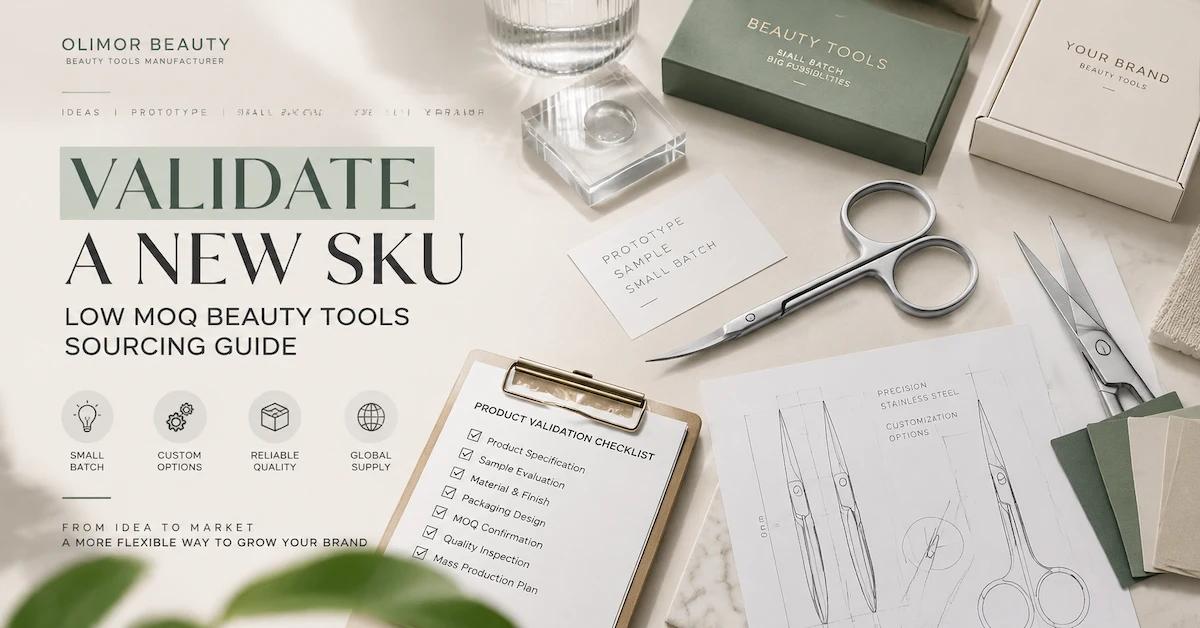
This guide addresses a real purchasing problem: How can a buyer test a new beauty-tool SKU in a small batch while keeping the project commercially repeatable? The intended readers are beauty brands, importers, retailers, distributors and ecommerce teams that need a manageable first order without losing control of product identity, quality evidence or repeat supply.
OLIMOR BEAUTY describes itself as a beauty and personal-care tools company supporting global brand, import, distribution and retail projects. Its provided company information confirms OEM and ODM support, development from drawings, physical samples, appearance concepts and structural requirements, plus listed capabilities in metal stamping, heat treatment, plastic injection, polishing, deburring, assembly, inspection and packaging. These capabilities are a starting point for an inquiry, not a substitute for model-specific confirmation.
The company information also confirms a China manufacturing and export context, with the factory located in Yangjiang, Guangdong, and export markets including Japan, the United States, France, Germany, Australia, Brazil, Argentina, India, Southeast Asia and the Middle East. Exact material, MOQ, lead time, certificate scope and test results remain project questions.
Buyer terminology used in this guide
Buyers may describe the project as a low MOQ beauty tools supplier search, a small batch beauty tools manufacturer inquiry, custom beauty tools low MOQ sourcing, an OEM beauty tools manufacturer low MOQ program, an ODM beauty tools manufacturer low MOQ program, private label beauty tools low MOQ development, a beauty tools factory China low MOQ request, or a wholesale beauty tools supplier low MOQ comparison. These phrases overlap, but the RFQ must still define the selected model, change scope, packaging and quantity assumptions.
1. Turn the buyer problem into a measurable brief
Treat the 'turn the buyer problem into a measurable brief' review as a decision gate, not a box to tick. For a buyer validating a beauty-scissors SKU, the buyer should state the commercial reason for the requirement, the person who approves it and the evidence that will close the question. That turns an open-ended request into a manageable supplier response.
Start the review with the linked product identity and then mark every requested change. Separate decoration, packaging, component changes and new development because each can affect sampling, minimums and schedule differently. Ask the supplier to show those effects instead of combining them in one unexplained price.
Close this gate with a named record: an approved sample, artwork proof, specification, inspection point or written commercial assumption. If the answer depends on the selected model, retain it as an RFQ question. Do not convert a conditional supplier response into a public product claim.
2. Separate product identity from decoration
The purpose of the 'separate product identity from decoration' review is to prevent two teams from discussing different products. For a buyer validating a beauty-scissors SKU, write the requirement in buyer language first, then ask the supplier to translate it into product, process and packaging terms. Ambiguous adjectives such as premium, strong or high quality need an observable acceptance point.
A useful working file shows what is fixed, what is preferred and what remains open. Fixed items may include the application and destination; preferred items may include finish or package; open items may include the practical route or quantity band. This gives the supplier room to propose an option without quietly changing the buyer's objective.
The evidence should match the claim. A photograph supports appearance, not hardness or material grade. A product link supports model identity, not current stock or lead time. A test record supports only the tested sample and stated method. Keep this distinction visible in the approval notes.
3. Choose the smallest meaningful test
Use the 'choose the smallest meaningful test' step to make the quotation comparable. For a buyer validating a beauty-scissors SKU, send every candidate supplier the same product reference, unit of sale, destination, quantity range and customization list. Otherwise, a lower quote may simply omit decoration, retail packaging, inspection or a required component.
Ask for one-time charges and recurring charges to be shown separately. Sample, tooling, artwork or setup costs affect the launch, while product, packaging and inspection assumptions affect repeat orders. This separation matters when a small first order is intended to become a regular program.
Before approving the commercial answer, check its validity period, exclusions and dependencies. A schedule should state what starts the clock. An MOQ should state the controlling model, finish, component or package. A material statement should identify the applicable part and supporting record.
4. Write a sample acceptance sheet
A disciplined 'write a sample acceptance sheet' review reduces rework after sampling. For a buyer validating a beauty-scissors SKU, identify the earliest stage at which a mistake can be seen and corrected. An artwork issue can be found in a digital proof; a fit issue may require a physical sample; a carton assumption may need a packed-unit review.
Assign an owner on both sides. The buyer owns the market brief, mandatory claims and approval decision. The supplier explains feasibility, applicable processes and model-level evidence. When a third-party laboratory, packaging vendor or logistics provider is involved, record exactly which question that party answers.
Use dated revisions rather than screenshots scattered across messages. The current file should identify the product, option, artwork, package, inspection notes and accepted deviations. A clean record protects the first order and makes the next inquiry much faster.
5. Protect the working-end requirement
The commercial value of the 'protect the working-end requirement' step appears at reorder time. For a buyer validating a beauty-scissors SKU, decide which details must remain identical and which may be reconfirmed. Product geometry, approved appearance and brand placement may be controlled references, while quantity, shipping term and destination documents may change with each order.
Ask the supplier how a requested change is classified. A different logo position is not the same as a new working end; a new carton is not the same as a new component. Classification helps the buyer understand whether a new sample, minimum, setup or approval step is needed.
Keep the release package concise enough to use. Include the current product link or code, approved physical reference, artwork revision, pack proof, inspection requirements and commercial assumptions. Archive obsolete versions so they cannot return accidentally during replenishment.
6. Review hand feel and user context
Review the 'review hand feel and user context' question from the end user's context, not only from the factory's production view. For a buyer validating a beauty-scissors SKU, describe where the product is sold, how it is handled, what the package must communicate and which failure would create the greatest commercial harm. That context helps the supplier prioritize meaningful controls.
Translate the context into independent questions. Ask about the selected component, the relevant surface, the applicable operation and the evidence retained for release. Do not ask a broad question such as 'Is quality good?' when the real concern is alignment, count, finish, protection or artwork readability.
A strong supplier response will distinguish confirmed capability from project assumptions. OLIMOR-provided information can establish company-level OEM, ODM, production, inspection and packaging capabilities, while the RFQ must still confirm the SKU-specific material, MOQ, timing, certificate scope and test result.
7. Decide what the package must prove
Treat the 'decide what the package must prove' review as a decision gate, not a box to tick. For a buyer validating a beauty-scissors SKU, the buyer should state the commercial reason for the requirement, the person who approves it and the evidence that will close the question. That turns an open-ended request into a manageable supplier response.
Start the review with the linked product identity and then mark every requested change. Separate decoration, packaging, component changes and new development because each can affect sampling, minimums and schedule differently. Ask the supplier to show those effects instead of combining them in one unexplained price.
Close this gate with a named record: an approved sample, artwork proof, specification, inspection point or written commercial assumption. If the answer depends on the selected model, retain it as an RFQ question. Do not convert a conditional supplier response into a public product claim.
8. Use a revision-controlled artwork file
The purpose of the 'use a revision-controlled artwork file' review is to prevent two teams from discussing different products. For a buyer validating a beauty-scissors SKU, write the requirement in buyer language first, then ask the supplier to translate it into product, process and packaging terms. Ambiguous adjectives such as premium, strong or high quality need an observable acceptance point.
A useful working file shows what is fixed, what is preferred and what remains open. Fixed items may include the application and destination; preferred items may include finish or package; open items may include the practical route or quantity band. This gives the supplier room to propose an option without quietly changing the buyer's objective.
The evidence should match the claim. A photograph supports appearance, not hardness or material grade. A product link supports model identity, not current stock or lead time. A test record supports only the tested sample and stated method. Keep this distinction visible in the approval notes.
9. Ask for a realistic quantity ladder
Use the 'ask for a realistic quantity ladder' step to make the quotation comparable. For a buyer validating a beauty-scissors SKU, send every candidate supplier the same product reference, unit of sale, destination, quantity range and customization list. Otherwise, a lower quote may simply omit decoration, retail packaging, inspection or a required component.
Ask for one-time charges and recurring charges to be shown separately. Sample, tooling, artwork or setup costs affect the launch, while product, packaging and inspection assumptions affect repeat orders. This separation matters when a small first order is intended to become a regular program.
Before approving the commercial answer, check its validity period, exclusions and dependencies. A schedule should state what starts the clock. An MOQ should state the controlling model, finish, component or package. A material statement should identify the applicable part and supporting record.
10. Compare first order and reorder economics
A disciplined 'compare first order and reorder economics' review reduces rework after sampling. For a buyer validating a beauty-scissors SKU, identify the earliest stage at which a mistake can be seen and corrected. An artwork issue can be found in a digital proof; a fit issue may require a physical sample; a carton assumption may need a packed-unit review.
Assign an owner on both sides. The buyer owns the market brief, mandatory claims and approval decision. The supplier explains feasibility, applicable processes and model-level evidence. When a third-party laboratory, packaging vendor or logistics provider is involved, record exactly which question that party answers.
Use dated revisions rather than screenshots scattered across messages. The current file should identify the product, option, artwork, package, inspection notes and accepted deviations. A clean record protects the first order and makes the next inquiry much faster.
11. Plan destination-market questions
The commercial value of the 'plan destination-market questions' step appears at reorder time. For a buyer validating a beauty-scissors SKU, decide which details must remain identical and which may be reconfirmed. Product geometry, approved appearance and brand placement may be controlled references, while quantity, shipping term and destination documents may change with each order.
Ask the supplier how a requested change is classified. A different logo position is not the same as a new working end; a new carton is not the same as a new component. Classification helps the buyer understand whether a new sample, minimum, setup or approval step is needed.
Keep the release package concise enough to use. Include the current product link or code, approved physical reference, artwork revision, pack proof, inspection requirements and commercial assumptions. Archive obsolete versions so they cannot return accidentally during replenishment.
12. Create a supplier response scorecard
Review the 'create a supplier response scorecard' question from the end user's context, not only from the factory's production view. For a buyer validating a beauty-scissors SKU, describe where the product is sold, how it is handled, what the package must communicate and which failure would create the greatest commercial harm. That context helps the supplier prioritize meaningful controls.
Translate the context into independent questions. Ask about the selected component, the relevant surface, the applicable operation and the evidence retained for release. Do not ask a broad question such as 'Is quality good?' when the real concern is alignment, count, finish, protection or artwork readability.
A strong supplier response will distinguish confirmed capability from project assumptions. OLIMOR-provided information can establish company-level OEM, ODM, production, inspection and packaging capabilities, while the RFQ must still confirm the SKU-specific material, MOQ, timing, certificate scope and test result.
13. Review process capability by operation
Treat the 'review process capability by operation' review as a decision gate, not a box to tick. For a buyer validating a beauty-scissors SKU, the buyer should state the commercial reason for the requirement, the person who approves it and the evidence that will close the question. That turns an open-ended request into a manageable supplier response.
Start the review with the linked product identity and then mark every requested change. Separate decoration, packaging, component changes and new development because each can affect sampling, minimums and schedule differently. Ask the supplier to show those effects instead of combining them in one unexplained price.
Close this gate with a named record: an approved sample, artwork proof, specification, inspection point or written commercial assumption. If the answer depends on the selected model, retain it as an RFQ question. Do not convert a conditional supplier response into a public product claim.
14. Clarify inspection ownership
The purpose of the 'clarify inspection ownership' review is to prevent two teams from discussing different products. For a buyer validating a beauty-scissors SKU, write the requirement in buyer language first, then ask the supplier to translate it into product, process and packaging terms. Ambiguous adjectives such as premium, strong or high quality need an observable acceptance point.
A useful working file shows what is fixed, what is preferred and what remains open. Fixed items may include the application and destination; preferred items may include finish or package; open items may include the practical route or quantity band. This gives the supplier room to propose an option without quietly changing the buyer's objective.
The evidence should match the claim. A photograph supports appearance, not hardness or material grade. A product link supports model identity, not current stock or lead time. A test record supports only the tested sample and stated method. Keep this distinction visible in the approval notes.
15. Record deviations instead of hiding them
Use the 'record deviations instead of hiding them' step to make the quotation comparable. For a buyer validating a beauty-scissors SKU, send every candidate supplier the same product reference, unit of sale, destination, quantity range and customization list. Otherwise, a lower quote may simply omit decoration, retail packaging, inspection or a required component.
Ask for one-time charges and recurring charges to be shown separately. Sample, tooling, artwork or setup costs affect the launch, while product, packaging and inspection assumptions affect repeat orders. This separation matters when a small first order is intended to become a regular program.
Before approving the commercial answer, check its validity period, exclusions and dependencies. A schedule should state what starts the clock. An MOQ should state the controlling model, finish, component or package. A material statement should identify the applicable part and supporting record.
16. Prepare the first replenishment conversation
A disciplined 'prepare the first replenishment conversation' review reduces rework after sampling. For a buyer validating a beauty-scissors SKU, identify the earliest stage at which a mistake can be seen and corrected. An artwork issue can be found in a digital proof; a fit issue may require a physical sample; a carton assumption may need a packed-unit review.
Assign an owner on both sides. The buyer owns the market brief, mandatory claims and approval decision. The supplier explains feasibility, applicable processes and model-level evidence. When a third-party laboratory, packaging vendor or logistics provider is involved, record exactly which question that party answers.
Use dated revisions rather than screenshots scattered across messages. The current file should identify the product, option, artwork, package, inspection notes and accepted deviations. A clean record protects the first order and makes the next inquiry much faster.
17. Use photos without overclaiming
The commercial value of the 'use photos without overclaiming' step appears at reorder time. For a buyer validating a beauty-scissors SKU, decide which details must remain identical and which may be reconfirmed. Product geometry, approved appearance and brand placement may be controlled references, while quantity, shipping term and destination documents may change with each order.
Ask the supplier how a requested change is classified. A different logo position is not the same as a new working end; a new carton is not the same as a new component. Classification helps the buyer understand whether a new sample, minimum, setup or approval step is needed.
Keep the release package concise enough to use. Include the current product link or code, approved physical reference, artwork revision, pack proof, inspection requirements and commercial assumptions. Archive obsolete versions so they cannot return accidentally during replenishment.
18. Build a clean RFQ email
Review the 'build a clean rfq email' question from the end user's context, not only from the factory's production view. For a buyer validating a beauty-scissors SKU, describe where the product is sold, how it is handled, what the package must communicate and which failure would create the greatest commercial harm. That context helps the supplier prioritize meaningful controls.
Translate the context into independent questions. Ask about the selected component, the relevant surface, the applicable operation and the evidence retained for release. Do not ask a broad question such as 'Is quality good?' when the real concern is alignment, count, finish, protection or artwork readability.
A strong supplier response will distinguish confirmed capability from project assumptions. OLIMOR-provided information can establish company-level OEM, ODM, production, inspection and packaging capabilities, while the RFQ must still confirm the SKU-specific material, MOQ, timing, certificate scope and test result.
19. Evaluate response quality
Treat the 'evaluate response quality' review as a decision gate, not a box to tick. For a buyer validating a beauty-scissors SKU, the buyer should state the commercial reason for the requirement, the person who approves it and the evidence that will close the question. That turns an open-ended request into a manageable supplier response.
Start the review with the linked product identity and then mark every requested change. Separate decoration, packaging, component changes and new development because each can affect sampling, minimums and schedule differently. Ask the supplier to show those effects instead of combining them in one unexplained price.
Close this gate with a named record: an approved sample, artwork proof, specification, inspection point or written commercial assumption. If the answer depends on the selected model, retain it as an RFQ question. Do not convert a conditional supplier response into a public product claim.
20. Release only after evidence is complete
The purpose of the 'release only after evidence is complete' review is to prevent two teams from discussing different products. For a buyer validating a beauty-scissors SKU, write the requirement in buyer language first, then ask the supplier to translate it into product, process and packaging terms. Ambiguous adjectives such as premium, strong or high quality need an observable acceptance point.
A useful working file shows what is fixed, what is preferred and what remains open. Fixed items may include the application and destination; preferred items may include finish or package; open items may include the practical route or quantity band. This gives the supplier room to propose an option without quietly changing the buyer's objective.
The evidence should match the claim. A photograph supports appearance, not hardness or material grade. A product link supports model identity, not current stock or lead time. A test record supports only the tested sample and stated method. Keep this distinction visible in the approval notes.
| Buyer question | Practical answer | Evidence to request |
|---|---|---|
| What controls MOQ? | Model, finish, packaging and order configuration | Written MOQ explanation for the selected SKU |
| Can a small batch be branded? | Often possible, but method and surface must be confirmed | Decorated sample and artwork proof |
| How is quality checked? | Use model-specific function, appearance, packing and shipment checks | Inspection plan and approved sample |
| How can a reorder match? | Keep a master sample and current revision package | Product file, artwork and deviation log |
1. Search intent: small-batch product validation
The primary intent is Commercial Investigation and RFQ Intent. A buyer is not asking for a generic low-price list. The buyer wants to know whether a small quantity can validate demand, whether the supplier can protect the intended design, and which commercial assumptions affect the first order.
The phrase low MOQ beauty tools supplier should therefore lead to a model-level conversation. Ask whether the supplier is quoting a standard product, a configurable product or a new development. Ask which part of the requested change controls the minimum. A printed carton, special finish, injected handle, logo method or new tool can each create a different MOQ condition.
2. Define what low MOQ means for your project
Low MOQ is relative to the buyer’s channel and launch plan. A salon distributor may call a small first order low MOQ because it is testing one region. A direct-to-consumer brand may need a smaller quantity to validate product pages and paid traffic. A retailer may need several SKUs in modest quantities rather than one large run. The buyer should state the commercial use instead of presenting low MOQ as an unexplained number.
A small batch beauty tools manufacturer should be asked to separate the base platform from the custom scope. The platform may be an existing pair of scissors, while logo, finish, pouch, card, carton or set composition changes the cost and minimum. That separation lets the buyer choose which parts to test first.
- State the first-order quantity range and expected reorder range.
- Name the sales channel and destination market.
- Identify fixed, preferred and open product requirements.
- Ask what changes the MOQ and what changes only the unit cost.
- Request an itemized quote with one-time and recurring charges.
3. Use a real OLIMOR product as the evidence anchor
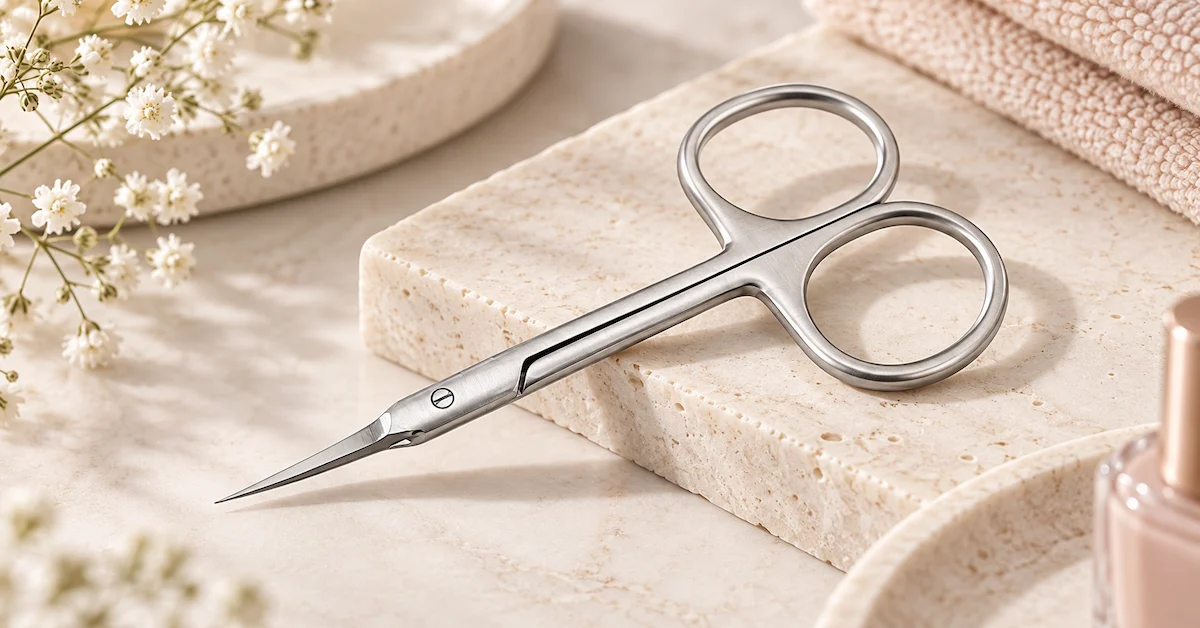
The linked OLIMOR beauty scissors page gives the buyer a concrete SKU to discuss. The image shows a slim scissor form with finger loops and a narrow working end. That is enough to start questions about use, hand feel, logo placement, protective packaging and the preferred retail unit. It does not prove a material grade, cutting test, production quantity or delivery date.
For this model, a buyer can ask whether the first batch should use the existing geometry with a logo, or whether the handle, working end, finish or pack should change. A low MOQ program usually benefits from testing one variable at a time. If the buyer changes geometry and packaging together, it becomes harder to know which change created a cost or approval issue.
4. Compare standard, configurable and new-development routes
| Route | What changes | Small-batch question | Approval evidence |
|---|---|---|---|
| Standard platform | No geometry change; brand or pack may be added | Can the platform be ordered with the requested mark? | Decorated product and pack proof |
| Configurable | Finish, colour, set or package changes | Which option controls MOQ? | Physical finish and packed sample |
| New development | Handle, working end, mechanism or case changes | What sample and tooling are required? | Drawing, feasibility note and development sample |
| Hybrid | Standard tool plus new pack or component | Can the base SKU and new element be quoted separately? | Component-level release package |
A custom beauty tools low MOQ project should use the smallest route that solves the buyer’s actual problem. If the buyer needs only a branded retail unit, a standard platform may be sufficient. If the buyer needs a different grip for a target user, the project may require a component change. If the buyer needs a distinctive working end, the development route must be priced and sampled honestly.
5. How OEM and ODM affect the first order
An OEM beauty tools manufacturer low MOQ project normally starts with stronger buyer input: a drawing, physical sample, dimensions, appearance concept or structural requirement. The supplier should identify feasibility questions and the production route. An ODM beauty tools manufacturer low MOQ project starts with more supplier contribution. The buyer may provide the user problem and appearance direction while the supplier proposes a platform, configuration or development option.
Do not use OEM and ODM as shortcuts for a quantity promise. Both routes need a model-specific MOQ. A standard ODM platform with a simple package may be more practical for a pilot than a new OEM geometry. Conversely, an OEM drawing can be efficient if the buyer has already frozen the product and wants execution rather than concept development.
| Input | OEM route | ODM route | Buyer check |
|---|---|---|---|
| Product definition | Buyer-controlled drawing or sample | Supplier contributes concept or platform | Which file controls the sample? |
| MOQ driver | Geometry, tooling and production route | New parts, finish and package scope | What element controls the minimum? |
| Sample | Execution sample against buyer input | Development sample plus proposal | What does the sample prove? |
| IP | Buyer files and supplier process input | Base platform and new project output | Who owns each asset? |
6. Material and process questions for a low MOQ order
A stainless steel beauty tools supplier should identify the material description for the selected model instead of allowing a silver photograph to become a grade claim. Ask which components are metal, which finish is applied, how the surface is checked and which documentation is available for the destination market.
The company information lists metal stamping, heat treatment, plastic injection, polishing, deburring, assembly, inspection and packaging. Map only the applicable operations to the scissors SKU. Ask whether the working end, handle, surface and package have separate inspection points. If a test is not applicable, keep it out of the public claim.
| Process area | Buyer question | Evidence |
|---|---|---|
| Forming or stamping | What operation creates the selected geometry? | Process map or supplier explanation |
| Heat treatment | Does the model require it and how is it checked? | Applicable method and record format |
| Polishing and deburring | How is surface and edge condition reviewed? | Sample comparison and inspection point |
| Assembly | Which parts must align or move? | Functional sample check |
| Packaging | How is the scissor protected in the unit of sale? | Packed master and carton plan |

7. Packaging can control the economics
Small-batch packaging is often where buyers discover that a low-MOQ request has multiple minimums. The tool may be available in a modest quantity while a printed carton, insert, sleeve or custom pouch requires a separate run. Ask the supplier to quote standard packaging, semi-custom packaging and fully custom packaging as separate options.
For custom logo beauty tools, define the logo surface and package surface together. A mark can be clear on a metal body but hidden in a pouch. A hanging card can show the brand but may require different artwork and barcode information. A carton can protect the scissor while changing the shipping assumptions. Review the complete retail unit, not just the loose product.
8. Build a model-specific quality plan
A low quantity does not remove the need for an approval reference. It makes the reference more important because the buyer may be learning which requirements matter. Define function, appearance, logo, package, quantity, carton marks and any destination documents. OLIMOR confirms production-process inspection and finished-goods shipment inspection as company capabilities; ask how they apply to the chosen model.
Do not copy a generic defect list from another tool. A scissor may need a different functional check from a tweezer or nail clipper. Ask the supplier to state the inspection characteristic, method, sample basis and disposition when a result is outside the agreed requirement.
9. Cost, MOQ and schedule questions to put in the RFQ
| RFQ line | Question | Reason |
|---|---|---|
| Unit product | Which exact model and finish are quoted? | Prevents standard and custom items being mixed |
| Logo | Which method, position and proof are included? | Controls decoration scope |
| Pack | What is the unit of sale and carton assumption? | Makes logistics comparable |
| MOQ | What process or component controls the minimum? | Explains the number instead of hiding it |
| Sample | What sample stages are included? | Protects approval and rework decisions |
| Schedule | What starts each milestone? | Avoids unsupported fixed dates |
| Documents | Which certificates or reports apply? | Keeps market claims precise |
10. Reorder control for a first small batch
The first order should create a repeat-order file. Keep the approved sample, product link, drawing or specification, logo proof, packaging artwork, inspection plan, carton data and approved deviations together. When the buyer returns, the supplier can quote the same configuration instead of interpreting a new email from memory.
A beauty tools factory China low MOQ inquiry should also ask how the factory handles a change. If the buyer changes the finish, package or quantity, request a reconfirmation of MOQ and timing. A low-MOQ program is not a promise that every later change will keep the first-order economics.
11. FAQ for low-MOQ beauty tools buyers
What is low MOQ for beauty tools?
There is no universal number. MOQ depends on model, finish, packaging and order configuration. Ask for a model-specific explanation.
Can a small batch include a logo?
Logo feasibility depends on surface, method, placement and packaging. Request a decorated sample and artwork proof.
Is low MOQ available for custom geometry?
It may require a different development and tooling route. Ask the manufacturer to separate standard, configurable and new-development options.
What should a buyer send first?
Send the product URL or sample, use case, market, quantity range, logo, packaging idea and desired timing.
Can OLIMOR support OEM and ODM?
OLIMOR-provided information confirms OEM and ODM support. The exact scope must be confirmed for the selected model.
How should material be described?
Use the model-specific material description confirmed by the supplier. Do not infer a grade from appearance.
What does small-batch quality evidence look like?
Use an approved sample, model-specific inspection plan, product identity, pack proof and shipment record.
How do I request a wholesale quote?
Link the product page, state first and repeat quantities, ask for MOQ drivers and request an itemized quote.
Are the scene images factory evidence?
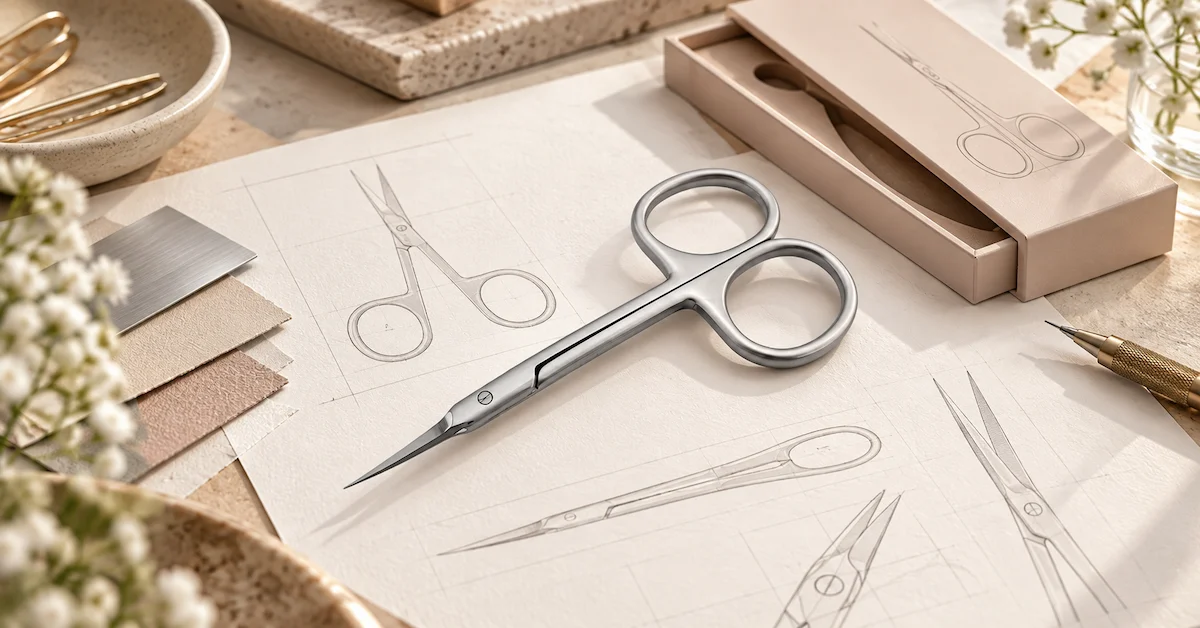
No. They are editorial workflow visualizations created for explanation.
Where should the inquiry go?
Use the OLIMOR contact page and include the complete RFQ fields.
Tag: