











Custom Logo Tweezers for Beauty Brands: What to Check Before Ordering
Custom logo tweezers are small tools, but they carry a large branding responsibility. A tweezer may be used daily by salon professionals, brow artists, makeup users, grooming kits, gift-set buyers and retail customers. If it pulls cleanly, feels balanced and still looks good after repeated handling, the logo on the handle gains value. If the tips misalign or the finish wears quickly, the branding can work against the business.
For beauty brands and distributors, the goal is not simply to place a logo on a metal tool. The goal is to choose tweezers that combine accurate gripping performance with a finish, logo method and packaging plan that match the selling channel. Olimor Beauty supplies beauty tools for buyers who need practical product options and factory communication. You can review broader beauty tool products or compare categories through Olimor product collections when planning a branded tool range.
Why Custom Logo Tweezers Work Well for Beauty Branding
Tweezers are a strong branding item because they are compact, useful and easy to add to multiple product formats. They can be sold as a standalone grooming tool, included in brow kits, packed with lash accessories, added to travel beauty sets or used as salon retail merchandise. Unlike disposable promotional items, a good pair of tweezers may stay in a makeup bag, treatment room or bathroom cabinet for a long time.
The branding area is also naturally visible. A logo on the handle can be seen when the tool is held, displayed in packaging or photographed for online listings. For retailers, this creates a simple way to connect the physical tool with the store, salon or beauty brand identity. For distributors, custom logo tweezers can help separate a private-label offer from generic tools in the same price segment.
However, branding should never hide poor performance. The user judges the tool first by whether it grips fine hairs, feels comfortable and closes evenly. The logo then reinforces the impression of quality. For this reason, selection should begin with the tweezer structure before moving to color, logo size or packaging design.
Tip Precision Matters More Than Decoration
The tweezer tip is the working part of the product. Even an attractive finish will not compensate for tips that do not meet cleanly. In buyer evaluations, the most important checks are tip alignment, closing tension and edge smoothness. The tips should come together consistently without visible gaps, and the tool should grip short or fine hairs without excessive pressure.
Different buyers may need different tip styles depending on the target use. Slanted tips are common for brow grooming because they give a useful angle for shaping. Pointed tips may be selected for more detailed work, while flat or straight tips can suit broader gripping tasks. If the exact use case is unclear, it is better to define the customer first: brow salon, retail grooming kit, travel kit, lash accessory set or professional makeup case.
When comparing samples, do not rely only on appearance. Test how the tips close at the very end, not only near the center. Check whether the arms spring back evenly and whether the gripping surface feels too sharp, too blunt or inconsistent. These small details affect user comfort and return rates more than decorative features.
Logo Placement, Finish and Readability
A custom logo should look intentional on the tweezer body. Placement is usually easiest on the handle area, where there is enough length for a name, mark or short slogan. The logo should not be so large that it wraps awkwardly around curved surfaces or becomes distorted near the edge. It should also leave enough blank space for a clean, retail-ready appearance.
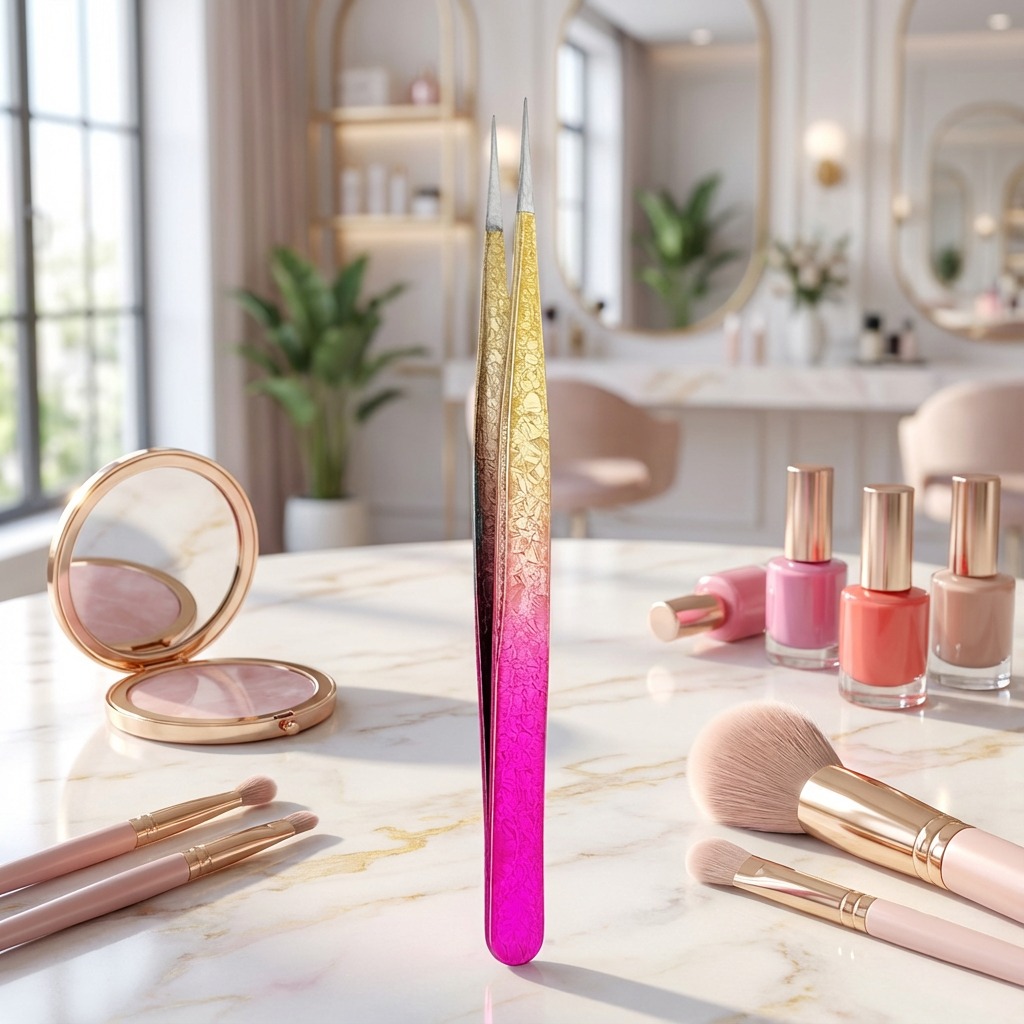
Finish choice affects how the logo is perceived. A polished metallic surface, matte coating, color finish or gradient appearance can all create different brand impressions. The original product trend behind this page includes vibrant tweezers and gradient-style designs, including transitions such as gold to hot pink. These finishes can suit beauty brands that want a more visible retail presence, while simpler colors may suit spa, clinical or minimalist product lines.
Before approving a logo design, review it at actual tweezer size. A logo that looks clear on a digital mockup may become crowded on a narrow handle. Thin lettering, complex icons and low-contrast colors can be difficult to read. For private-label programs, a simpler mark often prints more cleanly and photographs better for e-commerce.
Buyer Checklist for Custom Logo Tweezers
A structured checklist helps buyers compare samples and avoid focusing only on unit appearance. The following points are useful for salons, beauty retailers, wholesalers and brand owners preparing a custom order.
- Tip alignment: The tips should meet evenly at the end and grip without slipping.
- Comfort: The handle should feel stable and not require excessive squeezing force.
- Material suitability: Stainless steel components are commonly used for tweezers because they support durability and precision when produced well.
- Logo clarity: The logo should remain readable at real size and should suit the finish color.
- Finish consistency: Check color, coating and surface appearance across multiple samples, not only one piece.
- Packaging fit: Confirm whether the tweezer sits securely in its package and whether the logo remains visible.
- Market use: Match the style to the sales channel, such as salon retail, online beauty kits, wholesale distribution or promotional gifting.
- Inspection plan: Define what should be checked before shipment, including alignment, finish, logo position and packaging condition.
Export and Factory-Direct Sourcing Considerations
For international buyers, sourcing custom logo tweezers is not only about choosing a sample. It also involves communication, repeatability and packaging control. A factory-direct approach can help buyers discuss customization details earlier in the process, including finish, logo position and packing requirements. It may also reduce the number of handoffs between product development and production communication.
When evaluating a tweezers supplier, look for practical answers rather than broad claims. Buyers should clarify the available tweezer shapes, logo methods, color options, packaging formats and sample approval steps. It is also useful to understand how incoming materials, production appearance and final packing are checked. The original product information emphasizes inspection from raw materials to packaging, which is a relevant point for buyers who need consistent export quality.
Long-term supplier relationships are especially important for private-label tools because a brand may reorder the same item for months or years. If the finish tone, logo size or packaging layout changes unexpectedly, the retail range can look inconsistent. Clear approval files, reference samples and written order details help reduce this risk.
Packaging and Retail Presentation
Packaging should protect the tweezer tips and support the brand message. A good package prevents tip damage during shipping and handling, while also making the product easy to display or sell online. For retail, the customer should be able to understand the tool type quickly. For professional or kit use, secure and compact packaging may matter more than shelf impact.
Beauty brands should consider how the product will be photographed. A highly reflective tweezer finish may look attractive in person but require careful lighting for e-commerce images. A logo that is hidden by packaging may reduce the value of customization. If the tweezer is part of a larger set, the finish and logo should coordinate with the other beauty tools rather than compete with them.
Simple packaging checks include tip protection, barcode or label area, hang-hole needs, insert stability and carton arrangement. These details can affect both customer experience and warehouse handling. For distributors, consistent packaging dimensions may also help with storage and shipment planning.
How to Prepare a Better Custom Tweezer Inquiry
A clear inquiry helps the supplier respond with more relevant options. Before contacting Olimor Beauty, prepare basic information about the target user, preferred tweezer shape, finish direction, logo artwork, packaging needs and destination market. If exact specifications are not decided, describe the use case: for example, brow salon retail, makeup gift set, online grooming product or wholesale beauty accessory.
It is also helpful to share whether the order is a first test project, a private-label launch or a repeat program. This helps prioritize sample confirmation, logo readability and packaging planning. To discuss available options, buyers can contact Olimor or send an inquiry with artwork and project details.
Custom logo tweezers succeed when the tool performs first and the branding supports that performance. By checking tip precision, finish consistency, logo placement and packaging before placing an order, beauty brands can create a practical branded product that users are more likely to keep, use and associate with reliable quality.