

Women’s Nail Clippers: Hygiene, Precision and B2B Selection Guide
Nail clippers for women should do one simple job reliably: shorten the nail cleanly without crushing, tearing or leaving uncomfortable sharp points. For everyday users, that means easier hand hygiene, neater natural nails and fewer snags on fabric, hair or gloves. For retailers, salons and beauty-tool buyers, it means choosing a tool that feels controlled in the hand, is practical to clean, and can be explained clearly to customers.
Olimor Beauty offers nail care tools positioned around precision, comfort and hygiene-minded use. The Olimor Nail Care System is described with durable stainless steel construction, sharp cutting performance and an ergonomic grip. This guide explains how to assess women’s nail clippers for personal grooming, retail assortments or professional nail-care accessory ranges without relying on vague claims.
What Searchers Really Need From Women’s Nail Clippers
The main intent behind choosing women’s nail clippers is practical: people want a tool that trims fingernails safely, comfortably and neatly. Commercial buyers have the same core need, but they also consider packaging, quality consistency, customer education and how the item fits within a broader manicure or grooming range.
Women’s nail-care needs vary by routine. A healthcare worker, food-service employee, technician, parent or athlete may need short, smooth nails for comfort and hygiene. Someone who wears polish or maintains a natural manicure may want a clipper that removes length while preserving a consistent curve before filing. Travel users may value compact storage and simple cleaning. Salon and retail buyers may need a dependable clipper that supports repeat purchases and reduces avoidable complaints.
A good clipper is not only sharp. It should bring together blade alignment, leverage, grip comfort, surface finish and maintainability. Dull or misaligned clippers can bend the nail before cutting it, which may leave layered, ragged edges. A stable, clean-cutting tool reduces repeated pressure and makes the final filing step easier.
Key Product Features to Check Before Buying
When comparing nail clippers for women, start with the working parts rather than the decorative finish. Appearance matters for retail presentation, but the cutting experience determines whether the tool becomes part of a regular routine.
- Cutting edge alignment: The upper and lower blades should meet evenly. If one side closes earlier than the other, the clipper may pinch or tear instead of cutting smoothly.
- Sharp, controlled bite: A clipper should remove nail length without excessive force. The goal is a controlled cut, not an aggressive snap.
- Durable stainless steel construction: Stainless steel is widely used for grooming tools because it is strong, practical to wipe clean and suitable for repeated handling.
- Ergonomic grip: A comfortable lever and body shape help users trim with both the dominant and non-dominant hand.
- Appropriate jaw shape: A curved cutting edge can follow the natural fingernail arc, while a straighter edge may suit conservative shaping or users who prefer to finish most shaping with a file.
- Smooth lever action: The lever should press down predictably without wobbling, sticking or requiring awkward pressure.
- Cleanable hinge and blade area: Nail fragments and residue often collect near the hinge and jaw. Buyers should check whether these areas are easy to inspect and wipe.
- Protective storage: A pouch, case or suitable packaging helps protect the cutting edge and keeps the tool separated from loose items in a drawer or travel kit.
Olimor’s nail clipper information highlights stainless steel durability, sharp precision and an ergonomic grip. Buyers comparing nail-care items can review related Olimor beauty tools or explore broader beauty tool collections to see how clippers may fit into a manicure, travel or retail range.
How to Use Nail Clippers Without Damaging the Nail
Technique matters as much as tool quality. Many trimming problems come from taking one large cut across the nail, cutting too deeply into the corners, or trying to create the entire final shape with the clipper alone. Clippers are best for shortening; a nail file is better for finishing and smoothing.
- Wash hands first. Clean hands reduce residue on the nail and tool, and make it easier to see the free edge clearly.
- Soften hard nails when needed. If nails feel brittle or resistant, trim after a shower or after a brief fingertip soak, then dry the area before clipping.
- Clip in small sections. Make two or three controlled cuts instead of one deep cut. This gives better control over the curve.
- Leave a small free edge. Cutting too close can make fingertips tender and may encourage uneven regrowth.
- Avoid digging into side corners. Deep corner cuts can irritate surrounding skin and create an uneven edge.
- File after clipping. Use a file to smooth tiny points that could catch on clothing, stockings, towels or hair.
- Clean the clipper before storage. Remove nail fragments and wipe the contact surfaces before putting the tool away.
Users with gel polish, acrylic overlays or other nail enhancements should avoid forcing a standard clipper through artificial layers unless the tool and technique are appropriate. Excessive pressure can crack product layers or stress the natural nail. When in doubt, follow a trained nail technician’s method or remove enhancements using the correct process.
Hygiene and Maintenance for Home and Professional Settings
Nail clippers contact the nail edge and may contact surrounding skin, so hygiene should be part of every use. Even a personal clipper can collect nail dust, skin oils, lotion, makeup residue and moisture. Shared tools require more caution, especially in salons, family bathrooms, dormitories or workplace grooming kits.
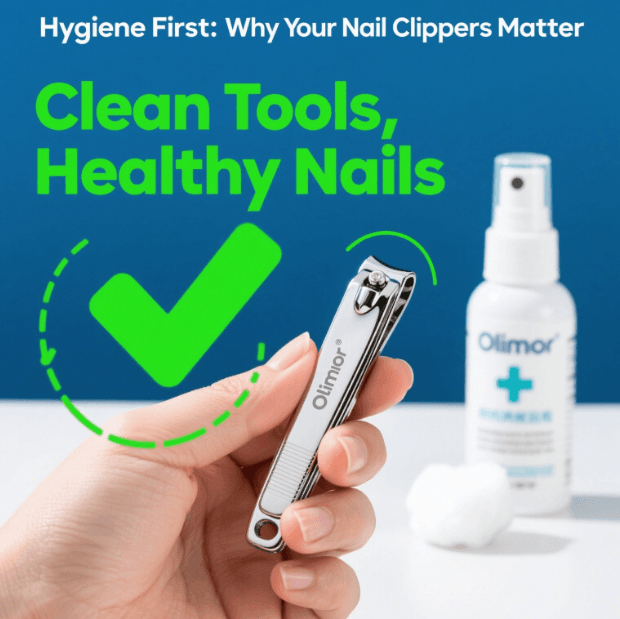
Olimor product information mentions pairing the Olimor Nail Care System with a specialized antibacterial cleaning solution. The practical principle is to remove visible debris, clean the blade and hinge area according to the tool’s care guidance, and store the clipper dry. Moisture and residue left inside a closed pouch can reduce cleanliness and make inspection harder before the next use.
Professional environments should follow current local salon, cosmetology or public health rules. General hand-hygiene concepts from the CDC and workplace safety expectations from OSHA may also be useful reference points, but buyers should verify the current versions of all applicable rules and supplier documents. These references do not mean a specific clipper is certified or approved by those bodies.
| Inspection or care point | What to look for | Why it matters |
|---|---|---|
| Blade closure | Edges meet evenly across the cutting area | Helps prevent crushed or torn nail edges |
| Lever movement | Presses smoothly without wobble | Improves control, especially with the non-dominant hand |
| Surface condition | Smooth stainless steel surface, no visible rough spots | Makes wiping and routine inspection easier |
| Hinge area | No trapped fragments after cleaning | Reduces buildup in a common residue point |
| Storage | Dry pouch, case or dedicated kit compartment | Protects the cutting edge and keeps the tool cleaner |
| Cut result | Nail edge is shortened cleanly before filing | Shows whether the tool remains suitable for routine use |
Personal Use, Retail Assortment or Salon Support: How Needs Differ
A personal buyer may choose a nail clipper based on hand feel, compactness and whether it creates a neat edge with minimal effort. A retail buyer has additional concerns: presentation, packaging protection, customer instructions and how the clipper compares with other tools in the same price tier. A salon or professional accessory buyer may focus more heavily on cleanability, repeated handling and consistent cutting feel.
For personal grooming kits
Choose a clipper that matches nail thickness, hand size and storage habits. If the tool will stay in a bathroom drawer, a protective case or dedicated compartment is useful. If it will travel in a handbag or wash bag, the lever should remain secure and the cutting edge should be protected from impact.
For retail beauty buyers
Look beyond a polished surface. Ask whether the packaging protects the jaw before sale, whether the product story is easy for staff or online content to explain, and whether the clipper fits into a logical nail-care assortment. A strong retail listing can describe the user problem clearly: clean trimming, comfortable grip, stainless steel construction, easy maintenance and a smoother finish after filing.
For professional or salon-related sourcing
Evaluate the clipper as a repeat-use tool. The lever should feel stable through multiple trims, the hinge should be inspectable, and the surface should be practical to clean according to the supplier’s instructions. If tools are used in a regulated service environment, confirm cleaning and sanitation procedures against current local requirements before purchase.
Cost Factors and Supplier Evaluation
Without using invented price claims, buyers can still understand what usually affects the cost of nail clippers. Material selection, cutting edge formation, assembly consistency, surface finishing, handle design, packaging and inspection processes all influence commercial value. A lower unit cost may not be attractive if the clipper feels unstable, arrives poorly protected or creates more customer service issues.
For B2B sourcing, evaluate the complete offer rather than the tool alone. Ask how samples are handled, what customization options are available, what packaging choices can be discussed, and how quality is checked before shipment. If importing or selling in a regulated market, request current supplier documents and confirm whether any required declarations, labeling or safety information apply to your channel.
Useful supplier questions include:
- Can the supplier provide samples for hands-on assessment before bulk ordering?
- What parts of the nail clipper can be customized, such as finish, packaging or branding?
- How are blade alignment, lever action and surface finish inspected?
- What care instructions are provided for end users or retail packaging?
- How is the cutting edge protected during storage, packing and transportation?
- Who should buyers contact for product details, order planning or documentation?
For product-specific discussions, buyers can contact Olimor Beauty or submit an inquiry for nail-care tools with application details, target channel and customization needs.
When to Replace a Nail Clipper
A nail clipper should be replaced when it no longer cuts cleanly or feels stable. Warning signs include ragged nail edges, extra pressure required to complete a cut, visible blade misalignment, rough lever movement, looseness at the hinge or surface damage that makes cleaning difficult. Rust-like discoloration, trapped debris that cannot be removed, or a bent cutting edge are also reasons to retire the tool from regular use.
Replacement timing depends on frequency of use, cleaning habits and storage conditions. A personal clipper kept dry in a dedicated kit will usually remain in better condition than one left loose in a damp drawer. Shared tools should be inspected more often because wear, residue and accidental damage may not be obvious until the tool is used.
Practical Buying Checklist
Use this checklist when comparing women’s nail clippers for home use, retail assortment planning or professional accessory sourcing.
- The clipper has a clean, even blade closure.
- The lever action is smooth and stable.
- The stainless steel surface is easy to inspect and wipe.
- The grip feels controlled in both hands.
- The jaw shape suits the intended nail type and shaping style.
- The tool can be cleaned around the blade and hinge area.
- The packaging or storage method protects the cutting edge.
- Care instructions are clear enough for end users.
- Samples can be reviewed before larger B2B commitments.
- Supplier documents and applicable market requirements can be verified before purchase.
FAQ: Samples, Customization, Quality and Ordering
Can B2B buyers request samples before ordering nail clippers?
Sample availability should be confirmed with Olimor directly. Samples are useful because buyers can check grip comfort, blade alignment, cutting feel, packaging and overall finish before making a larger purchasing decision.
Is there a minimum order quantity for women’s nail clippers?
MOQ depends on the specific product, packaging and customization requirements. Buyers should contact Olimor with the intended market, order type and any branding needs to receive current ordering details.
Can nail clippers be customized for retail or promotional use?
Customization may depend on the chosen item and project requirements. Possible discussion points include packaging, branding presentation and assortment planning. Confirm available options, artwork requirements and approval steps before production.
How should buyers evaluate quality before placing an order?
Review samples and check blade closure, lever stability, stainless steel surface finish, cleaning access, packaging protection and user instructions. For regulated channels, verify current supplier documents and applicable local requirements before sale or professional use.
A Better Nail Clipper Starts With Practical Details
The best women’s nail clippers are not defined by appearance alone. They combine clean cutting, stainless steel durability, ergonomic control, simple cleaning and suitable storage. For individual users, that means a more comfortable grooming routine. For retailers and professional buyers, it means a product that is easier to position, explain and evaluate.
Olimor Beauty’s nail-care approach emphasizes precision, ergonomic handling and hygiene-minded maintenance. Buyers comparing nail clippers for personal kits, retail assortments or professional accessory ranges should review samples, ask practical quality questions and confirm current supplier information before ordering.
Tag: