

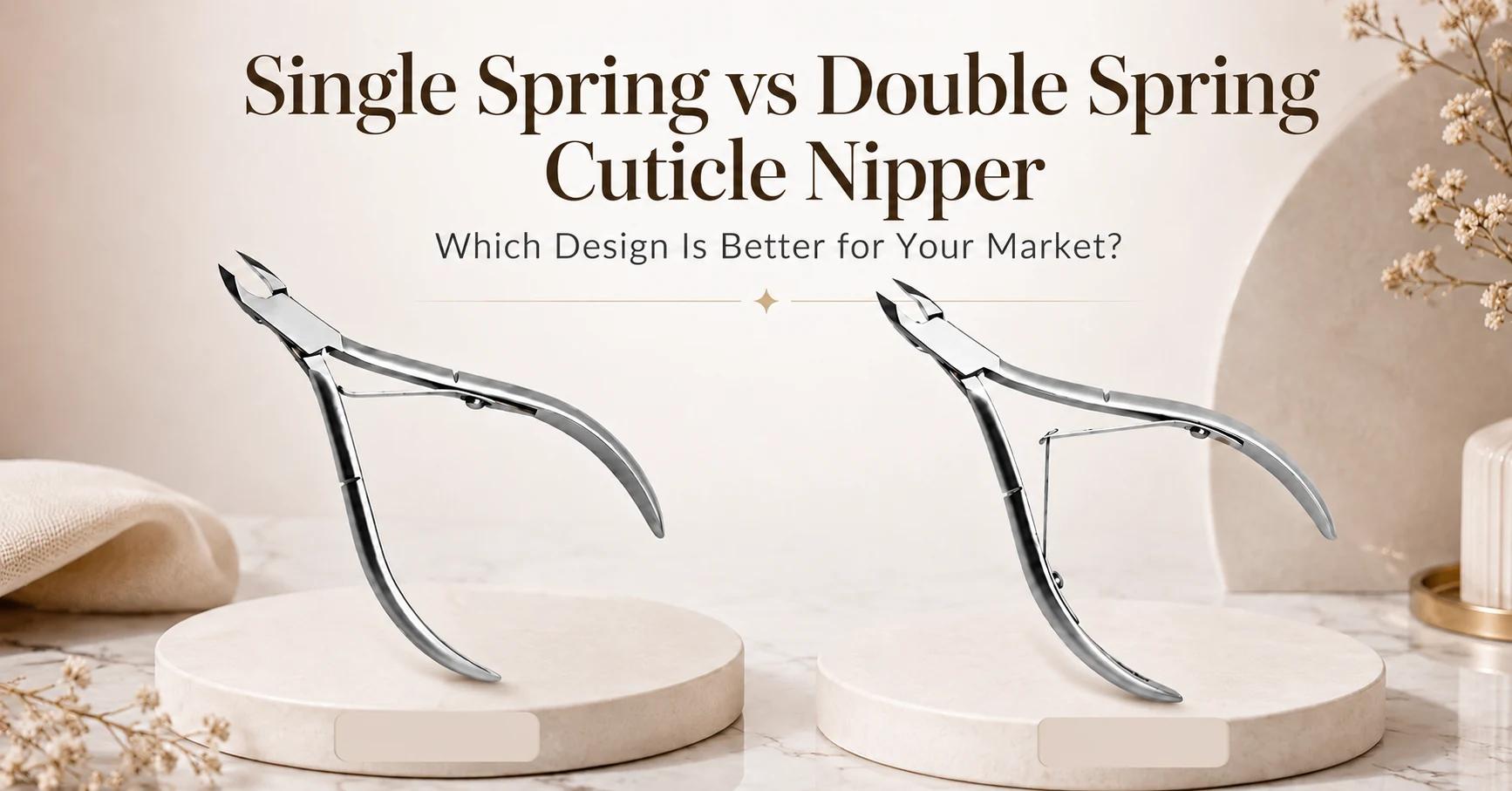
When buyers compare cuticle nippers, they often focus on blade sharpness, stainless steel material, and surface finish. These details are important, but there is another small part that strongly affects user experience: the spring.
The spring controls how the cuticle nipper opens after each cut. It affects hand comfort, rebound speed, long-term control, and the feeling of product quality. For salons, beauty retailers, ecommerce sellers, and private label buyers, understanding single spring vs double spring cuticle nipper designs can help you choose a product that better fits your market.
OLIMOR supplies manicure and beauty tools for global B2B buyers, including cuticle nippers, nail clippers, nail files, tweezers, eyelash curlers, eyebrow razors, manicure sets, foot files, and facial tools. You can explore related product categories here: https://www.olimor.com/products
Why the Spring Design Matters
A cuticle nipper is used for detailed work around the nail edge. The user needs control, precision, and smooth movement. If the spring is too weak, the tool may feel loose. If the spring is too strong, the hand may feel tired after repeated use.
For professional nail technicians, this difference becomes obvious during long service hours. For retail customers, the spring affects first impression. A smooth rebound makes the tool feel more stable and professional. A poor spring can make even a sharp nipper feel cheap.
That is why buyers should not treat the spring as a minor accessory. It is part of the product’s performance.
What Is a Single Spring Cuticle Nipper?
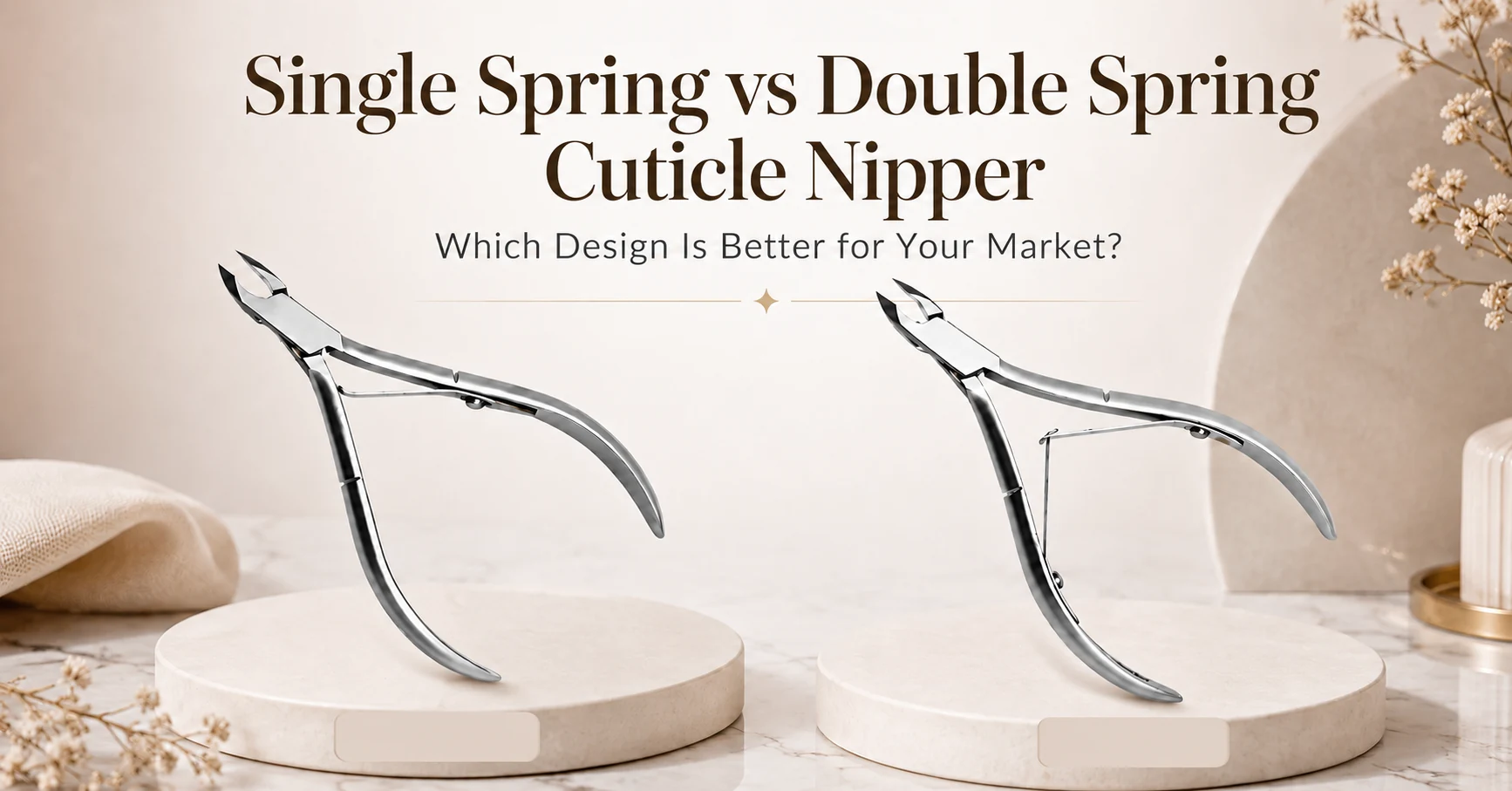
A single spring cuticle nipper uses one spring arm to push the handles apart after each cut. This design is common in many manicure tools because it is simple, practical, and easy to use.
Single spring designs are often suitable for:
- Basic retail cuticle nippers
- Home manicure tools
- Entry-level salon tools
- Cost-sensitive wholesale orders
- Simple manicure kits
The main advantage is simplicity. A single spring structure can provide enough rebound for general users when the design is well made. It is also easier for customers to understand and maintain.
However, buyers should still check spring stability. A poor single spring may become loose, uneven, or unstable after repeated opening and closing.
What Is a Double Spring Cuticle Nipper?
A double spring cuticle nipper uses two spring arms or a stronger dual-spring structure to create more balanced rebound. This design is often used in professional or higher-positioned cuticle nippers.
Double spring designs are often suitable for:
- Professional nail salons
- Higher-end manicure tools
- Frequent-use nail technicians
- Premium retail products
- Private label manicure sets
The main advantage is rebound stability. A double spring can provide smoother opening and a more balanced feeling when used repeatedly. For professional users, this can improve hand comfort and control.
The trade-off is that double spring designs may require better assembly and quality checking. If the spring alignment is poor, the tool may feel uneven.
Single Spring vs Double Spring: Key Comparison
Buyers should not choose only by saying one is always better than the other. The better choice depends on user type, price level, packaging, and sales channel.
| Feature | Single Spring Cuticle Nipper | Double Spring Cuticle Nipper |
|---|---|---|
| Structure | Simple one-spring design | Dual-spring rebound design |
| Hand Feel | Practical for general use | Smoother for frequent use |
| Best For | Retail, home use, basic kits | Salons, premium kits, professional use |
| Cost Level | Usually more cost-friendly | Usually higher positioning |
| Maintenance | Simple and easy | Requires better spring alignment |
| Perceived Value | Basic to mid-range | More professional feeling |
| Buying Focus | Stability and price balance | Comfort and long-term control |
For B2B buyers, this comparison helps match product style to the final customer instead of choosing based only on product appearance.
Which Design Is Better for Nail Salons?
For nail salons, double spring cuticle nippers are often preferred because nail technicians use tools repeatedly. A smoother rebound can reduce hand pressure and support better control during detailed cuticle work.
However, this does not mean all salons must use double spring models. Some technicians may prefer a lighter single spring tool if the rebound is stable and the blade alignment is good.
For salon supply buyers, the key is not just spring type. It is the full combination:
- Sharp blade
- Accurate tip alignment
- Smooth spring rebound
- Comfortable handle
- Stainless steel material
- Clean surface finish
- Reliable batch consistency
If the target market is professional salons, buyers should test both single spring and double spring samples before deciding.
Which Design Works Better for Retail and Ecommerce?
For retail and ecommerce sellers, the decision depends on product positioning.
If the product is a basic daily manicure tool, a good single spring cuticle nipper may be enough. It can keep cost reasonable while still offering practical function.
If the product is positioned as professional, premium, salon-grade, or gift-ready, a double spring cuticle nipper may support a stronger product story. Customers may perceive the tool as more advanced when the packaging and product description explain the rebound benefit clearly.
For ecommerce sellers, product reviews are important. If customers complain that the tool feels loose, stiff, or hard to control, the listing may be affected. That is why spring feel should be tested before bulk production.
What Private Label Buyers Should Consider
Private label buyers need to think about more than function. The spring design should match the brand’s product level.
A budget manicure kit may use a stable single spring nipper to control cost. A premium manicure kit may use a double spring nipper to improve perceived value and professional feel.
For private label projects, buyers should consider:
- Does the spring design match the selling price?
- Will the tool be sold as a single nipper or inside a kit?
- Does the target customer care about professional performance?
- Can the packaging explain the benefit clearly?
- Can the supplier keep spring quality consistent in repeat orders?
A cuticle nipper with a good spring design can strengthen the whole manicure set. But if the spring feels weak, the product may lower the perceived quality of the entire kit.
Quality Checks for Both Spring Types
Whether you choose single spring or double spring, sample testing is necessary. Buyers should not judge only by photos.
Useful checks include:
Open and close test
The nipper should open smoothly after each press.
Repeated rebound test
Open and close the tool several times to see whether the spring remains stable.
Alignment check
The spring should not push the handles unevenly.
Hand comfort check
The tool should not feel too stiff or too loose.
Blade performance check
Spring comfort is important, but blade sharpness and tip alignment still decide cutting quality.
Packaging check
The nipper should be secured properly so the spring and blades are not damaged during shipping.
For bulk orders, buyers should also confirm whether the same spring feel can be repeated across the batch.
Common Mistakes When Choosing Cuticle Nipper Springs
One mistake is assuming double spring is always better. If the product is for basic retail or low-cost kits, a stable single spring may be more practical.
Another mistake is focusing only on the spring and ignoring the blade. A smooth spring cannot fix poor cutting performance.
Some buyers also forget that spring feel is subjective. A salon technician may prefer stronger rebound, while a home user may prefer a lighter feel.
A final mistake is not matching the spring design with packaging and product positioning. A premium double spring nipper should not be packed in a way that makes the product look low value.
How OLIMOR Supports Cuticle Nipper Buyers
OLIMOR can support buyers who need single spring or double spring cuticle nippers for salons, retail, ecommerce, wholesale, and private label manicure sets. Buyers can compare product styles, review samples, discuss packaging, and combine cuticle nippers with nail clippers, nail files, cuticle pushers, tweezers, scissors, or manicure cases.
A practical sourcing process may include:
- Confirm target market and product level
- Choose single spring or double spring design
- Review sample rebound, blade alignment, and hand feel
- Decide surface finish, logo, and packaging
- Confirm quality expectations before bulk order
- Plan production, shipment, and repeat orders
You can learn more about OLIMOR’s company background here: https://www.olimor.com/about-us
For product options, visit: https://www.olimor.com/products
For quotation or custom project discussion, contact OLIMOR here: https://www.olimor.com/contact-us
FAQ
What is the difference between single spring and double spring cuticle nippers?
A single spring cuticle nipper uses one spring arm for rebound, while a double spring cuticle nipper uses a dual-spring structure for smoother and more balanced opening.
Is a double spring cuticle nipper better?
It can be better for professional or frequent-use scenarios because it often provides smoother rebound. However, a good single spring design can also work well for retail and home use.
Which cuticle nipper is better for salons?
Many salons prefer double spring cuticle nippers because they offer better hand comfort for repeated use, but blade sharpness and tip alignment are still more important.
Are single spring cuticle nippers suitable for retail sales?
Yes. Single spring models are suitable for general retail, home manicure tools, basic kits, and cost-sensitive wholesale projects.
Can spring design be customized for private label manicure sets?
Yes. Buyers can choose spring type, surface finish, packaging, logo branding, and product combinations based on their target market.
How can I request a quotation from OLIMOR?
Send your target market, quantity, preferred spring type, packaging needs, logo requirements, and product style through the OLIMOR contact page.
Choose the Spring Design That Matches Your Buyers
Understanding single spring vs double spring cuticle nipper designs helps buyers choose tools based on real user needs. The comparison of single spring vs double spring cuticle nipper options shows that single spring models are practical for general retail and basic kits, while double spring models are often better for professional salons and premium manicure sets. By evaluating single spring vs double spring cuticle nipper features carefully, buyers can make more informed sourcing decisions.
If you need cuticle nippers for salons, ecommerce, retail, wholesale distribution, or private label nail care sets, OLIMOR can help you compare options and build a suitable product solution.
Visit https://www.olimor.com/ to explore more manicure and beauty tools.
Tag: