

Nail Clipper OEM Manufacturing: A Practical Sourcing Guide for Beauty Brands
For beauty brands, retailers, salons, and grooming kit suppliers, a nail clipper may look like a simple product. In practice, it is one of the small personal care tools where quality differences are quickly noticed by end users. A clipper that pulls, bends, rusts, feels unstable, or arrives with inconsistent finishing can damage customer trust just as much as a more complex beauty device.
Nail clipper OEM sourcing is usually driven by a clear commercial goal: add a dependable grooming tool to an existing product line, build a private-label manicure set, prepare a promotional care kit, or supply retail-ready clippers in bulk. The right manufacturing partner helps turn those goals into a product that is comfortable to use, consistent across production runs, and suitable for the intended sales channel.
This guide explains how buyers can evaluate nail clipper OEM manufacturing in a practical way, from design and materials to inspection, packaging, and ordering decisions. It is written for teams comparing suppliers, preparing a specification sheet, or planning a new grooming tool launch with Olimor Beauty.
What Nail Clipper OEM Sourcing Usually Needs to Solve
A nail clipper OEM project is rarely only about finding the lowest unit price. Brands often need a balance between cutting performance, finish, packaging presentation, and repeatable quality. A mid-sized beauty brand expanding into grooming tools, for example, may want clippers that look premium enough for retail shelves while remaining cost-conscious for bulk distribution.
Common sourcing challenges include inconsistent blade sharpness, limited customization, unclear inspection standards, slow sample revisions, packaging that does not match the brand position, and production timelines that create launch risk. Buyers may also need flexibility when testing a new market, especially before committing to a large-scale reorder plan.
A reliable OEM process should make these decisions visible early. Before sampling, the buyer and manufacturer should align on the target user, the sales channel, the expected packaging format, the desired hand feel, and the inspection points that define an acceptable product. This prevents a common problem in beauty tool sourcing: approving a sample that looks correct, then receiving bulk goods that differ in cutting feel, surface finish, or assembly tightness.
Key Product Details That Affect Nail Clipper Quality
The performance of a nail clipper depends on several details working together. Buyers do not always need to specify every engineering point, but they should understand what influences the finished product.
- Blade alignment: The upper and lower cutting edges must meet cleanly. Poor alignment can leave nails rough or require repeated pressure.
- Cutting edge sharpness: A sharp, stable edge helps the clipper cut instead of crush. This is especially important for toenail clippers, which may need more leverage.
- Material and finish: Stainless-steel blades are commonly valued for durability and corrosion resistance, while surface finishing affects both appearance and comfort.
- Lever strength: The lever should move smoothly and provide enough pressure without feeling loose or unstable.
- Handle comfort: Ergonomic handles, textured areas, or coated grips can improve control, particularly for everyday and travel use.
- Size and shape: Compact clippers are convenient for travel kits, while larger formats may be better suited for toenails or professional grooming sets.
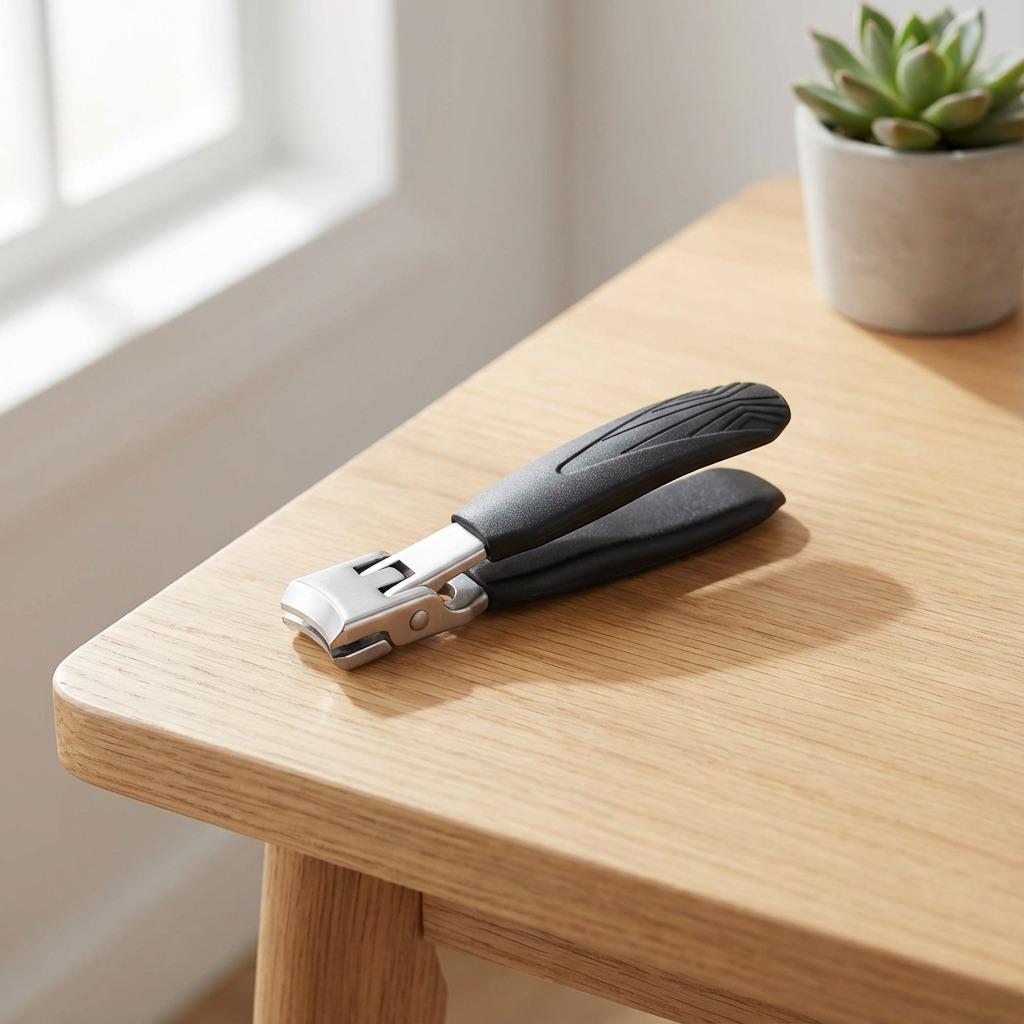
The original product direction may include durable stainless-steel blades and ergonomic black handles for comfortable grip. If that design fits the target customer, it can be a practical starting point. If the brand serves salons, gift sets, travel retail, or mass-market stores, the same basic clipper may need different packaging, finish, or size options.
Customization Choices for Private Label Nail Clippers
Customization should support the product’s sales purpose rather than add cost without value. For nail clippers, useful customization often includes color, handle treatment, logo placement, surface finish, packaging, and set configuration. A brand selling a minimalist grooming line may choose a clean metal finish and simple carton. A retailer building a travel care kit may prioritize compact size, low package weight, and a hangable retail card.
When preparing a custom nail clipper brief, include the intended retail environment and how the product will be used. A clipper sold individually at checkout has different packaging needs than a clipper included in a manicure kit or subscription box. The same applies to online sales, where product images, packaging protection, and barcode labeling may be part of the decision.
- Define the user: Everyday consumer, salon client, travel buyer, gift recipient, or promotional audience.
- Choose the clipper format: Fingernail, toenail, compact, large-size, or mixed grooming kit component.
- Select visible design elements: Finish, handle color, grip texture, and logo method where applicable.
- Confirm packaging needs: Poly bag, card, box, retail display, or kit-ready packaging.
- Set inspection priorities: Cutting test, appearance check, assembly stability, package accuracy, and quantity verification.
Olimor Beauty supports beauty tool sourcing discussions across different product types. Buyers comparing nail clippers with related grooming accessories can explore beauty tool products or review broader product collections to plan a consistent line.
Quality Control Points Buyers Should Confirm
Quality control for nail clipper OEM production should be specific. General promises such as “good quality” are not enough for a tool that customers physically test the first time they use it. A useful quality plan covers incoming materials, in-process assembly, surface appearance, cutting performance, and final packaging checks.
For a buyer, the goal is not to manage the factory’s entire production process. The goal is to define the product’s acceptance standard clearly enough that both parties know what is acceptable before mass production begins. This is especially important for bulk nail clipper orders, where small inconsistencies can multiply quickly.
| Inspection area | What to check | Why it matters |
|---|---|---|
| Blade performance | Clean cut, proper edge contact, no obvious burrs | Directly affects user satisfaction |
| Assembly | Lever movement, pin stability, no looseness | Prevents weak hand feel and early failure |
| Surface finish | Scratches, stains, coating consistency, sharp non-cutting edges | Protects retail appearance and comfort |
| Packaging | Correct artwork, barcode, quantity, carton marking | Reduces warehouse and retail errors |
| Bulk consistency | Comparison against approved sample | Keeps repeat orders aligned with expectations |
A pre-production sample is useful only when it becomes a reference point. Keep approved samples, artwork files, packaging specifications, and inspection criteria organized. If the project includes custom color, logo, or special packaging, confirm those details before production materials are prepared.
Bulk Ordering Without Overstocking
Many beauty brands want to buy nail clippers in bulk but avoid overstocking before the product is proven. This is a reasonable concern, especially when launching a new grooming category or testing a new retail account. Low MOQ flexibility may be discussed depending on the project, but buyers should also think beyond the minimum order number.
A more complete ordering plan includes forecasted monthly demand, packaging lead time, artwork approval time, shipping method, and reorder trigger points. If the clipper is part of a kit, all components need to arrive in sequence. A delay in one small tool can hold back an entire gift set or retail launch.
For first orders, many teams focus on getting the sample and packaging right, then place an initial run that supports launch quantities plus a safety buffer. For repeat orders, the emphasis shifts to consistency, replenishment timing, and any design improvements based on customer feedback. Keeping the approved specification stable is often the best way to control both quality and cost over time.
Questions to Prepare Before Contacting an OEM Supplier
A clear inquiry helps the manufacturer respond with more relevant guidance. Instead of sending only a photo and asking for a price, prepare a short sourcing brief. This reduces misunderstanding and speeds up the quotation and sampling process.
- What type of nail clipper do you need: fingernail, toenail, compact, large, or part of a grooming set?
- Will the product be sold individually, included in a kit, or used for promotional distribution?
- Do you need logo application, custom handle color, special finish, or specific packaging?
- What market or channel will the product serve: salon, retail, e-commerce, travel, or gift set?
- Do you already have artwork, package dimensions, barcode requirements, or carton labeling rules?
- What is the expected launch schedule, and when do samples need to be reviewed?
- Which inspection points matter most for your customer complaints risk?
If your team is preparing a new OEM project, you can send an inquiry with your target product details. For design questions, supplier evaluation, or grooming tool planning, you may also contact Olimor to discuss the next step.
Building a Reliable Nail Clipper OEM Partnership
A strong nail clipper OEM partnership is built on practical alignment: the buyer defines the market need, the supplier translates it into manufacturable details, and both sides confirm quality standards before bulk production. The best outcome is not only an attractive clipper, but a repeatable supply process that supports future orders and related beauty tool expansion.
For brands entering or growing in the grooming category, nail clippers can be a smart addition when sourced carefully. Focus on blade performance, assembly stability, user comfort, packaging accuracy, and clear approval steps. These details help reduce launch risk and create a product that customers are more likely to keep using.
Olimor Beauty works with buyers looking for practical beauty tool manufacturing solutions, including nail clipper OEM and bulk supply discussions. With a clear brief and a realistic quality plan, your sourcing project can move from concept to production with fewer surprises and a stronger foundation for long-term growth.
Tag: