

Why the right manicure tools matter in a salon
For any busy nail room, manicure tools for nail salons are not just small accessories on the cart; they shape the entire service experience. The wrong tool set slows the technician down, makes cleanup less precise, and can leave a client with a finish that looks rushed even when the polish itself is good. In a trade setting, that matters because the hand service is often the first close-up interaction a customer has with a salon’s standards.
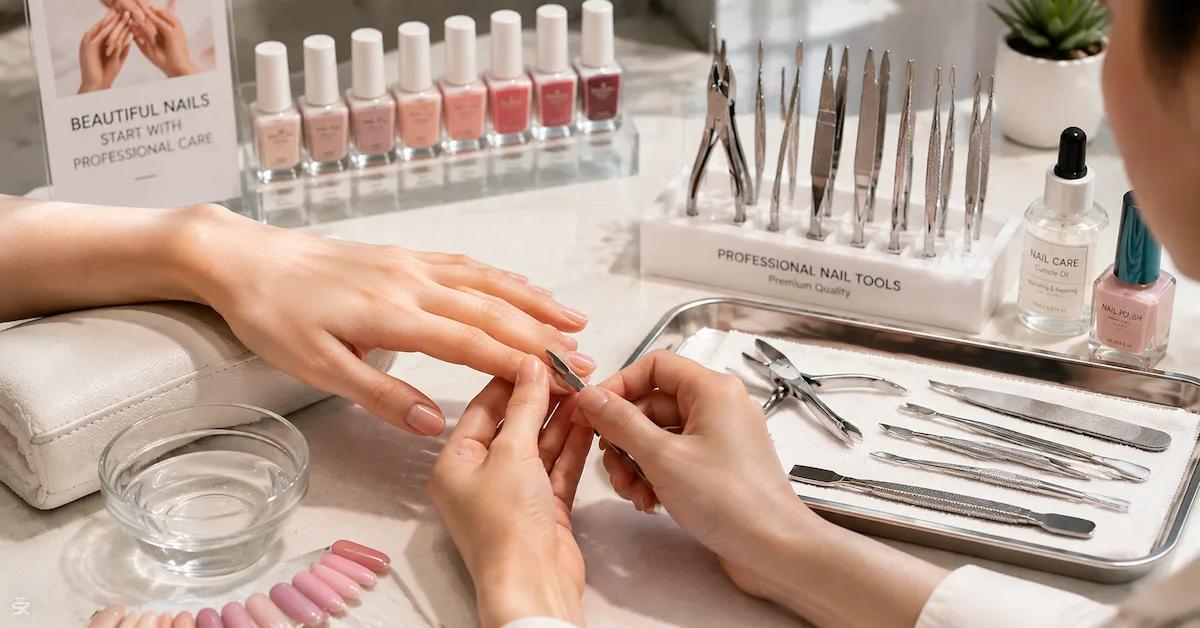
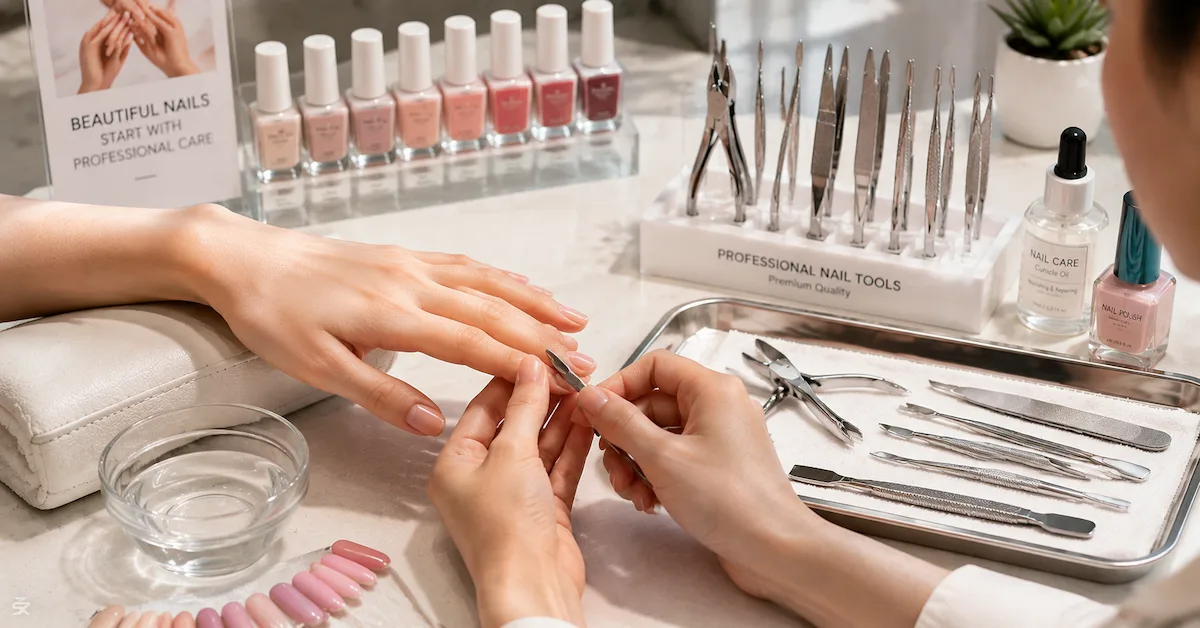
The workstation shown here reflects the kind of setup many professionals aim for: a group of polished metal tools arranged upright in a white holder, with a tray, absorbent pad, and supporting items like polish and cuticle oil nearby. That layout says something practical. It suggests order, quick access, and a cleaner handoff between shaping, cuticle work, and finishing. For sourcing managers and salon owners, the real question is not whether the tools look neat. It is whether the set supports consistent service, easy storage, and durable daily use.
What a professional manicure station needs to do
A manicure station has a simple job on paper and a more demanding one in practice. It needs to help a technician prepare the nail plate, manage cuticles, shape edges, and keep the working area organized enough that tools are not drifting across the table. In a salon, those details affect speed and hygiene habits, but they also affect the feel of the service. Clients notice when the process is controlled.
The visible tools in the supplied workstation appear to be metal instruments with a polished silver finish, likely stainless steel or a similar corrosion-resistant metal commonly used in professional grooming tools. That is a sensible choice for repeated handling and cleaning. Metal tools generally hold their shape better than softer materials, and the polished surface is easier to inspect for residue than a matte finish. Still, buyers should be careful not to assume every silver tool is equal. Surface finish alone does not tell you how the edge is ground, how the hinge behaves, or how well the tool will hold up after repeated sanitation cycles.
Quick reference: what to look for before buying
If you are comparing professional manicure tools or building out nail salon tools for a new workstation, a short checklist is usually more useful than a long spec sheet full of vague claims.
Core considerations
First, look at the tool mix. A practical set should support nail shaping, cuticle trimming, cleaning, and general prep. Second, check the ergonomics. Technicians work with these tools all day, so grip comfort and balance matter more than decorative styling. Third, think about storage. Upright slots, trays, and separated placement reduce clutter and make it easier to return each item to the same place. Fourth, evaluate finish quality. A polished surface is not only about appearance; it also makes wear, scratches, and residue easier to spot during routine checks.
Finally, do not overlook the workstation itself. The white display block and tray in the image are part of the system. A good display or holder is not cosmetic fluff. It helps the technician keep a clean workflow and can also support retail presentation if the salon sells tools or nail-care products at the counter.
How salon-grade manicure tools are usually used
Even when the exact tool count or model is unknown, the use cases are familiar. In a salon service, the set typically supports several stages of preparation. The technician may shape the nail edge, refine rough corners, clean around the nail, manage cuticle areas, and prepare the hand before coating or treatment. That sequence is routine, but it is also where sloppy tool selection shows up quickly.
Professional manicure tools often need to do more than one thing well. A shaping tool should be precise without feeling aggressive. A cuticle instrument should be controlled enough to avoid unnecessary pressure. A cleaning tool should reach small areas without bending or snagging. Those are the quiet qualities that separate a usable kit from one that just looks complete on a shelf.
The photo also shows cuticle oil and nail polish, which reinforces the service context. A station like this is not only about cutting and filing. It is about presentation and finishing, too. A technician may move from preparation to hydration to color, and the tools need to support that sequence without making the table feel crowded.
Material and finish: why they matter more than people think
For this category, material choice is not a minor detail. Metal tools are common because they can be formed precisely, sharpened or ground to a working edge, and cleaned repeatedly. In a salon environment, that makes them a sensible default. The reflective finish visible in the image is also useful from a practical standpoint. It helps the technician see the tool clearly under bright task lighting and makes wear patterns easier to identify.
That said, buyers should be cautious with broad promises. A polished metal tool is not automatically anti-rust, and it is not automatically suitable for every sterilization method. The right handling protocol depends on the manufacturer’s specifications, the exact alloy, and the salon’s own sanitation process. If you are purchasing in volume, ask for the details that matter: material grade, care instructions, and whether the tool is intended for repeated professional cleaning. If a supplier cannot answer those basics clearly, that is a warning sign.
Display and organization are part of the product story
One of the more useful things about the visible setup is the upright holder with vertical slots. It separates tools instead of stacking them in a drawer, which has two advantages. The first is speed: a technician can reach for the right instrument without sorting through a pile. The second is visibility: missing or misplaced tools are obvious right away.
That may sound like a small operational detail, but salons live or die by small details. A clean, organized workstation signals discipline to customers and to staff. It also helps when the same area is used for multiple services. In a mixed-use beauty room, separate storage makes it easier to keep manicure equipment distinct from other instruments, which reduces confusion and supports better housekeeping habits.
Common buying mistakes
One common mistake is buying on appearance alone. A polished case or a tidy display can be impressive, but it does not guarantee performance. Another mistake is overbuying redundant tools that do nearly the same thing. That fills drawers and slows down new technicians who have to guess which instrument is meant for which step.
A third mistake is ignoring the workflow. If the tools are stored badly, even a strong set becomes annoying to use. If the workstation is too crowded, bottles and tools compete for space, and the service area starts to look disorganized by midshift. Small stations can handle a lot, but only if every piece has a clear purpose.
There is also a procurement trap on the sourcing side: assuming all nail salon tools are equivalent because they fall under the same category. They are not. Edge quality, balance, finish, and storage format all affect day-to-day use. If your team is buying for multiple locations, it is worth standardizing the basics so technicians are not adapting to a different feel every time they move stations.
Practical advice for salon owners and sourcing teams
If you are setting up a new manicure table, start with the workflow instead of the product brochure. Ask how the technician will reach each tool, where used items will go during a service, and how the station will be reset between clients. A good set of professional manicure tools should fit the rhythm of the room, not force the room to work around the set.
For retail buyers, presentation matters too. The same organized layout that helps a technician can help a salon sell through on branded or bundled nail-care items. A neat display makes the tools look intentional rather than leftover. That is useful when customers ask what the salon uses and whether they can buy similar items for home care. Just be careful not to promise salon performance to retail buyers unless the product is genuinely intended for that use.
For procurement teams, a sensible trial is often better than a big first order. Test the handling, the storage fit, and the day-to-day convenience of the tools in a real workstation before expanding the buy. The best manicure tools for nail salons are the ones the staff keeps reaching for, not the ones that photograph well once and then disappear into a drawer.
FAQ
Are these tools only for salons?
Not necessarily. The workstation shown is clearly styled for professional use, but similar tools can also serve spas, training rooms, and retail demonstration counters. The important point is whether the tool set matches the service level and cleaning routine.
What makes a manicure tool professional?
In practice, it is usually a mix of precision, durability, and comfort in use. Professional manicure tools should feel reliable in the hand, support repeat use, and fit a salon workflow without creating clutter or delays.
Should salons choose stainless steel every time?
Stainless steel is common for good reasons, especially in metal grooming instruments, but the best choice still depends on the exact tool, the intended sanitation process, and the supplier’s product details. Material is important, but it is not the only factor.
What to do next
If you are evaluating manicure tools for nail salons, start with the service flow, then check the tool mix, finish quality, and storage method. The image here shows a practical direction: organized metal tools, a clean holder, and a workstation built for visible order. That is a good baseline, but the real test is how the set performs once the pace picks up.
When you compare options, ask for the details that matter to operations, not just the ones that sound polished in a catalog. The right set should help technicians work cleanly, keep the station orderly, and support a consistent client experience day after day. That is usually the difference between a manicure setup that looks professional and one that actually works like it.
Tag:
Related articles
- Manicure & Nail Tools
- OEM & Private Label
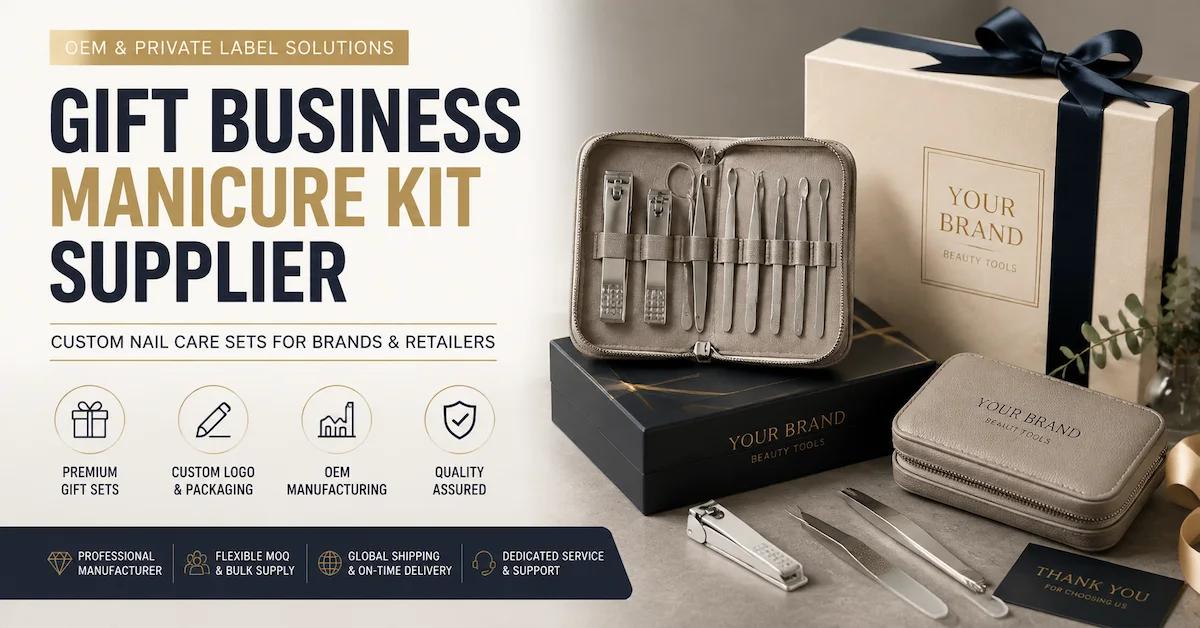
Gift Business Manicure Kit Supplier Guide: Custom Nail Care Sets for Brands and Retailers
- Manicure & Nail Tools
- OEM & Private Label
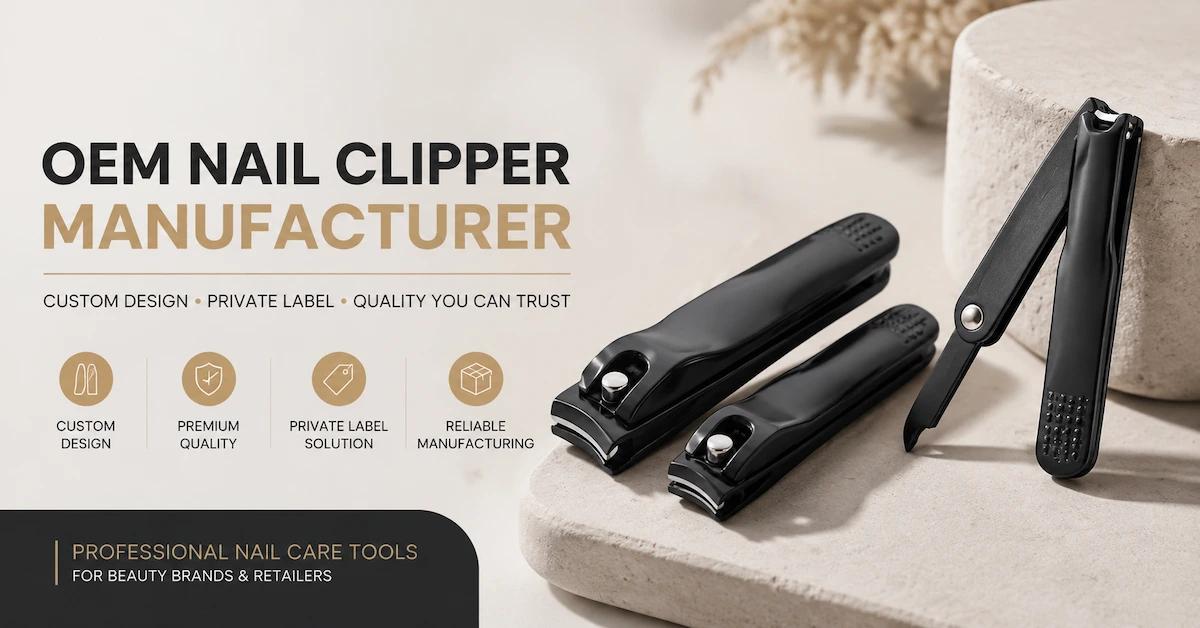
OEM Nail Clipper Manufacturer: Complete Guide to Custom Nail Care Solutions

- Manicure & Nail Tools
- OEM & Private Label