

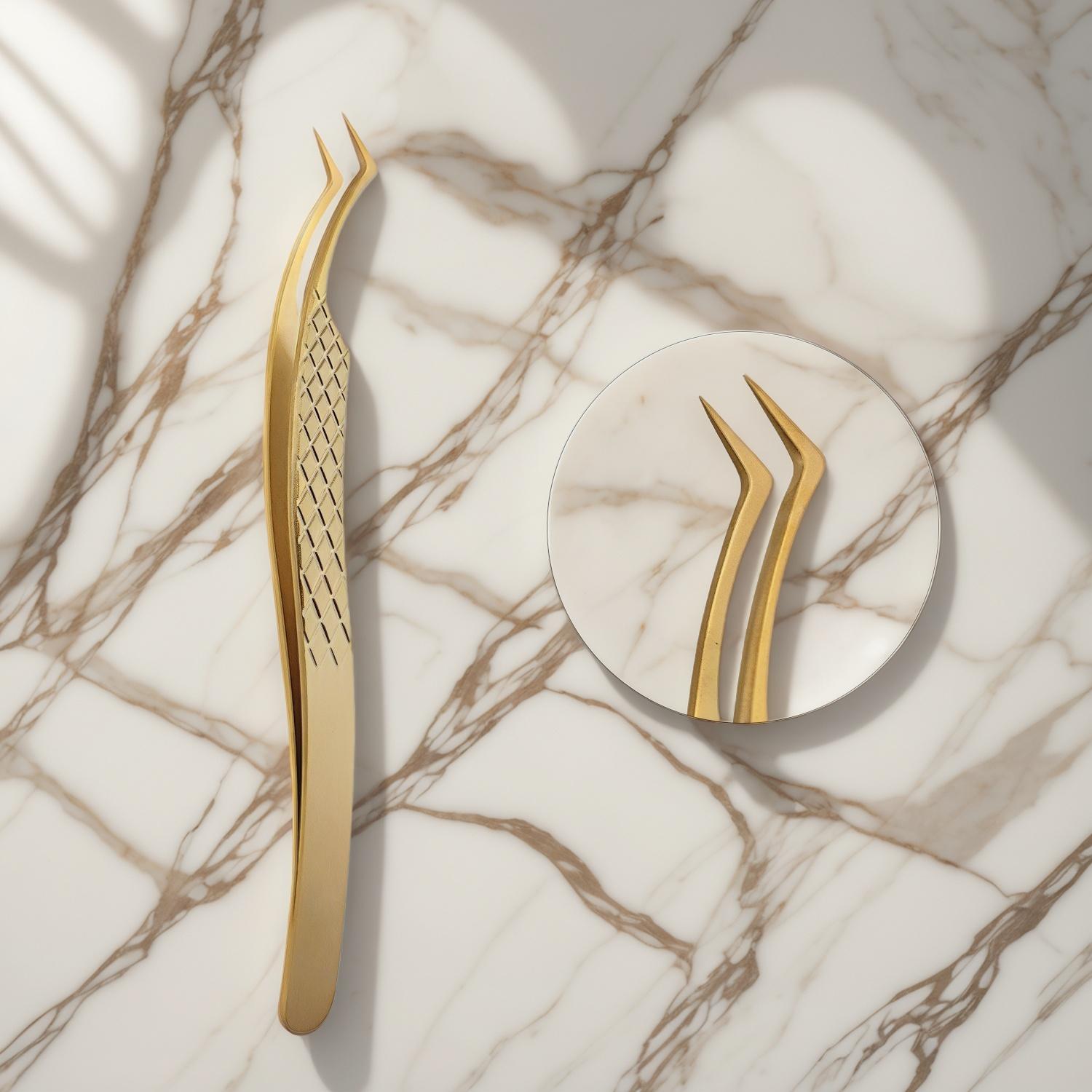
Golden Pro-Luxe Lash Extension Tweezers Buying Guide

Professional eyelash extension work depends on a controlled hand, clean isolation, careful adhesive handling and a tweezer that behaves predictably through hundreds of small movements. The Golden Pro-Luxe Lash Extension Tweezers from Olimor Beauty are positioned for lash artists and salon buyers who need a stainless steel tool for precision placement, comfortable handling and repeatable daily service use.
This guide explains how to evaluate these tweezers in practical terms: what the angled design is useful for, why ultra-fine tips matter, how salons should inspect and maintain precision tools, and what B2B buyers should ask before placing a bulk order. It is intended for lash technicians, salon managers, distributors and purchasing teams comparing professional eyelash tools for retail, salon or training environments.
What These Lash Extension Tweezers Are Designed to Do
The primary purpose of lash extension tweezers is to help the technician isolate natural lashes and place extensions accurately without interrupting the flow of the service. The Golden Pro-Luxe Lash Extension Tweezers combine stainless steel construction, a gold finish, an ergonomic curve, ultra-fine tips, a non-slip grip and an angled profile. Each visible feature should be considered in relation to real salon tasks rather than appearance alone.
For classic lash application, fine tips support controlled selection and placement of individual extensions. For more detailed styling, the angled shape can help the artist work around the eye area while maintaining visibility. The non-slip grip is useful when a technician is wearing gloves, working through a long appointment or adjusting hand position frequently. The gold finish gives the tool a polished professional look, which can matter for salons, academies and retail display, but the most important buying question remains how consistently the tips close and handle fine lash fibers.
Salons sourcing multiple tools can view related professional beauty tools through the Olimor product range when building a complete lash station or replenishment order.
Why Tweezer Precision Matters in Lash Services
Lash extensions are small, lightweight and placed close to a sensitive area. Even a minor tool issue can affect service speed and application confidence. A tweezer that does not close evenly may miss lashes, crush delicate fibers or force the technician to apply extra pressure. A tool that is too slippery or poorly shaped can make the hand work harder than necessary.
Precision matters in four everyday parts of the service. First, the technician must separate natural lashes clearly so the extension is not attached to more than one lash. Second, the extension must be picked up without shifting, slipping or twisting before placement. Third, the artist needs to approach the lash line at a comfortable angle while keeping the tip controlled. Fourth, the tool must remain comfortable enough to use during repeated appointment blocks.
The Golden Pro-Luxe Lash Extension Tweezers address these needs through their ultra-fine tips, ergonomic curve and angled design. These features do not replace technician training, adhesive knowledge or sanitation discipline, but they can support the small controlled movements required in professional eyelash extension work.
Feature-by-Feature Evaluation for Professional Buyers
When purchasing lash tweezers for one technician, the decision can be based on individual hand preference. When purchasing for a salon, academy or distribution program, the evaluation should be more structured. The following table connects each supplied product detail with practical inspection points.
| Feature | Practical benefit | What to check before buying |
|---|---|---|
| Stainless steel construction | Supports repeated professional use and cleaning when handled properly | Confirm the tool feels rigid enough for precision work and review supplier care guidance |
| Gold finish | Creates a polished appearance for salon stations, kits or retail display | Inspect the surface visually for evenness and ask how tools should be cleaned to protect appearance |
| Ultra-fine tips | Helps with isolation, pickup and detailed placement near inner or outer corners | Check tip alignment, closure and whether the tips meet cleanly without visible gaps |
| Angled design | Improves access and visibility for many lash application techniques | Test whether the angle suits the technician’s hand position and preferred working side |
| Ergonomic curve | Can support a more natural hand posture during long services | Compare comfort across technicians with different hand sizes and grip habits |
| Non-slip grip | Helps maintain steady control during repeated pickup and placement | Evaluate grip feel with clean dry hands and with gloves if gloves are used in the salon |
A useful purchasing process includes a visual inspection, a comfort check and a functional pickup check. If samples are available, test them with the type of lashes and working method your team actually uses. A tweezer that feels excellent for one service style may not be the ideal tool for every lash artist or every task.
How to Choose Between Lash Tweezer Styles
Many lash professionals keep more than one tweezer style on the workstation. A straight tweezer may feel natural for some isolation tasks, while a curved or angled tweezer can give better access during placement. The Golden Pro-Luxe Lash Extension Tweezers are most relevant for buyers who want an angled, fine-tip tool with a refined finish and a professional hand feel.
For individual artists, the best comparison is not based only on shape. Consider hand tension, tip closure, weight feel, visibility and how easily the tool returns to its open position. The tool should allow you to work with a relaxed grip. If you must squeeze too hard, reposition constantly or compensate for poor closure, fatigue and inconsistency can increase.
For salons and academies, selection should also consider standardization. Using a consistent tweezer type can make training easier because instructors and senior technicians can demonstrate with similar tool geometry. However, standardization should not eliminate practical choice. Some technicians may still need alternate tools for isolation, inner-corner work or personal hand comfort. A balanced purchasing plan may include a primary tweezer style plus backup or complementary styles.
Inspection Checklist Before Putting Tweezers Into Service
Precision tweezers should be inspected before first use and during regular salon operation. This is especially important for bulk orders because small differences can affect technician confidence. The checklist below gives salon managers and buyers a practical way to evaluate tools without relying on vague quality language.
- Tip alignment: Hold the tweezer under good lighting and confirm the tips meet evenly when closed.
- Tip condition: Look for bending, chips, burrs or uneven edges that could interfere with lash pickup.
- Closure feel: Open and close the tweezer several times to assess smoothness and tension.
- Grip security: Check whether the non-slip grip helps maintain control without forcing the hand.
- Surface condition: Inspect the gold finish and stainless steel body for visible defects before use.
- Balance and comfort: Ask technicians to hold the tool in their normal working position, not just in a quick display grip.
- Task fit: Test pickup and placement with the lash materials commonly used in your salon.
- Storage readiness: Confirm that the fine tips can be protected between services, during transport and in staff kits.
Documenting inspection results can help multi-chair salons track tool condition and plan replenishment. It also gives purchasing teams better feedback when they return to a supplier for future orders.
Care, Cleaning and Storage for Fine-Tip Lash Tools
Fine-tip lash tweezers should be treated as precision instruments. Dropping them on a hard floor, storing them loose in a drawer or using them to open packages can damage alignment. Once the tips are bent, the tool may still look usable from a distance, but pickup accuracy can be reduced.
After each service, remove visible residue according to your salon’s hygiene procedure and the cleaning products approved for your workplace. Dry the tool thoroughly before storage. Moisture left on metal tools can affect appearance over time, and residue near the tips can interfere with clean closure. Store tweezers in a protective case, sleeve, rack or dedicated tray so the tips are not compressed or knocked against other tools.
Salons should also follow applicable local health department requirements for beauty services and verify the current instructions on any disinfectant product used in the workplace. In the United States, buyers may encounter EPA-registered disinfectants for certain sanitation uses, and OSHA information may be relevant for worker handling of chemicals. Requirements vary by location and service type, so always confirm current rules, product labels and supplier documents rather than assuming one procedure applies everywhere.
Cost Factors for Salons, Retailers and Distributors
The cost of lash tweezers is not only the unit price. Professional buyers should consider the full operating cost of tool ownership. A low-cost tweezer that needs frequent replacement, fails inspection or does not match technician technique can be more expensive in practice than a tool that supports consistent work. At the same time, a premium appearance should not be accepted as proof of performance without inspection.
Key cost factors include the number of active lash stations, the number of technicians, backup inventory, replacement planning, packaging needs and the degree of product uniformity required. Training centers may need several identical tools for student kits. Salons may need separate active and backup tweezers so service is not interrupted if a tool is dropped. Distributors may consider packaging presentation, reorder stability and how easily the product can be explained to professional buyers.
When comparing suppliers, ask specific questions about available product options, packaging, customization possibilities and documentation. Avoid basing the purchase only on a product photo. If the tweezers will be used in quantity, request details that help you confirm whether the tool fits your retail or service workflow.
Supplier Evaluation Questions for B2B Buyers
A good supplier conversation is practical and detailed. Before contacting Olimor Beauty, prepare information about how the tweezers will be used, who will use them and what buying constraints matter. This helps the supplier respond with relevant options instead of generic product descriptions.
Useful questions include whether samples can be arranged, what customization options may be available, how packaging is handled, what order quantities apply and what current lead time should be expected for the specific inquiry. These details can change by product, destination, order scope and current production schedule, so they should be confirmed directly instead of assumed.
Buyers comparing broader salon supply programs can review related categories through the Olimor collections. For a direct purchasing discussion, share your intended use and target quantity through the product inquiry form. If you need help matching tweezers with other beauty tools, you can also contact Olimor Beauty for a focused sourcing conversation.
When These Tweezers Are a Good Fit
The Golden Pro-Luxe Lash Extension Tweezers are a strong candidate when the buyer needs an angled stainless steel lash tool with ultra-fine tips, a gold professional finish, ergonomic curve and non-slip grip. They are especially relevant for lash artists who value controlled placement and for salon buyers who want a presentable tool for daily service environments.
They may not be the only tweezer style a salon needs. Some technicians prefer a different shape for isolation, volume creation or personal hand posture. The best buying strategy is to define the role of each tool. Use the Golden Pro-Luxe Lash Extension Tweezers where angled access, fine-tip control and professional presentation are priorities, then supplement with other tweezer styles if your team’s workflow requires them.
For B2B buyers, the goal is not to select the most decorative tool but to choose a tool that can be inspected, maintained, reordered and integrated into a professional lash service system. That means evaluating comfort, tip precision, storage requirements and supplier communication together.
FAQ
Can I request samples before placing a larger order?
Sample availability should be confirmed with Olimor Beauty for the specific product and destination. If samples are possible, test them with your actual lash materials, technician workflow and cleaning procedure before making a bulk decision.
Is there a minimum order quantity for these lash tweezers?
MOQ can depend on the order type, packaging requirements and current supplier terms. Contact Olimor with your target quantity and intended use so the current requirement can be confirmed accurately.
Can the tweezers be customized for salon or distributor programs?
Customization may depend on the product, finish, packaging and order scope. Buyers should ask directly about available options and request confirmation before planning retail kits, branded sets or promotional bundles.
How should salons check quality when receiving a bulk order?
Inspect tip alignment, closure feel, grip condition, surface finish and packaging condition before putting tools into service. Any agreed supplier documents or specifications should be reviewed against the actual shipment.
What affects lead time for B2B orders?
Lead time can vary based on quantity, packaging, customization, production status and shipping destination. Confirm the current schedule directly with Olimor before committing to launch dates, training sessions or retail promotions.
Practical Takeaway
The Golden Pro-Luxe Lash Extension Tweezers are designed for professional eyelash extension work where fine control, angled access and comfortable handling matter. Their stainless steel construction, gold finish, ergonomic curve, ultra-fine tips and non-slip grip make them relevant for lash artists, salons and B2B buyers evaluating service-ready tools.
Choose them through a practical process: inspect the tips, test the hand feel, confirm the tool matches your application style, protect the fine ends during storage and verify all supplier details before ordering in quantity. A careful selection process helps salons maintain cleaner workflow, better tool consistency and more confident purchasing decisions.
Tag: