

Export Quality Tweezers: Reliable Supply Solutions for Beauty Tool Buyers
For beauty retailers, skincare brands, salon suppliers and importers, tweezers are small products with a large quality burden. A customer may judge an entire skincare tool range by how cleanly a tweezer tip aligns, how comfortable it feels in hand and whether it stays reliable after repeated use. When the product is designed for blackhead removal or blemish care, the margin for poor workmanship is even smaller. Export quality tweezers need consistent finishing, controlled tip geometry, dependable material selection and packaging that protects the tool until it reaches the end user.
Olimor Beauty manufactures beauty tools for businesses that need dependable supply rather than one-time purchasing. For buyers evaluating Professional Blackhead Tweezers or building a broader tool assortment, the goal should be clear: choose tweezers that are practical for skincare use, repeatable in quality and suitable for the standards of your market. This guide explains what to look for when sourcing export quality tweezers, how to assess a tweezers factory direct relationship and which details matter before placing repeat orders.
Why Export Quality Tweezers Require More Than a Sharp Tip
A tweezer may look simple, but quality depends on several manufacturing and finishing decisions. The two arms must have balanced tension. The tip must meet evenly without twisting. Edges should be finished well enough to avoid rough contact with skin. If the product is part of a skincare extraction set, the tip shape must match the intended use rather than being copied from eyebrow tweezers or craft tweezers.
For export buyers, consistency is the core issue. A sample can look acceptable, but the real question is whether cartons of finished goods will match the sample in alignment, feel and finish. A professional supplier should be able to discuss the important checkpoints: raw material inspection, tip shaping, polishing, functional inspection and final packing. These steps help reduce common problems such as misaligned tips, uneven spring tension, burrs, discoloration or inconsistent surface finish.
Because tweezers are often sold as personal care products, they also need to be presented with clear consumer expectations. They should be positioned as precision beauty tools, not as medical instruments. Retail copy, packaging and instructions should support safe, hygienic and careful use.
Choosing the Right Blackhead Tweezer Tip Style
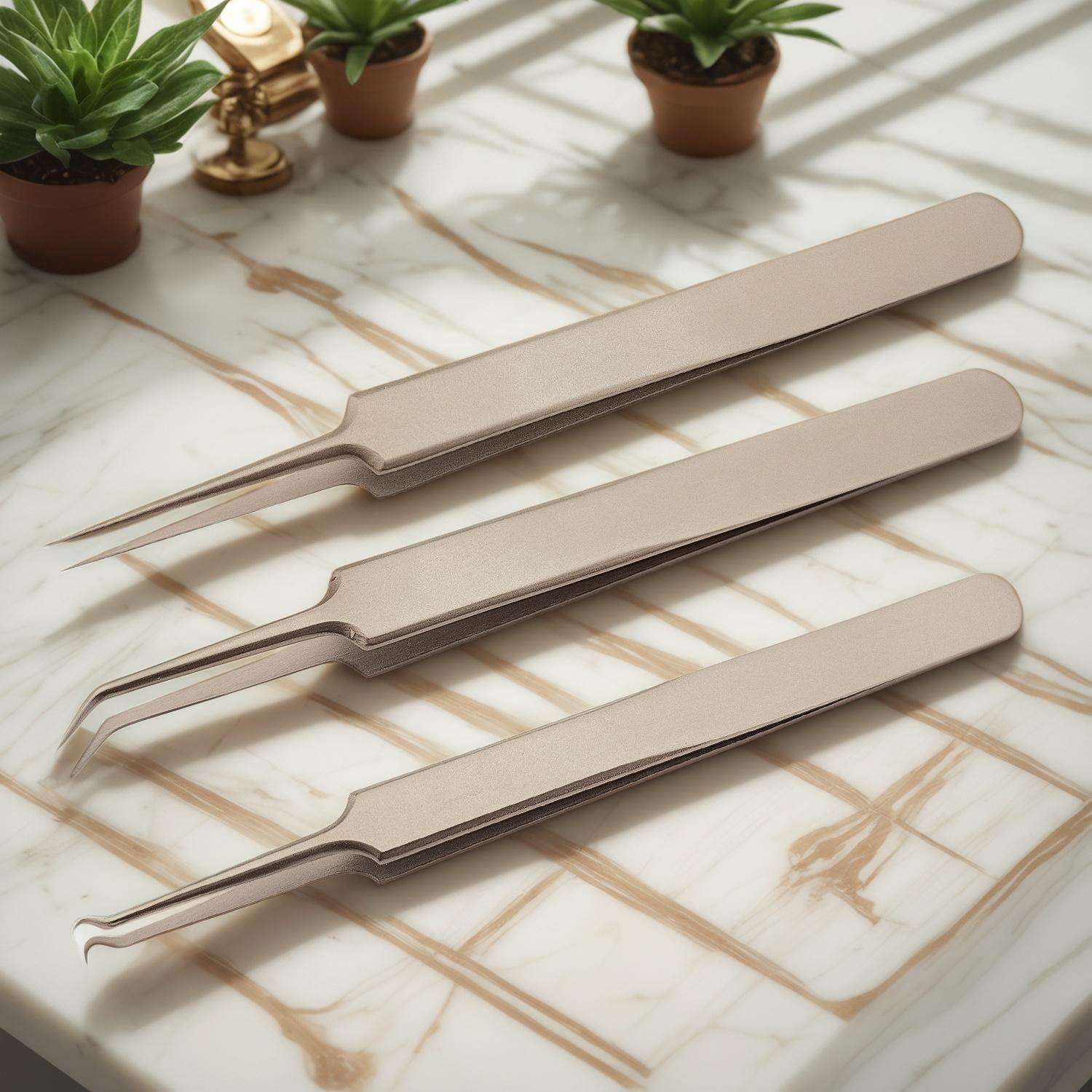
The original Professional Blackhead Tweezer set from Olimor Beauty is described with pointed, curved and hook tips. These three tip directions are useful because blackhead and blemish care is not one uniform task. Different users and product lines may require different access angles, control levels and contact surfaces.
- Pointed tips: Useful when a user needs controlled contact on a small target area. Alignment is especially important because even a small mismatch can reduce precision.
- Curved tips: Helpful for approaching the skin from an angle while keeping the hand position more comfortable. The curve should be smooth and symmetrical.
- Hook tips: Designed for specific extraction-style handling where the user needs a different grip angle or contact method. The hook area must be carefully finished so it does not feel rough.
When selecting among tip shapes, think about the customer experience you want to create. A professional salon supplier may prefer a set that offers multiple options. A skincare retail kit may need simpler instructions and a tip style that is easier for non-professional users to understand. If you are developing a line extension, compare how each tip type fits your existing packaging, safety guidance and customer education.
Material, Finish and Ergonomics: What Buyers Should Inspect
The supplied product description identifies the tweezers as crafted from high-grade stainless steel. Stainless steel is widely used for beauty tools because it can provide durability, a clean appearance and a suitable surface for routine hygiene practices. However, the words “stainless steel” alone do not guarantee a good tool. Buyers should inspect the finished product rather than relying only on a material claim.
Surface finish matters because beauty tools are handled close to the face. A smooth finish helps the product feel better in use and gives the customer confidence. Look for consistent polishing, clean edges and an even color tone. On blackhead tweezers, inspect the inner contact area of the tip closely; a visible burr or sharp irregularity can make the product unsuitable for sensitive skincare use.
Ergonomic design is also an explicit feature of the Professional Blackhead Tweezers. In practical terms, ergonomics means the tool should be easy to control without excessive hand pressure. The arms should not feel too loose or too stiff. The grip area should support stable handling, especially when the user is working near a mirror or under bright light. For export orders, it is useful to compare several samples side by side and note whether the hand feel remains consistent.
| Inspection point | What to check | Why it matters |
|---|---|---|
| Tip alignment | Tips meet evenly with no visible gap or crossing | Improves precision and reduces customer complaints |
| Tip finish | No burrs, rough points or uneven edges | Supports safer contact with skin |
| Arm tension | Consistent pressure when opening and closing | Affects comfort and control during use |
| Surface finish | Uniform polishing and clean appearance | Signals quality and protects brand perception |
| Packaging fit | Tool is secured and tip is protected | Prevents damage during storage and shipping |
Benefits of Working with a Tweezers Factory Direct
Working with a tweezers factory direct can be valuable because the buyer is closer to the production and quality control process. Instead of filtering feedback through multiple trading layers, you can discuss technical points directly: tip geometry, surface finish, packing method, inspection criteria and order consistency. Direct communication is especially useful when you are sourcing products that will be sold under your own brand or combined with other skincare tools.
Factory direct sourcing also supports better product development discipline. If a sample fails because the tip is too sharp, too blunt or not aligned, the production team can identify where the issue occurs. If packaging allows the tips to move during transport, the solution may be a revised holder, sleeve or insert rather than a change to the tool itself. The ability to separate product issues from packing issues is important for importers who want fewer surprises after shipment.
Olimor Beauty presents itself as a long-term tweezers supplier for companies worldwide, with internal quality controls from raw stainless steel inspection through final packaging. For buyers, that kind of process language is useful because it points to the areas that should be documented and evaluated. When reviewing any supplier, focus less on broad promises and more on whether the supplier can maintain the same accepted standard across future orders.
Quality Control Questions Before You Import Tweezers from China
Many businesses import tweezers from China because the supply chain offers a wide range of beauty tool manufacturing options. The challenge is not finding a product; it is identifying the right production partner for the quality level your customers expect. Before confirming a purchase, prepare a structured checklist that covers product, packaging and communication.
- Confirm the intended use. Define whether the tweezers are for blackhead care, general skincare kits, salon retail or professional tool assortments.
- Review approved samples carefully. Keep a signed or clearly documented sample standard for tip shape, finish, tension and packaging.
- Set visible defect criteria. Decide how you will treat scratches, stains, burrs, uneven polishing, bent tips or loose packaging.
- Check functional consistency. Test multiple pieces, not just one display sample, to understand variation.
- Evaluate packaging protection. The tip area should be protected so that alignment is not damaged before retail sale.
- Prepare user guidance. Skincare tools should include clear, responsible instructions appropriate for your market and customer type.
This checklist is not a replacement for your own compliance review, but it helps purchasing teams avoid vague buying decisions. If your business is comparing several beauty tool products, use the same evaluation method across categories so your final line feels consistent to customers.
Building a Consistent Beauty Tool Range Around Tweezers
Tweezers often sit inside a larger personal care range: blackhead tools, facial cleansing accessories, brow tools, manicure items or salon implements. A strong assortment does not need every possible tool. It needs products that make sense together in quality, finish and customer purpose. If your tweezers feel premium but the surrounding tools feel inconsistent, the final retail set may lose credibility.
When planning a range, think about how the Professional Blackhead Tweezers will be sold. A single product page may focus on tip precision and stainless steel construction. A kit may need a clearer explanation of which tool is used for which task. A wholesale catalog may need concise specifications, packaging options and product photos. Buyers can browse Olimor product collections to consider how tweezers fit within a broader sourcing plan.
It is also important to avoid overcomplicating the assortment. Too many similar tip styles can confuse customers and increase inventory pressure. A pointed, curved and hook tip selection gives a practical framework for different use cases without relying on exaggerated claims. The best retail presentation explains differences clearly and encourages careful, hygienic use.
Storage, Handling and Customer Care Guidance
Even well-made tweezers can be damaged by poor handling. Tips are the most delicate part of the product, and slight bending can affect performance. For retail and wholesale operations, store tweezers in packaging that prevents tip contact with hard surfaces. Avoid loose bulk handling after final inspection, especially for pointed or hook-tip designs.
End users should also receive simple care guidance. Tweezers should be cleaned before and after use according to the care instructions provided with the product. They should be dried after cleaning and stored in a clean, dry place. Customers should avoid dropping the tool or using it for non-skincare tasks, as this can damage the alignment or finish. Clear guidance reduces misuse and helps preserve the product experience your brand intends to deliver.
How to Move From Sample Review to Reliable Supply
Reliable supply is built through clear standards, not assumptions. Start with sample review, document what you approve and then use that approval as the reference for production. If you require retail packaging, confirm how the tool is held, how the tip is protected and how the finished unit will appear on shelf or online. If your order will be part of a larger product launch, coordinate timing with photography, listing content and quality inspection steps.
Olimor Beauty focuses on manufacturing beauty tools such as Professional Blackhead Tweezers for businesses that need consistent product quality. If you are comparing suppliers, preparing a private label beauty tool range or reviewing a new export order, you can send an inquiry with your product requirements. For broader sourcing questions or to discuss your project direction, you may also contact Olimor.
Export quality tweezers are defined by the details customers notice immediately: precise tip contact, smooth finish, comfortable handling and reliable packaging. By evaluating these details before purchase, beauty businesses can source blackhead tweezers that support long-term customer trust and fit naturally into a professional skincare tool range.
Tag: