

Export Quality Tweezers: How Beauty Buyers Should Evaluate Precision Skincare Tools
For beauty brands, salon suppliers and distributors, tweezers are small products with a large impact on customer trust. A pair that grips cleanly, aligns accurately and feels controlled in the hand can support professional-looking skincare and grooming results. A poorly made pair can pinch, slip, rust prematurely or create complaints that are difficult to solve after products have already reached retail shelves.
Export quality tweezers are not defined by appearance alone. Buyers need to look at material choice, tip finishing, tension, ergonomic handling, cleaning suitability, packaging readiness and the supplier’s ability to keep batches consistent over time. This is especially important when importing tweezers from China or building a product line that may include skincare tools, brow tools and blackhead extraction accessories.
Olimor Beauty works with beauty tool buyers who need practical, durable and retail-ready products. Whether you are comparing beauty tool products for a new range or narrowing down a tweezer supplier for repeat orders, the right evaluation process helps reduce sourcing risk before production scales.
What “Export Quality” Should Mean for Tweezers
In a sourcing context, export quality should mean that the tool is suitable for the expectations of the destination market, not simply that it can be shipped internationally. For tweezers, quality is visible in the way the two arms meet, how securely the tips grip fine material, and whether the tool maintains its feel after cleaning and repeated use.
Key areas to review include tip symmetry, edge smoothness, spring tension and the finish of the body. A tweezer that looks polished may still fail if the tips do not close evenly. Likewise, a tool with strong tension may feel tiring during extended salon use. Buyers should evaluate tweezers as working instruments rather than simple accessories.
For skincare use, precision is particularly important. Tools used around pores, brows or delicate facial areas need controlled contact. Rough edges or unstable grip can increase discomfort and reduce user confidence. A reliable supplier should therefore be able to discuss how the product is inspected, how tip alignment is checked, and how different tweezer shapes are matched to different tasks.
Core Selection Criteria for Professional and Retail Buyers
When assessing export quality tweezers, avoid making the decision on unit appearance alone. A useful buyer review should include handling, cleaning and end-user purpose. The following checklist can help teams compare samples more consistently:
- Tip alignment: The tips should meet cleanly without visible gaps or crossing. This is essential for gripping fine hairs, debris or skincare materials with control.
- Tip style: Straight, angled and precision-point tips each serve different uses. The selected style should match the intended user and product positioning.
- Material: Stainless steel is valued for durability, corrosion resistance and cleaning suitability. The finish should be smooth and free from sharp unintended edges.
- Tension: The tweezer should close with enough pressure to grip securely but not so much that it becomes uncomfortable for repeated use.
- Grip security: A slip-proof or textured grip can improve control, especially for skincare tools used with careful hand positioning.
- Cleanability: Buyers should consider how easily the tool can be wiped, sterilized or kept hygienic according to the user’s normal process.
- Packaging fit: The tool should sit securely in its packaging, with tips protected during transport and retail handling.
- Batch consistency: Samples should represent the production quality expected in future shipments, not only a best-case demonstration.
Understanding Different Tweezer Tips and Use Cases
One reason buyers search for factory direct tweezers is the need to build a balanced product range. Not every tweezer shape is suited to every skincare or grooming task. A simple retail set may need more than one tip type so customers can choose the right instrument for the job.
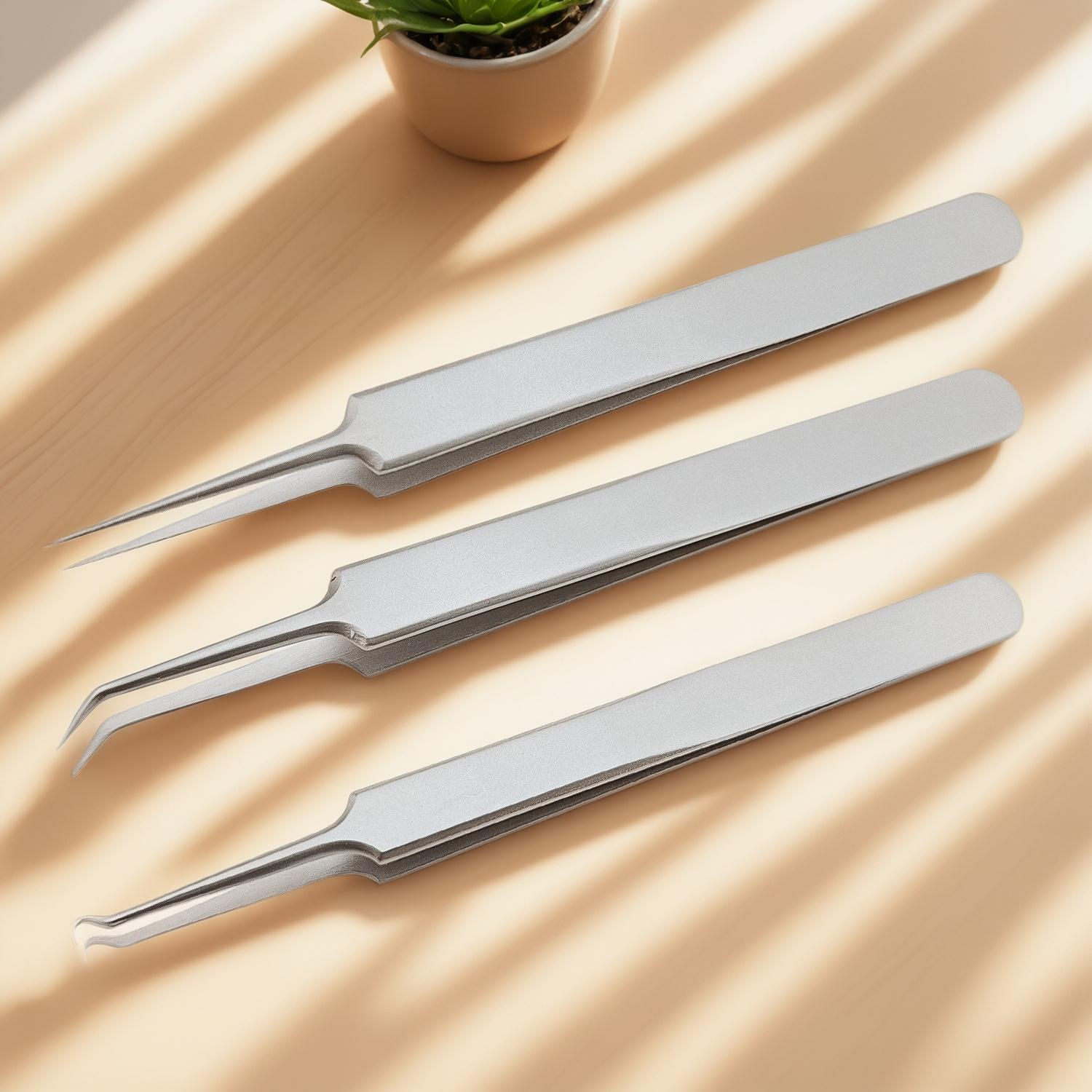
A straight tweezer can be useful for general gripping tasks where a flat meeting edge provides stable contact. An angled tweezer is often chosen for brow grooming or controlled access at a comfortable hand angle. A precision-point tweezer is intended for more targeted work where accuracy matters, and it requires especially careful finishing so the points meet properly without feeling harsh.
The Blackhead Tweezer Trio described by Olimor Beauty reflects this multi-use approach. The trio includes straight, angled and precision-point tweezers, giving users options for different skincare tasks. It is crafted from premium stainless steel, with a focus on durability, corrosion resistance and ease of sterilization. The secure, slip-proof grip supports a steady hand, which is important when tools are used around sensitive skin areas.
For brands, a trio can also make product education easier. Instead of selling one universal tool, packaging or product pages can explain which tweezer is designed for which purpose. This helps reduce misuse and improves the perceived value of the set.
Why Factory Direct Sourcing Can Improve Control
Sourcing from a tweezers factory direct can give buyers clearer communication about product expectations. When there are fewer layers between the brand and the manufacturer, it is easier to discuss tip style, surface finish, grip design, inspection priorities and packaging requirements. This does not remove the need for sample approval or quality checks, but it can make those steps more transparent.
Direct sourcing is especially useful when the product must match an existing retail line or when a buyer plans to reorder over time. If the first batch uses one finish, one tension feel and one package insert, future batches should not drift noticeably from that standard. Consistency is part of quality, particularly for distributors supplying salons or retailers that expect dependable repeat inventory.
Olimor Beauty positions its production around precision skincare tools and beauty accessories. Buyers comparing product collections can use direct communication to confirm whether a tweezer, set or related tool fits their brand’s price point, use case and packaging direction before committing to a larger purchasing plan.
Inspection Questions Before Approving a Tweezer Order
A practical inspection process should be simple enough for a purchasing team to repeat, but detailed enough to catch common failures. The goal is not only to approve attractive samples; it is to define what acceptable production should look and feel like.
- Check several samples, not just one. Compare tip alignment, surface finish and tension across multiple pieces to identify variation.
- Test the closing action. Open and close the tweezer repeatedly to see whether it feels stable and whether the arms return evenly.
- Inspect the tips under good light. Look for burrs, uneven grinding, gaps or tips that meet only at one corner.
- Review user comfort. Hold the tweezer as a salon worker or consumer would. A tool that looks refined but feels slippery may not be suitable for skincare use.
- Evaluate packaging protection. The tips should not be exposed to damage during shipping, storage or retail display.
- Confirm cleaning expectations. If the product is marketed as easy to sterilize, the material and finish should support that claim in normal tool-care conditions.
This type of inspection is also useful when comparing suppliers. A dependable tweezers supplier should be comfortable discussing how quality is controlled at each stage, from raw material handling through final packing. The conversation should focus on measurable product requirements rather than broad claims.
Packaging, Branding and Retail Readiness
For many buyers, the tweezer itself is only one part of the final product. Packaging influences perceived value, protects the tool and communicates correct use. For a skincare tweezer set, clear packaging information can explain the role of each tip shape, basic care guidance and safe storage reminders.
Retail packaging should also protect the precision tips. If tips rub against hard surfaces or move freely during shipping, performance may be affected before the customer ever opens the product. Inserts, sleeves or secure holders can help maintain alignment and presentation.
Brand owners should decide early whether they are selling a single tool, a small professional set or a broader skincare accessory range. The format affects packaging size, instructions, visual layout and logistics. Buyers can send an inquiry with their intended sales channel and product concept so the supplier discussion begins with the correct commercial context.
Building a Long-Term Tweezer Supply Partnership
A one-time sample can show whether a factory is capable of making an attractive tool. A long-term supplier relationship shows whether that quality can remain stable across repeat orders. For growing beauty businesses, this stability matters because a customer who likes the first purchase expects the next one to feel the same.
Long-term cooperation also helps refine details. Over time, buyers may learn that their customers prefer a different grip texture, clearer instructions, a different set combination or stronger packaging protection. A responsive supplier relationship makes these adjustments easier to manage without starting the sourcing process from the beginning.
Olimor Beauty emphasizes direct manufacturing communication, stainless steel skincare tools and practical product engineering. For buyers who need export quality tweezers, the best next step is to define the exact use case: brow grooming, blackhead tool sets, salon retail, beauty kits or general skincare accessories. From there, sample evaluation and packaging planning become more focused.
If you are comparing supplier options or developing a new tweezer range, you can contact Olimor to discuss product direction and sourcing requirements. A clear checklist, realistic inspection standards and open communication with the manufacturer will help you select tweezers that support your brand rather than create avoidable quality issues.
Tag: