

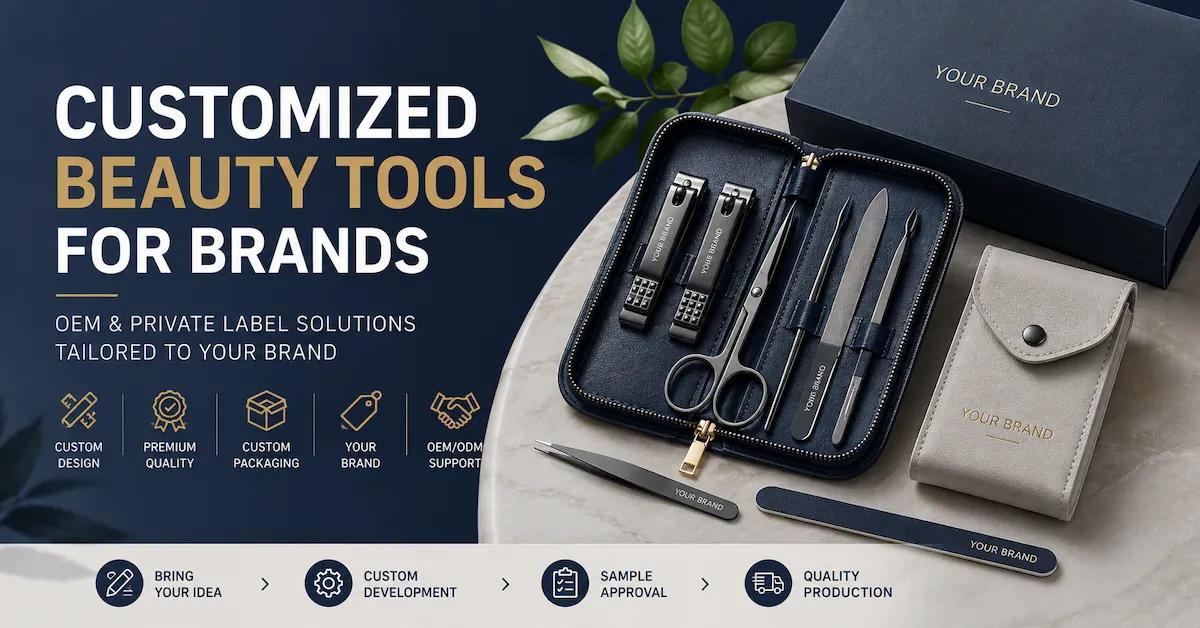
What Are Customized Beauty Tools for Brands?
Customized beauty tools for brands are beauty and personal care products developed around a company's target customer, product positioning, branding, packaging, and quality requirements rather than being sold only as generic ready-made items.
Customization can range from relatively simple changes, such as a branded logo and retail package, to a broader OEM project involving:
- Product selection
- Tool combinations
- Shape or configuration requirements
- Surface appearance
- Logo placement
- Packaging development
- Sample approval
- Functional quality standards
- Batch production requirements
For a beauty brand, the goal is not to customize every possible detail. The goal is to create a product that customers can recognize, trust, and associate with the brand.
A successful project therefore connects four areas:
Product function + Brand identity + Packaging + Manufacturing consistency
OLIMOR BEAUTY works across multiple beauty and personal care tool categories.Buyers can review the current OLIMOR product portfolio when planning a single SKU or a coordinated product collection.
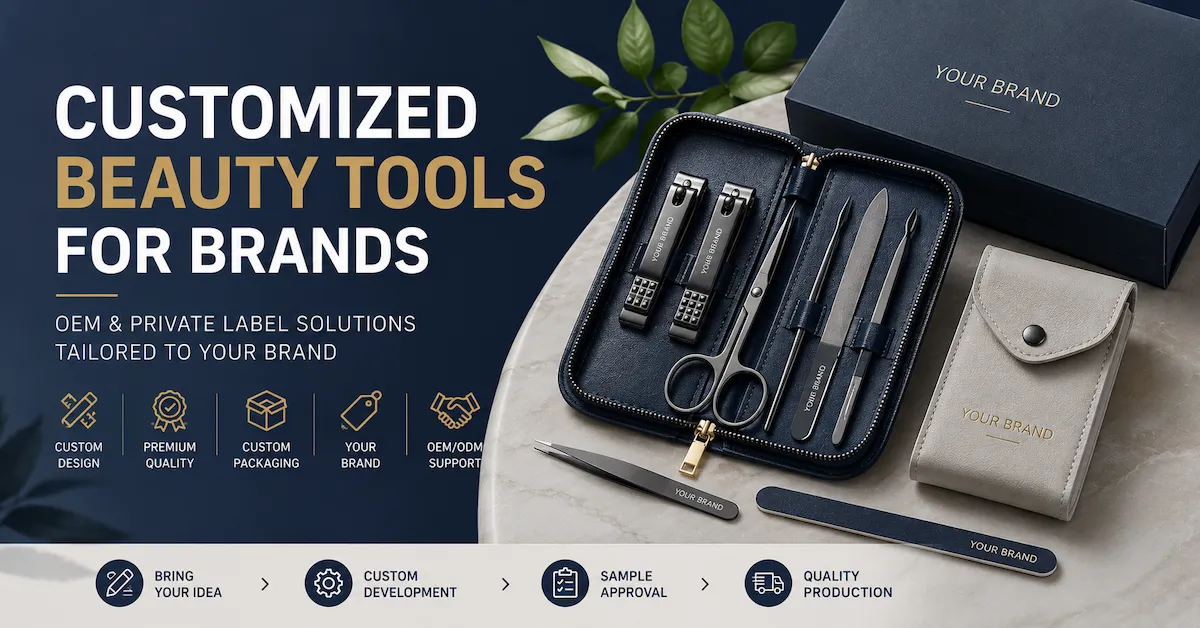
Which Brands Benefit Most from Customized Beauty Tools?
Custom development is particularly relevant when a business wants more differentiation and control than standard wholesale products can provide.
| Buyer Type | Main Requirement | Suitable Customization Focus |
|---|---|---|
| Beauty brands | Strong product identity | Finish, logo, packaging, collection design |
| Ecommerce sellers | Listing differentiation | Visual design, packaging, bundles |
| Retailers | Store-brand products | Retail packaging, assortment,branding |
| Distributors | Repeatable product range | Specifications, packaging, batch consistency |
| Salon suppliers | Professional performance | Precision, ergonomics, durability |
| Gift businesses | High perceived value | Product sets, cases, gift packaging |
| Private label companies | Scalable branded range | Multi-SKU consistency and OEM support |
When Standard Products May Be Enough
Customization is not automatically the best solution for every project.
A standard wholesale product may be more appropriate when the priority is:
- Testing a new category quickly
- Purchasing small quantities of existing products
- Avoiding additional development work
- Launching without custom packaging
Custom manufacturing becomes more valuable when the buyer already understands the target market and wants stronger control over the final product.
What Beauty Tools Can Brands Customize?
A multi-category product strategy allows brands to develop collections around different customer needs.
Nail Care Tools
Common products include:
- Nail clippers
- Cuticle nippers
- Nail files
- Nail scissors
- Manicure tools
- Manicure sets
These products can work across:
- Personal nail care
- Professional manicure
- Travel grooming
- Beauty retail
- Gift collections
For brands developing nail-care lines, related options can be explored through the OLIMOR product collection.
Lash and Brow Tools
Typical products include:
- Tweezers
- Eyelash curlers
- Eyebrow razors
- Beauty scissors
These products are especially relevant to:
- Makeup brands
- Brow brands
- Lash businesses
- Salon suppliers
- Ecommerce beauty sellers
Customization should consider both appearance and precision performance.
Foot Care Tools
Products may include:
- Foot files
- Pedicure tools
- Related grooming accessories
For these products, buyers should pay attention to:
- Filing surface consistency
- Handle structure
- Finish quality
- Packaging protection
Oral and Personal Care Tools
A broader personal-care collection may also include products such as tongue scrapers.
OLIMOR currently offers a dedicated Tongue Scraper collection, which can support brands expanding beyond traditional beauty accessories.
Six Levels of Beauty Tool Customization
For B2B buyers, “custom beauty tools” can mean many different things. Separating the project into six levels makes quotation and sampling much clearer.
1. Product Selection
The first decision is whether an existing product already matches the target market.
Brands should evaluate:
- Function
- Size
- Shape
- User group
- Sales channel
- Intended price position
A suitable existing model with custom branding may sometimes be more commercially efficient than developing a heavily modified product.
2.Product Configuration
Depending on the tool and project, configuration discussions may include:
- Dimensions
- Tool combinations
- Handle shape
- Tip or blade style
- Curvature
- Functional structure
Not every product supports the same degree of modification, so requirements should be confirmed per model.
3. Surface Appearance
Appearance can help multiple SKUs feel like one brand family.
Requirements may include:
- Polished finish
- Matte appearance
- Metallic appearance
- Color options where applicable
Consistency matters more than simply choosing a fashionable color.
4.Logo and Branding
Branding may appear on:
- Product surface
- Storage case
- Retail box
- Pouch
- Insert card
The suitable marking method depends on the material, surface, available area, and selected product.
A buyer should confirm actual logo appearance through a sample rather than approving only a digital mockup.
5. Packaging
Packaging can significantly change how customers perceive otherwise similar tools.
Potential formats include:
- Retail boxes
- Product cards
- Pouches
- Cases
- Gift boxes
- Custom inserts
- Multi-tool packages
6. Product Collection Design
The highest-value form of customization is often not one deeply modified SKU but a coherent collection.
For example:
Brow Collection
- Tweezers
- Eyebrow razor
- Beauty scissors
Nail Care Collection
- Nail clipper
- Nail file
- Cuticle tool
- Manicure set
Grooming Collection
- Tweezers
- Nail tools
- Foot file
- Tongue scraper
A coordinated assortment can provide a stronger brand experience than several unrelated products.
How to Develop Customized Beauty Tools for Your Brand
A structured development process reduces unnecessary revisions and makes the final quotation more meaningful.
Step 1: Define the Target Customer
Before selecting products, clarify:
- Who will use the product?
- What problem are they solving?
- Where will they purchase it?
- What product qualities matter most to them?
For example, a professional salon buyer may prioritize precision and handling, while an ecommerce buyer may place more weight on visual differentiation and packaging.
Step 2: Define the Sales Channel
Channel strongly influences product and packaging decisions.
Ecommerce
Priorities may include:
- Compact shipping
- Scratch protection
- Strong product photography
- Clear benefits
- Review-sensitive quality
Retail
Priorities may include:
- Shelf presentation
- Product visibility
- Barcode space
- Clear product information
Professional Beauty
Priorities may include:
- Tool performance
- Ergonomics
- Repeat use
- Practical storage
Gift Business
Priorities may include:
- Presentation
- Coordinated sets
- Packaging quality
- Perceived value
Step 3: Select the Initial SKUs
Avoid choosing products simply because they are available.
Each SKU should have a role.
| SKU Role | Example |
|---|---|
| Core product | Nail clipper or tweezers |
| Professional upgrade | Precision nipper or lash tweezer |
| Bundle product | Manicure set |
| Gift product | Packaged grooming kit |
| Cross-category expansion | Foot file or tongue scraper |
A focused initial assortment is often easier to manage than launching too many SKUs at once.
Step 4: Prepare Product Specifications
A useful specification should cover what can actually be inspected.
Instead of writing:
Premium quality tweezers
define:
- Tweezer type
- Tip shape
- Tip alignment expectation
- Surface appearance
- Logo position
- Packaging
Instead of:
High-quality nail clipper
define:
- Selected model
- Blade alignment
- Cutting action
- Lever operation
- Surface finish
- Branding and package
Step 5: Develop and Evaluate Samples
Samples should be reviewed from three perspectives.
Functional Review
Confirm:
- Cutting
- Gripping
- Movement
- Tension
- Alignment
- Handling
Cosmetic Review
Confirm:
- Finish
- Color
- Scratches
- Surface defects
- Logo appearance
Packaging Review
Confirm:
- Product fit
- Protection
- Artwork
- Labels
- Inserts
- Overall presentation
A sample should not move to approval simply because it photographs well.
Step 6: Freeze the Approved Specification
Before bulk production, both buyer and supplier should know exactly what has been approved.
A final reference can include:
- Product model
- Key dimensions
- Finish
- Logo artwork and location
- Package structure
- Set components
- Critical QC requirements
This makes later production and repeat orders easier to evaluate.
Precision Quality Control by Product Category
One of the biggest mistakes in beauty tool sourcing is using the same generic quality checklist for every product.
Different tools fail in different ways.
| Product | Critical QC Points |
|---|---|
| Nail clipper | Blade alignment, cutting action, lever movement |
| Cuticle nipper | Jaw alignment, edge finishing, spring response |
| Tweezers | Tip alignment, contact, tension, grip |
| Eyelash curler | Frame movement, curvature, pad position |
| Eyebrow razor | Blade assembly, product finish,structural stability |
| Foot file | Filing surface consistency, handle structure |
| Tongue scraper | Edge smoothness, curvature, surface finish |
| Manicure set | Individual tool QC, completeness,packaging |
Nail Clippers
Inspect:
- Whether cutting edges meet properly
- Whether the lever operates smoothly
- Whether the pivot feels stable
- Whether the finish is consistent
Tweezers
Inspect:
- Tip alignment
- Tip contact
- Tension
- Closing response
- Surface finishing
Tip alignment is especially important because a visually attractive tweezer can still perform poorly when the working ends do not meet correctly.
Cuticle Nippers
Inspect:
- Jaw alignment
- Cutting edge
- Spring response
- Handle resistance
- Finish
Eyelash Curlers
Inspect:
- Opening and closing movement
- Frame symmetry
- Pad position
- Component assembly
Multi-Tool Sets
Every tool should pass its own functional check before the entire set is evaluated for:
- Correct quantity
- Placement
- Case fit
- Packaging completeness
How Packaging Can Increase the Value of Customized Beauty Tools
Packaging should be treated as part of the product system, not as a final decoration.
Protect the Product
Beauty tools with polished or coated surfaces can be damaged by:
- Rubbing
- Movement
- Poor internal fit
Internal packaging should hold tools securely during storage and transportation.
Communicate Brand Positioning
Packaging can help communicate whether a product is:
- Professional
- Premium
- Minimal
- Travel-oriented
- Gift-focused
- Everyday personal care
Support Product Bundling
A well-designed case or box can convert several basic tools into a more valuable collection.
This is particularly relevant for:
- Manicure kits
- Brow kits
- Grooming sets
- Gift collections
Customized Beauty Tools vs Standard Wholesale Products
| Factor | Customized Beauty Tools | Standard Wholesale Tools |
|---|---|---|
| Branding | Buyer-controlled | Limited or generic |
| Packaging | Custom options | Standard |
| Product combination | Flexible | Usually fixed |
| Development time | Longer | Faster |
| Differentiation | Higher | Lower |
| Specification control | Greater | Limited |
| Best fit | Brand development | Rapid resale/testing |
Neither model is universally better.
Standard wholesale is useful for speed.
Customized products become more valuable when a business wants stronger brand ownership and repeatable long-term differentiation.
What Determines the Cost of Customized Beauty Tools?
The correct way to compare quotations is to compare the same specification.
Price can change according to:
- Product model
- Material
- Surface finish
- Level of customization
- Logo process
- Packaging
- Tool combination
- Order quantity
- Inspection requirements
Avoid Comparing Unit Price Alone
A quotation with a lower unit price may exclude:
- Customized packaging
- Special branding
- Additional quality checks
- Complex product combinations
The buyer should ask:
What exactly is included in this quotation?
instead of only:
Which supplier is cheaper?
MOQ, sample timing, production lead time, and other commercial terms should be confirmed for the actual product and project because they can vary by specification.
Common Risks in Customized Beauty Tool Projects
Customizing Before Validating the Market
Heavy customization increases development complexity.
A new brand may be better served by starting with:
- Proven product formats
- Controlled visual customization
- Strong packaging
- A focused assortment
More complex product changes can follow after market validation.
Approving Appearance but Not Function
A beautiful finish cannot compensate for:
- Poor blade alignment
- Weak tweezer grip
- Inconsistent movement
- Rough working edges
Functional approval should come before bulk production.
Vague Quality Requirements
Terms such as:
- Premium
- Professional
- Durable
are useful marketing language but weak manufacturing specifications.
Translate them into inspectable details.
Inconsistent Branding Across SKUs
If each product uses a different:
- Finish
- Logo placement
- Packaging style
- Visual language
the collection can feel fragmented.
Brands should establish a product-family system before expanding.
Ignoring Repeat-Order Reproducibility
A successful SKU is only commercially valuable if it can be reproduced.
Ask how the supplier manages:
- Approved samples
- Product specifications
- Artwork
- Packaging files
- Repeat production references
How to Evaluate a Customized Beauty Tools Manufacturer
A strong manufacturing partner should be able to answer technical questions about the product instead of discussing only price and packaging.
Product Category Knowledge
Ask how quality is controlled for:
- Nail clippers
- Tweezers
- Nippers
- Lash tools
- Foot-care products
The answers should reflect differences between these products.
Sample Process
A clear development process should move through:
Requirements → Product Selection → Customization → Sample → Review → Approval → Production → Inspection
Quality Control
Evaluate whether the manufacturer can define:
- Functional checkpoints
- Cosmetic checkpoints
- Packaging checks
- Batch consistency requirements
Product Range
Multi-category capability can be especially valuable for brands planning future expansion.
Communication
A reliable B2B supplier should confirm:
- Product specifications
- Artwork
- Packaging
- Sample changes
- Production requirements
in a way that reduces ambiguity before production.
A Practical RFQ Checklist for Beauty Brands
To receive a more useful quotation, prepare the following information before contacting a supplier:
- Target product category
- Preferred models or reference photos
- Target customer
- Sales channel
- Estimated order quantity
- Desired finish or appearance
- Logo artwork
- Packaging concept
- Required product combinations
- Critical quality points
- Delivery market or destination
What to Send OLIMOR for a Faster Project Review
For a new customized beauty tool project, a practical inquiry can include:
1.Products you want
Example: tweezers + eyebrow razor + eyelash curler.
2. Estimated quantity
Per SKU or per set.
3. Branding requirements
Logo, finish, color, packaging.
4. Sales channel
Retail, ecommerce, salon, distributor, or gift.
5. Packaging reference
Existing artwork, inspiration, or preferred package type.
6. Target market
This helps align product and packaging decisions with the intended use.
Providing these details allows the supplier to discuss a more specific solution rather than returning only a generic catalog quotation.
How OLIMOR Supports Customized Beauty Tools for Brands
OLIMOR BEAUTY's current product portfolio includes multiple beauty and personal-care categories such as:
- Beauty scissors
- Nail clippers
- Nippers
- Tweezers
- Eyelash curlers
- Eyebrow razors
- Manicure sets
- Foot files
- Tongue scrapers
- Facial tools
- Nail care tools
- Nail files
This makes it possible for buyers to discuss either a single customized tool or a multi-category branded collection.
Depending on the selected product and project, cooperation can cover areas such as:
- Product selection
- OEM development
- Private label branding
- Packaging
- Sample confirmation
- Quality inspection
Explore the OLIMOR product range, learn more about OLIMOR BEAUTY, or submit your project details through the OLIMOR contact page.
FAQ About Customized Beauty Tools for Brands
What are customized beauty tools for brands?
Customized beauty tools are products developed for a business with specific requirements for product selection, appearance, branding, packaging, and quality standards.
What beauty tools can be customized?
Depending on the supplier and selected model, categories may include nail clippers, nippers, tweezers, eyelash curlers, eyebrow razors, manicure sets, foot files, facial tools, tongue scrapers, and other grooming products.
Can I put my brand logo on beauty tools?
Yes, where the selected material and product structure support an appropriate branding process. Logo method and position should be confirmed during sampling.
What is the difference between OEM and private label beauty tools?
Private label commonly focuses on selling a product under the buyer's own brand, while OEM can involve more detailed buyer-defined specifications or product development. Many B2B projects combine both.
Can I customize beauty tool packaging?
Yes, depending on the project.Options may include retail boxes, pouches, cases, gift boxes, inserts, and multi-product packaging.
Should I customize the product or start with custom packaging?
It depends on market maturity. New brands may benefit from starting with a proven product format plus differentiated finish, branding, and packaging before investing in deeper product modification.
How should I inspect custom beauty tool samples?
Inspect both function and appearance. Check relevant details such as blade or jaw alignment, tweezer tip contact, tool movement, finish, logo, packaging, and overall handling.
Can several beauty tools be combined into one branded set?
Yes, where the supplier supports the required product combination and packaging. Manicure, brow, grooming, and gift sets are common directions.
How do I reduce risk before bulk production?
Define specifications clearly, approve representative samples, document packaging and artwork, identify critical QC points, and confirm how mass production will be compared with the approved reference.
What should I send when requesting a customized beauty tool quotation?
Send the product types, estimated quantities, reference models, logo requirements, preferred finish, packaging requirements, target market, sales channel, and any critical quality expectations.
Conclusion
Developing customized beauty tools for brands is most successful when customization is connected to a clear commercial purpose.
The strongest projects do not simply add more colors, logos, or packaging. They align:
- Target customer
- Product function
- Visual identity
- Packaging
- Quality standards
- Repeat-production requirements
For beauty brands, retailers, ecommerce sellers, distributors, salon suppliers, and gift businesses, this approach can turn generic tools into a coherent product collection that is easier to position and expand.
OLIMOR BEAUTY supports B2B buyers developing customized beauty and personal care tools across multiple product categories.
Explore the OLIMOR beauty tool portfolio or contact OLIMOR BEAUTY with your target products, estimated quantity, branding requirements, and packaging concept to begin evaluating your custom project.
Tag: