

Custom Nail Clippers for Business: How to Choose the Right B2B Option
A custom nail clipper can be a small product with a large commercial role. For distributors, retailers, salons, hotel amenities buyers, gift companies and personal care brands, it is not only a grooming tool; it is also a branded item that customers may keep and use for months or years. That makes product selection important. A clipper that feels solid, trims cleanly and carries a logo neatly can support brand recall, while a poorly matched model can create complaints even if the item looks attractive in photos.
Olimor Beauty offers custom nail clipper options for business buyers who need practical trimming tools suitable for B2B programs. The supplied model group includes three different sizes and weights, giving buyers a useful starting point for comparing portability, trimming strength and target customer use. Before placing a bulk order, it helps to understand how each model fits a different market position and what details should be confirmed during sourcing.
Why Businesses Choose Custom Nail Clippers
Custom nail clippers are often selected because they combine daily usefulness with compact distribution. They can fit into grooming kits, retail packs, travel sets, salon aftercare packages, corporate wellness gifts or promotional campaigns. Unlike many disposable giveaways, a well-made clipper has a practical purpose that encourages repeat handling. That repeated use is exactly why logo placement, surface finish and cutting comfort matter.
For B2B buyers, customization should be planned around the way the end customer will use the product. A nail salon may prioritize clean trimming and comfortable control. A travel retailer may prefer a compact, lightweight option. A distributor serving pharmacies or supermarkets may need a balanced model that works for many users. Promotional buyers may care more about visible branding and packaging presentation, but the cutting action still has to be dependable.
When reviewing beauty tool products, consider the clipper as part of a complete personal care range rather than an isolated item. If it will be sold with tweezers, manicure tools or travel accessories, the size, finish and perceived value should match the rest of the offer.
Comparing the Three B2B Nail Clipper Models
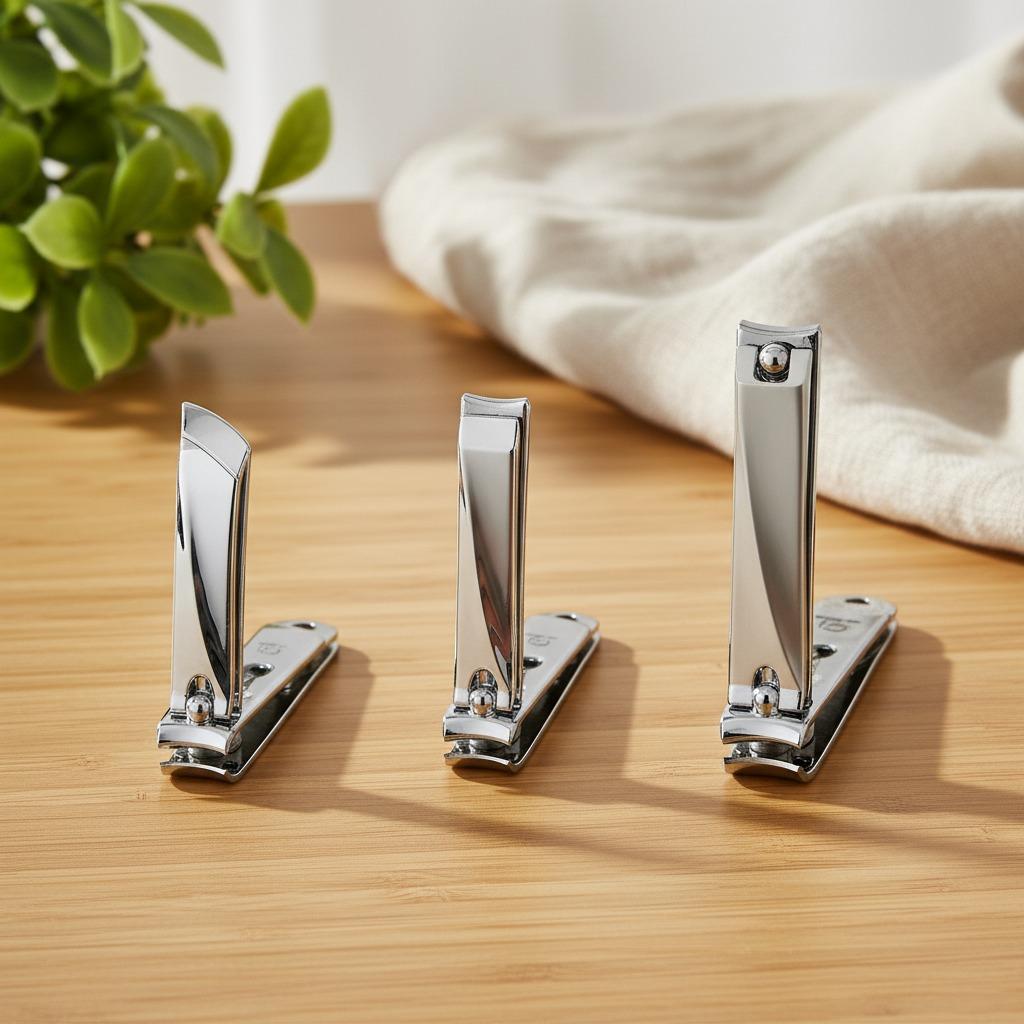
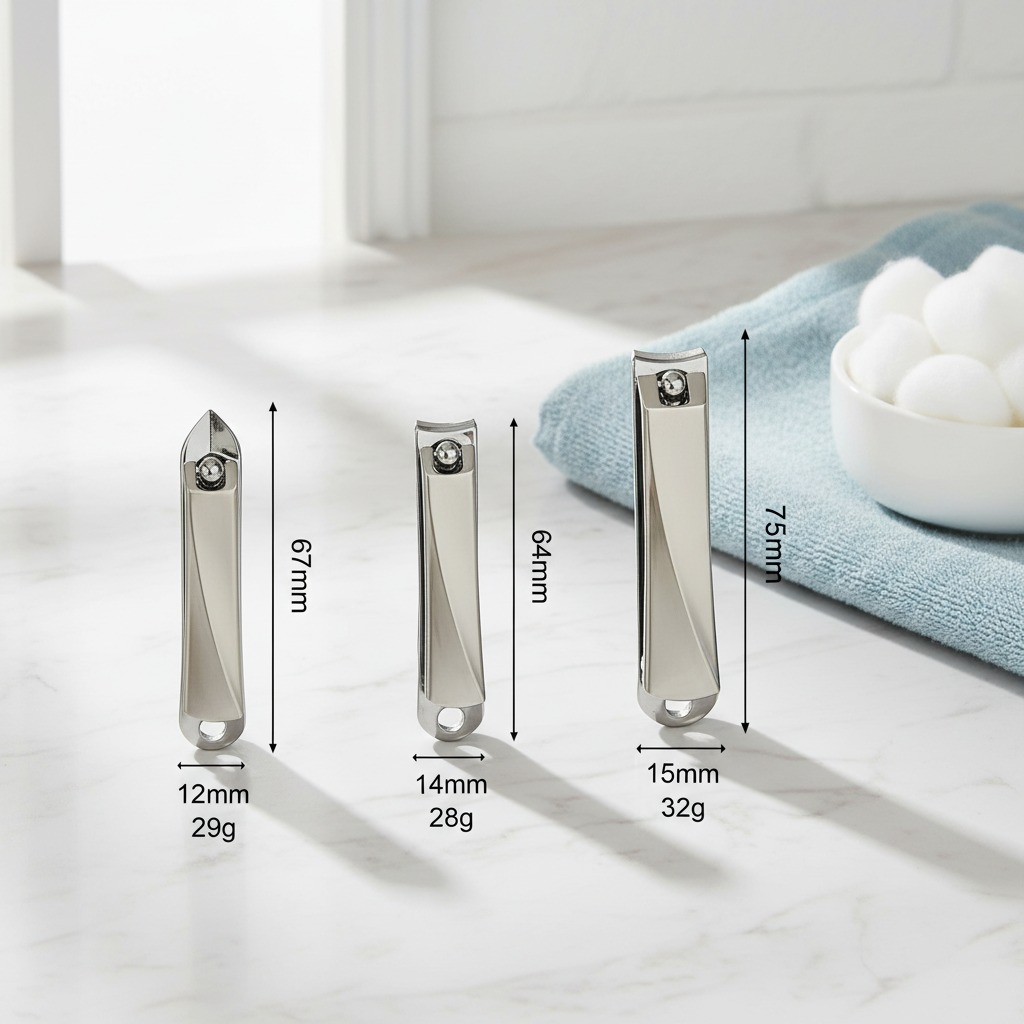
The original model set gives business buyers three clear choices: a left model, a middle model and a right model. Each one has a different size, weight and intended advantage. These differences are useful for segmenting bulk orders or selecting one model that best fits a specific customer group.
| Model Position | Length | Weight | Best-Fit Use Case | Notable Advantage |
|---|---|---|---|---|
| Left nail clipper | 67mm | 29g | Detailed trimming of curved nails | Angular edge for precise trimming |
| Middle nail clipper | 64mm | 28g | Travel use and quick touch-ups | Compact size with streamlined control |
| Right nail clipper | 75mm | 43g | Thicker nails and premium-feel sets | Larger build with ergonomic contours |
The left nail clipper measures 67mm in length and weighs 29g. Its angular edge is intended for precise trimming of curved nails, which can make it a strong option for buyers serving customers who value controlled grooming rather than only compact size. It may suit manicure sets, salon retail counters or grooming kits where accuracy is part of the selling point.
The middle nail clipper is slightly shorter and lighter at 64mm and 28g. Its main advantage is compactness, making it appropriate for travel sets, pocket grooming kits or promotional packs where space and weight matter. The streamlined control is designed to help reduce jagged edges during quick touch-ups, which is useful for customers who need a convenient tool away from home.
The right nail clipper is the largest of the three at 75mm and 43g. It is positioned for thicker nails and has ergonomic contours for comfort. Because it has more presence in the hand, it can also work well in higher-value kits or B2B programs where the buyer wants a more substantial product feel.
How to Match a Nail Clipper to Your Sales Channel
The best custom nail clipper for business is not always the largest or the least expensive. It is the model that fits the channel, packaging format and customer expectation. A distributor selling to multiple retailers may want a versatile option. A brand building a premium grooming set may choose a heavier model because it feels more substantial. A travel accessories company may prefer the compact middle model to keep the final kit light.
- Retail multipacks: Choose a model that balances broad usability, comfortable handling and packaging efficiency.
- Travel kits: Prioritize compact dimensions, lighter weight and secure presentation inside the kit.
- Salon resale: Consider precise trimming performance and a finish that looks professional at the counter.
- Corporate gifts: Review logo visibility, surface appearance and packaging space for brand messaging.
- Distributors: Compare whether one universal model or a three-model range will better serve different buyer segments.
If you are building a wider sourcing plan, review related product collections to check whether the nail clipper can be paired with complementary beauty tools in a coherent product line.
Customization Details That Affect the Final Product
Logo customization and unique design elements can make a nail clipper more relevant to a brand campaign, but the details should be decided carefully. On a small metal tool, even minor changes in logo size, placement or contrast can affect readability. Buyers should evaluate a physical sample or clear production reference before approving a large run whenever possible.
Important customization points include the branding area, logo orientation, surface finish, packaging style and whether the final design matches the market position. For example, a minimalist logo may suit a premium grooming set, while a bolder mark may work better for promotional distribution. If the clipper will be included in retail packaging, the product and package should be designed together so the branding does not feel like an afterthought.
Custom design choices should also respect usability. A decorative surface should not interfere with grip. Packaging should protect the cutting edge and keep the product clean during storage and shipping. If the item is intended for travel, the buyer may also need to consider how it will be stored inside a pouch or grooming case.
Bulk Nail Clipper Price: What Buyers Should Compare
Bulk nail clipper price is usually influenced by more than quantity alone. Model size, material use, finish, customization method, packaging complexity and inspection requirements can all affect the final cost. The right model, for example, is larger and heavier than the other two options, so buyers should expect it to sit differently in a cost comparison. That does not automatically make it better or worse; it simply means the price should be evaluated against the intended customer and selling channel.
Instead of comparing only the unit price, B2B buyers should calculate value in relation to the final program. A slightly heavier clipper may support a premium kit. A compact model may reduce pack size or shipping weight. A precise model may reduce dissatisfaction among users who care about trimming control. The lowest initial quote may not be the best choice if it leads to poor brand perception or customer returns.
- Define the target user and sales channel before comparing models.
- Confirm the preferred size, weight and trimming use case.
- Review logo placement and packaging requirements together.
- Compare pricing based on the same customization and packing assumptions.
- Check sample appearance, hand feel and cutting action before final approval.
Quality Checks for Distributors and Brand Buyers
A nail clipper is a precision item, so consistency matters. Business buyers should check alignment, lever movement, edge finish, trimming smoothness and overall hand comfort. The supplied product information notes durable stainless steel, which is an important baseline for grooming tools, but buyers should still evaluate workmanship and finishing against the requirements of their own market.
For distributors, quality checks are especially important because the product may move through several sales layers before reaching the end user. A clean, dependable clipper supports fewer complaints and easier repeat sales. For private label or promotional buyers, the brand mark adds another inspection point: the logo should be centered, readable and consistent across the order.
A practical inspection checklist may include cutting edge alignment, surface scratches, logo clarity, hinge movement, packaging condition and carton labeling. The checklist does not need to be complicated, but it should reflect how the product will be sold. Retail items require stronger shelf presentation, while kit components may need exact sizing to fit inserts or pouches.
Working With Olimor Beauty on a Custom Nail Clipper Project
Olimor Beauty provides B2B nail clipper options for buyers who need custom grooming tools for distribution, resale or branded programs. The three model choices make it easier to align product selection with market demand: precise trimming for curved nails, compact travel use or a larger ergonomic option for thicker nails. The best result comes from selecting the model first, then building the branding and packaging plan around that choice.
If you are comparing a custom nail clipper for business, prepare the key information before discussion: target market, expected sales channel, preferred model, logo artwork, packaging concept and any special handling requirements. This helps the sourcing process stay focused and makes price comparisons more meaningful.
To discuss model selection or customization needs, contact Olimor. If you already have project details prepared, you can also send an inquiry with your quantity expectations, branding requirements and packaging plan.
A custom nail clipper may be compact, but it should still be selected with the same care as any branded beauty tool. By matching size, weight, trimming purpose and customization details to the intended customer, businesses can create a practical product that supports both daily use and long-term brand visibility.
Tag: