

Custom Logo Tweezers for Beauty Brands, Salons and Retail Buyers
Custom logo tweezers are small tools, but they carry a lot of responsibility. They need to grip fine hair cleanly, feel stable in the hand, resist daily wear and represent your brand every time they are placed on a salon trolley, retail shelf or gift set insert. For beauty businesses, the decision is not only about adding a logo. It is about selecting a tweezer that performs well enough for repeat use and looks consistent enough to support a professional product line.
Olimor Beauty supplies beauty tools for buyers who need practical sourcing options, including personalized tweezers for professional and retail use. This guide explains how to evaluate custom logo tweezers before you place an order, what details to include in a supplier brief and which quality points deserve attention during sampling and inspection.
What Makes Custom Logo Tweezers Different from Standard Tweezers?
A standard tweezer is usually chosen as an individual grooming item. A custom logo tweezer is selected as part of a wider brand experience. It may be sold in a retail pack, included in a brow-care kit, offered as a salon accessory or used as a promotional beauty tool. Because of that, both performance and presentation matter.
The logo should not be treated as a decorative afterthought. Its placement, size, color and durability affect how the finished tool is perceived. If the branding is too large, it can look unbalanced. If it is placed where fingers apply pressure, it may wear faster. If the logo color clashes with the metal finish, the tool may look less refined even when the tweezer itself is well made.
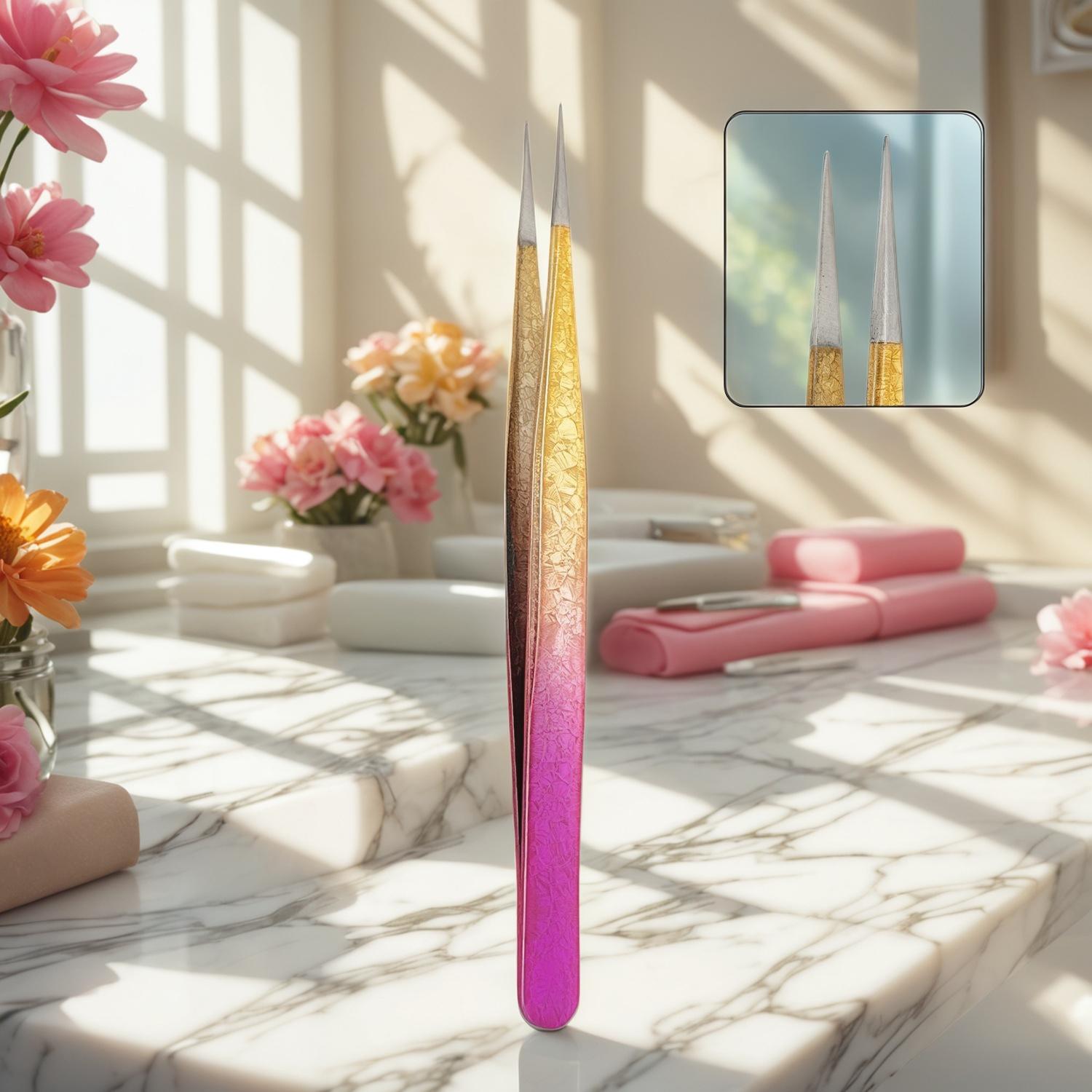
The original Olimor Beauty range has included designs such as Gradient Precision Tweezers with a gold-to-pink gradient and brushed metallic finish. A decorative finish like this can help a product stand out, but the buyer should still start with function: the tweezer must align properly, close evenly and grip hair without excessive force.
Key Selection Criteria for Branded Tweezers
When comparing custom logo tweezers, it is useful to separate appearance from working performance. A good sourcing decision considers both. The following criteria can help buyers review samples more consistently:
- Tip style: Slanted tips are commonly used for eyebrow shaping and general grooming. Pointed tips are better suited to detailed work, while flat tips may be selected for broader gripping needs.
- Tip alignment: The two tips should meet evenly without visible gaps. Poor alignment leads to slipping, cutting hair instead of gripping it or requiring repeated attempts.
- Grip tension: The arms should offer enough resistance for control but not so much that the user experiences hand fatigue during repeated use.
- Surface finish: Brushed, polished or colored finishes should look even, with no rough edges, patchy color or obvious marks that weaken the retail impression.
- Logo readability: The logo must be clear at the actual tool size. Fine lines and small lettering may need adjustment before production.
- Edge comfort: Outer edges should feel smooth in the hand. A tweezer may have precise tips but still feel unpleasant if the body edges are too sharp.
- Packaging fit: If the tweezers will be packed in a pouch, blister card, box or kit, confirm that the product dimensions suit the intended presentation.
Choosing Tip Styles for Different Beauty Use Cases
The most suitable tweezer depends on how your customers will use it. A salon buyer may prioritize control and durability. A retail buyer may need an attractive finish that photographs well and fits a beauty kit. A brow brand may care most about clean hair removal and tip precision.
For eyebrow shaping, slanted tweezers are often the easiest option for a wide audience because the angled edge can grip individual hairs while still covering enough surface for efficient grooming. This makes them a practical choice for retail lines and salon resale.
For precision tasks, a pointed tip can be helpful, but it requires more careful handling and may not be the best first choice for every consumer. If your product is aimed at professionals or experienced users, pointed styles may be worth considering. If the audience is broad, a slanted or slightly angled style may reduce misuse and returns.
For gift sets, travel kits or entry-level beauty accessories, the tool should be easy to understand immediately. In that case, a comfortable shape, clean closing action and simple logo placement may matter more than a highly specialized tip.
Logo Placement, Finish and Brand Presentation
Branding a tweezer requires attention to scale. Unlike a mirror, brush handle or cosmetic bag, the visible branding area is narrow. A logo that looks strong on a website header may become illegible on a metal tweezer arm. Buyers should prepare artwork in a clean format and consider simplified versions for small surfaces.
A well-planned logo position usually avoids the highest friction zones. The outer arm is often a logical area because it remains visible when the tweezer is displayed and does not usually interfere with the closing action. However, the best placement depends on the tweezer shape, finish and packaging orientation.
Color contrast is another practical detail. A dark logo may show clearly on a lighter metallic finish, while a light logo may stand out on a darker coated surface. For gradient or brushed finishes, check the logo against the full color range, not just one part of the tool. If the background shifts from gold to pink, for example, the same logo color may appear stronger in one area and weaker in another.
Quality Checks to Request Before Approving Production
Before approving a custom logo tweezer for production, buyers should create a clear review checklist. This reduces subjective decisions and helps internal teams compare samples fairly. The table below outlines useful checkpoints.
| Check area | What to review | Why it matters |
|---|---|---|
| Tip closure | Tips meet evenly along the gripping area | Improves hair grip and reduces slipping |
| Spring tension | Arms open and close smoothly | Affects comfort during repeated use |
| Logo appearance | Artwork is centered, readable and consistent | Protects brand presentation |
| Surface condition | No rough edges, scratches or uneven finish | Supports retail quality and user comfort |
| Packaging compatibility | Tool fits the insert, pouch or display format | Prevents last-minute packing issues |
It is also helpful to test the sample in real handling conditions. Open and close it repeatedly, use it at different angles and check whether the logo remains visually balanced when held naturally. A product can look good flat on a desk but feel awkward in use if the body shape, tension or finish has not been considered carefully.
How Retailers and Salons Can Plan a Better Supplier Brief
A strong supplier brief saves time and reduces misunderstanding. Instead of asking only for “custom logo tweezers,” describe the intended user, sales channel and preferred look. For example, a salon chain may need a practical tweezer for staff use and resale, while an online retailer may prioritize product photography, packaging consistency and a finish that matches a beauty collection.
Your brief can include the following points:
- The intended use, such as eyebrow shaping, professional grooming, gift sets or retail beauty kits.
- The preferred tip style, or a request to compare suitable styles during sampling.
- The desired finish direction, such as brushed metal, polished metal or a colored surface.
- Logo artwork and guidance on acceptable size, placement and color.
- Packaging requirements, if the tweezers must fit an existing box, pouch or insert.
- Any market-specific labeling or handling requirements your company needs to meet.
If you are still comparing product categories, you can review Olimor beauty tool products to consider how tweezers may fit with other beauty accessories. Buyers building a wider retail range can also explore product collections for ideas on grouping tools by use case, finish or customer segment.
Maintenance Guidance for End Users
Good care instructions can improve customer satisfaction and reduce avoidable complaints. Tweezers should be kept clean and dry after use. If they are used in a professional setting, the cleaning process should follow the salon’s hygiene procedures and local requirements. For consumer retail packs, simple care guidance can be included on the packaging or insert.
End users should avoid dropping tweezers on hard surfaces because the tips can be knocked out of alignment. They should also avoid using precision tweezers for non-beauty tasks such as prying open containers, removing staples or handling hard craft materials. Misuse can damage the tip edge and reduce gripping performance.
Storage matters as well. A sleeve, cap or pouch helps protect fine tips from bending and keeps the tool clean inside a cosmetic bag. If your branded tweezer is part of a kit, consider whether the packaging protects the tips during transit and after purchase.
Working with Olimor Beauty on Custom Logo Tweezers
Olimor Beauty supports buyers looking for custom logo tweezers with attention to tool function, surface presentation and practical sourcing communication. As a tweezers exporter and beauty tool supplier, the goal is to help businesses make choices that match their market rather than select a generic item without context.
For the best result, begin with your target audience and the role the tweezer will play in your product range. A professional brow tool, a retail grooming accessory and a branded promotional item may all need different decisions on tip shape, finish and packaging. Clear priorities at the start make sampling and approval much more efficient.
To discuss a custom logo tweezer project, you can contact Olimor with your product goals, artwork direction and intended use. If you already have a brief prepared, you can also send an inquiry so the team can review the requirements and help you evaluate suitable options.
Custom logo tweezers work best when branding and usability are developed together. A clean logo, comfortable hand feel, precise tip closure and suitable finish all contribute to a product that customers will keep using. For beauty brands, salons and retailers, that combination is what turns a small tool into a reliable part of a professional beauty assortment.
Tag: