

Buy Tweezers in Bulk: Practical Sourcing Guide for Beauty Buyers
Buying tweezers in bulk is not only a unit-price decision. For salons, brow studios, beauty retailers, online sellers, distributors, promotional buyers and private-label planners, the better question is whether every pair in the order can grip consistently, feel comfortable, arrive protected and match the agreed presentation.
A tweezer that looks attractive but has weak alignment, rough edges or uneven tension can create returns, poor reviews or wasted salon time. A well-sourced tweezer becomes a repeat-purchase beauty tool because it solves a simple daily problem reliably. This guide explains how to compare bulk eyebrow tweezers by tip type, material, finish, packaging, inspection points and supplier communication before placing a wholesale or repeat order.
Olimor Beauty supplies practical beauty tools for business buyers, including precision eyebrow tweezer options such as slanted and pointed styles, rust-resistant stainless steel construction, colorful gradient finishes and compact formats. Buyers can review related options through Olimor beauty tool products while using the sourcing checklist below to make a more controlled decision.
Why Bulk Tweezers Need a Higher Buying Standard
When a consumer buys one pair of tweezers for personal use, they can judge the tool by feel and replace it if it disappoints. Business buyers do not have that freedom. If tweezers are ordered by the carton for retail shelves, salon kits, ecommerce fulfillment or promotional beauty sets, small variations in tip closure, spring tension, finish or packaging can affect many customers at once.
Bulk buying can make sense when you need stable stock for brow services, grooming kits, travel sets, retail displays or resale channels. It can also simplify replenishment because your team works from one agreed specification instead of constantly comparing random stock from different sources. However, the buying standard must be practical: define how the tweezers will be used, who will use them and how they will be presented before comparing quotations.
A salon buyer may value grip performance and tip alignment above decorative packaging. A retailer may need both performance and strong visual appeal. A distributor may focus on repeatable quality, carton marking, labeling clarity and reorder reliability. A private-label buyer may need packaging artwork, surface finish consistency and sample approval before production. These differences should be reflected in the sourcing brief, not discovered after the shipment arrives.
Retail, Wholesale or Factory Sourcing: Which Route Fits?
Many buyers begin by asking where to buy tweezers in bulk, but the more useful question is which sourcing route matches the order size, quality expectation, packaging requirement and level of coordination your team can manage. Retail purchasing is convenient for urgent replacement tools or small trials, but it is rarely efficient for repeat business supply. Wholesale purchasing gives access to larger quantities and more business-oriented communication. Factory-style sourcing may suit experienced buyers who can define specifications, approve samples and manage production details carefully.
| Buying route | Best for | Main limitation | What to check |
|---|---|---|---|
| Retail purchase | Very small quantities, urgent replacement tools or personal testing | Limited business pricing, inconsistent availability and fewer packaging choices | Use only for early product feel checks, not as a stable sourcing plan |
| Tweezers wholesaler | Salons, retailers, online shops and distributors needing repeatable supply | Product choices depend on the wholesaler’s available range and service scope | Confirm tip styles, packaging options, samples, order handling and reorder consistency |
| Factory-style sourcing | Buyers with defined specifications, planned order cycles and customization needs | More coordination is required for samples, packaging, inspection and logistics | Document specifications clearly and approve pre-production details before scaling |
For many beauty businesses, a tweezers wholesaler is a practical middle ground. It allows buyers to compare tool styles, discuss packaging needs and plan bulk orders without managing every manufacturing detail. If you are building a broader beauty assortment, Olimor’s product collections can help you compare tweezers with related personal care tools.
Choose the Right Tweezer Tip for the Use Case
Tip style is one of the most important bulk tweezer decisions because it affects how the tool grips hair and how confidently the user can control it. The best choice depends on the customer’s grooming task, skill level and expectation.
Slanted tweezers for everyday brow shaping
Slanted tips are familiar to many users and are commonly chosen for eyebrow shaping and general grooming. Their angled edge can help catch fine hairs while still giving a broad enough contact area for controlled use. For salons, retail displays and everyday grooming kits, slanted tweezers are often a safe core option because they are easy to explain and suitable for a wide audience.
Pointed tweezers for detail work
Pointed tips are useful for targeting stubborn, isolated or very fine hairs. They can support precise work, but they require careful handling because the working point is finer. If you are selling pointed tweezers to consumers, packaging and product copy should make the intended use clear so customers understand that the tool is for detail-focused grooming rather than broad, fast removal.
Flat, specialty or dual-ended designs
Flat-pointed, specialty and dual-ended tweezers can be useful when the buyer wants a more complete grooming kit or a distinctive retail product. A dual-ended design may reduce the number of separate tools in a set when each end serves a different gripping purpose. However, clever design is not enough. Both working ends must be inspected for alignment, edge finish and protection during packaging.
Assorted sets for kits and resale
Assorted tweezer sets can help customers handle different hair types and grooming tasks. They are especially relevant for brow kits, gift sets, travel grooming sets and ecommerce bundles. The tradeoff is that set consistency becomes more important: each piece must match the agreed style, finish, tip protection and packaging layout.
| Tip type | Best use | Bulk buying consideration |
|---|---|---|
| Slanted tip | General eyebrow shaping and catching fine hairs | Versatile for salons, retail displays and everyday grooming kits |
| Pointed tip | Targeting stubborn or isolated hairs with more precision | Best positioned for detail-focused users who can handle a sharper working point |
| Flat-pointed or specialty tip | Controlled removal and specific grip preferences | Evaluate with samples because feel and alignment matter more than appearance |
| Dual-ended tweezer | Combining different working tips in one tool | Inspect both ends and confirm packaging protects each working edge |
| Assorted set | Complete brow grooming or resale as a multi-tool set | Useful when customers value variety, but set configuration must be documented |
Material, Finish and Grip: What to Inspect Before Ordering
Stainless steel is commonly preferred for beauty tools because it is durable and suitable for routine cleaning when cared for correctly. Olimor product information describes rust-resistant stainless steel construction for relevant tweezer options. However, material alone does not guarantee performance. A buyer should also check how the tips meet, how the handle feels, whether the coating is even and whether the tool remains comfortable during repeated use.
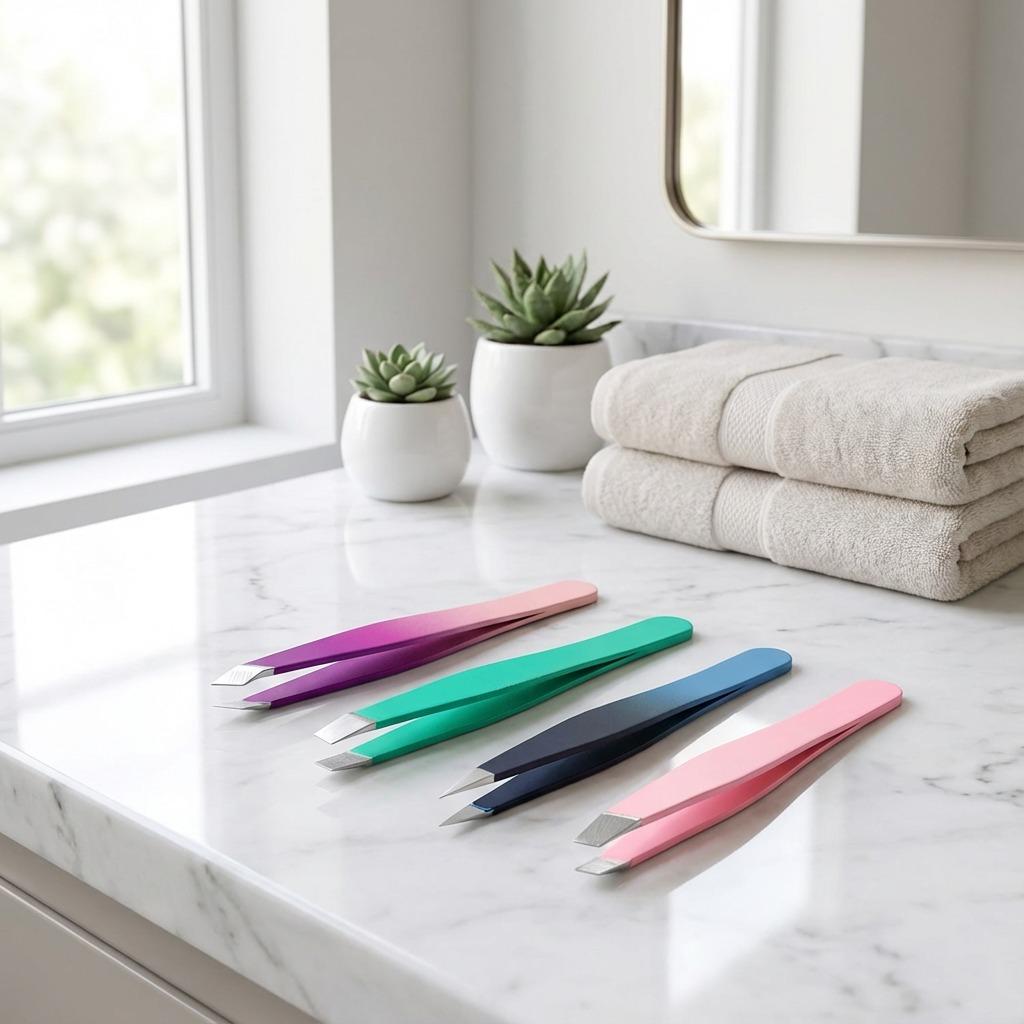
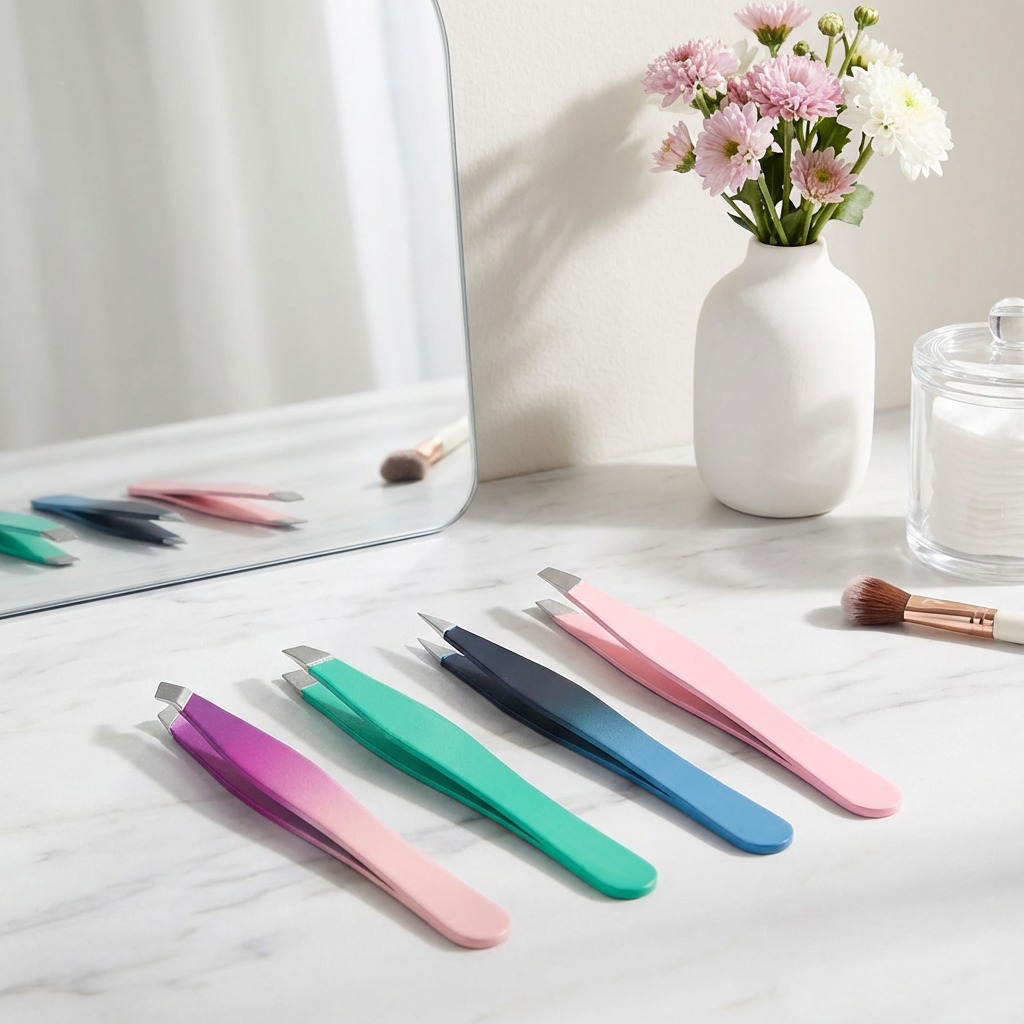
Colorful finishes can strengthen retail presentation. Olimor’s described gradient eyebrow tweezers include visual effects such as purple-pink, turquoise-mint, navy to ocean blue and peach to pink transitions. These finishes can help a product stand out on shelf or online, but buyers should still prioritize function. A beautiful tweezer that cannot grip cleanly will not meet customer expectations.
Use sample inspection to compare several pieces, not only one. Consistency is the true test in a bulk purchase. Check the following points before confirming a larger order:
- Tip alignment: The two edges should meet evenly without a visible gap when light pressure is applied.
- Grip performance: Test on fine hair or a fine thread to see whether the tips catch cleanly instead of sliding.
- Spring tension: The tweezer should close smoothly without feeling too stiff or too loose during repeated use.
- Edge comfort: Pointed or sharp tips should be precise, but the tool should still feel controlled and not rough in the hand.
- Surface finish: Polished, colored, ombre or gradient finishes should look even, without obvious peeling, rough patches or staining.
- Cleanliness: Check for residue, burrs or rough edges around the working tips and handle.
- Packaging protection: Tips should be protected from pressure and impact during transport, storage and display.
Packaging and Presentation for Retail, Salon and Ecommerce
Packaging should match the selling channel. A salon may need simple, easy-to-store packaging that keeps tools protected and hygienic before use. A retailer may need attractive presentation, clear product information, barcode space and a display-friendly format. An ecommerce seller may need packaging that photographs well and protects the tip during parcel handling. A promotional buyer may need packaging that fits a kit while keeping the tool secure.
Before ordering, confirm whether the tweezers are sold as single pieces, compact tools, four-piece sets, assorted kits or other configurations. Compact tweezer formats, including 63 mm tools described in Olimor product information, may be practical when portability and travel-friendly packaging matter. If the order includes multiple colors or tip styles, the packing list should clearly identify the mix so receiving teams can check the shipment accurately.
Retail buyers should also consider how customers understand the difference between slanted, pointed and dual-ended tweezers. Clear product descriptions, visible tip protection and accurate images reduce confusion and help customers choose the right tool. If buyers cannot understand the intended use, they may select the wrong product and become disappointed even if the item is well made.
Cost Factors Beyond the Unit Price
When comparing bulk tweezer quotations, the lowest unit price may not be the lowest total cost. Returns, poor reviews, repacking work, damaged tips, unclear labeling or inconsistent colors can all add cost after delivery. A more useful comparison looks at the full order value: tool performance, finish consistency, packaging suitability, communication clarity and reorder reliability.
Key cost factors can include the tip style, set composition, material and finish, packaging format, customization requirements, inspection expectations, labeling needs, carton handling and shipping arrangement. Buyers should avoid assuming that two tweezers with similar photos are equal. The real difference is often in tip closure, tension control, edge finishing and packing protection.
If customization is needed, confirm what can be customized and what information the supplier needs before quoting. Custom packaging, color selection, set configuration or private-label presentation may require additional approval steps. Do not rely on informal messages alone for final order details; use a written specification that both sides can review.
Supplier Evaluation Checklist for Bulk Tweezer Orders
A good tweezers wholesaler should make repeat buying easier, not only cheaper. The best supplier conversations are specific and documented. Instead of asking only for the lowest price, prepare a practical checklist that covers product function, packaging, order handling and quality expectations.
- Define the intended use. Is the order for salon service, retail resale, travel kits, promotional sets or ecommerce fulfillment?
- Confirm the tip type. Specify slanted, pointed, flat, dual-ended or assorted styles, and avoid vague wording.
- Confirm the size and set configuration. If selecting compact tweezers or multi-piece sets, document exactly what is included.
- Review material and finish. Ask how the stainless steel construction, color finish or gradient effect will be described and controlled.
- Request samples when possible. Inspect several pieces for alignment, tension, grip and surface finish before scaling the order.
- Agree packaging details. Confirm single packaging, set packaging, tip protection, labeling space and carton information.
- Discuss inspection expectations. Clarify what the supplier checks before shipment and what evidence or photos can be shared.
- Confirm lead-time communication. Ask how production, packing and shipment updates will be handled without assuming a fixed schedule.
- Plan for reorders. If continuity matters, ask how style, finish and packaging consistency will be managed for future purchases.
For regulated consumer product markets, buyers should verify which safety, labeling or documentation requirements apply in their destination market. Public bodies and standards organizations such as ISO and relevant consumer product safety authorities can provide frameworks or rules that may influence quality systems, labeling or product safety expectations. Buyers should always verify the applicable version and request supplier documentation where relevant. This is not the same as assuming that any supplier holds a certification unless it is specifically documented.
How Olimor Supports Business Buyers
Olimor Beauty focuses on practical beauty tools for business buyers who need reliable product selection and clear sourcing communication. Available tweezer-related information includes slanted and pointed eyebrow tweezer options, rust-resistant stainless steel construction, compact formats and colorful gradient finishes suitable for retail presentation.
If you are comparing bulk eyebrow tweezers for salon use, retail shelves, online resale or beauty kits, start with a clear specification and sample review. Olimor can help buyers discuss available product formats, packaging expectations and order questions without relying only on product photos. To begin a sourcing conversation, use the bulk tweezer inquiry form or contact the team through Olimor contact support.
FAQ: Buying Tweezers in Bulk
Can I request samples before placing a bulk tweezer order?
Sample discussion is recommended whenever possible because alignment, tension, edge finish and grip are difficult to judge from photos alone. Use samples to inspect several pieces and confirm whether the selected tip style fits your use case.
What MOQ applies to bulk tweezers?
MOQ can depend on the tweezer style, packaging choice, customization needs and order plan. Buyers should ask Olimor for the applicable requirement for the exact product and configuration they are considering rather than assuming one fixed number.
Can tweezers be customized for retail or private-label use?
Customization may involve packaging, color selection, set configuration or presentation details, depending on the product and order requirements. Confirm the available options, artwork needs and approval steps before production.
What quality checks should buyers ask about?
Ask about tip alignment, grip performance, spring tension, surface finish, cleanliness, tip protection and packaging consistency. Buyers should also clarify what inspection information, photos or documentation can be provided before shipment.
How should lead time be handled for repeat orders?
Lead time should be confirmed based on the selected product, packaging, customization and order schedule. For repeat buying, discuss reorder planning early so style, color, packaging and stock expectations are easier to manage.
Tag: